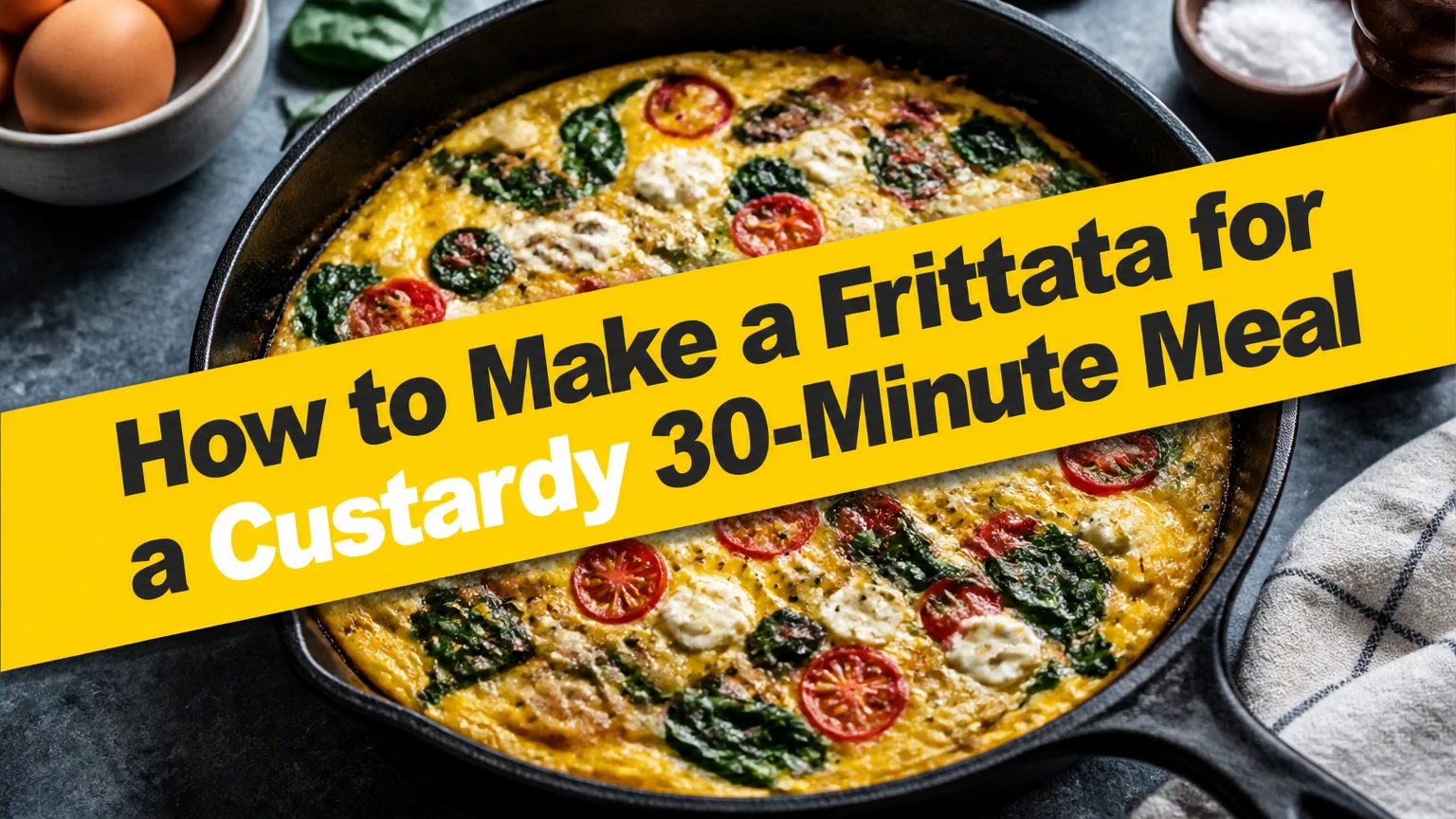
A frittata is an open-faced Italian egg dish made by combining beaten eggs with cooked fillings, setting the edges gently on the stovetop, and finishing the mixture in a 350°F oven or under a broiler. For an 8-egg frittata, use a 10-inch oven-safe skillet, about 8 tablespoons of dairy, fully cooked fillings, and remove the dish while the center still has a slight jiggle.
Key Facts at a Glance
- An 8-egg frittata serves 4-6 people and fits a 10-inch skillet.
- The practical dairy ratio is 1 tablespoon of cream, half-and-half, or whole milk per large egg.
- Watery vegetables, not the eggs themselves, cause most wet or weeping frittatas.
- A 350°F oven gives a wider doneness window than a broiler.
- The frittata is ready when the edges are firm and the center quivers slightly.
- A cooked frittata keeps in the refrigerator for up to 4 days when cooled and covered promptly.
What Is a Frittata?
A frittata is a thick, crustless Italian egg preparation in which fillings are mixed into the egg base rather than folded inside it. The Italian word comes from friggere, meaning “to fry,” while the cooking method combines gentle pan cooking with an oven or broiler finish.
Unlike a French omelet, a frittata is designed for wedges and group service. Unlike quiche, a frittata has no pastry shell and usually contains less dairy. Spanish tortilla differs again because its defining filling is potato, often with onion, and the eggs are commonly set by turning or finishing the pan without a broiler.
The best frittata has a tender, cohesive curd. It should hold a wedge without leaking liquid, yet remain softer than a fully firm baked egg casserole.
Before You Start
| Item | Standard specification | Typical amount or time |
|---|---|---|
| Eggs | Large, approximately 50 g each in shell | 8 eggs |
| Dairy | Heavy cream, half-and-half, or whole milk | 8 tablespoons |
| Skillet | Oven-safe, 10-inch diameter | 1 pan |
| Cheese | Parmesan, cheddar, feta, Gruyère, or goat cheese | 1/2-1 cup |
| Fat | Olive oil or butter | 1-2 tablespoons |
| Total time | Preparation, stovetop, oven, rest | 25-35 minutes |
| Yield | Main-course portions | 4-6 wedges |
Gather a medium mixing bowl, whisk, flexible spatula, cutting board, knife, oven mitt, and instant-read thermometer if you want a precise safety check. Typical ingredient cost is $6-$14 for four to six portions in the United States, depending on cheese, meat, and seasonal produce.
Use an oven-safe skillet with no plastic handle. Preheat the oven to 350°F, or 175°C, before cooking the eggs. The single biggest success factor is moisture control: cook and drain every filling before it meets the egg mixture.
How to Make a Frittata
This 8-egg frittata takes approximately 10 minutes to prepare, 3-5 minutes to set on the stovetop, 8-10 minutes to finish in the oven, and 5 minutes to rest. The method is beginner-friendly, but the center must be removed before it becomes fully firm because carryover heat continues cooking the eggs.
Step 1: Choose and Prepare the Pan
Choose a 10-inch cast-iron, carbon-steel, or oven-safe nonstick skillet for an 8-egg batch. Add 1-2 tablespoons of olive oil or butter, spreading the fat over the base and lower sides before heating the pan over medium heat.
A wider pan creates a thinner frittata that cooks quickly. A smaller pan creates a deeper custard that needs longer, gentler cooking and carries a greater risk of a liquid center with overcooked edges.
You’ll know it worked when: the pan is evenly coated and the fat shimmers without smoking.
Common mistake: heating an empty nonstick pan aggressively. Medium-low to medium heat is sufficient, and overheated nonstick coatings can deteriorate.
Step 2: Prepare the Fillings
Cook raw vegetables and meats before adding the eggs. Sauté 1 cup of chopped onion, pepper, mushroom, zucchini, or broccoli in the skillet until tender, then continue cooking until visible surface moisture disappears.
Cook bacon, sausage, ham, or pancetta completely. Drain excess grease, leaving about 1 tablespoon in the pan for flavor and lubrication. Wilt 2-3 packed cups of spinach, kale, or chard, then squeeze or press out excess water before chopping.
Aim for approximately 2-3 cups of prepared filling for 8 eggs. Overloading the pan makes the frittata fragile, while under-seasoned fillings make the finished eggs taste flat.
You’ll know it worked when: vegetables are tender and no liquid pools when they sit in the skillet.
Common mistake: adding raw mushrooms or zucchini directly to the eggs. Both release substantial water during cooking and can create a wet center.
Step 3: Build the Egg Mixture
Crack 8 large eggs into a bowl and whisk with 8 tablespoons of dairy, 1/2 teaspoon kosher salt, and several turns of black pepper. Whisk until the yolks and whites are uniform, but do not whip the mixture into a dense foam.
Stir in half of the cheese, reserving the remainder for the top. Use heavy cream for the richest texture, half-and-half for a balanced custard, or whole milk for a lighter result. Dairy is optional, but a no-dairy frittata needs closer heat control because the egg proteins set more quickly.
The 1-tablespoon-per-egg ratio is a dependable starting point, not an unbreakable rule. Use 6 tablespoons of dairy for six eggs or 10 tablespoons for ten eggs, provided the pan is large enough for the increased volume.
You’ll know it worked when: no separate streaks of egg white remain and the seasoning is evenly dispersed.
Common mistake: salting only the fillings. Eggs need seasoning throughout, and cheese or cured meat may require reducing the added salt.
Step 4: Combine the Fillings and Eggs
Return the cooked fillings to the greased skillet and distribute them evenly. Pour the egg mixture over the fillings, then gently shake the pan so the eggs flow around the ingredients.
Do not stir the mixture continuously. Stirring produces scrambled-egg curds and can move the fillings into a dense layer at the bottom. A single gentle sweep with a spatula is acceptable if large gaps remain.
Reduce the heat to medium-low. Leave the pan uncovered.
You’ll know it worked when: fillings remain suspended across the pan and egg reaches the skillet’s edges without vigorous bubbling.
Common mistake: using high heat to speed up the process. High heat firms the bottom before the center has time to set, producing a browned base and loose interior.
Step 5: Set the Edges on the Stovetop
Cook the frittata for 3-5 minutes over medium-low heat. When the outer 1 inch looks opaque, lift the edge gently with a silicone or heat-resistant spatula so uncooked egg can flow underneath.
Stop moving the frittata once the perimeter holds its shape. The center should still look liquid or very loose before the oven finish. This initial stovetop stage creates structure and helps the frittata release from the pan.
You’ll know it worked when: the rim is set, the bottom is lightly colored, and the center moves as one soft mass when the skillet is nudged.
Common mistake: waiting until the center is firm before transferring the pan. The oven will overcook the edges while the center finishes.
Step 6: Add the Topping and Finish the Frittata
Scatter the remaining cheese over the surface. Transfer the skillet to a preheated 350°F oven and bake for 8-10 minutes, or broil 4-6 inches from the heating element for approximately 3-4 minutes.
Baking is the better default for beginners and deep frittatas because heat reaches the center gradually. Broiling suits shallow frittatas and produces faster browning, but the surface can burn within a minute if the pan is too close to the element.
The United States Department of Agriculture recommends cooking egg dishes to 160°F, or 71°C, measured in the center. For the best texture, remove the frittata when the center is nearly set, then verify that residual heat carries it to a safe temperature.
You’ll know it worked when: the top is lightly puffed, the edges are firm, and the center quivers slightly rather than rippling like liquid.
Common mistake: judging doneness by browning alone. A browned top can conceal a loose center, while a pale top can contain fully cooked eggs.
Step 7: Rest, Release, and Slice
Rest the frittata in its skillet for 5 minutes. Run a thin spatula around the rim, place a plate or board over the pan if needed, and cut the frittata into four to six wedges.
Resting allows the egg proteins to finish setting and gives trapped steam time to redistribute. The frittata may deflate slightly; that is normal and indicates that air and steam are escaping rather than remaining in large pockets.
Serve warm, at room temperature, or chilled. Add fresh herbs, arugula, hot sauce, salsa, or a dressed salad after slicing rather than adding watery garnishes before cooking.
You’ll know it worked when: each wedge holds its shape and the interior looks moist without releasing a puddle.
Common mistake: cutting immediately. A hot, unrested frittata is more likely to crumble and leave wet-looking slices.
Which Pan and Heat Setting Work Best?
A 10-inch oven-safe nonstick skillet is the most forgiving choice for beginners, while cast iron gives stronger browning and retains heat longer. Stainless steel can work, but it needs careful preheating and enough fat because egg proteins bond readily to bare metal.
| Pan type | Best batch | Main advantage | Main risk |
|---|---|---|---|
| Nonstick, 10-inch | 8 eggs | Easiest release, even low heat | Broiler use may exceed coating limits |
| Cast iron, 10-inch | 8-10 eggs | Strong browning, oven durability | Retained heat can overcook the center |
| Carbon steel, 10-inch | 8 eggs | Fast response, naturally slick when seasoned | Requires seasoning and heat control |
| Stainless steel, 10-inch | 6-8 eggs | High-heat tolerance, dishwasher-safe models | Greater sticking and uneven release |
Check the manufacturer’s temperature limit before placing nonstick cookware under a broiler. Use cast iron or carbon steel for very high radiant heat, but reduce the finish time because both pans continue transferring heat after removal.
Why Does a Frittata Turn Rubbery or Watery?
A rubbery frittata results from excessive heat or prolonged cooking, while a watery frittata usually results from wet fillings, excessive low-fat liquid, or undercooked eggs. Egg proteins tighten as they over-coagulate and squeeze out moisture, so gentle heat and pre-cooked ingredients protect the custard.
The USDA’s food-safety guidance states, “Cook eggs until both the yolk and white are firm.” For mixed egg dishes, the USDA recommends 160°F in the center. Texture and safety overlap, but they are not identical: a frittata can look firm before reaching the target temperature, especially when it contains dense vegetables.
Troubleshooting Table
| Problem | Likely cause | Immediate fix | Prevention |
|---|---|---|---|
| Water on the plate | Wet spinach, zucchini, mushrooms, or peppers | Drain, blot, and serve warm | Cook fillings until dry |
| Rubbery interior | Oven above 400°F or excessive cook time | Slice thinly and add sauce | Remove at slight center jiggle |
| Burnt bottom | Stovetop heat too high | Transfer to a cool plate immediately | Use medium-low heat |
| Pale top, cooked center | Oven lacks top browning | Broil for 30-60 seconds | Add cheese before finishing |
| Sticking rim | Insufficient fat or unseasoned steel | Loosen edges with a thin spatula | Grease base and sides |
| Soufflé-like collapse | Excess air and aggressive heat | Rest before cutting | Whisk until uniform, not foamy |
A slightly underdone center can often be returned to a 300°F oven for 2-4 minutes. A dry frittata cannot be restored to a custardy texture, although a spoonful of salsa, yogurt, pesto, or tomato sauce can improve the serving.
Which Flavor Formulas Work Reliably?
Reliable frittata combinations balance one cooked vegetable group, one concentrated savory ingredient, one cheese, and one fresh aromatic. Keep total prepared fillings near 2-3 cups for eight eggs so the egg network remains strong enough to hold slices.
| Style | Prepared fillings | Cheese and herbs | Finish |
|---|---|---|---|
| Mediterranean | 1 cup spinach, 1/2 cup roasted pepper, 1/4 cup olives | 3/4 cup feta, oregano | Lemon zest |
| Mushroom and onion | 1 cup browned mushrooms, 1 cup onions | 1/2 cup Gruyère, thyme | Black pepper |
| Bacon and cheddar | 4 oz crisp bacon, 1/2 cup scallions | 3/4 cup sharp cheddar | Chives |
| Italian vegetable | 1 cup zucchini, 1/2 cup onion, 1/2 cup peas | 1/2 cup Parmesan, basil | Olive oil |
| Potato and leek | 1 1/2 cups cooked potato, 1/2 cup leek | 1/2 cup fontina, parsley | Paprika |
Salt carefully when using feta, olives, bacon, pancetta, soy sauce, or aged Parmesan. Strong salty ingredients should replace part of the added salt, not supplement a full salt measure.
How Does a Frittata Compare With Other Egg Dishes?
A frittata is the best choice when you need a scalable, crustless egg dish that can be sliced and served over several hours. Omelets cook faster for one person, quiche offers pastry and richer custard, and tortilla española is the stronger choice when potatoes are the central ingredient.
| Dish | Cooking method | Typical serving size | Texture and structure |
|---|---|---|---|
| Frittata | Stovetop plus oven or broiler | 4-6 people | Custardy wedges, no crust |
| French omelet | Fast pan cooking, folded | 1 person | Soft, creamy, rolled curd |
| Quiche | Pastry shell, baked custard | 6-8 people | Firm custard with flaky crust |
| Spanish tortilla | Potato and egg pan dish | 4-6 people | Dense, sliceable potato layers |
A frittata is not ideal when you need a crisp pastry shell, a highly fluid omelet center, or a dish with an almost entirely potato-based filling. Choosing the format first prevents forcing one technique to imitate another.
Can You Make a Frittata Without Cream?
A dairy-free frittata works with eggs, olive oil, and well-drained fillings, although the finished curd is firmer and less forgiving than one made with cream. For eight eggs, omit the dairy, add 1 extra tablespoon of olive oil to the pan, and use lower heat with an earlier doneness check.
For a softer dairy-free result, add 2 tablespoons of water or unsweetened soy milk rather than a large quantity of thin liquid. Avoid sweetened plant milks because their sugar and flavor do not suit savory eggs.
For a vegetarian frittata, rely on mushrooms, caramelized onions, peppers, herbs, and aged cheese for savoriness. For a vegan alternative, chickpea flour batter can imitate a sliceable egg-free dish, but it is a different preparation with a more legume-like flavor and denser texture.
How Should You Scale the Recipe?
Scale the egg mixture with the pan diameter and depth rather than simply multiplying ingredients. Six eggs suit an 8-inch skillet, eight eggs suit a 10-inch skillet, and ten to twelve eggs suit a 12-inch skillet or a rectangular baking dish.
| Eggs | Dairy | Pan size | Servings | Oven finish |
|---|---|---|---|---|
| 4 | 4 tbsp | 8-inch | 2 | 6-8 minutes |
| 6 | 6 tbsp | 8-9-inch | 3-4 | 7-9 minutes |
| 8 | 8 tbsp | 10-inch | 4-6 | 8-10 minutes |
| 10 | 10 tbsp | 12-inch | 6-8 | 9-12 minutes |
| 12 | 12 tbsp | 9 x 13-inch dish | 8-10 | 18-25 minutes |
A deeper pan requires more time at a moderate temperature, while a thin frittata cooks rapidly and can dry around the rim. When doubling a recipe, use two skillets if possible rather than creating a very deep center.
How Long Does a Frittata Keep?
A cooked frittata keeps for up to 4 days in a refrigerator at 40°F or below when cooled promptly and stored in a sealed container. Refrigerate leftovers within 2 hours, or within 1 hour if the surrounding temperature exceeds 90°F, following USDA food-safety guidance.
For meal prep, cool the whole frittata for approximately 20-30 minutes, cut it into wedges, and wrap individual portions. Reheat one wedge in a microwave at 50% power for 60-90 seconds, or in a 325°F toaster oven for 8-12 minutes.
Freezing is possible for about 1-2 months, but thawed eggs often lose water and become slightly spongy. Dairy-heavy frittatas and fillings with mushrooms or zucchini show the largest texture decline after freezing.
What Are the Most Important Practitioner Rules?
Experienced cooks use three rules to prevent most frittata failures: dry the fillings, control the pan depth, and stop cooking before the center looks completely firm. These rules matter more than whether the pan contains cream, milk, or no dairy.
- Treat cooked filling volume as a limit. Keep prepared ingredients to roughly 1/4-3/8 cup per egg.
- Season each layer. Salt vegetables while cooking, then season the egg mixture separately.
- Use the skillet handle as a heat warning. If the handle becomes too hot to touch safely before the edges set, the stovetop heat is probably excessive.
- Prefer baking for thick frittatas. Broiling browns quickly but gives the center less time to set evenly.
- Measure the center, not the edge. An instant-read thermometer should enter the thickest middle section without touching the pan.
One counterintuitive point matters: a frittata that looks slightly underdone in the oven often becomes perfect after resting. A frittata that looks fully firm before removal usually becomes dry by the time it reaches the plate.
Frequently Asked Questions
Can I use frozen vegetables in a frittata?
Yes. Thaw frozen vegetables completely, press or squeeze out excess water, and sauté them for 2-4 minutes before adding the eggs. Frozen spinach requires especially thorough draining because retained ice water can create a loose center even when the egg mixture reaches 160°F.
Should I cover a frittata while it cooks?
Do not cover the skillet during the stovetop or oven finish unless the top is browning too quickly. A lid traps steam and can condense water onto the eggs, while an uncovered pan allows the surface to set and the cheese to brown.
Can I make a frittata in a glass baking dish?
Yes, but use a greased 9 x 13-inch glass dish for approximately 10-12 eggs and add 5-10 minutes to the 350°F baking time. Glass heats more slowly than metal, so check the center with a thermometer and avoid placing a cold glass dish into a fully heated oven.
Why does my frittata stick even when I use oil?
Eggs stick when the pan is poorly seasoned, the fat is unevenly distributed, or the frittata is moved before its bottom sets. Grease the sides as well as the base, use medium-low heat, and loosen the rim only after the edges become opaque.
Can I serve a frittata at room temperature?
Yes. A frittata can be served warm or at room temperature for a meal, picnic, or buffet, but it should not remain unrefrigerated for more than 2 hours. Cut wedges after the five-minute rest, then cover and refrigerate any portion that will not be served promptly.
The Bottom Line
To make a frittata, cook and drain the fillings, whisk 8 eggs with 8 tablespoons of dairy, set the edges over medium-low heat, finish in a 350°F oven, and rest for 5 minutes. The reliable target is a firm rim, a lightly browned surface, and a center that still quivers slightly when removed. A dry pan, moderate heat, and restrained filling quantity produce the best results.