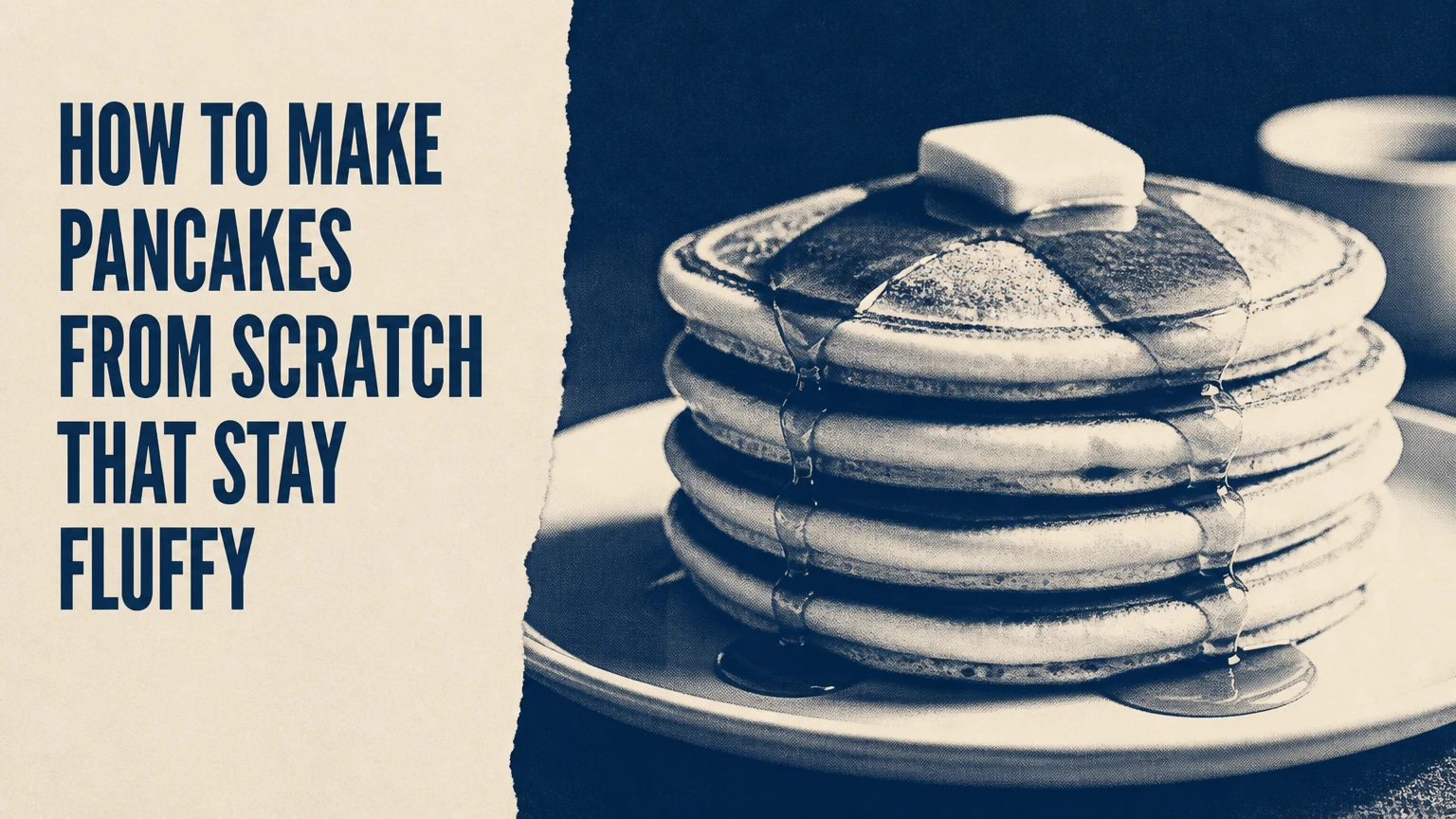
To make pancakes from scratch, whisk flour, sugar, baking powder, and salt separately from milk, egg, melted butter, and vanilla, then combine the mixtures with minimal stirring. Rest the batter for 5-10 minutes, cook 60 ml portions on a lightly greased 190°C pan, and flip when bubbles remain open and the edges look set.
Key Facts
This recipe yields about 8 pancakes, each approximately 10-12 cm wide.
Use 125 g all-purpose flour, 240 ml milk, 1 large egg, and 1 tablespoon baking powder.
A 5-10 minute rest hydrates the flour and thickens the batter.
Medium heat, approximately 190°C / 375°F at the cooking surface, prevents burnt exteriors and raw centers.
Flip each pancake once, when bubbles have opened and the top edge looks matte.
A batch typically costs $1.50-$2.50 and takes 20-30 minutes from mixing to serving.
Before You Start
The pancake method takes about 10 minutes to mix, 5-10 minutes to rest, and 10-15 minutes to cook in two or three batches. The difficulty is beginner-friendly, but pan temperature and mixing technique determine the texture more than expensive equipment does.
Ingredients for Eight Pancakes
| Ingredient | US measure | Metric measure | Function |
|---|---|---|---|
| All-purpose flour | 1 cup | 125 g | Provides starch and protein structure |
| Granulated sugar | 2 tbsp | 25 g | Adds sweetness and browning |
| Baking powder | 1 tbsp | 12 g | Releases carbon dioxide for lift |
| Fine salt | 1/2 tsp | 3 g | Balances flavor |
| Whole milk | 1 cup | 240 ml | Hydrates flour and carries steam |
| Large egg | 1 | 50 g without shell | Adds structure, fat, and emulsification |
| Unsalted butter, melted | 3 tbsp | 42 g | Adds richness and tenderness |
| Vanilla extract | 1 tsp | 5 ml | Adds aroma |
The formula is intentionally simple. Baking powder supplies the main lift, while the egg and flour provide enough structure for the batter to hold gas bubbles during cooking. For a less sweet breakfast pancake, reduce the sugar to 1 tablespoon without changing the liquid.
Equipment
Use a large mixing bowl, a medium bowl, a whisk, a flexible spatula, a 60 ml measuring cup, and a heavy skillet or electric griddle. A cast-iron pan holds heat well but needs longer preheating; a nonstick pan releases pancakes more easily but can develop hot spots if the burner is too high.
A digital surface thermometer is useful but optional. The USDA recommends cooking egg dishes to 160°F, or 71°C, for food safety; a fully set pancake center normally reaches that range before the surface is properly browned.
Why This Recipe Works
Pancakes become fluffy when chemical leavening produces gas, the batter traps that gas, and heat sets the resulting network before the bubbles escape. Minimal mixing limits gluten development, while a moderate pan temperature lets the center cook before the sugars darken excessively.
Flour, Liquid, and Gluten
Wheat flour contains gluten-forming proteins that develop when flour meets water and receives mechanical agitation. A few visible lumps are desirable because they indicate the batter has not been worked until elastic. Overmixed pancake batter often produces a chewy, rubbery crumb instead of a tender one.
The 125 g flour to 240 ml milk ratio creates a pourable but thick batter. Flour brands absorb different amounts of liquid, so the finished batter may need 1-2 tablespoons of extra milk if it falls from the spoon in a solid clump rather than a thick ribbon.
Baking Powder and Baking Soda
Baking powder contains an acid and a base, so it can generate carbon dioxide when moistened and again during heating. Baking soda is different: it needs an acidic ingredient such as buttermilk, yogurt, lemon juice, or molasses. The standard recipe uses baking powder alone because milk is not acidic enough to activate a useful quantity of baking soda.
King Arthur Baking recommends replacing baking powder after roughly 9-12 months once opened, although storage conditions affect its strength. To test baking powder, stir 1 teaspoon into a small amount of hot water. To test baking soda, stir it into vinegar or lemon juice. A baking-soda test in water alone does not reliably measure its performance.
Steam and Browning
Water in the milk and egg turns to steam as the pancake heats, expanding the batter from inside. The Maillard reaction creates much of the browned flavor when proteins and reducing sugars react on a hot surface, while caramelization contributes additional color as sugar heats.
The surface needs enough heat to brown, but not so much that the exterior sets before the center cooks. That is why medium heat is more reliable than a high burner setting, especially with thick pancakes.
Ingredients and Substitutions
Milk, eggs, butter, and wheat flour can each be replaced, but every substitution changes structure, browning, or moisture. The closest easy substitution is buttermilk for milk, while vegan and gluten-free versions require more than a one-for-one swap.
| Need | Substitute | Quantity | Expected change |
|---|---|---|---|
| Buttermilk flavor | Buttermilk | 240 ml | Tangier flavor and softer crumb |
| Dairy-free batter | Unsweetened soy milk | 240 ml | Similar moisture and protein |
| Butter-free cooking | Neutral oil | 3 tbsp in batter | Slightly less buttery aroma |
| Whole-wheat version | Whole-wheat flour | 60 g plus 65 g white flour | Denser texture and nuttier flavor |
| Higher protein | Greek yogurt plus milk | 120 g yogurt plus 120 ml milk | Thicker batter and more acidity |
| Egg-free structure | Commercial egg replacer | Amount for 1 egg | More delicate pancakes |
| Gluten-free batter | 1:1 gluten-free flour blend | 125 g | Softer, sometimes more fragile texture |
Can You Use Buttermilk?
Yes, replace the whole milk with 240 ml buttermilk and keep the baking powder. For additional tang and lift, replace 1 teaspoon of baking powder with 1/4 teaspoon baking soda, but do not increase the soda because excess alkalinity can create a soapy taste and darken the pancakes too quickly.
Buttermilk is thicker than ordinary milk, so the batter may need 1-2 tablespoons of water. The correct consistency is thick enough to mound briefly after pouring, yet fluid enough to spread into a round shape.
How Do You Make Vegan Pancakes?
Use 240 ml unsweetened soy milk, 1 tablespoon apple cider vinegar, and 1 tablespoon ground flaxseed mixed with 3 tablespoons water. Let the flax mixture gel for 5 minutes, then replace the egg and butter with 2 tablespoons neutral oil.
Soy milk generally provides more protein than almond or oat milk, which helps the pancake set. Vegan pancakes brown differently, so judge doneness by a firm edge and a dry-looking top rather than color alone.
How Do You Make Gluten-Free Pancakes?
Use a gluten-free flour blend containing a binder such as xanthan gum, or add approximately 1/4 teaspoon xanthan gum for every 125 g of blend if the package contains none. Let the batter rest for 10 minutes so rice flour and starches can hydrate.
Gluten-free batter often thickens more during resting. Loosen it with 1 tablespoon milk at a time, and make pancakes slightly smaller, around 45 ml each, because smaller rounds are easier to turn without breaking.
How to Make Pancakes from Scratch
Follow these six steps for a batch of approximately eight fluffy American pancakes. The most important rule is to stop mixing when the flour disappears, because additional stirring develops gluten without improving the batter.
Step 1: Mix the Dry Ingredients
Whisk 125 g flour, 25 g sugar, 12 g baking powder, and 3 g salt in a large bowl for about 20 seconds. Break up baking powder clumps and distribute the leavener evenly through the flour.
You will know this step worked when the mixture has one consistent color and no visible pockets of baking powder. A whisk is better than a spoon because it disperses small clumps without compacting the flour.
The common mistake is measuring flour by scooping directly from the bag. That can compress extra flour into the cup. Spoon flour into a cup and level it, or weigh 125 g for greater consistency.
Step 2: Combine the Wet Ingredients
Whisk 240 ml milk, 1 egg, 42 g cooled melted butter, and 5 ml vanilla in a separate bowl until the egg yolk is dispersed. Cool melted butter for several minutes first, because hot butter can partially cook the egg.
The wet mixture should look uniform rather than streaked with egg. Small butter flecks are acceptable if the milk is cold, but large solid pieces can distribute unevenly through the batter.
The common mistake is adding hot butter directly to the egg. If that happens, discard any obvious cooked egg pieces and mix the remaining liquid with a fresh egg.
Step 3: Combine the Batter
Pour the wet ingredients into the dry ingredients. Fold with a spatula or whisk using about 10-15 broad strokes, stopping as soon as no dry flour remains.
The batter should contain small lumps and fall from the spoon in a thick ribbon. Batter that is perfectly smooth has usually been mixed too far, although a few large dry pockets must still be incorporated.
The common mistake is trying to remove every lump. Small lumps disappear during cooking; excessive stirring creates a stronger gluten network and makes the finished pancakes tough.
Step 4: Rest the Batter for 5-10 Minutes
Leave the covered or uncovered bowl on the counter for 5-10 minutes. Resting allows the flour starches to absorb liquid and gives the batter a more even consistency.
You will know the batter is ready when it has thickened slightly but still spreads after pouring. Stir once gently after resting if a layer of liquid has separated.
The common mistake is resting the batter for 30 minutes or longer at room temperature. Chemical leavening begins working as soon as liquid is added, so a long delay can reduce lift. Cook promptly after the short rest.
Step 5: Heat and Grease the Pan
Preheat a heavy skillet or griddle over medium heat for 4-6 minutes, aiming for approximately 190°C / 375°F at the surface. Rub the pan with about 1 teaspoon neutral oil, then wipe away visible excess with a paper towel.
A small water droplet should skitter briefly and evaporate within about 1-2 seconds. Instant violent evaporation usually indicates excessive heat, while a droplet that sits for several seconds indicates an underheated surface.
The common mistake is leaving a thick film of butter in the pan. Butter solids can burn before the pancake cooks. Use a thin oil coating, or combine a small amount of oil with butter for flavor.
Step 6: Portion, Cook, and Flip
Pour 60 ml, or 1/4 cup, of batter for each pancake, leaving at least 5 cm between rounds. Cook the first side for approximately 2-3 minutes, then flip once and cook the second side for 1-2 minutes.
The first side is ready when bubbles have formed across the top, several have opened and stayed open, the edges look matte, and the underside is golden brown. A single quick flip preserves more trapped gas than repeated turning.
The second side needs less time because the pancake is already hot. You will know it is cooked when the center springs back lightly when pressed and no wet batter appears at the edge.
The common mistake is flipping when only a few bubbles appear. Early flipping can tear the surface and leave a wet center. If the underside is dark before the top sets, lower the heat immediately.
Which Pancake Style Should You Make?
American pancakes are the best choice for a fast, fluffy breakfast, crêpes suit thin rolled fillings, and Japanese soufflé pancakes suit a slow presentation-focused dessert. The three styles use different structures, so an American pancake recipe cannot be converted into a soufflé pancake simply by adding extra baking powder.
| Style | Typical flour per serving | Leavening | Cooking time | Best use |
|---|---|---|---|---|
| American | 60-65 g | 1-2 tsp baking powder | 6-8 minutes per batch | Syrup and fruit |
| Crêpe | 35-45 g | None | 2-3 minutes per crêpe | Rolled sweet or savory fillings |
| Japanese soufflé | 35-45 g | Whipped egg whites | 12-18 minutes per batch | Tall dessert presentation |
| Whole-wheat American | 60-65 g | Baking powder | 7-9 minutes per batch | Nutty, filling breakfast |
Crêpes use more liquid relative to flour and rely on steam rather than chemical leavening. Japanese soufflé pancakes depend on stable whipped egg whites and gentle covered cooking, making them less suitable for a first batch or a large family breakfast.
Time, Yield, and Cost
A standard batch produces eight 10-12 cm pancakes in 20-30 minutes, including a 5-10 minute rest. Typical ingredient cost is $1.50-$2.50 in the United States when flour, sugar, salt, and leavening are already pantry staples.
| Batch size | Flour | Milk | Eggs | Expected yield |
|---|---|---|---|---|
| Half batch | 62.5 g | 120 ml | 1/2 beaten egg | 4 pancakes |
| Standard batch | 125 g | 240 ml | 1 large egg | 8 pancakes |
| One-and-a-half batch | 188 g | 360 ml | 1 1/2 eggs | 12 pancakes |
| Double batch | 250 g | 480 ml | 2 large eggs | 16 pancakes |
For a half batch, beat one egg and use approximately 25 g, or 1 1/2 tablespoons, of the beaten mixture. For larger batches, keep the batter in one bowl but cook in stages rather than overcrowding the pan, because too many pancakes lower the surface temperature.
Common Mistakes and How to Fix Them
Pancake failures usually come from incorrect heat, excess mixing, inaccurate flour measurement, or weak leavening. The recovery depends on whether the problem is in the uncooked batter or already-cooked pancakes.
| Problem | Likely cause | Immediate fix | Next-batch adjustment |
|---|---|---|---|
| Dense, rubbery centers | Overmixed batter | Serve smaller pancakes if cooked | Use 10-15 folds only |
| Burnt outside, raw inside | Pan above 200°C | Lower heat and cool pan | Use medium-low heat |
| Flat pancakes | Old baking powder or thin batter | Add fresh leavener only before cooking | Test baking powder and weigh flour |
| Pale, greasy surface | Low heat or excess oil | Increase heat gradually and wipe pan | Use a thin oil film |
| Pancakes spread too far | Batter too thin or pan too hot | Add 1 tbsp flour and rest 3 minutes | Reduce milk slightly |
| Dry, crumbly texture | Too much flour or overcooking | Add syrup or yogurt when serving | Weigh flour and shorten second side |
Dense or Rubber-Like Pancakes
Overmixing is the usual cause of toughness. Once the flour is hydrated, repeated stirring aligns gluten proteins and removes the irregular air pockets that help create a tender crumb.
A smaller pancake can finish cooking more evenly, but cooked dense pancakes cannot be made fluffy afterward. Prevent the problem by accepting small lumps and using a spatula instead of vigorous whisking during the final mix.
Burnt Outside and Raw Center
A pan that is too hot browns the surface before the batter’s center sets. Scrape away burnt residue, move the pan off the burner for 2-3 minutes, then resume at medium-low heat.
Thicker pancakes are especially sensitive to high heat. Reduce the portion from 60 ml to 45 ml if the outside repeatedly darkens before the center firms.
Flat Pancakes
Check baking powder first. If 1 teaspoon of baking powder does not fizz strongly in hot water, replace it. Flat results can also occur when batter sits too long, when flour is overmeasured, or when the pan is too cool to expand the steam quickly.
Do not add a large amount of extra baking powder to a finished batter. More than approximately 1 tablespoon per 125 g flour can create bitterness, rapid browning, and a fragile crumb.
Uneven Batch Color
Uneven browning usually indicates inconsistent grease or a pan with hot spots. Wipe the cooking surface between batches if butter solids accumulate, and rotate the pan if the burner heats one side more strongly.
The first pancake often functions as a calibration test. Adjust heat and portion size after that pancake instead of judging the entire batch from it.
How Do You Store and Reheat Pancakes?
Cool pancakes in a single layer for 10-15 minutes, refrigerate them in an airtight container for up to 3-4 days, or freeze them for about 2 months for best texture. Reheat refrigerated pancakes in a toaster, skillet, or microwave until the center is hot.
For freezing, place parchment between pancakes and freeze them flat before transferring them to a sealed bag. A toaster reheats individual pancakes well, while a 160°C / 325°F oven can warm a covered stack in approximately 10-15 minutes.
Do not stack hot pancakes tightly in a sealed container. Trapped steam condenses against the surface and makes the edges wet. Keep finished pancakes warm on a rack in a 90°C / 200°F oven for no more than about 20 minutes.
How Do You Make Pancake Batter Ahead?
For the best lift, mix pancake batter shortly before cooking and rest it only 5-10 minutes. Refrigerating fully mixed batter overnight is possible, but the pancakes may be flatter because the chemical leavener has already reacted.
A better make-ahead method is to whisk the dry ingredients in one container and the wet ingredients in another, refrigerating the wet mixture for up to 24 hours. Combine them immediately before cooking, then rest the batter for 5-10 minutes.
Do not store batter containing raw egg at room temperature. Refrigerate it at 4°C / 40°F or below, and discard it if it has remained unrefrigerated for more than 2 hours, or 1 hour when the surrounding temperature exceeds 32°C / 90°F.
How Do You Serve Pancakes Without Making Them Soggy?
Serve pancakes immediately with butter, maple syrup, fruit, yogurt, nut butter, or toasted nuts. Add wet toppings immediately before eating because syrup and fruit juices migrate into the crumb and soften the browned surface.
For a crisp edge, use a lightly oiled pan and avoid covering cooked pancakes. For a softer stack, place the pancakes under a clean towel for several minutes, but expect some surface steam and reduced crispness.
Maple syrup is thinner when warmed, so 2-3 tablespoons can soak into a stack quickly. A spoonful of Greek yogurt or nut butter adds a thicker topping that remains on the surface longer.
Frequently Asked Questions
Can You Make Pancakes Without Eggs?
Yes. Replace one egg with a commercial egg replacer, 1 tablespoon ground flaxseed mixed with 3 tablespoons water, or 60 g mashed banana. Egg-free pancakes are usually softer and more fragile, so cook 45 ml portions and flip only after the edges are fully set.
Can You Make Pancakes Without Butter?
Yes. Replace the 3 tablespoons of melted butter with 2 tablespoons neutral oil in the batter, and grease the pan with an additional thin layer of oil. Canola, sunflower, and refined avocado oil work well because their flavors remain mild during cooking.
Why Are My Pancakes Not Fluffy?
Flat pancakes usually result from expired baking powder, an overly thin batter, a cool pan, or batter that waited too long after mixing. Weigh the flour, test the baking powder in hot water, rest the batter for 5-10 minutes, and cook immediately afterward.
Can You Use Water Instead of Milk?
Yes, but water produces less flavorful and less tender pancakes because it supplies no milk fat or protein. Replace 240 ml milk with 240 ml water, then add 1 extra tablespoon of melted butter or oil to restore some richness.
Should Pancake Batter Be Smooth?
No. Small lumps are normal and desirable in pancake batter. Mix only until dry flour disappears, because smoothing every lump requires additional stirring that develops gluten and can produce a chewy texture.
How Do You Know When to Flip a Pancake?
Flip when the top contains several open bubbles that do not immediately close, the edges look matte and set, and the underside is golden brown. A pancake that is flipped before these signs appear can tear or retain a wet center.
The Bottom Line
To make pancakes from scratch successfully, measure 125 g flour, mix the wet and dry ingredients separately, combine them with minimal stirring, rest the batter for 5-10 minutes, and cook 60 ml portions on a lightly greased 190°C / 375°F pan. The exact keyword answer is simple: how to make pancakes from scratch comes down to controlled heat, fresh leavening, and stopping the mixing early.