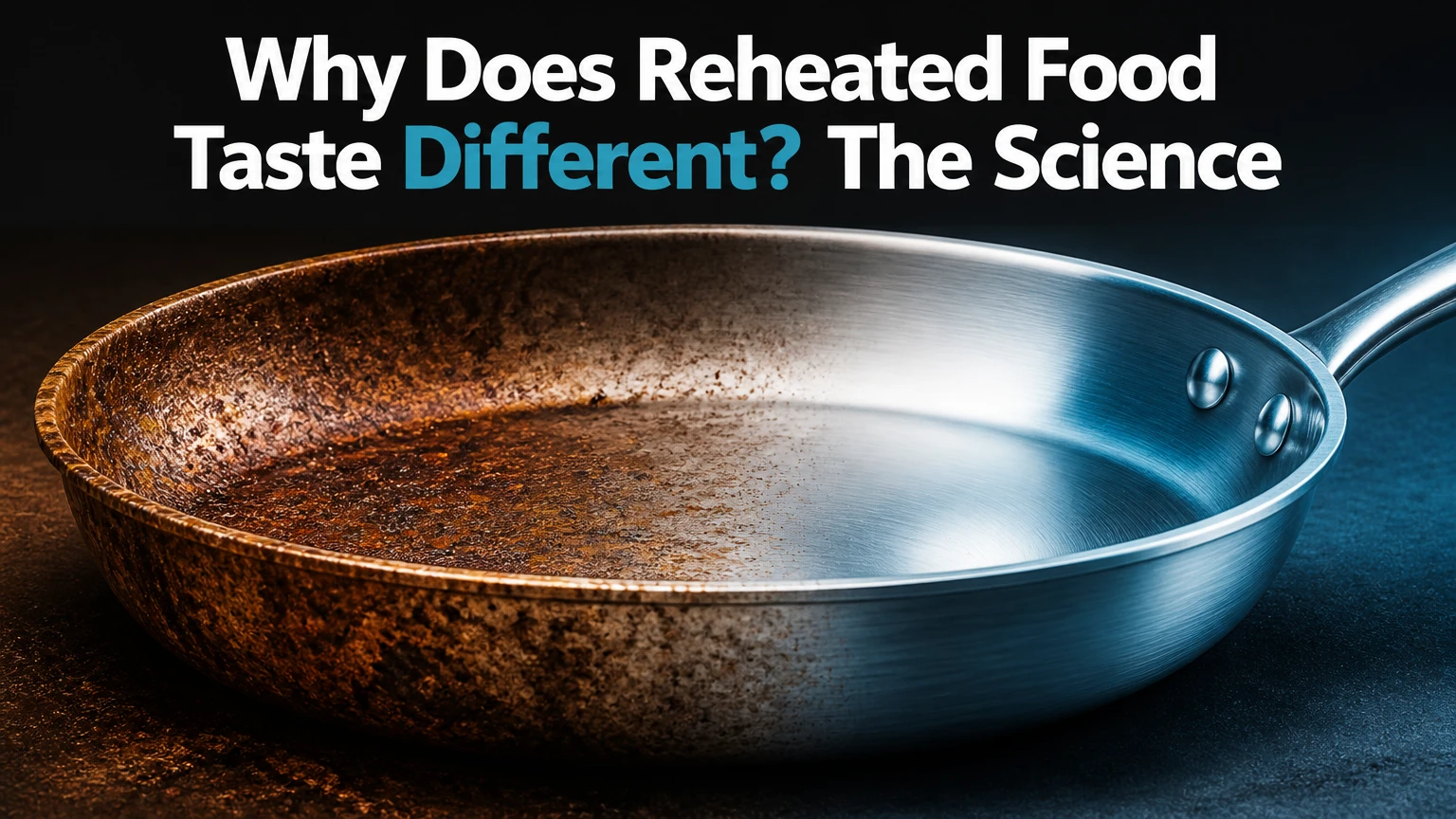
Reheated food tastes different because cooling, storage, and renewed heat change its aromas, fats, water distribution, proteins, and starches. Oxidized fats can create warmed-over flavor in meat, while evaporation removes fresh aromas and heat alters texture. Reheating method, storage time, oxygen exposure, and the food’s original structure determine whether leftovers improve or deteriorate.
Key Facts at a Glance
- Warmed-over flavor comes mainly from oxidation products formed in cooked meat fats during storage and reheating.
- Cooling causes starch retrogradation, which makes bread, rice, pasta, and potatoes firmer or drier.
- Microwave heating preserves moisture better than dry heat, but steam can soften crisp surfaces.
- Oven and air-fryer heat can restore browning, yet surface temperatures high enough for crispness can dry interiors.
- The USDA recommends reheating leftovers to 165°F, or 74°C, measured with a food thermometer.
- Refrigerated leftovers generally keep three to four days at 40°F, or 4°C, or below, although quality can decline sooner.
What Changes When Food Cools?
Cooling changes food structure before reheating begins. Water migrates through the food, gelatinized starch molecules reassociate, cooked fats solidify, and oxygen continues reacting with susceptible lipids during storage.
Freshly cooked food has a particular balance of dissolved aroma compounds, surface moisture, internal steam, and fat distribution. Cooling disrupts that balance. A sauce may separate, a roast may lose surface juices, and bread may become firm even though its water content has not disappeared completely.
Temperature also changes taste perception. Warm food releases volatile compounds more readily into the nose, so a reheated dish may seem more aromatic than the same dish cold. If reheating drives those compounds away or creates harsh oxidation products, the food can taste flatter or stale despite reaching the same serving temperature.
What Happens During Cooling and Reheating?
The sequence usually follows four stages:
- Initial cooling: Steam condenses, fats firm, and water moves from one region of the food to another.
- Cold storage: Oxygen reacts slowly with fats, while starches continue reorganizing.
- Renewed heating: Water evaporates, aromas volatilize, and proteins contract further.
- Serving: The final texture and aroma depend on the heating rate, humidity, surface temperature, and storage duration.
The 165°F safety target does not restore the original molecular structure. Safety and quality are separate outcomes. Food can reach a safe temperature while still tasting dry, oxidized, or soggy.
Why Does Reheated Meat Develop a Stale Flavor?
Reheated meat develops warmed-over flavor when oxygen-driven lipid oxidation produces aldehydes and related compounds with stale, metallic, cardboard-like, or paint-like notes. Poultry and pork are especially vulnerable because their muscle membranes contain oxidation-sensitive polyunsaturated fatty acids.
Cooking damages cell membranes and releases iron-containing compounds that can accelerate oxidation. During refrigeration, oxygen in the container headspace and dissolved oxygen in the food support further reactions. Reheating increases the release of volatile oxidation products, making the defect easier to smell and taste.
The effect is often strongest in chicken, turkey, pork, and lean cooked meats stored for one or more days. Beef can develop the same problem, but its fat composition and seasoning may make the defect less obvious in some preparations.
Food scientist R. A. Gray described warmed-over flavor as a “rapid development of off-flavors during refrigerated storage and subsequent reheating” in research on cooked meat quality. The exact sensory profile varies with species, fat composition, storage atmosphere, cooking temperature, and time.
How Can You Reduce Warmed-Over Flavor?
Reduce oxygen exposure and reheating severity rather than repeatedly heating a whole batch.
- Refrigerate meat in shallow, tightly sealed containers within two hours of cooking.
- Divide large portions before chilling so they cool faster and reheat only once.
- Use moist heat for chicken, turkey, pork, and lean beef.
- Add sauce, stock, or gravy before heating to limit surface drying.
- Reheat only the portion you will eat.
- Finish with fresh acid, herbs, scallions, citrus zest, or toasted spices after heating.
Freezing can slow oxidation and preserve quality better than several days of refrigeration, although freezing introduces its own texture damage through ice crystals. Airtight packaging with minimal headspace helps because less oxygen remains available for lipid oxidation.
Why Do Rice, Pasta, Potatoes, and Bread Change Texture?
Rice, pasta, potatoes, and bread change texture because gelatinized starch molecules reorganize during cooling and then respond unevenly to renewed heat. This process, called retrogradation, can make starch firmer, drier, or more crumbly.
During cooking, starch granules absorb water and swell. Cooling allows portions of amylose and amylopectin to reassociate into more ordered structures. Reheating softens some of those structures, but it may also evaporate water or leave regions that remain firm.
Rice often becomes hard when uncovered heating removes surface moisture faster than heat can redistribute it. Pasta may become rubbery when dry heat tightens its outer layer, while potatoes can become mealy because their cell structure has already been weakened by cooking and cooling.
| Food | Main quality change | Typical repair | Best reheating approach |
|---|---|---|---|
| Cooked rice | Hard grains, dry edges | 1-2 teaspoons water per cup | Covered microwave, 50%-70% power |
| Pasta | Rubbery edges, clumped strands | 1-2 tablespoons sauce per cup | Covered skillet, 3-6 minutes |
| Mashed potatoes | Thick, gluey, or separated texture | 1 tablespoon milk or butter per cup | Low saucepan heat, frequent folding |
| Bread | Firm crumb, softened crust | 1 teaspoon water near the bread | Covered skillet or 325°F oven |
| Roasted potatoes | Soft crust, dry center | 1 teaspoon oil per serving | Air fryer, 375°F-400°F |
Water does not always solve the problem. Adding too much liquid to pasta or rice can create a wet exterior while the center remains firm. Small additions, covered heating, and gentle redistribution work better than flooding the food.
Why Do Crisp Foods Become Soft After Reheating?
Crisp foods become soft when steam from their moist interior condenses on a cooler crust. The crust’s low-moisture starch structure absorbs that water, reducing fracture and replacing crispness with chewiness.
A microwave heats water-rich regions efficiently, so it produces steam quickly and traps humidity under a cover. That makes soup warm but turns fried chicken, fries, pizza crust, and pastry soft. Dry circulating heat removes surface moisture and can restore crispness.
Crispness requires a dry surface, not merely a high internal temperature. An air fryer or convection oven is therefore better for fried foods, although it may over-dry thin edges before the center warms.
Pizza illustrates the trade-off clearly. A microwave melts cheese quickly but softens the base. A covered skillet can warm the underside directly, while a few drops of water placed away from the slice create steam to soften the cheese. An uncovered air fryer restores the crust but can make toppings leathery.
Why Does Reheated Food Smell Flatter?
Reheated food smells flatter because volatile aroma compounds escape during the original cooking, cooling, storage, and second heating cycle. Fresh herbs, garlic, citrus oils, toasted spices, and delicate fats lose their most noticeable top notes faster than heavier savory compounds.
Aroma reaches the brain through the nose, including retronasal smell while chewing. Heat increases vapor release, but excessive heat can drive aromatic molecules out of the dish before they reach the diner. The result is often a one-dimensional taste even when salt, acidity, and calories remain unchanged.
Add fragile aromas after heating. Chopped parsley, cilantro, basil, green onion, lemon zest, vinegar, fresh chilies, and toasted sesame oil can restore contrast without subjecting those compounds to another high-temperature cycle.
Heavy spices and browned ingredients behave differently. Cumin, black pepper, roasted garlic, browned butter, and caramelized onions often survive reheating better because their flavor compounds are less dependent on delicate fresh top notes.
Which Reheating Method Preserves Flavor Best?
No single reheating method preserves every food equally. Covered microwave heating is usually best for moist dishes, a skillet is best for controlled sauces and grains, and dry circulating heat is best for crisp surfaces.
| Reheating method | Typical time | Best foods | Main quality risk |
|---|---|---|---|
| Microwave, 50%-70% power | 1-4 minutes | Soup, stew, rice, vegetables | Uneven hot spots and steam-softened crust |
| Covered skillet | 4-10 minutes | Pasta, stir-fry, grains, pizza | Scorched base or broken sauce |
| Conventional oven, 325°F-375°F | 15-35 minutes | Casserole, roast, baked pasta | Dry edges and slow center heating |
| Air fryer, 350°F-400°F | 4-12 minutes | Fries, wings, pizza, pastries | Dry interior and burnt toppings |
| Double boiler | 8-20 minutes | Custard sauce, chocolate, delicate gravy | Slow heating and water condensation |
Which Foods Suit Each Appliance?
Microwave: Choose the microwave for water-rich foods and small portions. Cover loosely, use 50%-70% power, stir dense food halfway, and let it rest for one to two minutes so heat can conduct inward.
Skillet: Choose a skillet for pasta, rice, pizza, vegetables, and sauces that need active control. Add one to two tablespoons of liquid per serving when the food looks dry, then use low or medium-low heat.
Oven: Choose an oven for dense casseroles, lasagna, roasts, and several portions. Cover with foil for most of the heating period, then uncover briefly if the surface needs browning.
Air fryer: Choose an air fryer for crisp foods in one or two portions. Use 350°F for delicate pastries and 375°F-400°F for fries or wings, checking early because small pieces heat quickly.
The best appliance matches the food’s desired final moisture. Moisture preservation and crispness require opposite conditions.
Can Reheating Make Food Unsafe?
Reheating can make food unsafe when poor storage allowed bacteria to multiply or produce toxins before heating. Reheating does not reliably reverse every hazard, so time and temperature control begins immediately after cooking.
The USDA recommends refrigerating perishable leftovers within two hours, or within one hour when ambient temperatures exceed 90°F. Keep the refrigerator at 40°F, or 4°C, or below. The USDA also recommends reheating leftovers to 165°F, or 74°C.
The USDA’s plain-language rule is: “When in doubt, throw it out.” That advice applies when storage time, refrigerator temperature, or contamination history is unknown.
| Safety variable | Recommended value | Why it matters |
|---|---|---|
| Refrigerator temperature | 40°F / 4°C or lower | Slows bacterial growth |
| Standard room-temperature limit | 2 hours | Limits time in the bacterial growth range |
| Hot-weather room-temperature limit | 1 hour above 90°F / 32°C | Heat accelerates growth |
| Leftover storage window | 3-4 days | USDA quality and safety guidance |
| Reheating internal temperature | 165°F / 74°C | Reduces many active pathogens |
Use a thermometer in the thickest portion, especially for casseroles, stuffed foods, dense rice dishes, and large meat pieces. A steaming surface does not prove that the center reached 165°F.
How Should Leftovers Be Cooled and Stored?
Cool leftovers quickly in shallow portions, seal them once steam no longer causes excessive condensation, and label the container with the cooking date. Large, deep containers retain heat in the center and can keep food in the bacterial growth range for too long.
Do not wait for a large pot of soup or stew to reach room temperature on the counter. Divide it into shallow containers, use an ice bath for very large batches, or refrigerate promptly in portions that allow rapid cooling.
Storage also controls flavor. A tight container limits moisture loss and oxygen exposure, while separate containers prevent crisp foods from absorbing steam from sauces. Store fried toppings, herbs, crunchy garnishes, and wet components apart whenever possible.
Freezing is preferable when food will not be eaten within three to four days. Label frozen portions, remove excess air, and thaw in the refrigerator or as part of a controlled cooking process rather than leaving food on the counter.
How Can You Repair Damaged Flavor and Texture?
Repair reheated food by restoring the missing variable: moisture for dryness, airflow for sogginess, fat for harshness, or acid and fresh aromatics for flatness. The repair should happen after identifying whether the defect is structural, chemical, or seasoning-related.
| Problem | Likely cause | Repair quantity or setting | Avoid |
|---|---|---|---|
| Dry chicken | Protein contraction and evaporation | 2 tablespoons sauce per 4 ounces | High-power microwave |
| Hard rice | Moisture loss and retrogradation | 1-2 teaspoons water per cup | Uncovered heating |
| Soggy fries | Condensed steam | Air fryer at 375°F-400°F | Covered microwave |
| Split cream sauce | Excess heat and emulsion failure | 1 tablespoon milk, low heat | Boiling |
| Flat stew | Aroma loss and reduced contrast | 1 teaspoon acid plus fresh herbs | Adding only more salt |
| Burnt edge | Uneven heating | Remove edge, mix center gently | Scraping char into dish |
For meat, slice before reheating when possible. Smaller pieces warm faster, allowing a lower surface temperature and shorter exposure. For sauce, add liquid gradually and stir gently rather than boiling the entire portion.
For rice, place the serving in a microwave-safe bowl, sprinkle water across the surface, cover loosely, and heat at reduced power in 30- to 60-second intervals. Rest for one minute before checking the center.
For crisp food, never cover it during the final crisping stage. If a food has already absorbed too much moisture, reheating may improve the surface but cannot fully recreate the original crust.
Does Reheating Food Repeatedly Make It Taste Worse?
Repeated reheating usually makes food taste and feel worse because each cycle adds moisture loss, protein contraction, aroma loss, and further oxidation. The effect is strongest when the entire batch is heated, cooled, and heated again.
Portion leftovers before storage. Reheat only the amount needed, and return the remaining cold portion to the refrigerator promptly. Repeated temperature cycling also creates more opportunities for uneven heating and accidental time in unsafe temperature ranges.
Some foods tolerate one additional heating well. Soup, chili, curry, and braised beans often improve after one reheating because flavors diffuse through the liquid phase. Delicate fish, fried foods, rare meat, custards, and cream sauces have narrower quality limits.
A practical rule is to plan one full reheat per portion. If a recipe requires several service periods, store the sauce, protein, starch, and garnish separately.
Why Does Food Sometimes Taste Better the Next Day?
Food sometimes tastes better the next day because salt, acids, spices, and dissolved savory compounds redistribute during storage. Braised dishes and thick sauces can become more integrated when their components remain in contact overnight.
This improvement does not contradict the chemistry of reheating. The stew may gain flavor integration while also losing some fresh aroma and developing slight oxidation. Stronger gains occur in soups, curries, chili, ragù, and braises than in fried chicken, grilled steak, or fresh salads.
Use low, moist reheating to preserve that improvement. Add fresh herbs, citrus, grated cheese, or a small amount of vinegar at serving time to replace aromas lost during storage.
What Are the Most Common Reheating Mistakes?
The most common reheating mistakes are excessive power, uncovered dry heat, oversized portions, and repeated whole-batch heating. Each mistake creates a predictable quality failure that can often be prevented before the appliance starts.
- Using maximum microwave power: High power creates hot edges and a cold center. Use 50%-70% power and short intervals.
- Heating a deep container: The surface becomes hot while the core remains cold. Spread food into a shallow layer.
- Adding too much water: Excess liquid produces a wet exterior and diluted flavor. Add teaspoons gradually.
- Covering crisp food throughout: Trapped steam softens the crust. Cover only during warming, then finish uncovered.
- Boiling delicate sauces: High heat breaks emulsions and tightens proteins. Use low heat and stir gently.
- Ignoring carryover heating: Dense food continues warming after removal. Rest for one to two minutes before judging texture.
The doughnut arrangement can help microwave meals heat more evenly. Place food in a ring around the plate, leaving the center open, then rotate or stir halfway through. The arrangement does not eliminate cold spots, so a thermometer or careful mixing remains useful for dense foods.
A mug of water beside food may add humidity in some microwave situations, but it does not guarantee even heating and can lengthen the process by absorbing microwave energy. Covering the food itself is usually the more direct moisture-control method.
How Can Meal Prep Preserve Fresh Flavor?
Meal prep preserves fresh flavor when components are stored and reheated according to their different moisture and heat requirements. Keep sauce, starch, protein, garnish, and crunchy elements separate when their ideal reheating conditions conflict.
Cook meat until safe rather than deliberately leaving it undercooked for later reheating. A safer quality strategy is to avoid overcooking during the first cook, chill quickly, slice portions thinly, and reheat gently in sauce or stock.
For a five-day plan, freeze portions intended for later use instead of holding all meals in the refrigerator. Refrigerated leftovers generally have a three-to-four-day window under USDA guidance, so a five-day schedule requires freezing or a different preparation cycle.
Add fresh finishing ingredients after heating. Lemon juice, herbs, pickled vegetables, fresh onion, yogurt, toasted seeds, and grated hard cheese provide aroma and contrast without prolonged heat exposure.
The Bottom Line
Why does reheated food taste different? Reheating exposes food to a second round of evaporation, aroma loss, protein contraction, starch restructuring, browning, and fat oxidation after storage has already changed its structure. Warmed-over flavor affects meat, while moisture and starch changes dominate rice, pasta, potatoes, bread, and crisp foods.
Use covered, reduced-power microwave heating for moist dishes; low skillet heat for sauces and grains; and uncovered dry heat for crisp surfaces. Store leftovers quickly at 40°F or below, reheat portions to 165°F, and finish with fresh acid or herbs when the flavor seems flat.
Reheated food cannot always return to its original state. The practical goal is controlled improvement, not molecular reversal.
Frequently Asked Questions
Does reheating food destroy its nutrients?
Reheating can reduce some heat-sensitive nutrients, especially vitamin C and certain B vitamins, but the amount depends on the food, water exposure, temperature, and duration. Short microwave heating often causes less nutrient loss than prolonged boiling because it uses less time and water. Reheating does not remove all nutritional value.
Can you reheat food twice?
You can reheat food twice only when it was cooled and stored safely between heating cycles, but repeated reheating usually reduces quality. Divide leftovers into portions, heat only what you need, and return unused food to the refrigerator promptly. Each serving should reach 165°F before eating.
Why does reheated fish smell stronger?
Reheated fish can smell stronger because heat releases volatile amines and sulfur-containing compounds, while oxidation affects fish oils. Fatty fish such as salmon, mackerel, and sardines are particularly aromatic after storage. Gentle covered heating, shorter storage, and fresh acidic garnishes can reduce the perceived odor.
Why does reheated steak become tough?
Reheated steak becomes tough because its muscle proteins contract further when exposed to additional heat, squeezing out moisture. Slice steak thinly, warm it briefly in gravy or stock, and avoid boiling or high-power microwave settings. For medium-rare steak, reheating will not fully restore the original doneness.
Is food that tastes stale unsafe?
A stale taste does not automatically mean food is unsafe. Oxidation and aroma loss can damage quality while the food remains within its safe storage period, whereas bacteria can create risk without an obvious smell. Follow time, temperature, and storage rules rather than using taste or odor as the safety test.
Why does reheated food taste better with lemon or vinegar?
Lemon juice and vinegar add acidity that increases contrast and reduces the perception of heaviness in stored food. They also supply fresh volatile aromas that may have disappeared during cooking and reheating. Add small amounts after heating, usually 1/4 teaspoon at a time, because excess acid can overpower the dish.