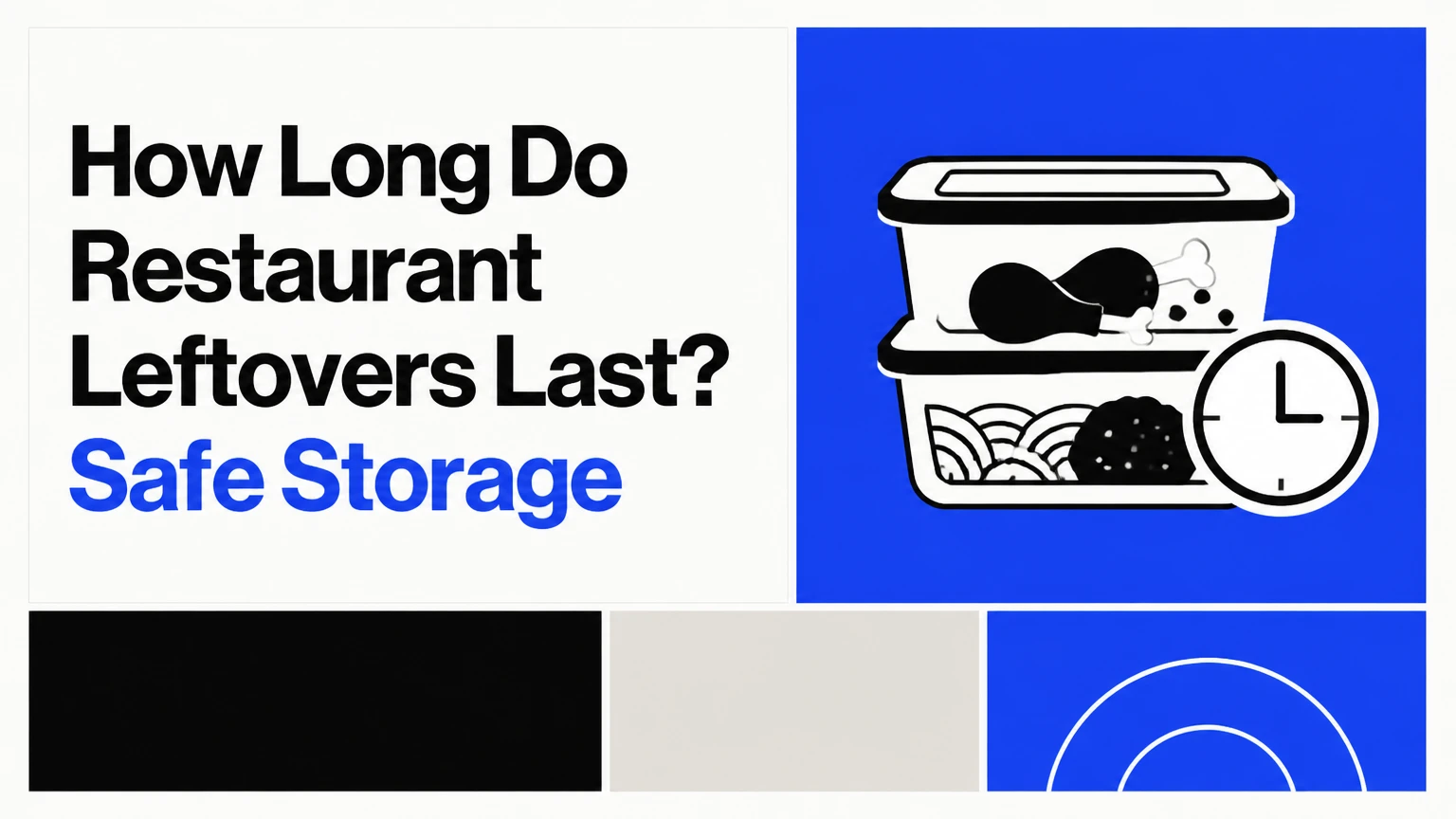
Restaurant leftovers last 3 to 4 days in a refrigerator at 40°F (4°C) or colder, provided they were refrigerated within 2 hours of serving or pickup. If the surrounding temperature exceeded 90°F (32°C), the limit is 1 hour. Food left longer should be discarded, even when it looks and smells normal.
Key Facts at a Glance
The USDA refrigerator limit for most cooked restaurant leftovers is 3-4 days at 40°F (4°C) or colder.
Refrigerate takeout within 2 hours, or within 1 hour when the temperature is above 90°F (32°C).
Reheat leftovers to 165°F (74°C), checking the thickest part with a food thermometer.
Freezing stops bacterial growth, but it does not reverse unsafe time spent warm.
Smell, taste, and appearance cannot reliably detect pathogens such as Listeria monocytogenes or Salmonella.
Day 5 is outside the USDA recommended refrigerator window, so the safest decision is disposal.
How Long Do Restaurant Leftovers Last in the Fridge?
Restaurant leftovers last 3-4 days when promptly chilled and continuously stored at 40°F (4°C) or below. The count begins with the time food was left warm at the restaurant, on the table, during transport, and at home, although consumers usually can verify only the period after pickup or service.
The USDA states that cooked leftovers should be used within 3-4 days or frozen. That recommendation applies to many cooked foods, including meat, poultry, seafood, soups, stews, casseroles, rice, and pasta. Restaurant food does not automatically receive a longer window because a commercial kitchen prepared it.
Restaurants can add unknown exposure before serving. Ingredients may have been prepared earlier, held on a steam table, portioned, transported, or exposed during service. The 3-4 day period is therefore a maximum recommended refrigerator window, not a guarantee that every dish remains safe for four complete days.
Does the four-day rule apply to every dish?
The 3-4 day rule is the general limit for cooked leftovers, but delicate ingredients can lose quality sooner and some raw foods require a different decision. Cooked shrimp may become unpleasant after two days even when the general safety window has not expired, while a sealed portion of braised beef may retain acceptable quality for four days.
Raw oysters, sashimi, tartare, and other uncooked animal foods should not be treated like cooked leftovers. Follow the restaurant’s handling advice and consume them promptly. Freezing raw fish also has parasite-control requirements that depend on species, preparation, and freezing conditions.
Food safety and food quality are separate measurements. A fried chicken coating may become soggy overnight, but texture loss does not create the same risk as leaving chicken unrefrigerated for five hours.
What Happens When Leftovers Sit Out?
Restaurant leftovers become unsafe when they remain between 40°F and 140°F (4°C and 60°C) long enough for bacteria to multiply. Refrigeration slows growth, but it does not sterilize food, and reheating cannot reliably remove toxins produced during prolonged warm storage.
The FDA Food Code describes 41°F-135°F as the temperature range requiring strict time and temperature control in commercial food service. Consumer guidance commonly rounds the danger zone to 40°F-140°F. The difference between those reference points does not change the practical rule: chill perishable food quickly.
The two-hour limit includes all unrefrigerated time. For example, a curry that spends 45 minutes on the restaurant table, 35 minutes in a delivery car, and 50 minutes on the kitchen counter has used 130 minutes of its allowance before refrigeration.
Bacillus cereus is particularly relevant to cooked rice and pasta. Its spores can survive cooking, and slow cooling can allow toxin production. Reheating may kill some bacteria but may not neutralize every toxin already formed.
How should you calculate the time limit?
Use the total warm-time method:
- Record when the food was served, collected, or delivered.
- Add time at the table, in a bag, in a vehicle, and on the counter.
- Refrigerate within 2 hours, or within 1 hour above 90°F.
- Discard food that exceeds the limit instead of trying to cool or reheat it.
- Label the container with the refrigeration date.
A typical delivery order reaches a home within 30-75 minutes, but traffic, multiple stops, and insulated bags make the actual temperature unknown. An insulated delivery bag delays cooling and does not replace refrigeration.
| Situation | Maximum unrefrigerated time | Safe action |
|---|---|---|
| Indoor meal, room below 90°F | 2 hours | Refrigerate promptly |
| Outdoor meal above 90°F | 1 hour | Refrigerate or discard |
| Takeout in a warm car | 1 hour above 90°F | Use a thermometer if possible, otherwise take the conservative option |
| Food left overnight | More than 8 hours | Discard |
| Food held on active ice | Until food remains 40°F or colder | Transfer to a refrigerator |
Can a cold car keep takeout safe?
A cold car is not a dependable refrigerator. Food is safe during transport only when its internal temperature stays at 40°F (4°C) or below, which requires active cold storage such as ice packs and an insulated cooler.
A vehicle at 50°F outside can become substantially warmer in sunlight, and a closed takeout container can retain heat. “It was cold outside” does not prove that chicken, rice, seafood, or cream sauce stayed below the safe threshold. After three hours in an ordinary vehicle, discard perishable leftovers.
How Should You Store Restaurant Takeout?
Store restaurant takeout in shallow, covered portions within 2 hours, using a refrigerator set at 40°F (4°C) or colder. Divide deep containers, keep the refrigerator door closed, and mark the date so the 3-4 day window remains visible.
Modern refrigerators can cool modest amounts of hot food safely when food is divided into shallow containers. The U.S. Department of Agriculture recommends placing leftovers in shallow containers to promote rapid cooling rather than waiting for food to reach room temperature.
Step 1: Separate hot and cold components
Remove salad, raw vegetables, sour cream, guacamole, pickles, and crisp toppings from hot foods. Place cold components in separate covered containers, because steam from hot food causes condensation, wilting, and faster quality loss.
Separate sauces when practical. A container of rice covered with curry cools more slowly than two smaller containers holding the components apart.
Step 2: Divide large portions
Transfer soup, stew, rice, pasta, or casserole into shallow containers no deeper than about 2-3 inches. Leave room for the lid without compressing the food, and avoid stacking containers until the food has cooled.
A large restaurant tub can remain warm in the center long after its surface feels cool. Portioning reduces the distance heat must travel before reaching the refrigerator’s cold air.
Step 3: Cover, label, and refrigerate
Use a clean, food-safe container with a secure lid. Write the date and, when useful, the dish name on masking tape. Refrigerate food on a middle shelf rather than relying on the warmer, frequently opened door.
Keep the refrigerator at 40°F or below. A built-in dial shows a setting, not the actual food temperature, so an inexpensive appliance thermometer gives a more meaningful check.
| Storage choice | Typical cost | Main benefit | Important limitation |
|---|---|---|---|
| Original takeout box | $0 | Immediate convenience | Lids may leak, crack, or vent heat poorly |
| Reusable plastic container | $5-$15 per set | Lightweight and stackable | Some plastics stain or warp with hot food |
| Glass container | $15-$40 per set | Stable, washable, microwave-compatible when labeled | Heavy and breakable |
| Insulated cooler with ice packs | $20-$60 | Maintains cold transport | Requires enough ice and space |
| Vacuum sealer | $50-$130 | Reduces freezer air exposure | Does not extend an unsafe refrigerator window |
Vacuum sealing is not a substitute for rapid chilling. Low-oxygen packaging can support growth of certain organisms when food is mishandled, so vacuum-sealed restaurant food should be chilled or frozen promptly and kept cold.
Which Restaurant Foods Last Longest?
Cooked meat, poultry, seafood, rice, pasta, soups, and sauces generally share the USDA 3-4 day refrigerator limit when handled correctly. Delicate seafood, raw preparations, dressed salads, and dairy-based toppings often lose quality earlier or require separate handling.
The table below gives practical decisions, not permission to exceed the overall time-temperature rules. The shortest applicable limit controls when a dish contains several ingredients.
| Food type | Refrigerator safety window | Typical best-quality window | Storage detail |
|---|---|---|---|
| Cooked chicken or turkey | 3-4 days | 2-3 days | Refrigerate in sliced or shallow portions |
| Cooked beef, pork, or lamb | 3-4 days | 3-4 days | Keep gravy separate when possible |
| Ground-meat dishes | 3-4 days | 2-3 days | Cool promptly because pieces retain heat |
| Cooked fish or shellfish | 3-4 days | 1-2 days | Use a sealed container to limit odor and oxidation |
| Rice, noodles, or pasta | 3-4 days | 2-3 days | Rapid cooling matters because of Bacillus cereus |
| Soup, stew, or curry | 3-4 days | 3-4 days | Divide large volumes before chilling |
| Dressed leafy salad | 1-2 days for quality | Same day to 1 day | Greens wilt and toppings soften |
| Creamy sauce or custard | 3-4 days if chilled correctly | 1-3 days | Discard if warm-time limits were exceeded |
| Sushi, sashimi, or tartare | Same day is the conservative choice | Same day | Raw seafood needs separate risk assessment |
| Pizza or fried food | 3-4 days for safety | 1-2 days | Reheat for texture in an oven or air fryer |
How long does leftover rice last?
Cooked restaurant rice lasts up to 3-4 days in a refrigerator at 40°F or below, but only when it was cooled promptly. Rice left warm for several hours should be discarded rather than rescued by refrigeration or reheating.
Bacillus cereus spores can survive cooking. The risk comes from the combination of surviving spores, warm holding, and time. Spread rice into shallow portions, refrigerate it quickly, and reheat only the amount needed for one meal.
How long does leftover seafood last?
Cooked seafood follows the general 3-4 day refrigerated leftover guidance, but its quality often declines after 1-2 days. Shellfish, oily fish, and seafood mixed with mayonnaise or cream deserve extra attention because odor and texture change quickly.
Do not use smell as a safety clearance. If cooked seafood exceeded the two-hour limit, discard it regardless of whether it smells fresh.
Are pizza and fried foods safe after four days?
Pizza and fried foods can remain within the general 3-4 day safety window if chilled within 2 hours and stored at 40°F or below. Their crust or coating may become stale, soggy, or tough well before the safety window ends.
Reheat pizza in an oven or air fryer at approximately 350°F (175°C) until the center reaches 165°F. A microwave heats quickly but can leave a cold center and soften crisp coatings.
Should You Refrigerate or Freeze Leftovers?
Refrigerate restaurant leftovers when you will eat them within 3-4 days; freeze them sooner when the meal will not be eaten during that period. Freezing at 0°F (-18°C) keeps food safe for an indefinite period while frozen, although flavor and texture gradually decline.
Freezing does not reset the clock. Food that sat on a counter for four hours remains unsafe after freezing because the hazardous warm exposure happened before the temperature dropped.
| Food | Practical freezer quality window | Recommended package | Main quality risk |
|---|---|---|---|
| Cooked chicken or meat | 2-3 months | Airtight freezer container | Dryness and freezer burn |
| Fish or shellfish | 1-2 months | Double-wrapped, airtight package | Oxidized flavor and soft texture |
| Soup or stew | 2-3 months | Rigid container with headspace | Expansion and separation |
| Rice or pasta | 1-2 months | Flat freezer bag or shallow container | Clumping and drying |
| Pizza or fried food | 1-2 months | Foil plus freezer bag | Soggy coating after thawing |
Freeze food in meal-size portions, remove excess air, and label the date. Thaw in the refrigerator, in cold water changed regularly, or in a microwave followed by immediate cooking. Do not thaw perishable food on the counter.
How Do You Reheat Restaurant Leftovers Safely?
Reheat restaurant leftovers to an internal temperature of 165°F (74°C), measured in the thickest or coldest section. Stir liquid or dense food during microwave heating, allow standing time, and reheat only the portion you plan to eat.
The USDA recommends 165°F for reheating leftovers. A food thermometer is more reliable than a steaming appearance because microwaves create cold spots and thick foods heat unevenly.
Microwave method
Place food in a microwave-safe container and cover it loosely to retain moisture. Heat in short intervals, stir or rotate halfway through, check several locations, and let the food stand briefly before taking the final temperature.
Do not microwave takeout packaging unless the package specifically states that it is microwave-safe. Foam containers can deform, and some plastic containers are intended for cold storage only.
Oven or stovetop method
Use an oven for pizza, roasted meats, and fried foods when texture matters. Heat at about 350°F (175°C), cover foods that dry easily, and verify that the thickest portion reaches 165°F.
For soups and sauces, reheat on the stovetop while stirring. Boiling the surface does not prove that a dense center has reached a safe temperature.
Repeated reheating increases handling and temperature exposure. Divide leftovers before storage, then heat one serving at a time.
Can You Trust Smell, Appearance, or Taste?
You cannot prove that restaurant leftovers are safe by smelling, looking at, or tasting them. Pathogens including Listeria monocytogenes, Salmonella, and some strains of Escherichia coli may be present without changing flavor, odor, or appearance.
Spoilage organisms can make food sour, slimy, moldy, rancid, or unpleasant. Those signs mean discard the food, but their absence does not establish safety. The calendar and temperature history provide stronger evidence than the senses.
Never taste food to decide whether it is safe. A small sample can expose a person to pathogens or toxins, and cooking afterward may not remove every hazard created during poor storage.
What should you do on day five?
Discard refrigerated restaurant leftovers on day 5, even when the food looks normal. The USDA 3-4 day recommendation has been exceeded, and visual inspection cannot close that gap.
When the storage date is uncertain, use the earlier plausible date. A container marked “Tuesday” should be treated as Tuesday food, not shifted to Wednesday because the refrigerator is cold.
What If the Refrigerator Loses Power?
A closed refrigerator generally keeps food cold for about 4 hours during a power outage, according to the USDA. A full freezer stays cold longer, approximately 48 hours when full or 24 hours when half full, provided the door remains closed.
Use a refrigerator thermometer if available. Perishable food is generally safe when it remains at 40°F or below, but discard food that has been above 40°F for 2 hours or more, or for 1 hour when the surrounding temperature exceeds 90°F.
Do not use taste to evaluate outage food. When in doubt, throw it out.
Are Restaurant Leftovers Safe for Pregnant or High-Risk Diners?
Pregnant people, adults aged 65 and older, children under 5, and people with weakened immune systems face a higher risk of severe foodborne illness. The FDA and CDC recommend stricter attention to temperature control and avoidance of certain raw or undercooked foods, although the standard household leftover window is not formally reduced to one-half.
For these diners, use freshly refrigerated food early in the 3-4 day window, avoid uncertain delivery or buffet histories, and reheat leftovers to 165°F. Pregnant diners should avoid raw fish preparations and unpasteurized ingredients unless a qualified health authority confirms they are safe.
A practical rule is to freeze suitable leftovers on the first day when they will not be eaten soon. That choice improves quality and reduces reliance on an uncertain fourth-day decision.
Common Restaurant Leftover Mistakes
- Waiting for food to cool on the counter: Divide hot food and refrigerate it promptly. The risk comes from prolonged warm exposure, not from a properly functioning refrigerator receiving a modest portion.
- Leaving food in a deep container: Transfer soup, rice, and casseroles into shallow portions. The center of a large container cools slowly.
- Counting only refrigerator days: Add table, delivery, car, and counter time. The two-hour rule covers the complete unrefrigerated period.
- Heating the entire container repeatedly: Reheat one serving and keep the rest cold. Repeated temperature cycles increase handling and quality loss.
- Treating an insulated bag as a refrigerator: Use ice packs and check the food temperature. Insulation slows warming but does not guarantee 40°F or below.
- Extending the deadline because food smells fresh: Discard day-five food or food with an unknown history. Sensory checks cannot detect every pathogen.
An expert rule of thumb is to treat uncertain time as elapsed time. If the restaurant, delivery driver, and household cannot establish when the food left temperature control, conservative disposal is safer than reconstructing an optimistic timeline.
Frequently Asked Questions
Can I eat restaurant leftovers after 3 days?
Yes, restaurant leftovers can generally be eaten on day 3 when they were refrigerated within 2 hours and held at 40°F or below. Reheat the portion to 165°F and discard it if the food spent too long warm, has an uncertain history, or contains raw ingredients that require same-day use.
How long can takeout stay in its container?
Takeout can remain in its container for up to 2 hours below 90°F, or 1 hour above 90°F, before refrigeration. The original container is acceptable for short storage if it is covered and food cools adequately, but shallow containers are safer for deep portions.
Can I freeze leftovers on the fourth day?
You can freeze properly handled leftovers on the fourth day, but quality will usually be better when freezing occurs on day 1 or day 2. Freezing does not make food safe if the meal previously exceeded the two-hour unrefrigerated limit.
Is food safe if I reheat it twice?
Food may be reheated more than once only when each cycle is controlled, but repeated reheating increases temperature abuse and quality loss. Store leftovers in portions, heat only what you will eat, and verify 165°F each time rather than repeatedly warming the full container.
Can I donate restaurant leftovers?
Do not assume a food bank can accept restaurant leftovers. Donation rules vary by location, and organizations may reject opened, temperature-uncertain, or previously served food. Contact the receiving organization before donating, and keep eligible food at 40°F or below during transport.
What is the safest decision when I am unsure?
Discard restaurant leftovers when the refrigeration time, warm exposure, or refrigerator temperature is unknown. The cost of replacing one meal is lower than the potential cost of foodborne illness, and appearance or smell cannot reliably resolve an uncertain safety history.
The Bottom Line
Restaurant leftovers last 3-4 days in the refrigerator at 40°F (4°C) or colder when refrigerated within 2 hours, or within 1 hour in temperatures above 90°F. Divide large portions, label the storage date, freeze food you will not eat within that window, and reheat servings to 165°F. For how long do restaurant leftovers last, the safest answer depends first on time and temperature, then on the dish.