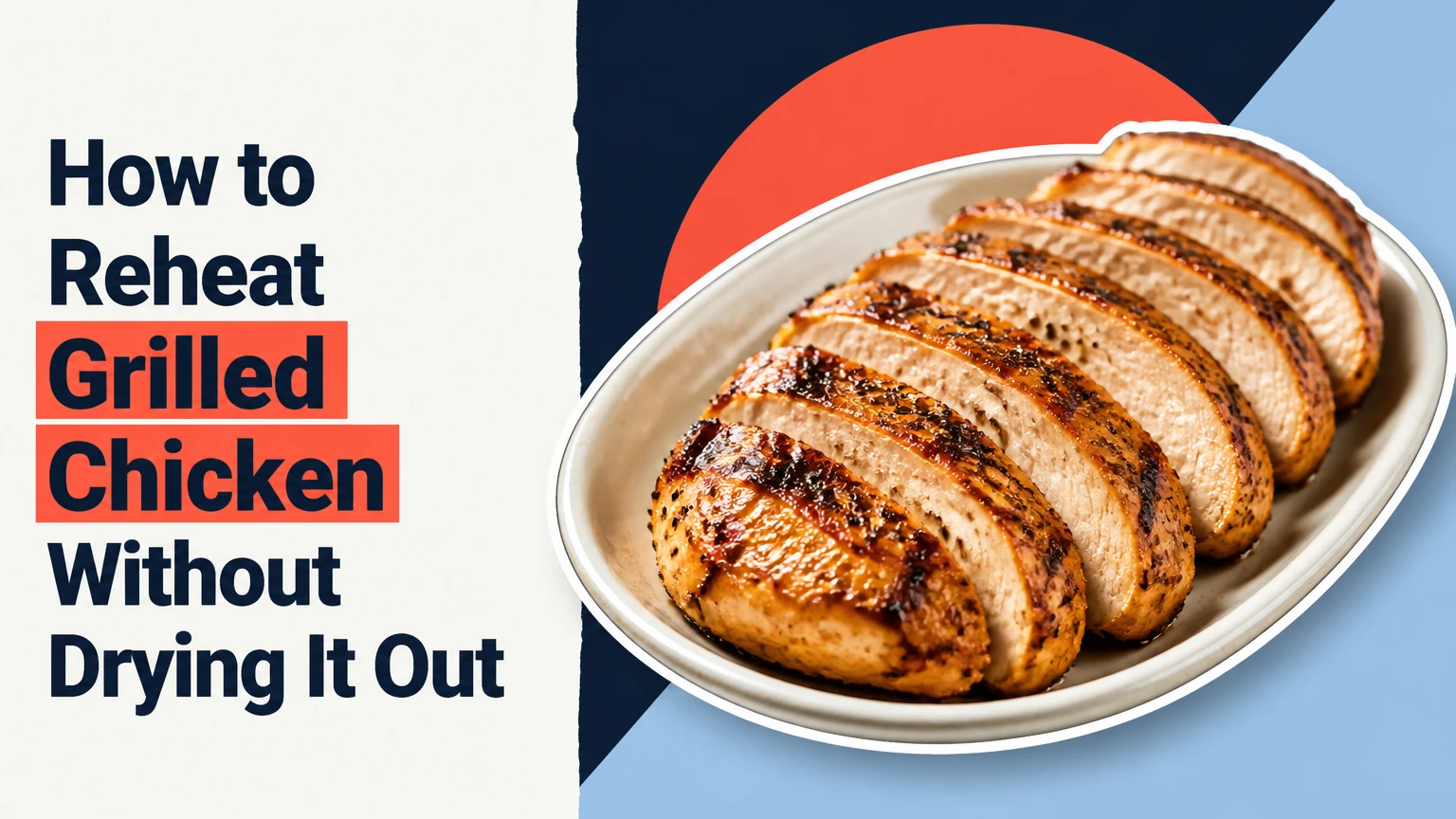
To reheat grilled chicken without drying it out, warm it gently with a small amount of broth, water, or sauce, then stop as soon as the center reaches 165°F (74°C). Use a covered skillet for sliced chicken, a microwave at 50-70% power for one serving, or a covered 325°F oven for larger pieces.
Key Facts at a Glance
Reheated grilled chicken should reach 165°F (74°C), measured in the thickest part with a food thermometer.
A covered skillet with 1-2 tablespoons of broth usually reheats sliced chicken in 3-5 minutes.
A microwave at 50-70% power reduces surface overheating compared with full power.
A covered 325°F oven best preserves moisture in bone-in pieces and batches of chicken.
Refrigerated cooked chicken is generally usable for 3-4 days, according to USDA FoodKeeper guidance.
Chicken left above 40°F (4°C) for more than 2 hours should be discarded, or after 1 hour when the surrounding temperature exceeds 90°F (32°C).
What Is the Best Way to Reheat Grilled Chicken?
The best reheating method depends on the chicken’s cut, quantity, and desired surface texture. A covered skillet is the best everyday choice for sliced breast, a microwave is fastest for one serving, and a covered oven produces the most even results for bone-in pieces or several portions.
Grilled chicken has already lost some moisture during its first cooking cycle. A second long exposure to high heat causes muscle proteins to contract further, which pushes water toward the surface and eventually out of the meat. Lean chicken breast shows this change faster than thigh meat because breast meat contains less intramuscular fat.
Moisture management matters more than adding heat. Covering the chicken traps steam, while broth or sauce replaces some of the liquid that escapes during storage. The goal is to heat the center quickly without holding the exterior at high temperature for longer than necessary.
How do heat and moisture affect grilled chicken?
Heat makes chicken proteins tighten, while an uncovered cooking environment allows surface moisture to evaporate. A covered pan or dish limits evaporation, but too much liquid can soften grill marks and produce a boiled texture rather than a grilled one.
A practical rule is to use 1-2 tablespoons of liquid per serving, not enough to submerge the meat. Slice thick breasts before reheating when speed matters, because thinner pieces reach the target temperature with less exposure to heat.
Which Reheating Method Fits Your Chicken?
The right method is determined by serving size and texture priority. Choose the skillet for sliced meat, the oven for whole or bone-in pieces, the microwave for speed, and the air fryer when crisp skin or breading matters more than maximum moisture retention.
| Method | Best chicken type | Heat setting | Typical time | Typical energy cost |
|---|---|---|---|---|
| Covered skillet | Sliced breast, shredded chicken | Medium-low | 3-8 minutes | $0.03-$0.10 |
| Microwave | One boneless serving | 50-70% power | 1.5-3 minutes | $0.01-$0.04 |
| Covered oven | Bone-in pieces, 3-8 servings | 325°F-350°F | 15-25 minutes | $0.15-$0.30 |
| Air fryer | Skin-on thighs, wings, breaded pieces | 350°F-375°F | 3-8 minutes | $0.04-$0.10 |
| Sous vide | Vacuum-sealed meal-prep portions | 140°F-165°F | 30-60 minutes | $0.05-$0.20 |
Energy figures are typical household estimates, not fixed prices. Appliance wattage, electricity rates, preheating time, and batch size change the result.
Which method preserves moisture best?
A covered oven or water-bath method generally preserves the most moisture because the chicken warms gradually in a humid environment. The microwave can also retain moisture when covered and run below full power, but uneven heating makes it easier to overheat thin edges.
Air fryers are poor choices for already-cooked, skinless chicken breast when juiciness is the main goal. Their circulating dry heat quickly improves the exterior while removing surface moisture from lean meat.
Before You Start
Time: 2 minutes of preparation, plus 2-25 minutes of heating
Difficulty: Easy
Cost: Approximately $0.01-$0.30 in appliance energy, excluding ingredients
Tools: Digital food thermometer, microwave-safe cover or lid, skillet or baking dish, tongs
Ingredients: 1-2 tablespoons broth, water, gravy, or sauce per serving; optional 1 teaspoon oil or butter
Prerequisite: Chicken must have been chilled promptly and stored safely
A digital thermometer is the most useful tool because time alone cannot account for thickness, bone density, starting temperature, or appliance power. Insert the probe sideways into the thickest section, avoiding the bone, and check more than one piece when reheating a batch.
Do not deliberately leave chicken at room temperature for long periods. A 10-minute rest may reduce the temperature gap, but it is unnecessary for safety and should count toward the USDA two-hour limit for perishable food.
Step 1: Reheat Sliced Chicken in a Covered Skillet
A covered skillet reheats sliced or shredded grilled chicken in about 3-5 minutes while preserving a grilled flavor. Use medium-low heat, 1-2 tablespoons of broth per serving, and a lid; higher heat browns the outside before the middle becomes warm.
- Slice thick chicken breasts into pieces about 1/2 inch thick, or separate shredded chicken into loose strands.
- Place a skillet over medium-low heat and add 1 teaspoon of oil, butter, or 1-2 tablespoons of broth.
- Arrange the chicken in a single layer. Add another teaspoon of liquid if the meat looks dry.
- Cover the skillet and heat for 1-2 minutes.
- Turn or stir the pieces, cover again, and continue for 1-3 minutes.
- Check the thickest piece with a thermometer. Stop at 165°F.
You will know the skillet method worked when the chicken is hot in the center, flexible rather than stiff, and lightly glossy from the trapped moisture. The common mistake is using medium-high heat to shorten the process. If browning starts before the interior is warm, lower the burner and add 1 tablespoon of broth.
For a sauce-based meal, add barbecue sauce, curry sauce, gravy, or salsa during the final minute. Sauce protects small pieces from direct pan heat, but acidic sauces can mask a stale odor, so inspect the chicken before adding them.
Step 2: Reheat One Serving in the Microwave
The microwave is the fastest method for one serving, usually taking 1.5-3 minutes at 50-70% power. Covering the chicken and heating in 30-second intervals prevents the outer slices from becoming rubbery while the center remains cold.
- Cut thick chicken into evenly sized slices or cubes.
- Spread the pieces in one layer on a microwave-safe plate, with thicker pieces near the outer edge.
- Sprinkle 1/2-1 teaspoon of water or broth over each serving.
- Cover the plate with a vented microwave lid or an inverted microwave-safe plate.
- Set the microwave to 50-70% power.
- Heat for 30 seconds, rearrange the pieces, and repeat until hot.
- Let the chicken stand covered for 30-60 seconds, then verify 165°F.
You will know the microwave method worked when the thickest piece is steaming or reaches 165°F without hard, curled edges. The common mistake is using 100% power for several minutes. Full power concentrates energy at the edges and often leaves the center cooler.
Microwave ovens produce uneven fields, so rotating the plate and rearranging pieces matters. A damp paper towel can help with a small boneless serving, but a microwave-safe lid is more reliable because it traps steam without placing paper directly against hot food for an extended period.
Step 3: Reheat Bone-In Chicken in the Oven
A covered 325°F oven reheats bone-in thighs, drumsticks, and whole breasts most evenly, generally within 15-25 minutes. Add a shallow layer of liquid to the dish, seal it tightly with foil, and uncover briefly only when crisp skin matters.
- Heat the oven to 325°F (163°C).
- Put the chicken in a baking dish with the thicker pieces toward the center.
- Add 2 tablespoons of broth or water per serving to the bottom of the dish.
- Brush skin with a thin layer of oil if you want better browning.
- Cover the dish tightly with foil.
- Bake for 15 minutes, then begin checking the thickest piece.
- Remove the foil for the final 2-4 minutes if the skin needs to crisp.
- Stop when the meat reaches 165°F.
You will know the oven method worked when the meat is hot beside the bone and the skin has regained some surface texture. The common mistake is baking uncovered from the beginning. Uncovered chicken loses surface moisture before the center has warmed.
A shallow dish heats faster than a deep casserole. Place pieces with space between them, because stacked chicken creates cold pockets and increases the time needed for the center to reach a safe temperature.
Step 4: Reheat Skin-On or Breaded Chicken in an Air Fryer
An air fryer reheats skin-on chicken and breaded pieces in 3-8 minutes at 350°F-375°F. The method restores surface crispness efficiently, but skinless breast needs a light oil coating and close monitoring because circulating air dries it quickly.
- Preheat the air fryer to 350°F (177°C).
- Brush skinless pieces with a thin film of oil, or spray the surface lightly.
- Place chicken in a single layer with space around each piece.
- Heat for 3 minutes for sliced meat, or 5-8 minutes for thick bone-in pieces.
- Turn the chicken halfway through the cycle.
- Check the thickest section with a thermometer before serving.
You will know the air fryer method worked when the exterior is crisp and the center reaches 165°F without tough edges. The common mistake is using 400°F for leftovers. That temperature can burn breading or skin before the meat warms through.
Air fryers vary substantially in basket design and wattage. Begin checking two minutes earlier than the stated range for thin cutlets, wings, or small pieces.
How Long Should You Reheat Different Chicken Cuts?
Reheating time depends more on thickness and bone structure than on weight alone. Thin slices can be ready in under 3 minutes, while a cold bone-in breast may need 20 minutes in an oven even when a smaller boneless piece is hot in 8 minutes.
| Chicken form | Skillet, covered | Microwave, 50-70% | Oven, covered at 325°F | Air fryer |
|---|---|---|---|---|
| 1/2-inch slices, 4 ounces | 3-5 minutes | 1.5-2.5 minutes | 10-15 minutes | 3-4 minutes |
| Boneless breast, whole, 6-8 ounces | 6-8 minutes | 3-4 minutes | 15-20 minutes | 5-7 minutes |
| Bone-in thigh or drumstick | 7-10 minutes | 3-5 minutes | 18-25 minutes | 5-8 minutes |
| Wings, 6 pieces | 5-7 minutes | 2-3 minutes | 15-20 minutes | 4-6 minutes |
| Shredded chicken, 1 cup | 3-4 minutes | 1.5-2 minutes | 10-15 minutes | 3-4 minutes |
These are typical starting ranges for refrigerated chicken, not guarantees. Frozen or partially frozen chicken requires longer heating and presents a greater uneven-temperature risk.
How Do You Reheat a Large Batch?
A covered oven is the most practical choice for more than four servings because it heats several pieces together with less handling. Arrange chicken in one layer, add 1/2 cup of broth for a family-sized dish, cover tightly, and check multiple pieces rather than relying on the outer portion.
For 2-4 servings, a covered skillet can work if the pieces are sliced and the pan is wide enough. For 5 or more servings, divide the chicken between two dishes or use a larger oven-safe pan. Crowding slows heating and creates a mixture of dry edges and cool centers.
A large batch should rest for 3 minutes after removal from the oven. That pause allows heat to equalize, but it does not replace a thermometer check. Verify the thickest pieces near the center of the pan and any pieces with bones.
How Do You Reheat Frozen Grilled Chicken?
Thaw frozen grilled chicken overnight in a refrigerator when possible, then use the skillet, microwave, or oven instructions for chilled chicken. If reheating directly from frozen, use a covered 325°F oven with broth and allow approximately 30-45 minutes, checking the center frequently.
Microwave thawing is acceptable only when the chicken will be heated immediately afterward. Use the defrost setting in short intervals, separate pieces as they loosen, and then switch to 50-70% power. Do not thaw chicken on the counter, because the exterior can enter the bacterial growth range while the interior remains frozen.
Frozen chicken often loses more texture than refrigerated leftovers because ice crystals damage muscle structure. Sauce, gravy, or a small amount of broth can make the result more palatable, especially for sliced breast meat.
What Temperature Makes Reheated Chicken Safe?
Reheated grilled chicken should reach 165°F (74°C), the internal temperature recommended by the USDA for poultry and leftovers. Measure the thickest part with a food thermometer, then check a second piece when several portions are being reheated.
The USDA Food Safety and Inspection Service also advises refrigerating leftovers within two hours, or within one hour when ambient temperatures exceed 90°F (32°C). Refrigerated cooked chicken should generally be eaten within 3-4 days under USDA FoodKeeper guidance.
| Safety question | Practical threshold | Action |
|---|---|---|
| Safe reheating target | 165°F (74°C) | Check thickest section |
| Maximum room-temperature time | 2 hours | Refrigerate or discard |
| Maximum time above 90°F ambient | 1 hour | Refrigerate or discard |
| Typical refrigerator storage | 3-4 days | Reheat once for best quality |
| Freezer storage for quality | 2-6 months | Wrap airtight and label |
The USDA’s consumer guidance includes the phrase, “When in doubt, throw it out.” That advice applies when storage time, refrigeration history, or contamination exposure is unknown. Reheating can kill many bacteria, but it cannot reliably reverse spoilage toxins or restore quality.
Sous vide requires extra care. A 140°F-145°F water bath may warm already-cooked chicken gently, but the common household safety benchmark remains 165°F unless a validated time and temperature process is being followed. Do not treat a low-temperature bath as automatically safe.
Common Mistakes and How to Fix Them
| Mistake | Result | Immediate fix |
|---|---|---|
| Heating uncovered | Dry edges and tough breast | Add 1-2 tablespoons broth and cover |
| Using full microwave power | Hot edges, cold center | Switch to 50-70% power and use 30-second bursts |
| Overcrowding a pan | Uneven warming | Separate pieces or divide the batch |
| Starting with high skillet heat | Burned surface | Lower to medium-low and add broth |
| Air-frying skinless breast too long | Dry, stringy meat | Stop at 165°F and add sauce |
| Reheating by time only | Unsafe cold center | Check the thickest section with a thermometer |
Can you fix chicken that is already dry?
Dry grilled chicken is best recovered with moisture and a flavorful coating, not with more heat. Slice or shred the meat, then combine it with 1-2 tablespoons of warm broth, gravy, salsa, barbecue sauce, or butter-enriched stock per cup of chicken.
For very dry breast, mince the meat into tacos, soup, fried rice, enchiladas, or chicken salad. Warm the sauce separately and fold in the chicken at the end, because prolonged simmering tightens the fibers further.
Do not expect added liquid to restore the original texture completely. Moisture can improve lubrication and flavor, but severe overcooking permanently changes the protein structure.
How Should You Choose for Different Situations?
Use the microwave for a quick office lunch, the skillet for meal-prepped slices, the oven for a family batch, and the air fryer for crisp skin. No single appliance is best for every cut because moisture retention and surface texture require different heat patterns.
- One boneless serving: Microwave at 50-70% power, covered, for 1.5-3 minutes.
- Daily meal-prep breast: Slice cold chicken and use a covered skillet with broth for 3-5 minutes.
- Bone-in thighs or drumsticks: Use a covered 325°F oven for 18-25 minutes.
- Wings or skin-on pieces: Use a 350°F-375°F air fryer for 4-8 minutes.
- Large family batch: Cover a baking dish and heat at 325°F until several pieces reach 165°F.
- Chicken already in sauce: Reheat gently in a covered skillet or saucepan over low heat.
Can You Reheat Grilled Chicken More Than Once?
You can technically reheat grilled chicken more than once, but reheating only the portion you plan to eat produces safer, juicier results. Each heating and cooling cycle increases moisture loss and creates additional opportunities for the food to spend time in unsafe temperature ranges.
Divide leftovers into shallow containers before refrigeration. Reheat one portion to 165°F, keep the remaining portions cold, and discard food that has been repeatedly warmed and returned to the refrigerator.
Frequently Asked Questions
Can you reheat grilled chicken in its marinade?
Reheat grilled chicken in marinade only if the marinade was cooked after contacting raw chicken. Uncooked used marinade can contain pathogens, so boil it thoroughly before using it as a sauce. A fresh sauce, broth, or gravy is safer and usually gives cleaner flavor.
Should you slice chicken before reheating it?
Slice boneless chicken before reheating when speed and even temperature matter. Pieces around 1/2 inch thick warm quickly in a skillet or microwave, while whole breasts retain more moisture in the oven. Cut bone-in chicken only after reheating because the bone helps protect the meat.
Why does reheated chicken taste strange?
A stale, sour, sulfur-like, or unusually sweet odor can indicate spoilage, especially when the chicken has been refrigerated longer than 3-4 days. Charred grill flavor, dried edges, or a slightly smoky smell usually indicates overcooking rather than spoilage, but uncertain food should be discarded.
Can you reheat grilled chicken and rice together?
You can reheat chicken and rice together if both were refrigerated promptly and kept for no more than 3-4 days. Spread the mixture in a shallow dish, add a tablespoon of water or broth, cover, stir halfway through, and confirm the chicken reaches 165°F.
Is reheated grilled chicken safe when it is not steaming?
Visible steam is not a reliable safety test. Reheated grilled chicken is safe when the thickest portion reaches 165°F (74°C), measured with a thermometer. Food can be hot without steaming, while steam can appear before the coldest center has reached the target temperature.
How can you keep chicken moist during meal prep?
Cool cooked chicken promptly, store it airtight, and slice it only when you are ready to reheat. Reheat individual portions with 1-2 tablespoons of broth or sauce under a lid, and stop immediately after the center reaches 165°F rather than holding it at heat.
The Bottom Line
The most reliable way to reheat grilled chicken is to match the appliance to the cut, add a small amount of moisture, cover the chicken, and verify 165°F in the thickest section. Use a skillet for sliced chicken, a microwave for one quick serving, an oven for batches, and an air fryer for crisp skin. The exact keyword is simple, but the successful method depends on controlling both time and moisture.