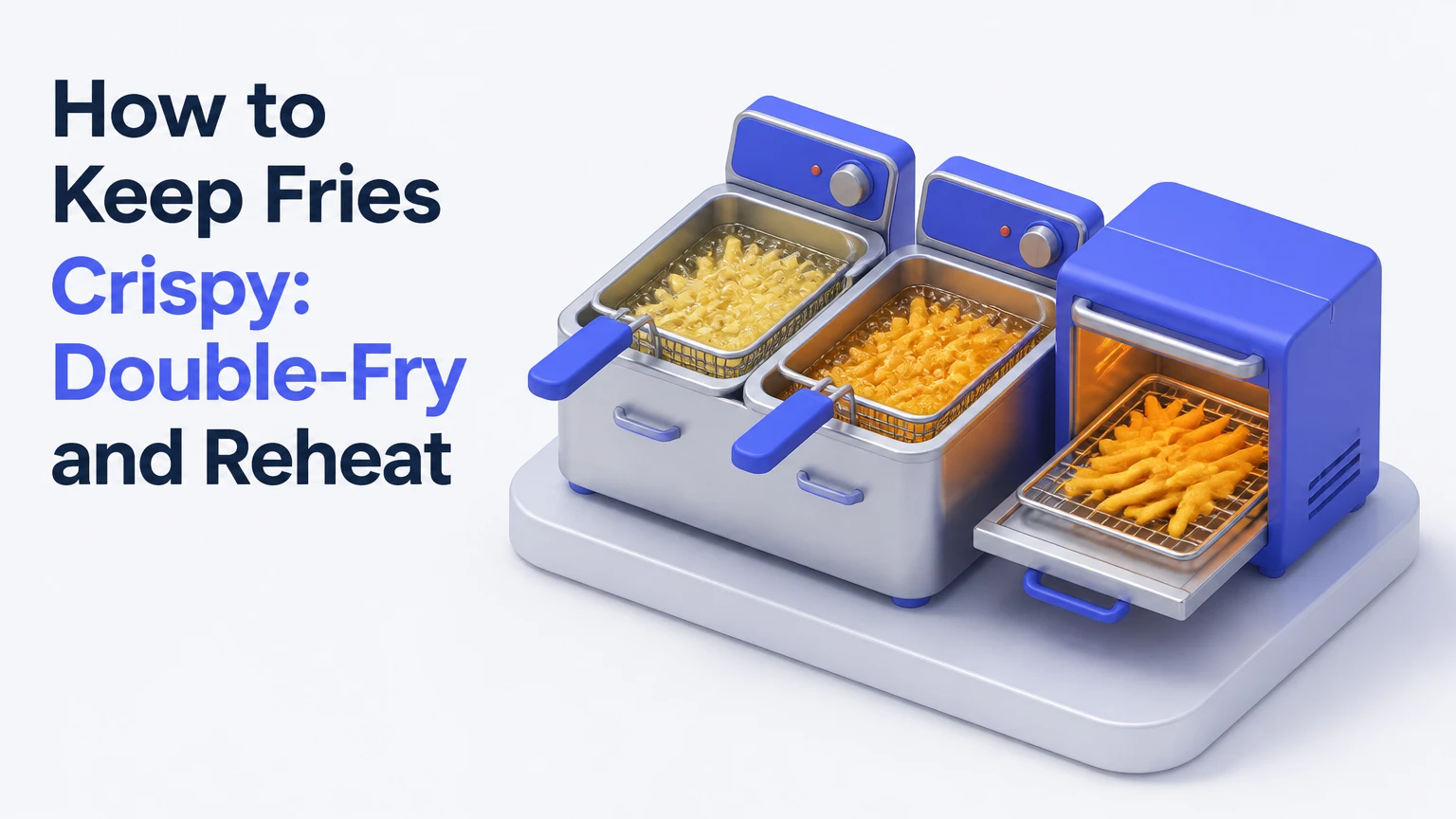
To keep fries crispy, create a dry, rigid potato-starch crust and prevent steam from rewetting it after cooking. For homemade fries, soak and dry uniform potato sticks, fry them first at 325°F, rest or freeze them, then fry at 375-400°F and drain them on a wire rack. Ventilation matters as much as heat.
Key Facts at a Glance
- A wire rack keeps cooked fries crisper than a flat layer of paper towels because steam can escape below the fries.
- Double-frying separates interior cooking from crust browning: use about 325°F for the first fry and 375-400°F for the final fry.
- A single layer prevents trapped steam, while crowded oil lowers temperature and produces greasy, soft fries.
- Air fryers revive refrigerated or takeout fries in approximately 3-6 minutes at 375-400°F.
- Salt fries immediately after draining while the surface still carries a thin film of oil.
- USDA FSIS advises keeping hot food at 140°F or above, while the FDA Food Code uses 135°F for hot holding in food-service settings.
Why Do Fries Lose Their Crispness?
Fries become soft because moisture moves from the hydrated potato center into the dehydrated outer crust, where it softens the starch structure. Cooling accelerates condensation, while stacking, sealed packaging, and deep containers trap the resulting steam against the fried surface.
During frying, potato starch gelatinizes as it absorbs heat and water. The center becomes tender, while the surface loses water rapidly and forms a porous crust. That crust feels crisp because its starch network is rigid and relatively dry.
The crust cannot remain dry indefinitely. As the fry cools, water vapor inside the potato condenses and travels toward the surface through pores and capillaries. A paper bag slows the problem, but a closed plastic container makes it worse by trapping humid air.
Starch retrogradation also changes texture during cooling and storage. The term describes starch molecules gradually reassociating after cooking, although moisture migration is usually the immediate reason hot fries turn limp. Reheating can restore some rigidity, but it cannot fully reverse oil absorption, dehydration, or damage from prolonged storage.
What Makes a Crisp Fry?
A crisp fry has three physical characteristics: a low-moisture outer layer, a porous starch crust, and a tender interior that retains enough water to remain fluffy. Potato variety, cut thickness, cooking temperature, and surface drying control that balance.
Russet Burbank and other russet potatoes generally work well because their high starch content supports a fluffy center and substantial crust. Waxy potatoes hold their shape but usually produce a denser, less floury interior. Yukon Gold fries have a buttery flavor and yellow color, but they tend to be less dramatically crisp than russets.
Cut size changes the ratio of crust to center. Shoestring fries have more surface area and crisp quickly, while steak fries retain more moisture and soften sooner. A 3/8-inch, approximately 9.5-millimeter, cut is a practical middle ground for home frying.
How to Keep Fries Crispy From Scratch
The most reliable method is a soak, optional acidulated blanch, thorough drying, low-temperature first fry, rest or freeze, and high-temperature final fry. A 3/8-inch batch typically takes 30-60 minutes to soak, 4-6 minutes for the first fry, 20-30 minutes to rest, and 3-5 minutes to finish.
Before You Start
| Requirement | Typical specification | Why it matters |
|---|---|---|
| Potatoes | 2 lb russets, 3/8-inch sticks | High starch and even cooking |
| Frying oil | 2-3 quarts neutral oil | Maintains depth and heat recovery |
| Soaking water | 2-3 quarts cold water | Removes loose starch and sugars |
| Optional vinegar | 1-2 tablespoons per quart water | Helps preserve stick structure |
| Equipment | Dutch oven, thermometer, rack, sheet pan | Controls heat and vents steam |
| Total active time | 20-30 minutes | Cutting, drying, frying, seasoning |
| Total elapsed time | 1.5-3 hours | Includes soaking and resting |
| Typical ingredient cost | $5-$12 for four servings | Varies by oil and potato prices |
Use a thermometer that can measure at least 400°F. A heavy Dutch oven or other deep, stable pot reduces temperature swings, but the pot should never be filled more than halfway with oil. Keep a lid nearby for a grease fire, but never pour water onto hot oil.
Step 1: Cut and Soak the Potatoes
Cut peeled or unpeeled russets into sticks between 1/4 and 1/2 inch thick, then soak them in cold water for 30-60 minutes. Rinse until the water becomes less cloudy, especially when using potatoes with a visibly powdery surface.
The soak removes loose surface starch that can make fries stick together and encourages uneven browning. It also removes some reducing sugars from the surface, which helps fries brown less aggressively. Soaking does not remove all sugar from an old or cold-stored potato, so color still requires attention.
Keep the sticks submerged and cold. A soak longer than 2 hours can be useful when refrigerated, but it is not automatically better because extended water exposure can dilute flavor and complicate drying.
Success checkpoint: The water is cloudy at first, and the cut surfaces feel clean rather than heavily sticky after rinsing.
Common mistake: Cutting irregular sticks. Thin pieces burn before thick pieces become tender, so sort out extreme size differences before cooking.
Step 2: Blanch for a Fluffy Interior
For a more controlled result, simmer the drained potato sticks in water for 5-8 minutes, until the edges look slightly softened but the sticks remain intact. Add 1 tablespoon of distilled white vinegar per quart of water when you need extra structural support.
Acid slows the breakdown of pectin, the plant-cell-wall material that helps potatoes hold together. Vinegar is optional, not a universal requirement. Too much acid or too vigorous a boil can give fries a noticeable sharp flavor or cause surface damage when the potato is later fried.
Some cooks skip water blanching and rely on the first oil fry alone. That approach reduces handling and can produce excellent fries, but water blanching provides a larger margin of error for thick cuts and helps establish a soft center before browning.
Success checkpoint: A stick bends slightly without breaking, and a knife meets gentle resistance near the center.
Common mistake: Boiling until the sticks split. Split edges shed potato particles into the oil and create fragile, greasy crusts.
Step 3: Dry the Potato Sticks Completely
Spread the blanched fries on a wire rack over a sheet pan, or arrange them in a single layer on clean towels. Pat them dry and air-dry for 15-20 minutes, turning once if the surfaces remain wet.
Surface water creates violent oil splatter and temporarily consumes energy as it turns into steam. Wet potatoes also reduce the frying oil temperature, which delays crust formation and increases the amount of oil absorbed before the exterior sets.
A fan can shorten the drying period, but do not aim a fan across an uncovered pot of hot oil. Drying is complete when the sticks feel cool and matte, with no visible beads of water.
Success checkpoint: A towel pressed against a potato stick picks up little or no moisture.
Common mistake: Drying only the top layer. Fries touching the tray retain water, so rotate them or use a rack with airflow beneath.
Step 4: Fry at 325°F
Heat the oil to 325°F, or 160°C. Fry a small batch for 4-6 minutes, depending on thickness, until the fries are pale, flexible, and tender inside but not browned.
Do not fill the pot beyond roughly one-quarter to one-third of its oil surface area with raw or blanched potatoes. A crowded batch can drop the oil temperature below 300°F, creating a greasy surface before the crust has time to dehydrate.
The first fry cooks the interior and builds the initial crust. It is not meant to produce the final color. Lift the fries when they look blond and slightly swollen, then drain them briefly on a rack.
Success checkpoint: A cooled test fry bends easily, has no hard raw center, and remains pale.
Common mistake: Chasing crispness during the first fry. Extended cooking at 325°F dries the interior before the final browning stage.
Step 5: Rest or Freeze the First-Fried Fries
Rest the first-fried potatoes on a rack for 20-30 minutes at room temperature, or freeze them in a single layer for at least 1 hour and preferably 2-12 hours. Transfer frozen fries to a sealed freezer bag only after their surfaces are firm.
Freezing is useful because ice formation disrupts some potato cell structure and creates a drier, more open texture during the final fry. Freezing is not mandatory for crispness, and a short rack rest works well when dinner must be served quickly.
Refrigerating first-fried fries overnight is possible, but exposed surfaces can dry and discolor. Cover them loosely after they have cooled, then bring them directly to the final fry. Never place warm fries into a sealed container, because condensation forms inside the package.
Success checkpoint: Rested fries feel dry and firm on the outside; frozen fries are separate rather than fused into a block.
Common mistake: Freezing a wet pile. Clumped, wet fries freeze together and release excess water into hot oil.
Step 6: Fry at 375-400°F
Heat fresh or filtered oil to 375°F for thick fries or 390-400°F for smaller fries. Fry for 3-5 minutes until golden, rigid, and audibly crisp when shaken in the basket.
Frozen fries may cause a sharper temperature drop, so add them gradually and allow the oil to recover before judging the cooking time. The final temperature, not the clock alone, determines crust quality. Dark brown color signals excessive browning, not necessarily superior crispness.
Drain fries immediately on a wire rack over a sheet pan. Season while hot, when salt adheres to the thin oil film on the crust. Serve within 5-10 minutes for the best contrast between crisp shell and fluffy core.
Success checkpoint: The fry resists bending, the surface has small blisters or pores, and the center remains tender when bitten.
Common mistake: Returning a full basket to oil at once. The temperature drop leaves the surface pale, oily, and soft.
Which Method Keeps Cooked Fries Crispy?
For leftovers, an air fryer is usually the fastest texture-recovery method; for a large batch, an oven with a wire rack is more practical. A dry skillet works for small portions, while a heat lamp is a short holding solution rather than a true crisping method.
| Method | Temperature or setting | Typical time | Best batch size |
|---|---|---|---|
| Air fryer | 375-400°F | 3-6 minutes | 1-3 servings |
| Convection oven with rack | 400-425°F | 6-12 minutes | 3-8 servings |
| Conventional oven with rack | 425°F | 10-15 minutes | 4-8 servings |
| Dry cast-iron skillet | Medium-high, 350-400°F surface | 4-8 minutes | 1-2 servings |
| Toaster oven with rack | 400-425°F | 6-10 minutes | 1-2 servings |
| Heat lamp or warming station | At least 140°F food temperature | 5-15 minutes | Service holding only |
How Do You Reheat Fries in an Air Fryer?
Spread refrigerated or takeout fries in one layer and air-fry them at 375-400°F for 3-6 minutes, shaking once halfway through. Add 1 teaspoon of oil per pound only when the fries look dry and leathery; most takeout fries already contain enough oil.
Preheat the basket for thick, cold fries, but avoid preheating for very thin shoestring fries that can darken rapidly. Stop as soon as the exterior firms because air fryers remove moisture quickly. A second minute can turn a crisp fry brittle and hollow.
How Do You Reheat Fries in an Oven?
Heat an oven to 425°F and place fries on a wire rack set over a sheet pan. Reheat for 10-15 minutes, turning once, with the fries spaced apart so hot air reaches the lower surfaces.
A preheated metal sheet pan can improve browning, but direct contact with a crowded flat pan creates a damp underside. Do not cover the fries with foil. Foil traps steam and produces a soft surface.
Can a Skillet Restore Crispness?
A dry cast-iron or stainless-steel skillet can restore crispness to one or two servings in 4-8 minutes over medium-high heat. Spread the fries without overlap, turn them every 60-90 seconds, and add only a few drops of oil if the surface appears completely dry.
Skillet reheating gives precise control but requires attention. Thin fries can burn before their centers warm, and thick fries can remain cold if the heat is too high. The skillet is a poor choice for a large pile because overlapping pieces steam rather than toast.
How Should Fries Be Held and Transported?
Keep fries in a shallow, ventilated layer on a wire rack, and keep the container open or vented during short transport. A sealed takeout box captures steam, while a deep pile allows moisture from lower fries to condense on upper and side surfaces.
For a 10-20 minute trip, ask the restaurant to leave the bag open or perforated, and avoid placing it inside an insulated cooler. Insulation preserves heat but also preserves humidity. At home, reheat the fries immediately rather than letting them sit in the closed package.
| Situation | Best setup | Texture window, typical | Corrective action |
|---|---|---|---|
| Serving immediately | Single layer on wire rack | 5-10 minutes | Salt and serve promptly |
| Buffet holding | Perforated pan, shallow layer | 10-20 minutes | Refresh in hot oven or fryer |
| Takeout travel | Vented paper bag | 10-20 minutes | Air-fry at 375-400°F |
| Large home batch | Rack over sheet pan | 10-15 minutes | Hold at 200°F, uncovered |
| Restaurant service | Perforated dump pan | 5-15 minutes | Cook smaller replacement batches |
| Closed plastic container | Avoid | Under 5 minutes | Open, spread, and reheat |
Food texture and food safety use different targets. USDA FSIS states, “Keep hot food hot, 140 °F or above,” while the FDA Food Code 2022 specifies 135°F or above for hot holding in food-service operations. Neither temperature guarantees crispness, so safe holding requires ventilation and short staging times rather than simply hotter storage.
What Potato, Cut, and Oil Choices Work Best?
Russet potatoes and neutral oils provide the most forgiving combination for crisp, fluffy fries. Peanut, refined sunflower, canola, and refined vegetable oils are common choices because their flavor is mild and their smoke points suit frying temperatures.
| Choice | Typical result | Useful specification | Limitation |
|---|---|---|---|
| Russet potato | Fluffy center, firm crust | 3/8-inch cut | Can darken if sugar-rich |
| Yukon Gold | Creamy center, moderate crust | 1/4-3/8-inch cut | Less porous than russet |
| Shoestring cut | Maximum crust area | 1/4-inch sticks | Burns quickly at 400°F |
| Standard cut | Balanced texture | 3/8-inch sticks | Requires even cutting |
| Steak-fry cut | Soft, substantial center | 1/2-inch sticks | Shorter crisp holding time |
| Refined peanut oil | Mild flavor, high-heat use | 375-400°F frying | Allergen concern in some kitchens |
| Canola oil | Neutral, accessible | 325-400°F frying | Flavor changes if repeatedly overheated |
| Coated frozen fries | Longest holding potential | Modified starch coating | Less fresh potato flavor |
Frozen commercial fries often remain crisp longer because manufacturers may par-fry them and apply starch-based coatings. Those coatings reduce direct moisture contact with the crust, but they do not make fries immune to steam. Coated fries still need a single layer and vented holding.
Common Mistakes and How to Fix Them
| Symptom | Likely cause | Immediate fix | Prevention |
|---|---|---|---|
| Pale and greasy | Oil below 325°F | Return a small batch at 390°F | Fry in smaller batches |
| Brown but soft | Surface moisture or crowded oil | Spread and refry briefly | Dry fully and avoid overlap |
| Soggy underside | Flat pan or paper towels | Move to a wire rack | Vent underneath every batch |
| Hollow and hard | Overlong reheating | Stop earlier and lower time | Use 375-400°F bursts |
| Dark before tender | High reducing sugars | Soak, blanch, or use fresher potatoes | Avoid cold-stored potatoes |
| Fries stick together | Loose starch or crowding | Separate and refry | Rinse and maintain spacing |
| Soggy takeout | Sealed packaging | Open, spread, air-fry | Request a vented bag |
Why Do Fries Turn Dark Before They Become Crisp?
Fries turn dark early when surface sugars accelerate browning, especially in potatoes that were stored cold for long periods. Soak the cut potatoes for 30-60 minutes, rinse them, and use a lower final temperature near 375°F if color develops too quickly.
Acidulated blanching can help preserve structure, but vinegar does not reliably remove all browning sugars. If the raw potato tastes unusually sweet or the cut surface browns rapidly, choose a different batch rather than extending the soak indefinitely.
Why Do Fries Become Crispy but Dry?
Fries become crisp but dry when the final fry or reheating period is long enough to evaporate much of the center moisture. Use a hotter, shorter reheating cycle, such as 400°F for 3-5 minutes in an air fryer, and remove the fries as soon as the crust firms.
Very thin fries are especially vulnerable because their crust-to-center ratio is high. Thick steak fries have the opposite issue: they retain moisture but may need a longer initial cook to become tender.
Does Paper Towel Make Fries Soggy?
Paper towels can make fries soggy when hot fries sit in a pile on the towel because the towel blocks airflow beneath them and absorbs oil while retaining humid air. A wire rack over a sheet pan is better for freshly fried or reheated fries.
Paper towels are useful for blotting a small amount of surface oil after brief draining. They are poor as the primary holding surface for a batch that must remain crisp.
Does Salting Make Fries Soggy?
Salting immediately after frying is the most reliable practice because the hot, lightly oiled surface holds the seasoning evenly. Delayed salt does not automatically make fries soggy through osmosis, but salt can draw moisture at the surface when fries sit for a long time, particularly in a dense pile.
Use fine salt sparingly, about 1/4 teaspoon per pound of finished fries as a starting point. Season in a bowl or tray, toss once, and return the fries to an uncovered rack.
Variations for Specific Situations
How Do You Keep Fast-Food Fries Crispy?
Open the bag as soon as possible, spread the fries in one layer, and reheat them in an air fryer at 375-400°F for 3-5 minutes. Avoid microwaving because microwave energy excites water throughout the potato, producing a hot but rubbery crust.
If no air fryer is available, use a dry skillet for 4-8 minutes or a 425°F oven for 10-15 minutes. Do not add salt before reheating if the fries are already seasoned, since additional salt will not repair lost crispness.
How Do You Keep Baked Fries Crispy?
Use a russet potato, soak the sticks, dry them thoroughly, coat them with a measured amount of oil, and leave space between pieces on a preheated metal pan. Bake at 425°F, turning once, until the edges are browned and rigid.
Baked fries generally have a thinner, less blistered crust than deep-fried fries because the surface receives less direct heat and oil. A convection setting improves airflow, but it cannot duplicate the rapid heat transfer of a deep fryer.
How Do You Keep Fries Crispy Without a Deep Fryer?
Use an air fryer at 400°F or a convection oven at 425°F, with one uncrowded layer and a light oil coating. Parboiling or water blanching helps thick potato sticks cook through before the exposed surface becomes overly dark.
For the best oven result, preheat a perforated tray or wire rack, dry the potatoes carefully, and turn them halfway through. Oven fries are a poor choice when you need a large batch held for 20 minutes, because their lower oil content gives them less protection against moisture softening.
The Bottom Line
To keep fries crispy, manage moisture at every stage: rinse or soak the potato, dry the surface, fry in small batches, separate the first and final cooking stages, and release steam on a wire rack. For leftovers, use an air fryer at 375-400°F for 3-6 minutes; for large batches, use a 425°F oven with airflow beneath the fries. The exact keyword remains simple, but the winning method is moisture control rather than heat alone.
Frequently Asked Questions
Should You Put Fries in the Fridge Before Reheating?
Refrigerate cooked fries in a shallow, loosely covered container once they have stopped steaming, and use them within 3-4 days for best quality. Do not seal hot fries immediately because condensation softens the crust. Reheat cold fries in a single layer at 375-400°F.
Can You Keep Fries Crispy in an Oven at 200°F?
A 200°F oven can hold fries briefly, but it is better for maintaining warmth than creating crispness. Keep the fries uncovered on a wire rack and limit holding to about 10-15 minutes, because prolonged low-temperature storage gradually dries the center while trapped steam softens the crust.
Is Cornstarch Necessary for Crispy Fries?
Cornstarch is optional for homemade fries and is not required when potatoes are soaked, dried, and double-fried. A very light dusting can add surface roughness to oven fries, but excess starch creates a powdery coating and can burn before the potato cooks.
Why Are Restaurant Fries Crispier Than Homemade Fries?
Restaurants often use high-starch potatoes, calibrated fryers, consistent cut sizes, par-frying, frozen storage, and coated frozen products. Commercial fryers also recover heat faster than most home pots. Home cooks can narrow the gap with a thermometer, small batches, double-frying, and vented holding.
Can You Keep Fries Crispy Overnight?
You cannot preserve the original crust perfectly overnight because moisture continues moving through the potato during storage. Refrigerate fries safely, then restore much of the texture with a hot, short air-fryer or oven cycle. Microwaving alone will not recreate a dry crust.
Title tag: How to Keep Fries Crispy: Double-Fry Method Explained
Meta description: Keep homemade and takeout fries crisp with exact soak times, 325°F and 400°F frying steps, rack cooling, and fast reheating fixes.