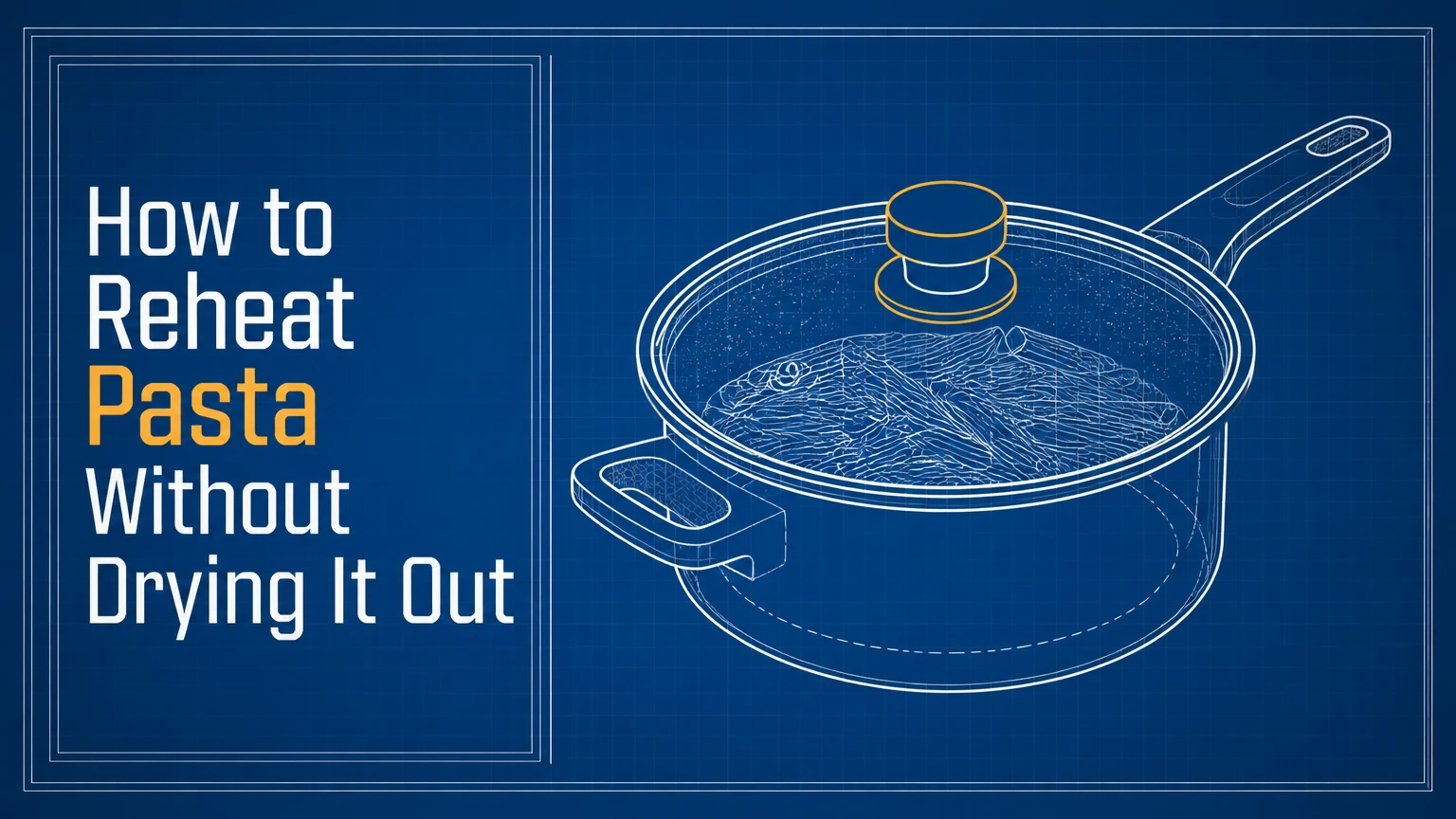
To reheat pasta without drying it out, add controlled moisture, use moderate heat, and keep the pasta covered whenever possible. Blanch plain pasta in boiling water for 30-60 seconds, warm sauced pasta in a covered skillet with 1-2 tablespoons of liquid, or microwave one portion at 50-70% power in 60-second intervals.
Key Facts at a Glance
- Plain refrigerated pasta reheats best in boiling water for 30-60 seconds.
- Sauced pasta needs approximately 1-2 tablespoons of water, broth, milk, or cream per serving.
- A covered container traps steam and reduces moisture loss during reheating.
- Microwave pasta at 50-70% power and stir after every 60-second interval.
- Reheated leftovers should reach 165°F, or 74°C, according to the USDA.
- Refrigerate cooked pasta within two hours and use it within 3-4 days.
Why Does Reheated Pasta Dry Out?
Refrigerated pasta dries because cooked starch changes structure as it cools, while the pasta continues absorbing available moisture from its sauce. Dry heat then evaporates surface water faster than the chilled starch can rehydrate, producing tough edges, rubbery strands, or a chalky center.
Cooking gelatinizes pasta starch by adding heat and water. During refrigeration, some starch molecules reassociate in a process called retrogradation. The rearranged starch holds water less effectively, and some liquid migrates into the container or sauce through syneresis.
Reheating works when heat and moisture arrive together. Water, broth, milk, or steam softens the starch network, while moderate temperatures prevent the outside from drying before the center becomes hot.
The practical rule is simple: do not reheat cold pasta with dry heat alone. An uncovered skillet, high microwave setting, or foil-free oven dish removes moisture faster than the pasta can absorb it.
What Determines the Best Reheating Method?
The best method depends on whether the pasta is plain, sauced, baked, delicate, or frozen. Plain noodles benefit from a short water blanch, while sauced pasta needs gentle pan or microwave heating that loosens the sauce without overcooking the noodles.
| Pasta condition | Best method | Added liquid | Typical time |
|---|---|---|---|
| Plain spaghetti or linguine | Boiling-water blanch | 0 tablespoons | 30-60 seconds |
| Sauced penne or fusilli | Covered skillet | 1-2 tablespoons per serving | 3-5 minutes |
| Single portion of Alfredo | Microwave at 50-60% | 1 tablespoon milk per cup | 2-4 minutes |
| Lasagna or baked ziti | Covered oven dish | 2-3 tablespoons per portion | 15-30 minutes |
| Frozen cooked pasta | Thaw, then skillet or microwave | 1-3 tablespoons | 5-12 minutes |
How Do You Reheat Plain Pasta?
Reheat plain pasta by immersing it in boiling water for 30-60 seconds, then drain it immediately and toss it with warm sauce. The brief blanch restores moisture without giving the noodles enough time to absorb excessive water or become overcooked.
Step 1: Boil Water
Fill a pot with enough water to submerge the pasta completely. Bring the water to a full boil; salt is optional because the noodles are already cooked and will usually be finished with seasoned sauce.
A wire-mesh strainer or metal colander makes this method faster because you can lift the entire portion at once. For a large quantity, work in batches rather than crowding the pot.
Step 2: Blanch the Pasta
Place cold, plain pasta in the strainer and lower it into the boiling water. Heat thin strands such as angel hair for approximately 20-30 seconds, standard spaghetti for 30-45 seconds, and thicker shapes such as fettuccine or penne for 45-60 seconds.
You will know the pasta is ready when the strands separate easily and feel flexible, but the center is still firm. Do not leave pasta submerged for several minutes because the noodles can become soft before the sauce is ready.
Step 3: Drain and Finish Immediately
Lift the strainer, shake off excess water, and transfer the pasta directly into warm sauce. A small amount of water clinging to the noodles helps the sauce spread and can improve its texture.
Common mistake: rinsing the pasta under cold water after reheating. Cold rinsing removes surface starch and cools the noodles, which makes sauce adhesion worse.
How Do You Reheat Sauced Pasta in a Skillet?
Reheat sauced pasta in a covered skillet over medium-low heat with 1-2 tablespoons of liquid per serving. Stir gently every 45-60 seconds, adding another teaspoon or two if the sauce becomes thick before the pasta is hot throughout.
Step 1: Add Pasta and Liquid
Place the refrigerated pasta in a skillet or saucepan. Add water or broth to tomato and oil-based sauces, and use milk or cream for dairy-based sauces.
| Sauce type | First liquid choice | Starting amount per serving | Main risk |
|---|---|---|---|
| Tomato sauce | Water or unsalted broth | 1-2 tablespoons | Acidic sauce thickening |
| Pesto | Water or pasta water | 1 tablespoon | Oil separation |
| Alfredo | Whole milk or cream | 1-2 tablespoons | Curdling and scorching |
| Butter sauce | Water or unsalted broth | 1 tablespoon | Greasy separation |
| Meat ragù | Water, broth, or wine-free stock | 2 tablespoons | Dense cold center |
Cold pasta absorbs liquid quickly, so the first splash should be slightly larger for thick sauces or dense shapes. Avoid adding several tablespoons at once because watery sauce is harder to correct than a thick sauce.
Step 2: Cover and Heat Gently
Cover the skillet and set the burner to medium-low. Steam trapped under the lid warms the pasta while reducing evaporation, and gentle heat gives the sauce time to loosen.
Stir delicate pasta with tongs or a silicone spatula rather than scraping aggressively across the pan. Rotate the lower pasta to the top after each interval so the hottest area does not remain against the pan.
Step 3: Check Texture and Temperature
Heat until the sauce flows around the pasta and the thickest piece reaches 165°F, or 74°C. The USDA Food Safety and Inspection Service recommends reheating leftovers to “165 °F,” measured with a food thermometer.
You will know the texture is ready when the pasta bends easily, has no cold center, and remains slightly firm rather than mushy. Remove the pan from the burner immediately because carryover heat can continue softening the noodles.
Common mistake: using medium-high heat to shorten the process. High heat can scorch the sauce, split dairy or oil emulsions, and toughen the pasta before the middle warms.
How Do You Reheat Pasta in the Microwave?
Microwave one portion in a covered glass or ceramic bowl with approximately 1 tablespoon of liquid per cup of pasta. Use 50-70% power for 60-second intervals, stirring between intervals to redistribute heat and moisture.
Step 1: Arrange the Portion
Spread the pasta into an even layer rather than leaving it in a compact refrigerated block. For dense pasta such as baked ziti, arrange the food in a ring with a small empty space in the center to reduce cold spots.
Add water to tomato or oil-based pasta. Add milk or cream to white sauces, but use only enough to loosen the sauce because excess dairy can make the dish thin.
Step 2: Cover and Set Power
Cover the bowl with a microwave-safe lid, plate, or vented silicone cover. A cover retains steam, but it must allow pressure to escape unless the manufacturer specifically labels it as sealed for microwave use.
Set the microwave to 50-70% power. Lower power does not mean the food receives no heat; it spaces out energy delivery, giving moisture time to move through the pasta instead of creating hard outer edges.
Step 3: Heat in Intervals
Microwave for 60 seconds, stir from the outside toward the center, and check the temperature. Continue in 30-60-second intervals until the pasta is hot throughout, with a typical total time of 1.5-3 minutes for one cup and 3-5 minutes for two cups.
Let the covered pasta stand for 30-60 seconds before serving. The resting period allows steam and heat to equalize without further intense microwave exposure.
Common mistake: microwaving uncovered pasta at full power for several minutes. That combination creates hot edges, a cold center, separated sauce, and a leathery surface.
How Long Should Pasta Be Reheated in the Oven?
Reheat sauced or baked pasta in a covered oven dish at 350°F, or 175°C, for 15-20 minutes, while dense lasagna usually needs 25-30 minutes. Add liquid before covering the dish, and remove the foil only during the final 3-5 minutes if a crisp topping is desired.
Oven Procedure
- Heat the oven to 350°F, or 175°C.
- Transfer pasta to an oven-safe glass, ceramic, or metal dish.
- Add 2-3 tablespoons of water, broth, milk, or cream per portion.
- Cover the dish tightly with aluminum foil.
- Bake until the center reaches 165°F.
- Remove the foil briefly if the cheese or breadcrumbs need browning.
A shallow layer reheats more evenly than a deep container. Divide a large mass of pasta into two dishes when possible; a 2-inch layer warms faster and develops fewer cold centers than a 4-inch block.
For lasagna, add liquid around the edges rather than flooding the top. For baked ziti, distribute the liquid across the surface, then cover tightly so steam can soften exposed pasta.
The oven is not ideal for one small serving. Preheating consumes more time and energy than a skillet or microwave, and an uncovered dish can dry before the center becomes safe to eat.
Which Reheating Method Should You Choose?
Choose boiling-water blanching for plain pasta, a covered skillet for the best sauced-pasta texture, a microwave for one quick serving, and a covered oven for lasagna, baked ziti, or several portions. The method should match both the pasta structure and the amount being reheated.
| Method | Quantity | Texture result | Active time | Best sauce or dish |
|---|---|---|---|---|
| Water blanch | 1-6 servings | Closest to freshly cooked | 1-2 minutes | Plain noodles |
| Covered skillet | 1-4 servings | Rich, evenly coated | 3-5 minutes | Tomato, pesto, ragù |
| Microwave | 1-2 servings | Convenient, moderate control | 2-5 minutes | Office lunches, soft sauces |
| Covered oven | 4-12 servings | Even, sometimes softer | 15-30 minutes | Lasagna, baked pasta |
| Air fryer | 1-2 servings | Crisp edges, drier center | 5-8 minutes | Baked pasta only |
Best Choice for Plain Pasta
Use the boiling-water method when noodles are stored without sauce. Water surrounds the entire surface, so the pasta rehydrates evenly instead of losing moisture to hot air.
Separate stored pasta gently before blanching. If the noodles are stuck together, loosen the largest clumps with wet hands or a tablespoon of water before placing them in the strainer.
Best Choice for Cream Sauce
Use a covered skillet or microwave at reduced power with milk or cream. Cream sauces are emulsions, so direct high heat can separate butterfat and proteins even when the pasta itself is adequately moist.
For Alfredo, carbonara-style leftovers, or cheese sauce, stir gently and remove from heat as soon as the sauce becomes fluid. Carbonara can become scrambled if reheated aggressively because egg proteins set at relatively moderate temperatures.
Best Choice for a Large Batch
Use the oven for four or more portions, especially when the pasta is baked or layered. A tightly covered shallow dish retains steam and reduces the need for constant stirring.
For sauced but unbaked pasta, two covered skillets may produce better texture than one deep roasting pan. Large quantities in a deep dish heat slowly at the center and can remain in the food-safety danger zone longer.
How Much Liquid Should You Add?
Start with 1 tablespoon of liquid per cup of pasta in a microwave, 1-2 tablespoons per serving in a skillet, and 2-3 tablespoons per serving in an oven dish. Add more in teaspoon-sized increments after heating begins rather than correcting an overly watery sauce.
| Reheated amount | Microwave liquid | Skillet liquid | Oven liquid |
|---|---|---|---|
| 1 cup or 1 serving | 1 tablespoon | 1-2 tablespoons | 2-3 tablespoons |
| 2 cups or 2 servings | 2 tablespoons | 2-4 tablespoons | 4-6 tablespoons |
| 4 cups or 4 servings | Not recommended | 4-8 tablespoons | 8-12 tablespoons |
| 8 cups or 8 servings | Not recommended | 8-16 tablespoons | 16-24 tablespoons |
Use unsalted liquid when the sauce is already seasoned. Salted broth can make a reduced tomato or cheese sauce noticeably too salty after reheating.
Pasta water is useful when available because dissolved starch can help the sauce cling. Plain water works well when the original cooking water was discarded.
How Should Different Pasta Sauces Be Reheated?
Tomato and meat sauces tolerate moderate skillet heat, while cream, cheese, pesto, and egg-based sauces require lower heat and smaller stirring movements. Sauce composition determines whether water, broth, milk, or cream is the safest replenishing liquid.
| Sauce | Heat setting | Added liquid | Stirring rule | Finish |
|---|---|---|---|---|
| Marinara | Medium-low | Water or broth | Every 60 seconds | Fresh basil after heating |
| Ragù | Medium-low | Broth or water | Every 45-60 seconds | Grated cheese off heat |
| Pesto | Low | Water or pasta water | Fold gently | Olive oil only if needed |
| Alfredo | Low | Milk or cream | Frequent gentle stirring | Parmesan off heat |
| Carbonara | Very low or residual heat | Warm water | Toss continuously | Egg must not scramble |
| Bolognese bake | 350°F covered | Water or broth | No stirring required | Uncover briefly |
Pesto should not be boiled because heat can darken basil and encourage oil separation. Toss warm pasta with pesto after reheating, or use low skillet heat only long enough to remove the refrigerator chill.
For a broken cream sauce, remove the pan from heat and whisk in 1 tablespoon of warm water or milk. The added liquid can help restore a smoother emulsion, although a sauce that has curdled severely may not return to its original texture.
How Should You Store Pasta for Better Reheating?
Cool cooked pasta promptly, store it in a shallow airtight container, and keep sauce separate when practical. Refrigerate leftovers within two hours and use them within 3-4 days, following USDA Food Safety and Inspection Service guidance.
Toss plain pasta with a small amount of olive oil only when separation is necessary. Too much oil coats the starch and makes sauce slide off during the next meal.
Store pasta in portions that match the next reheating session. A 1-cup container reheats more evenly than a single 6-cup mass, and shallow containers reduce the time required to cool and later reheat the food.
Do not leave cooked pasta at room temperature while waiting for it to cool completely. Divide a large batch into shallow containers, then refrigerate promptly.
What Temperature Makes Leftover Pasta Safe?
Leftover pasta should reach 165°F, or 74°C, throughout the thickest portion. A food thermometer is more reliable than judging safety by steam, because a steaming surface can surround a cold center.
The USDA recommendation applies to refrigerated cooked pasta, sauce, meat, cheese, and baked dishes. Reheating does not reliably reverse every quality change, so safe temperature and good texture are separate goals.
What Are the Most Common Reheating Mistakes?
The most common mistakes are using dry heat, heating too quickly, omitting a cover, adding too much liquid, and reheating the same portion repeatedly. Each mistake either removes moisture faster than starch can absorb it or exposes the pasta to unnecessary cooking.
- High microwave power: Use 50-70% power and shorter intervals.
- No added liquid: Add the measured amount for the pasta quantity and sauce.
- Uncovered heating: Cover with a vented microwave lid, plate, or foil.
- Deep, compact portions: Spread pasta into a shallow layer or divide it.
- Aggressive stirring: Use tongs for strands and a silicone spatula for soft shapes.
- Repeated reheating: Heat only the portion you intend to eat.
A practitioner rule of thumb is to correct dryness early. Adding one teaspoon of water while the pasta is warm can restore looseness; adding a quarter cup after the sauce has already become watery creates a different problem.
Another counterintuitive point is that more heat does not produce faster usable results. High heat raises the surface temperature quickly, but moisture still needs time to migrate into chilled starch.
How Can You Fix Dry, Gummy, or Separated Pasta?
Dry pasta can often be improved with a tablespoon of liquid and covered low-temperature heating, but gummy pasta cannot be restored to al dente texture completely. A separated sauce may be recoverable off heat, while severely overcooked noodles are better crisped than softened further.
| Problem | Likely cause | Recovery action | Expected result |
|---|---|---|---|
| Dry edges | Uncovered high heat | Add 1 tablespoon liquid and cover | Softer surface |
| Thick sauce | Pasta absorbed moisture | Add liquid 1 teaspoon at a time | Looser coating |
| Gummy noodles | Original overcooking | Crisp briefly in oil | Firmer exterior |
| Broken cream sauce | Excessive heat | Whisk warm milk off heat | Partial re-emulsion |
| Cold center | Dense portion | Divide and reheat again | More even temperature |
| Mushy ravioli | Excessive stirring or boiling | Warm gently in sauce | Shape may remain fragile |
For pasta that is merely dry, use a covered skillet over low heat and add liquid gradually. For noodles that are already mushy, pan-fry them briefly in butter or olive oil; crisping changes the texture more successfully than adding additional water.
Ravioli, tortellini, and stuffed shells need gentle handling. Use a wide skillet, turn them with a spoon, and avoid a vigorous boil that can split the pasta casing.
Can You Reheat Pasta in an Air Fryer?
An air fryer can reheat baked pasta or crisp a small portion, but it is not the best tool for plain or lightly sauced noodles because circulating hot air removes moisture. Use a covered foil parcel at 325-350°F for 5-8 minutes, then uncover briefly for browning.
Air fryers work better for baked ziti, macaroni and cheese, and lasagna slices than for spaghetti. Add a teaspoon or two of water, cover the portion with foil, and place it in an air-fryer-safe dish.
Do not put loose sauced spaghetti directly into the basket. Sauce can drip, noodles can dry at the edges, and the portion may heat unevenly.
How Do You Reheat Frozen Cooked Pasta?
Thaw frozen cooked pasta in the refrigerator overnight when possible, then use the skillet or microwave method with extra liquid. A frozen compact block can be reheated directly, but it needs lower heat, a covered vessel, and several additional intervals.
For one frozen serving, place the pasta in a covered skillet with 2-3 tablespoons of water or broth. Heat over low to medium-low heat for 8-12 minutes, breaking apart the edges as they soften.
Microwave frozen pasta at 50% power in 2-minute intervals. Stir or rotate the portion after each interval, then continue in 30-60-second increments until the center reaches 165°F.
Frozen pasta usually loses more firmness than refrigerated pasta because ice crystals damage the starch and surface structure. Freeze sauce and pasta together only when convenience matters more than the best possible texture.
How Do You Reheat Pasta for Work or Meal Prep?
For an office lunch, portion pasta into a microwave-safe container, add 1 tablespoon of water per cup, cover loosely, and microwave at 60% power for 60-second intervals. For meal prep, store two or three individual portions rather than one large container.
Pack cream sauce with milk, tomato sauce with water, and baked pasta with 2-3 tablespoons of liquid per portion. Keep grated cheese, herbs, toasted breadcrumbs, and fresh greens separate until serving.
If no microwave is available, use an insulated food container only after the pasta has been heated to 165°F. An insulated container preserves temperature but cannot safely reheat a cold meal.
Frequently Asked Questions
Is It Better to Reheat Pasta With or Without Sauce?
Plain pasta is usually easier to reheat without sauce because boiling water can restore its surface moisture evenly. Sauced pasta should remain with its sauce during reheating because separating it can dry the noodles and make the sauce harder to reincorporate.
Can You Reheat Pasta Twice?
You can reheat pasta twice if it was cooled promptly, refrigerated correctly, and reaches 165°F each time, but quality usually declines. Reheat only the serving you need because repeated heating softens starch and increases the chance of sauce separation.
Why Does Pasta Absorb Sauce in the Refrigerator?
Pasta absorbs sauce because cooked starch continues interacting with the surrounding liquid during storage. Refrigeration also thickens fats and starches, so adding a small amount of water, broth, milk, or cream restores fluidity during reheating.
Should You Add Olive Oil When Reheating Pasta?
Add olive oil only to plain pasta when strands are sticking, and use approximately 1 teaspoon per serving. Oil does not rehydrate dry pasta, and too much oil prevents tomato, cheese, or cream sauce from adhering to the noodles.
Can You Reheat Pasta Straight From the Refrigerator?
You can reheat refrigerated pasta directly, but smaller portions warm more evenly. Cold pasta straight from the refrigerator should receive added liquid and moderate heat, while dense baked dishes benefit from dividing before reheating.
How Do You Keep Spaghetti From Sticking After Reheating?
Blanch refrigerated spaghetti in boiling water for 30-45 seconds, drain it thoroughly, and toss it immediately with warm sauce. If reheating sauced spaghetti, add liquid before heating and separate strands gently with tongs after each interval.
The Bottom Line
To reheat pasta without drying it out, match the technique to the pasta’s condition: blanch plain noodles for 30-60 seconds, warm sauced pasta in a covered skillet with 1-2 tablespoons of liquid, microwave single servings at 50-70% power, and cover oven-baked dishes at 350°F. Add moisture before the pasta becomes dry, heat only until the center reaches 165°F, and reheat individual portions rather than repeatedly warming the entire batch.