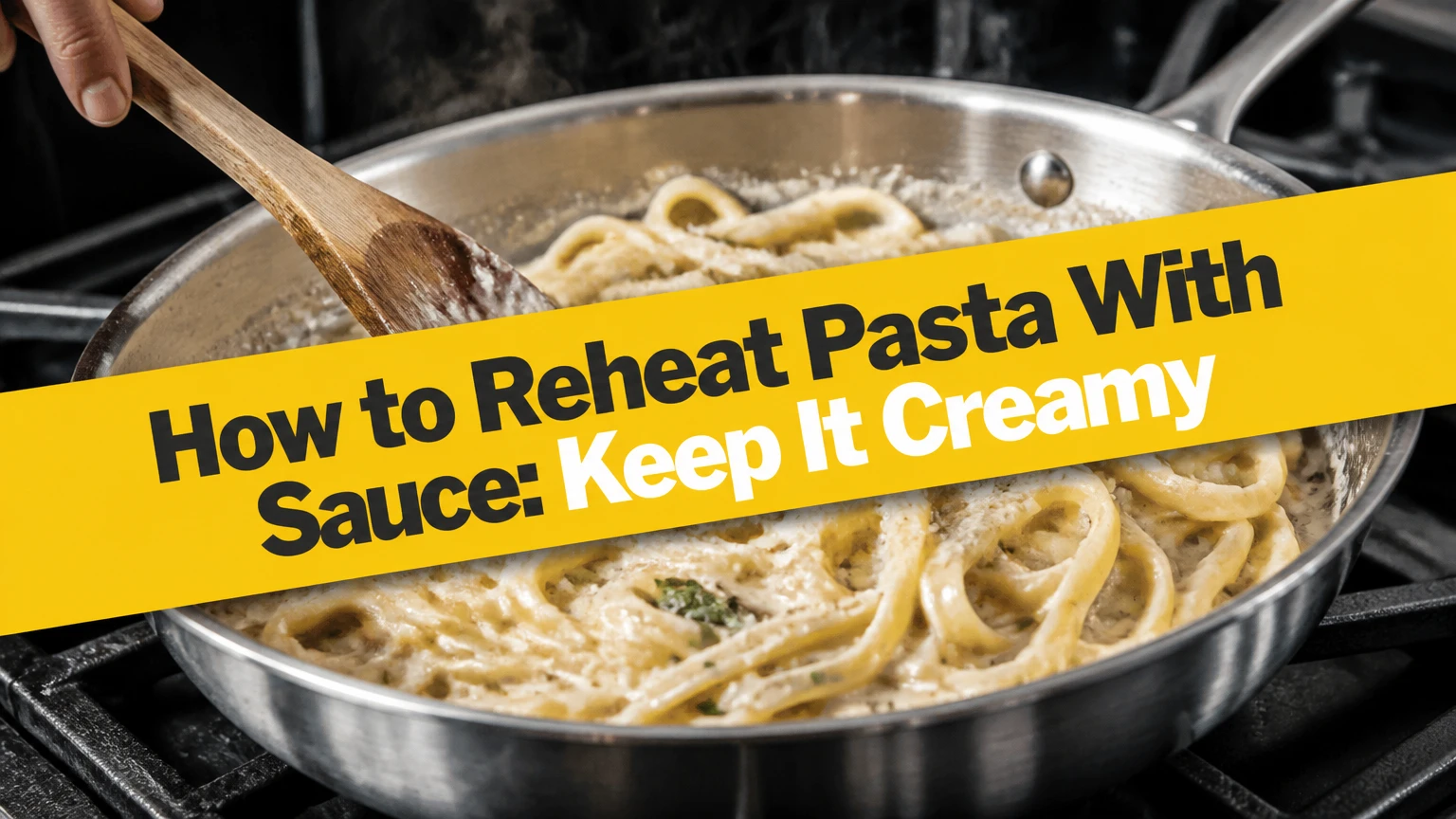
To reheat pasta with sauce, add a small amount of water, broth, milk, cream, or reserved pasta water, then warm the portion gently while stirring or covering it to trap steam. Use a skillet for the best texture, a microwave for one serving, or a covered 350°F oven for a large batch, and heat leftovers to 165°F.
Key Facts at a Glance
Refrigerated pasta leftovers generally keep for 3-4 days when chilled promptly in a refrigerator at 40°F or below.
Add about 1 tablespoon of liquid per serving on the stovetop or in the microwave.
A covered 350°F oven reheats large baked-pasta portions in about 15-25 minutes.
Microwave pasta at 50%-70% power in short intervals, stirring after each interval.
Cream, cheese, egg, and pesto sauces need lower heat than tomato or meat sauces.
A food thermometer should read 165°F in the thickest part before serving.
Before You Start
The most successful reheating starts with three decisions: the sauce type, the portion size, and the equipment available. Tomato sauce tolerates more heat than Alfredo, while a single serving warms more evenly in a microwave than a deep casserole.
| Factor | Single serving | Family batch | Frozen portion |
|---|---|---|---|
| Typical quantity | 1-2 cups | 6-10 cups | 1-4 cups |
| Best equipment | Microwave or skillet | Covered oven or skillet | Covered oven or skillet |
| Added liquid | 1 tablespoon | 2-6 tablespoons | 2 tablespoons per cup |
| Typical heating time | 1.5-4 minutes | 15-30 minutes | 25-45 minutes |
| Useful tool | Deep bowl or 10-inch skillet | 9-by-13-inch dish | Lidded oven-safe dish |
| Main risk | Uneven hot spots | Dry edges | Cold center |
Use a microwave-safe bowl, skillet, saucepan, silicone spatula, oven-safe dish, foil, and a thermometer if available. Typical added-liquid costs are negligible at home, although cream, milk, broth, and cheese can add approximately $0.10-$0.75 per portion depending on the ingredient.
The USDA Food Safety and Inspection Service advises that “leftovers should be placed in the refrigerator or freezer within two hours,” with the limit reduced to one hour when ambient temperatures exceed 90°F. Reheat only the amount you expect to eat. Repeated warming increases texture loss and creates more opportunities for unsafe cooling.
Why Does Leftover Pasta Dry Out?
Cooked pasta dries during storage because the noodles absorb available sauce and their gelatinized starch gradually reorganizes as the food cools. Food scientists call that starch reorganization retrogradation. Gentle heat reverses some of the firming, but reheating cannot fully restore pasta that was originally overcooked.
Sauce also changes during refrigeration. Tomato sauces usually become thicker because water moves into the pasta or evaporates from the surface. Cream and cheese sauces can separate because fat, water, proteins, and starch no longer remain evenly dispersed. Pesto may develop a duller color and stronger herbal flavor after repeated heating.
Moisture and agitation solve different problems. Added liquid replaces what the pasta absorbed, while stirring distributes heat and encourages starch from the noodles to bind water and dispersed fat. Boiling the mixture works against both goals because it drives off moisture and can force dairy proteins or oil out of suspension.
How Much Liquid Should You Add?
Start with 1 tablespoon of liquid per cup of pasta, then add another teaspoon or tablespoon only if the sauce remains tight. Use water or broth for tomato sauce, reserved pasta water for most savory sauces, and milk or cream for dairy sauces.
| Sauce type | Starting liquid per cup | Preferred heat | Liquid to avoid first |
|---|---|---|---|
| Marinara or tomato meat sauce | 1 tablespoon water or broth | Medium-low | Extra oil |
| Alfredo or cream sauce | 1 tablespoon milk or cream | Low | Cold water in a large amount |
| Pesto or olive-oil sauce | 1 tablespoon water | Low | More olive oil |
| Carbonara or egg-cheese sauce | 1 tablespoon pasta water | Off heat to low | Boiling cream |
| Baked cheese pasta | 1 tablespoon marinara or water | Covered 350°F oven | Uncovered dry heat |
Reserved pasta water is useful because its dissolved starch helps loosen sauce while improving cling. Water from already-cooked pasta is still suitable if it was refrigerated promptly in a clean, covered container, but plain water is safer than old pasta water that has been left at room temperature.
How to Reheat Pasta With Sauce on the Stovetop
A stovetop skillet gives the most control and usually produces the best texture in 3-7 minutes. Warm one or two servings over medium-low heat with 1 tablespoon of liquid per cup, stir gently, and stop as soon as the center is steaming hot.
- Choose a wide skillet or saucepan. A 10-inch skillet spreads two cups of pasta into a shallow layer, reducing cold centers and overheated edges.
- Add the liquid first. Put 1-2 tablespoons of water, broth, milk, cream, or pasta water in the pan for a two-cup portion.
- Add the cold pasta. Break apart large clumps with a spatula, but leave ravioli and stuffed shells intact.
- Cover for the first 1-2 minutes. The lid creates steam that softens dry surfaces before direct heat browns them.
- Stir gently every 30-45 seconds. Scrape the bottom and fold long noodles rather than cutting through them.
- Check the center. Remove the pan when the pasta reaches 165°F or when the portion is visibly steaming throughout, usually after 3-5 minutes for refrigerated pasta.
You will know the skillet method worked when the sauce coats the noodles in a continuous layer, the pasta bends without cracking, and no dry clumps remain at the bottom. A common mistake is starting with a dry, hot pan. Dry contact overheats the sauce before the cold noodles can release enough starch to loosen it.
For a large skillet batch, use medium heat only after the pasta has begun steaming. The wider surface area handles up to four cups efficiently; beyond that amount, a covered oven dish usually heats more evenly.
When Is the Skillet the Best Choice?
The skillet is the best choice for tomato, meat, pesto, and oil-based pasta when you can spend several minutes stirring. It is less suitable for fragile tortellini, delicate cream sauces, or a batch larger than the pan can hold in a shallow layer.
Can You Reheat Pasta in the Microwave?
You can reheat pasta in a microwave safely and effectively when you use a deep bowl, add liquid, cover loosely, and stir at 50%-70% power. One refrigerated serving usually takes 1.5-3 minutes in a 700-1,000 watt microwave, depending on density and starting temperature.
- Put 1-2 cups of pasta in a microwave-safe bowl. Spread it into a ring around the bowl rather than making a tall mound.
- Add 1 tablespoon of liquid per cup. Use water for tomato sauce, milk for cream sauce, and pasta water for cheese or pesto.
- Cover with a vented microwave lid or a damp paper towel. Do not seal the container airtight.
- Heat at 60% power for 60 seconds.
- Stir from the outside toward the center, then rotate the bowl.
- Continue in 30-second intervals until the thickest section reaches 165°F or the entire serving is steaming.
The ring arrangement helps microwaves reach more of the food’s surface, while the short intervals prevent the outer sauce from boiling before the center warms. Microwaves create uneven energy distribution, so stirring is a safety and texture step rather than an optional finishing touch.
| Microwave setting | Portion | First interval | Additional intervals | Typical total |
|---|---|---|---|---|
| 50% power | 1 cup | 60 seconds | 30 seconds | 1.5-2.5 minutes |
| 60% power | 2 cups | 60 seconds | 30 seconds | 2-3 minutes |
| 70% power | 3 cups | 90 seconds | 30 seconds | 3-4 minutes |
| 100% power | 1 cup only | 30 seconds | 15-20 seconds | 1-2 minutes |
Maximum power is a poor default because cream sauces can split and pasta edges can become rubbery before the center is hot. If the microwave has no power setting, use shorter intervals and stir more frequently.
How Should You Reheat Pasta in the Oven?
Reheat baked pasta, lasagna, stuffed shells, or a family-size portion in a covered 350°F oven. Add liquid, seal the dish with foil, and heat for 15-25 minutes for refrigerated food, extending the time for dense or frozen portions.
- Heat the oven to 350°F.
- Transfer pasta to an oven-safe dish if it is not already in one.
- Add 2-3 tablespoons of water, broth, or sauce for a four-cup portion. Apply more around dry edges.
- Cover tightly with foil so steam stays inside the dish.
- Bake for 15-20 minutes if the pasta layer is less than 2 inches deep.
- Bake for 25-30 minutes if the dish is dense, heavily chilled, or deeper than 2 inches.
- Remove the foil for the final 3-5 minutes if you want browned cheese.
- Verify 165°F in the center before serving.
A covered dish prevents surface dehydration, which matters more in an oven than in a microwave because the surrounding air stays hot and dry for a longer period. A shallow 9-by-13-inch dish reheats more predictably than a deep casserole dish holding the same quantity.
| Pasta format | Dish depth | Covering | Typical refrigerated time at 350°F |
|---|---|---|---|
| Lasagna, 2 portions | 1.5 inches | Foil, fully sealed | 18-22 minutes |
| Baked ziti, 6 portions | 2 inches | Foil, fully sealed | 20-25 minutes |
| Stuffed shells, 8 shells | 2 inches | Foil plus sauce | 20-25 minutes |
| Dense casserole, 8 portions | 3 inches | Foil, fully sealed | 25-30 minutes |
| Frozen baked pasta | 2-3 inches | Foil, fully sealed | 40-60 minutes |
Do not put a frozen glass baking dish directly into a hot oven unless the manufacturer specifically approves that use. Thermal shock can break the dish. Thaw the container in the refrigerator or use a metal baking pan designed for oven reheating.
Should Creamy Pasta Use a Double Boiler?
A double boiler is the gentlest method for Alfredo, cheese, carbonara, and other sauces that separate easily. Heat the pasta in a heat-safe bowl over barely simmering water for 5-10 minutes, adding 1 tablespoon of warm liquid per cup and stirring carefully.
The bowl should sit above the water rather than touch it. Indirect heat keeps the sauce below the aggressive bubbling that causes dairy fat to pool and egg proteins to tighten. Carbonara requires particular care because direct high heat can turn the egg mixture into small curds.
For carbonara, add warm pasta water and stir over low indirect heat, then remove the bowl while the sauce is still slightly loose. Residual heat continues cooking the sauce after removal. For Alfredo, warm milk or cream blends more smoothly than cold liquid, which can briefly tighten a cheese-based sauce.
The double boiler is not ideal for a large serving of tomato pasta because the method takes longer without offering a meaningful texture advantage. It also cannot create a crisp cheese surface, so use the oven when browning is part of the intended result.
Which Reheating Method Should You Choose?
The skillet wins for texture, the microwave wins for speed, the oven wins for large or baked portions, and the double boiler wins for delicate dairy or egg sauces. The correct choice depends on portion size, sauce stability, and whether the pasta needs a browned surface.
| Method | Best portion size | Typical time | Texture result | Cleanup |
|---|---|---|---|---|
| Skillet | 1-4 cups | 3-7 minutes | Glossy sauce, tender noodles | One pan |
| Microwave | 1-3 cups | 1.5-4 minutes | Soft, sometimes uneven | One bowl |
| Oven | 4-12 cups | 15-30 minutes | Even, possible crisp top | One baking dish |
| Double boiler | 1-3 cups | 5-10 minutes | Smooth delicate sauce | Two vessels |
Choose the microwave for an office lunch, dorm room, or single portion when time matters more than a perfect sauce emulsion. Choose a skillet when you are serving one or two people at home and can stir for several minutes. Choose the oven for lasagna, baked ziti, or a family batch that would overcrowd a pan.
The oven is not a good choice for a small, uncovered portion. A single cup can lose moisture before its center becomes hot. The microwave is not a good choice for an entire deep casserole because the outside may overheat while the middle remains cold.
How Do You Reheat Different Sauces?
Sauce composition determines the heat level and the liquid that will restore the pasta most effectively. Tomato sauces tolerate medium heat, while cream, cheese, egg, and pesto sauces require low heat and frequent checks.
| Sauce | Best method | Add per cup | Maximum practical heat | Finishing adjustment |
|---|---|---|---|---|
| Marinara | Skillet | 1 tablespoon water | Medium-low | Add basil after heating |
| Bolognese | Skillet or oven | 1 tablespoon broth | Medium-low | Stir in Parmesan off heat |
| Alfredo | Double boiler or skillet | 1 tablespoon milk | Low | Add warm cream gradually |
| Pesto | Low skillet | 1 tablespoon water | Low | Add fresh pesto after heating |
| Carbonara | Double boiler | 1 tablespoon pasta water | Very low | Remove before sauce thickens |
| Vodka sauce | Skillet | 1 tablespoon water or cream | Low-medium | Stir continuously |
| Mac and cheese | Skillet | 1 tablespoon milk | Low | Add milk in teaspoons if tight |
| Seafood cream sauce | Skillet | 1 tablespoon stock | Low | Stop as soon as seafood is hot |
Pesto should be warmed only enough to make the pasta comfortable to eat. High heat darkens basil and encourages the oil to separate. Adding more olive oil usually creates a greasy surface rather than restoring the original emulsion.
Tomato meat sauce is the most forgiving variation. Water or unsalted broth loosens the sauce without changing its flavor substantially, and a small amount of Parmesan or fresh herbs added after heating can improve a sauce that tastes flat from refrigeration.
Seafood pasta needs extra caution. Shrimp, scallops, and fish become firm and dry quickly, so use low heat, add a spoonful of stock, and stop at 165°F rather than holding the pan at that temperature for several minutes.
How Do You Reheat Frozen Pasta?
Frozen pasta reheats best when thawed overnight in the refrigerator, then warmed by skillet or covered oven. If thawing is not possible, use a covered 350°F oven for a compact baked portion or microwave at 50% power with frequent stirring for a loose portion.
Thawing reduces the temperature difference between the sauce and the noodles. Move frozen leftovers to the refrigerator 12-24 hours before heating, keeping them in a leakproof container. Do not thaw meat or dairy pasta on the counter.
For frozen skillet portions, add 2 tablespoons of liquid per cup, cover over low heat for 5 minutes, then stir and continue until the center reaches 165°F. Frozen pasta blocks need patience. Forcing high heat creates a scorched outside and a frozen center.
Pasta that was frozen after a long refrigerator stay may have inferior texture even when it is safe. Freezing preserves the food but does not prevent starch from continuing to weaken during repeated thawing and heating.
Common Mistakes and How to Fix Them
Dry, Sticky Pasta
Add 1 tablespoon of warm liquid per cup, cover for 60-90 seconds, and stir gently. If the noodles have absorbed every drop of sauce, add warmed sauce rather than repeatedly pouring in water, which can dilute the flavor.
Greasy or Split Sauce
Remove the pan from heat immediately. Whisk in 1 teaspoon of warm water or milk at a time while stirring the pasta, then return it to low heat only after the sauce looks cohesive. Starch released from the noodles can help pull dispersed fat back into the sauce.
Mushy Noodles
Mushy pasta cannot be returned to its original texture. Stop heating, drain excess liquid, and repurpose it as a baked pasta dish with cheese, breadcrumbs, or vegetables. Broiling for 2-3 minutes can add a crisp surface, but it cannot reverse overcooked starch.
Cold Center and Hot Edges
Spread microwave pasta into a ring, lower the power to 50%-60%, and stir every 30 seconds. For oven pasta, use a shallow dish and keep it covered. A thermometer reading from the center is more reliable than touching the edge.
Broken Ravioli or Tortellini
Avoid vigorous stirring and use a wide spatula to fold the pasta. Warm stuffed pasta in sauce rather than boiling water, because pressure and agitation can split the dough and release the filling.
Burned Bottom
Transfer the unburned upper portion to a clean pan without scraping the base. Add fresh sauce or a tablespoon of water, then resume heating over lower heat. Burned sauce will continue contributing bitterness if mixed back into the dish.
Safety, Storage, and Reheating Limits
Refrigerate pasta leftovers within two hours of cooking or serving, and keep the refrigerator at 40°F or below. USDA FSIS recommends using refrigerated leftovers within 3-4 days and reheating them to 165°F, measured in the thickest portion.
A sealed container improves both safety and texture. Shallow containers cool faster than deep pots, so divide a large batch into containers no deeper than about 2 inches when practical. Leave the lid slightly ajar during initial cooling if the container is hot, then seal it after chilling.
Do not taste pasta that has sat at room temperature overnight. Smell and appearance cannot reliably identify every foodborne hazard. Discard leftovers with uncertain storage history, visible mold, unusual bubbling, or a container that has swollen.
Reheat only once when possible. If a full batch must be reheated and served again, keep the unused portion cold rather than returning repeatedly warmed pasta to the refrigerator.
Practical Variations for Common Situations
For an office lunch: Pack one serving in a shallow microwave-safe container, add the liquid before leaving home, and keep the container refrigerated with an ice pack until lunch. Microwave at 60% power for 60 seconds, stir, and continue in 30-second intervals.
For a busy family: Put the pasta in a covered baking dish with 2-3 tablespoons of extra sauce per four cups. Add mozzarella during the last five minutes if a browned top is wanted, but keep the dish covered until the center is hot.
For delicate pasta: Use a low skillet with a lid or a double boiler. Avoid tongs on ravioli, avoid boiling sauce, and add liquid in teaspoons once the pasta begins to loosen.
For meal preparation: Slightly undercook pasta before refrigeration, cool it quickly, and store sauce separately when possible. Separating sauce prevents noodles from absorbing all available moisture and gives you better control during reheating.
FAQ
Can You Reheat Pasta With Cold Water?
Yes, but warm water, broth, milk, or cream blends faster and reduces the time the pasta spends heating. Cold water is acceptable for a microwave or skillet when only 1 tablespoon is added per cup. Large quantities of cold liquid can cool the sauce and produce a watery result.
Is It Better to Reheat Pasta Separately From the Sauce?
Separating pasta and sauce usually gives the best texture when you expect leftovers. Warm the sauce in a skillet with a splash of liquid, then fold in the pasta for the final 1-2 minutes. Already-combined pasta can still be reheated well with steam and gentle agitation.
How Long Can Pasta Sit Out Before Reheating?
Discard cooked pasta that has remained at room temperature for more than two hours, or more than one hour when the surrounding temperature exceeds 90°F. Reheating does not reliably eliminate every toxin that some bacteria can produce during improper storage.
Can You Reheat Pasta With Sauce More Than Once?
You can technically reheat it again if the food was cooled promptly and refrigerated, but one reheating cycle gives better safety control and texture. Divide leftovers into single portions before storage so you warm only what you will eat.
Why Does My Alfredo Sauce Turn Oily?
Alfredo turns oily when high heat causes the emulsion of dairy, water, cheese, and fat to break. Remove the pan from heat, add warm milk or water a teaspoon at a time, and stir continuously until the sauce becomes cohesive again.
What Is the Fastest Way to Reheat Pasta?
The microwave is fastest for one serving, usually taking 1.5-3 minutes at 50%-70% power. Add liquid, cover with a vented lid or damp paper towel, stir halfway through, and confirm that the center is fully hot rather than relying on the bowl’s edges.
The Bottom Line
To reheat pasta with sauce successfully, match the method to the portion and sauce: use a skillet for the best everyday texture, a microwave for speed, a covered 350°F oven for large or baked portions, and a double boiler for fragile cream or egg sauces. Add about 1 tablespoon of liquid per cup, heat gently, stir or cover, and verify 165°F before serving.