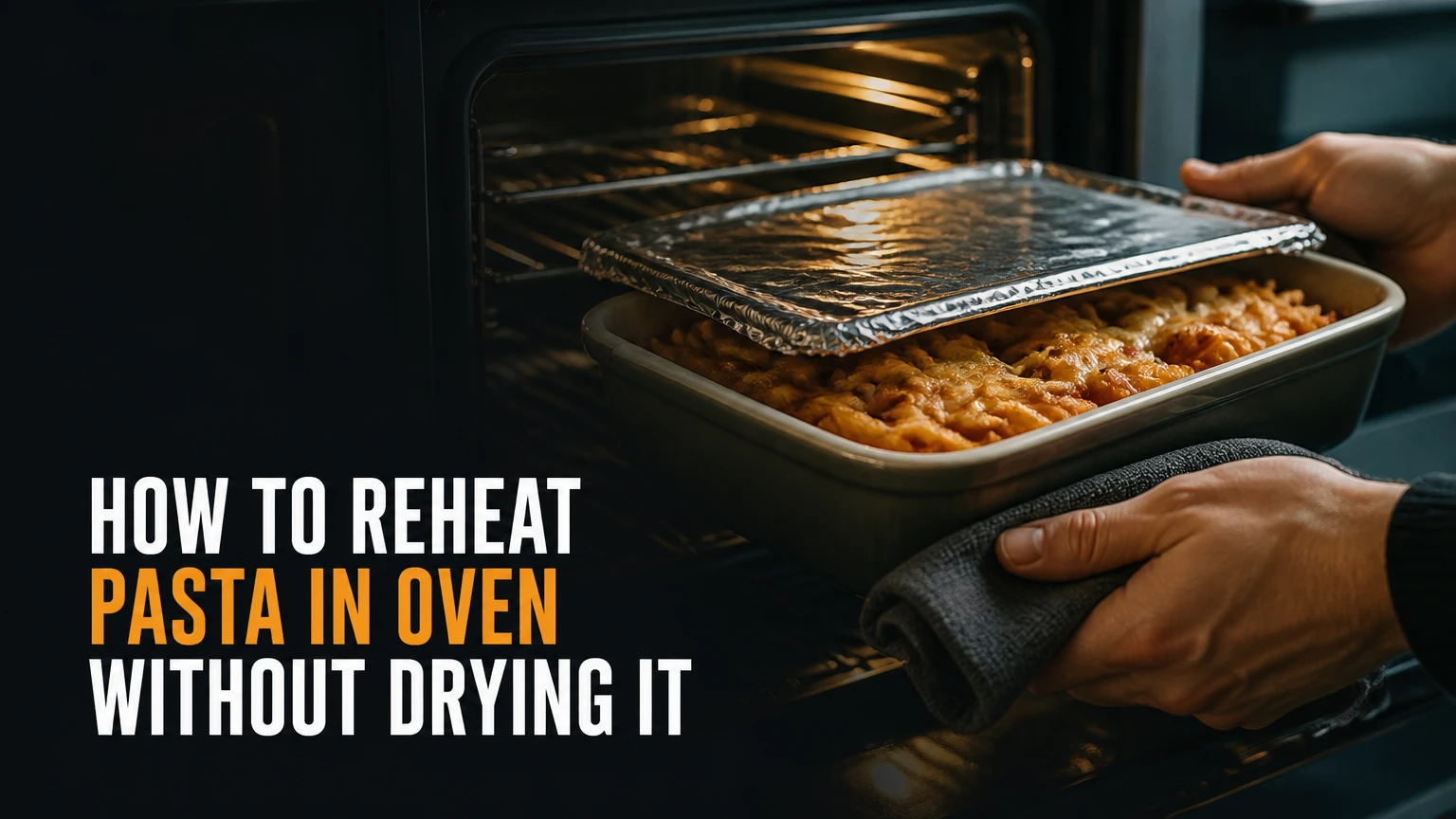
To reheat pasta in the oven, place refrigerated pasta in an oven-safe dish, add 1-2 tablespoons of water, broth, or compatible dairy per serving, cover tightly with foil, and bake at 350°F (175°C) for 15-25 minutes. Heat dense dishes until the center reaches 165°F (74°C), then uncover baked pasta briefly for a browned top.
Key Facts / At a Glance
Best temperature: 325°F-350°F (160°C-175°C) preserves moisture better than high heat.
Typical timing: A single serving takes 12-18 minutes; a dense casserole takes 20-30 minutes.
Moisture rule: Add approximately 1 tablespoon of liquid per serving before sealing the dish.
Covering rule: Foil traps steam for sauced and plain pasta; uncover only at the end when browning is wanted.
Safety target: The USDA recommends reheating leftovers to 165°F (74°C), measured at the coldest center.
Best use case: The oven is strongest for lasagna, baked ziti, pasta casseroles, and several servings.
How to Reheat Pasta in Oven
The most reliable oven method uses moderate heat, added moisture, and a tight foil seal. Preheat the oven to 350°F, arrange pasta in a shallow oven-safe dish, add liquid, cover, and bake until the center is hot. The pasta should be loose enough to heat evenly, not compressed into a thick refrigerated block.
Before You Start
| Requirement | Typical specification | Why it matters |
|---|---|---|
| Oven temperature | 350°F (175°C) | Warms pasta efficiently without excessive surface drying |
| Cooking vessel | 1-2-quart glass, ceramic, or metal dish | Holds one to four servings in a shallow layer |
| Added liquid | 1 tablespoon per serving | Replaces moisture absorbed by cooled starch |
| Foil | Heavy-duty sheet covering the full rim | Traps steam and limits evaporation |
| Heating time | 15-25 minutes | Depends on quantity, thickness, and starting temperature |
| Food thermometer | Instant-read, 165°F target | Confirms the center is safely reheated |
Estimated difficulty: Easy.
Typical active time: 3-5 minutes.
Typical total time: 20-35 minutes, including preheating.
Typical cost: About $0.10-$0.40 in oven energy, plus a few cents for foil, depending on local utility rates and oven efficiency.
Use a shallow dish whenever possible. A 2-inch layer of pasta heats more evenly than a 4-inch mound because the center has less distance to travel before reaching serving temperature.
Step 1: Preheat the Oven to 325°F-350°F
Set the oven to 350°F (175°C) for one or two servings, or 325°F (160°C) for a large, dense casserole. Allow a conventional oven to finish preheating before inserting the dish, since a cold-start oven extends the surface-drying period.
You can use a fan-assisted oven, but reduce the setting to approximately 325°F because convection transfers heat more aggressively. A toaster oven works for one or two portions if the dish fits without touching the heating elements.
Success checkpoint: The oven has reached its selected temperature before the pasta goes inside.
Common mistake: Starting at 400°F or higher because the pasta is cold. High heat browns exposed edges before the middle warms.
Step 2: Transfer and Loosen the Pasta
Move the pasta into an oven-safe dish and spread it into an even layer. Separate stuck noodles with a fork or silicone spatula, but do not aggressively break apart lasagna or other layered dishes.
For a thick block of baked pasta, cut it into individual portions first. Leave about 1 inch between pieces when the dish allows it. This increases exposed surface area and shortens the path heat must travel to the center.
Success checkpoint: The pasta layer has a reasonably consistent thickness, with no frozen or solid mass at the center.
Common mistake: Reheating an entire compact lasagna block. The outside can become dry while the middle remains cold.
Step 3: Add the Right Liquid
Add approximately 1 tablespoon of liquid per serving, then distribute it across the pasta. Use water for tomato or oil-based sauces, broth for meat sauces, and milk or cream for dairy sauces when the recipe already contains those ingredients.
Plain noodles benefit from water plus a small amount of olive oil. Oil alone lubricates the surface but does not provide steam, so it cannot correct substantial dryness as effectively as water or broth.
| Pasta or sauce | Liquid per serving | Typical amount for 4 servings | Best use |
|---|---|---|---|
| Tomato sauce | Water | 4 tablespoons | Loosens thick, absorbed sauce |
| Bolognese or meat sauce | Beef or vegetable broth | 4 tablespoons | Adds savory moisture |
| Alfredo or cheese sauce | Milk or cream | 2-4 tablespoons | Softens sauce without diluting it heavily |
| Pesto | Water or reserved pasta water | 2-4 tablespoons | Prevents oil separation from excess heat |
| Plain noodles | Water plus 1 teaspoon oil | 4 tablespoons water | Rehydrates and reduces sticking |
| Seafood pasta | Water or light seafood stock | 2-4 tablespoons | Limits additional dairy or fat |
Sauce thickness changes the amount required. Begin conservatively because excess liquid can make thin pasta soupy, especially when the dish already contains vegetables or watery tomato sauce.
Success checkpoint: The pasta looks lightly moistened, not submerged.
Common mistake: Adding cold cream to a very dry Alfredo and then using high heat. The sauce can separate before the pasta warms.
Step 4: Cover the Dish Tightly
Seal the dish with aluminum foil, pressing the foil around the rim. Leave enough space above the pasta so steam can circulate, but do not leave large gaps where moisture can escape.
A tight lid can replace foil if the lid is oven-safe at the selected temperature. Parchment alone is not a reliable seal because it does not retain steam as effectively and may darken near exposed heating elements.
Success checkpoint: Condensation begins forming under the foil during heating, and the top layer is not visibly drying.
Common mistake: Covering only the center of the dish. Unsealed edges lose steam first and usually become crunchy.
Step 5: Bake Until the Center Reaches 165°F
Bake a single serving for 12-18 minutes and two to four servings for 15-25 minutes. Dense lasagna, frozen portions, and dishes deeper than 2 inches may require 25-40 minutes.
Check the thickest or coldest center with an instant-read thermometer. The USDA states, “Reheat leftovers to 165°F,” because reheating to that temperature reduces food-safety risk when leftovers have been properly stored.
Success checkpoint: The center reaches 165°F (74°C), the sauce is fluid, and the pasta bends easily without a chilled core.
Common mistake: Checking only the surface. Surface temperature does not confirm that a dense casserole has heated throughout.
Step 6: Uncover Baked Pasta for the Final 3-5 Minutes
Remove the foil during the final 3-5 minutes when reheating lasagna, baked ziti, macaroni and cheese, or another cheese-topped casserole. This allows surface moisture to evaporate and promotes browning.
A broiler can add rapid color, but use it only for 30-90 seconds while watching continuously. Broiler elements can burn cheese before the center changes temperature, particularly in shallow metal pans.
Success checkpoint: The cheese is melted with light browning, while the interior remains moist.
Common mistake: Broiling a cold casserole. Browning cannot compensate for an underheated center.
Step 7: Rest for Two Minutes and Serve
Rest the covered pasta for about two minutes after baking, except when a crisp crust is the main objective. The short rest allows heat to equalize and gives thick sauce time to settle back over the noodles.
Stir loose sauced pasta before serving. For layered dishes, use a wide spatula so the hot filling and top layer remain together.
Success checkpoint: The sauce coats the pasta rather than pooling separately at the bottom.
Common mistake: Leaving the dish uncovered during the rest. Steam escapes and the edges continue drying.
Why Does Refrigerated Pasta Dry Out?
Refrigerated pasta becomes firmer because cooked starch changes structure during cooling, a process commonly called starch retrogradation. Pasta also absorbs free sauce while it sits, so reheating must restore both heat and moisture rather than simply expose the noodles to more dry heat.
The oven supplies even ambient heat, while a covered dish converts some moisture into steam. That steam softens the pasta surface and slows evaporation. Added water or broth can migrate into the sauce as the dish warms.
The oven does not reverse every texture change. Overcooked noodles may become softer but cannot regain their original firmness, and a sauce that has already split may need vigorous stirring with warm liquid after heating.
Which Oven Method Fits Your Pasta?
| Pasta structure | Vessel and arrangement | Covering | Typical time at 350°F |
|---|---|---|---|
| Lasagna or baked ziti | Portion in a shallow casserole | Covered, then uncovered | 20-30 minutes |
| Spaghetti Bolognese | Tossed in a 1-2-quart dish | Fully covered | 15-22 minutes |
| Alfredo or carbonara | Shallow ceramic dish | Fully covered | 12-18 minutes |
| Plain noodles | Individual foil packet or small dish | Fully sealed | 12-15 minutes |
| Macaroni and cheese | Shallow casserole with milk | Covered, then uncovered | 15-25 minutes |
| Frozen pasta casserole | Covered baking dish | Fully covered initially | 30-45 minutes |
How Do You Reheat Plain Pasta in an Oven?
Plain pasta reheats best inside a sealed foil packet with 1 tablespoon of water per serving and a small amount of oil to reduce sticking. Bake the packet at 350°F for 12-15 minutes, then open it carefully because concentrated steam escapes quickly.
Place the noodles in the middle of a large foil sheet. Sprinkle water over the surface, add roughly 1 teaspoon of olive oil for a single serving, and toss gently if the noodles are loose. Fold the foil into a sealed pouch with some headspace above the food.
This method is useful for spaghetti, linguine, penne, and egg noodles that have no sauce to protect them. A shallow covered dish works equally well for several portions, but a foil packet retains more steam around one serving.
How Do You Reheat Lasagna and Baked Ziti?
Reheat lasagna and baked ziti at 325°F-350°F under tightly sealed foil, using 20-30 minutes for refrigerated individual portions and up to 40 minutes for a thick or frozen section. Remove the foil for the final 3-5 minutes if a browned cheese surface is desired.
Slice a large refrigerated casserole before reheating whenever possible. Individual portions warm more evenly, and the cut edges allow heat to reach the sauce and pasta layers faster.
Add 1-2 tablespoons of water or broth around, rather than directly over, a dry portion. Avoid pouring liquid onto the cheese topping, which can dilute the crust and create a wet surface. For a casserole larger than 9 by 13 inches, rotate the dish halfway through heating if the oven has uneven hot spots.
Can You Reheat Creamy Pasta in the Oven?
Creamy pasta can be reheated in the oven, but low heat and added milk produce better results than aggressive baking. Use 325°F, cover the dish completely, add 1-2 tablespoons of milk per serving, and stop as soon as the center is hot.
Alfredo, carbonara, vodka sauce, and cheese sauces contain emulsified fat, dairy proteins, or eggs that can separate when overheated. The oven is therefore less forgiving than a skillet for a small portion of creamy pasta.
For a single serving of Alfredo, a covered skillet over low heat is usually the better appliance. The cook can add warm milk one teaspoon at a time and stir continuously. The oven becomes more practical when several portions must be warmed together and the dish can remain covered.
Seafood pasta has an additional limitation. Shrimp, scallops, salmon, and mussels become rubbery when held at high heat, so use 300°F-325°F and check the dish early.
Oven, Microwave, or Skillet: Which Is Best?
The oven is the best choice for baked pasta, multiple portions, and cheese-topped dishes, while a microwave is fastest for one serving and a skillet gives the greatest control over fragile sauces. Appliance choice should follow portion size, sauce structure, and whether browning matters.
| Method | Single-serving time | Best pasta type | Main weakness | Typical energy or equipment cost |
|---|---|---|---|---|
| Conventional oven | 15-25 minutes plus preheat | Lasagna, baked ziti, casseroles | Slow startup | $0.10-$0.40 typical |
| Toaster oven | 12-20 minutes | One or two portions | Limited dish size | $0.03-$0.15 typical |
| Microwave | 1-3 minutes | Loose sauced noodles | Uneven heating and sauce splitting | Under $0.05 typical |
| Skillet | 5-10 minutes | Cream, oil, or tomato sauces | Requires stirring | Under $0.05 typical |
| Air fryer | 6-12 minutes | Small baked portions | Exposed edges dry quickly | $0.03-$0.12 typical |
Microwave reheating can work when the pasta is covered and stirred at intervals. A tablespoon of water, a loose lid, and 30-60-second bursts reduce cold centers, but the microwave cannot produce the same crisp cheese crust as an uncovered oven finish.
An air fryer is a specialized option rather than a universal replacement. Keep the pasta in a small covered oven-safe container for most of the heating period, then uncover briefly if the top needs color.
What Changes for Frozen Leftover Pasta?
Frozen leftover pasta should be reheated covered at 325°F, usually for 30-45 minutes, rather than treated like refrigerated pasta. The dish needs enough time for the center to thaw and reach 165°F without burning the exposed edges.
Use an oven-safe container that can tolerate the temperature change. Do not transfer a frozen glass dish directly into a hot oven unless the manufacturer specifically rates it for that use, because thermal shock can fracture the glass.
For a frozen individual portion, add 1-2 tablespoons of liquid, cover tightly, and check the center after 25 minutes. Add 5-minute increments until the thermometer reaches 165°F. Frozen plain noodles often lose more texture than frozen sauced pasta because sauce protects the starch during storage.
Common Mistakes and How to Fix Them
Dry edges and hard top
Dry edges usually indicate an incomplete foil seal, too little liquid, or an oven temperature above 350°F. Add 1-2 tablespoons of warm water around the perimeter, reseal the dish, and continue at 325°F for 5-10 minutes.
Hot surface and cold center
A hot surface with a cold center means the dish is too deep or the heat is too intense. Divide the pasta into smaller portions, lower the oven to 325°F, reseal it, and verify the center with a thermometer.
Oily or broken sauce
An oily sauce usually results from overheating a dairy or cheese emulsion. Stir in 1 tablespoon of warm milk, cream, broth, or water at a time after removing the dish from the oven. Do not add a large quantity at once, because sudden dilution can make the sauce thin.
Mushy pasta
Mushy pasta cannot be restored to its original firmness. For the remaining portion, reduce the liquid, lower the temperature, and stop heating immediately after the center reaches 165°F.
Unevenly heated lasagna
Uneven lasagna usually comes from reheating a thick, compact block. Cut the casserole into portions, space them apart, and cover the dish again. A thermometer inserted into the largest portion provides a more dependable endpoint than the timer.
Burned cheese
Burned cheese means the top was exposed too early or the broiler ran too long. Scrape away only the burned surface if the interior remains sound, then cover future portions until the last 3-5 minutes and skip the broiler.
Food Storage and Safety Boundaries
Reheating cannot make improperly stored pasta safe. The USDA advises refrigerating perishable leftovers within two hours, or within one hour when ambient temperatures exceed 90°F, and using refrigerated leftovers within three to four days.
Discard pasta that has remained at room temperature beyond those limits, developed an unusual odor or appearance, or has an uncertain storage history. Do not repeatedly cool and reheat the entire dish; warm only the portion you plan to eat.
A thermometer should enter the thickest center, avoiding the hot surface and the dish itself. The USDA 165°F target applies to reheating leftovers, while the quality endpoint may occur earlier for delicate noodles, so remove the dish promptly after the safety temperature is reached.
How Much Time and Energy Does Oven Reheating Use?
Typical oven reheating takes 15-25 minutes for refrigerated pasta and 30-45 minutes for frozen or unusually dense portions. A conventional electric oven may use roughly 1.5-3 kilowatt-hours during preheating and heating, making local electricity prices more important than the foil cost.
For example, at $0.16 per kilowatt-hour, 0.8-1.5 kilowatt-hours would cost approximately $0.13-$0.24. Actual consumption varies with oven insulation, preheat duration, thermostat cycling, pan material, and ambient temperature.
A toaster oven generally costs less for one serving because its heated chamber is smaller. The full oven becomes more efficient per serving when reheating a family-sized casserole or multiple dishes at once.
Variations for Common Situations
Reheating one office-style portion
Use a foil packet or lidded toaster-oven dish at 350°F for 12-15 minutes. Add 1 tablespoon of water, seal the packet, and open it away from your face to avoid steam burns.
Reheating a family meal-prep tray
Set the oven to 325°F, add 4-8 tablespoons of compatible liquid across a large tray, and seal it tightly. Heat for 25-35 minutes, checking the center of the thickest portion at 20 minutes.
Reheating a cheese-topped casserole
Keep the casserole covered for at least 80% of the heating time. Remove the foil for the final 3-5 minutes, and use the broiler for no longer than 30-90 seconds when a more pronounced crust is wanted.
Reheating without aluminum foil
Use an oven-safe lid or cover the dish with an inverted baking sheet if it seals reasonably well. Add slightly less liquid than usual when the alternative cover traps more condensation, and inspect the pasta halfway through heating.
Expert Rules That Prevent Most Failures
Practitioner rule one: Match liquid to sauce chemistry, not personal preference. Water preserves tomato and oil sauces, milk supports dairy sauces, and broth improves meat sauces without making them taste diluted.
Practitioner rule two: Control thickness before controlling time. A shallow 1-inch portion can heat safely and evenly in 15 minutes, while a dense 3-inch block may need twice that time and still develop dry edges.
Practitioner rule three: Browning is a finishing stage, never the primary reheating stage. The Maillard reaction colors the surface, but it does not reliably heat a cold center, so use foil first and direct heat last.
FAQ
Can I put cold pasta directly into the oven?
Yes, refrigerated pasta can go directly into a preheated oven if it is in a suitable oven-safe dish. Add liquid, cover it tightly, and allow extra time for a dense portion. Do not place a cold glass dish into a hot oven unless its manufacturer permits that temperature transition.
Should I add olive oil when reheating pasta?
Add olive oil mainly to plain noodles or oil-based pasta, usually about 1 teaspoon per serving. Oil reduces sticking but does not rehydrate starch as effectively as water, broth, or milk. Sauced pasta generally needs only the liquid that matches its existing sauce.
Can I reheat pasta twice?
Repeated reheating is less desirable for both texture and safety. Warm only the portion needed, keep the rest refrigerated, and return leftovers to the refrigerator within two hours. Each reheating cycle increases the chance of drying, sauce separation, and prolonged time in unsafe temperature ranges.
Why does my reheated pasta taste bland?
Pasta can taste bland because the noodles absorb sauce during refrigeration. Correct the texture first with moisture, then adjust seasoning after heating with salt, pepper, grated cheese, herbs, or a small amount of fresh sauce. Adding salt water before baking rarely distributes seasoning evenly.
Is glass or metal better for reheating pasta?
Metal heats faster and can brown exposed cheese more aggressively, while glass and ceramic heat more gently and retain warmth longer. Use metal for quick, shallow portions and crisp toppings; use glass or ceramic for creamy pasta and dishes that need gradual heating.
Can I reheat pasta in an oven without preheating?
You can, but timing becomes less predictable and the pasta spends longer warming slowly. A cold-start oven may work for a covered casserole, yet the center should still reach 165°F. Preheating gives more repeatable results, particularly for single portions and cheese-topped dishes.
The Bottom Line
How to reheat pasta in oven successfully comes down to three controls: moderate heat, enough compatible liquid, and tight coverage. Use 350°F for most refrigerated portions, 325°F for dense or delicate dishes, cover pasta until the center reaches 165°F, and uncover baked pasta only for the final browning stage.