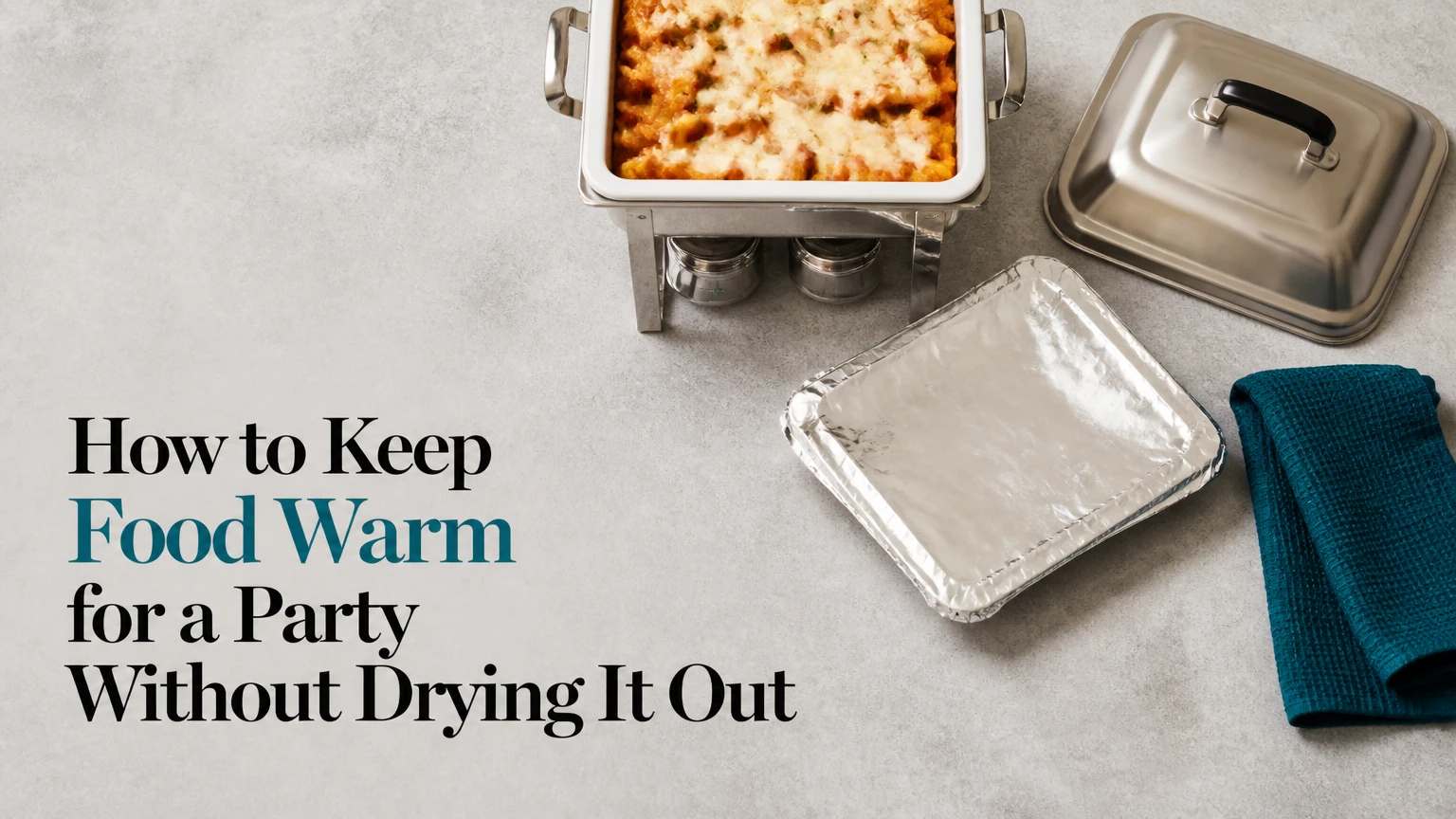
To keep food warm for a party, reheat cooked dishes thoroughly, transfer them to a preheated oven, slow cooker, chafing dish, warming tray, or insulated carrier, and keep the food at 140°F or higher. Use a digital thermometer, cover moist dishes, vent crisp foods, and discard perishables left below 140°F for more than two hours.
Key Facts at a Glance
The USDA recommends keeping hot food at 140°F or warmer during serving.
Reheat leftovers, casseroles, and previously chilled foods to 165°F before hot holding.
Perishable food should not remain between 40°F and 140°F for more than 2 hours, or 1 hour when the room or outdoor temperature exceeds 90°F.
Chafing dishes need water in the lower pan, while insulated carriers need preheating before food enters.
Fried foods stay crisp longer on a rack with ventilation than under a sealed lid.
Small serving pans retain heat and texture better than one deep, repeatedly opened pan.
What Is the Safest Way to Keep Food Warm?
The safest way to keep party food warm is active hot holding at 140°F or above after the food has been fully reheated. The best device depends on the menu: use a slow cooker for soup, chili, or dip; a chafing dish for buffet pans; an oven for casseroles; and a ventilated rack for fried food.
Food warmers maintain temperature; they are not dependable reheating appliances. A cold tray of pasta placed on a low warming mat can spend hours in the bacterial growth range even when the surface eventually feels hot.
The FDA Food Code 2022 sets 135°F as the minimum hot-holding temperature for many food-service operations, but the USDA consumer guidance uses 140°F. Using 140°F gives a home host a practical safety margin and aligns with the commonly quoted USDA instruction: “Keep hot foods hot, 140 °F or warmer.” Measure the food itself, not the air around the dish.
What temperature should party food reach before serving?
Previously chilled food should reach 165°F before it goes into a holding device. Food that has just finished cooking and has remained continuously hot does not need to reach 165°F again, but its center must remain at least 140°F during service.
Insert the thermometer into the thickest area and stir liquid foods before measuring. Check several spots in a deep casserole because the surface may be hot while the center remains cooler.
How long can food stay warm at a party?
Hot food can remain in service while it stays at 140°F or higher, but quality usually declines after 2-4 hours. Food left below 140°F should be discarded after 2 hours at normal room temperature, or after 1 hour above 90°F, according to USDA food-safety guidance.
A six-hour party therefore needs portion management rather than one giant pan. Hold half the food in the kitchen, replenish the buffet with a fresh hot pan, and keep the reserve covered until needed.
Which Equipment Keeps Food Warm Best?
The best equipment is determined by food moisture, serving depth, electricity, transport distance, and expected holding time. Chafing dishes suit buffet pans, slow cookers suit liquid dishes, ovens suit large casseroles, and insulated carriers suit transport rather than extended serving.
Typical consumer prices vary by brand and region. The ranges below describe common United States retail or rental costs, not guaranteed prices.
| Equipment | Typical temperature or heat behavior | Best holding time | Suitable foods | Typical cost |
|---|---|---|---|---|
| Chafing dish | 140°F-165°F with water pan and fuel | 2-4 hours | Pasta, meat, vegetables, casseroles | $20-$80 each |
| Slow cooker | Warm setting often 160°F-200°F, model-dependent | 2-6 hours | Chili, soup, queso, pulled pork | $30-$70 |
| Electric warming tray | Surface commonly 130°F-200°F | 2-4 hours | Shallow appetizers, pizza, serving dishes | $40-$100 |
| Conventional oven | Usually 150°F-200°F, appliance-dependent | 1-3 hours | Roasts, casseroles, sheet pans | Existing appliance |
| Insulated food carrier | Passive heat retention, often losing 2°F-4°F per hour | 1-4 hours | Full pans, barbecue, transported meals | $50-$400 |
| Preheated cooler | Passive insulation, often losing 5°F-8°F per hour | 1-3 hours | Wrapped pans, barbecue, potluck dishes | $20-$80 |
Should you use a chafing dish?
Use a chafing dish for a buffet with several shallow food pans and no convenient outlet. A standard chafer uses fuel below a water pan, and steam transfers gentle heat to the food pan above it.
Add approximately 1 inch of hot water to the water pan, place the food pan above the water, and light the fuel according to the manufacturer’s instructions. Never operate a water-based chafer without water because the empty pan can warp, overheat, or scorch food.
Two-hour and four-hour fuel cans are common. Wind shields help outdoors, but open fuel still creates a burn and fire hazard, especially near tablecloths, children, and low branches. Extinguish fuel with the supplied lid rather than moving a burning can.
Are slow cookers better for soups and dips?
Slow cookers are usually the most practical choice for soup, stew, chili, queso, meatballs, and shredded meat because their deep ceramic vessel limits evaporation. Use the appliance to bring food fully hot, then switch to Warm for holding if the manufacturer permits that setting.
Slow cookers are poor choices for crisp foods, delicate fish, roasted vegetables, and dishes that need a dry surface. Stir thick foods every 30-60 minutes, scrape the bottom gently, and add small amounts of hot broth or sauce only when texture permits.
Do not put cold leftovers into a slow cooker and assume the Warm setting will reheat them safely. Reheat the food separately to 165°F, or use the cooker’s documented cooking cycle when the recipe and appliance instructions support it.
When is an oven the right option?
An oven is the strongest option for large casseroles, roasted meats, baked pasta, and sheet-pan food when electricity is available. Set the oven to its verified Keep Warm setting or approximately 170°F, then check the food with a thermometer after 20-30 minutes.
Many ovens run above or below their displayed temperature. An inexpensive oven thermometer reveals whether a nominal 170°F setting is actually 150°F or 210°F.
Cover casseroles and sliced meats with foil to slow moisture loss. Keep fried foods uncovered or on a rack because sealed foil traps steam and turns a crisp crust soft.
How Do You Set Up a Warm Party Buffet?
Set up a warm party buffet by dividing the menu into holding groups, preheating equipment, reheating every dish correctly, and placing only manageable portions on the serving table. The most reliable arrangement keeps reserve food hot in the kitchen and minimizes lid openings during service.
Before You Start
| Requirement | Typical amount or specification | Why it matters |
|---|---|---|
| Digital probe thermometer | 1 unit, readable to 1°F | Confirms the food center is safe |
| Reheating temperature | 165°F for chilled leftovers | Reduces risk before hot holding |
| Holding target | 140°F or higher | Maintains the USDA consumer threshold |
| Preheating time | 20-30 minutes | Stabilizes the appliance before loading |
| Serving pan size | Half-size pan for 8-12 portions | Limits heat loss during service |
| Backup fuel or power plan | 1 spare can per chafer, or alternate outlet | Prevents a mid-party temperature failure |
Step 1: Match Each Dish to a Holding Method
Separate wet, dry, crisp, delicate, and cold foods before choosing equipment. Chili belongs in a slow cooker, baked ziti belongs in a covered chafer or oven, and fried chicken belongs on a rack in a ventilated warm oven.
You will know this step worked when every dish has a method that preserves both safety and texture. A common mistake is choosing equipment based only on capacity, such as placing crispy appetizers in a deep, humid slow cooker.
Step 2: Reheat Food Completely
Reheat chilled casseroles, leftovers, sauces, and cooked meats to 165°F before transferring them to a warmer. Stir sauces and dense foods so the thermometer does not measure a hot edge instead of the cooler center.
You will know this step worked when multiple thermometer readings reach 165°F. A common mistake is treating “steaming” or “piping hot” as a measurable safety standard.
Step 3: Preheat the Holding Equipment
Turn on electric warmers and ovens 20-30 minutes before loading them. Fill a chafing dish with about 1 inch of hot water, light the fuel, and wait until the pan is producing steady heat.
Preheat an insulated carrier by filling it with boiling water for 5-10 minutes, emptying it completely, and drying it before adding wrapped hot pans. You will know the setup is ready when the equipment maintains heat with an empty test pan or reaches the manufacturer’s operating temperature.
Step 4: Control Moisture and Surface Exposure
Keep lids on soups, sauces, rice, pasta, and casseroles. Cover roasts and sliced meat with foil, but leave a small vent if condensation is softening the surface.
Place fried food on a wire rack over a sheet pan and use an oven around 150°F-200°F, depending on the appliance and food. You will know the moisture control is correct when sauces remain fluid without a thick skin and fried coatings remain firm rather than wet.
Step 5: Measure the Food, Not the Container
Check each dish with a clean probe thermometer at least once before guests eat and approximately every hour during extended service. Measure the center, a corner, and the area nearest the heat source, then stir liquid foods before taking the final reading.
You will know the process is working when every serving pan remains at 140°F or higher. A common mistake is checking only the chafer water, which can be hot while the food pan remains under temperature.
Step 6: Replenish With Small Hot Batches
Place only 30-60 minutes of food on the buffet when practical, and hold the remainder in the kitchen. Replace a nearly empty pan with a fresh hot pan instead of pouring new food over an old layer.
This two-pan approach reduces repeated opening, preserves texture, and makes temperature checks easier. You will know it worked when the serving pan stays shallow, covered, and above 140°F throughout the meal.
How Should You Keep Different Foods Warm?
Different foods need different heat and moisture controls. Liquid-rich dishes tolerate enclosed heat, casseroles need coverage, roasted meats need limited venting, and fried foods need airflow rather than steam retention.
| Food type | Preferred equipment | Covering method | Service rule |
|---|---|---|---|
| Soup, chili, stew | Slow cooker at Warm | Tight lid, stir every 30-60 minutes | Add hot broth only if thickening occurs |
| Casserole, baked pasta | Oven or chafer | Foil or fitted lid | Use shallow pans and check the center |
| Pulled pork, meatballs | Slow cooker or chafer | Lid with occasional stirring | Add sauce or stock to limit drying |
| Roast beef, turkey slices | Oven or insulated carrier | Foil tent, not sealed plastic | Slice close to service time |
| Fried chicken, fries | Ventilated oven and wire rack | No sealed lid | Serve in small batches |
| Pizza, flatbread | Warming tray or low oven | Loose foil tent | Avoid stacking hot slices |
| Bread and rolls | Low oven or insulated basket | Cloth or loose foil | Remove from heat before crust hardens |
| Rice and vegetables | Chafer or covered oven pan | Tight cover | Stir rice gently and avoid prolonged holding |
How do you keep pizza warm without making it soggy?
Keep pizza warm on a preheated tray or rack in an oven at approximately 170°F-200°F, with slices separated rather than stacked. A loose foil tent retains heat while allowing some steam to escape.
A sealed cardboard box traps moisture against the crust and usually softens it. For a large order, ask the restaurant to stagger delivery, or transfer slices to a wire rack as soon as they arrive.
How do you keep fried food crisp?
Keep fried food crisp by holding it uncovered on a wire rack in a low oven and serving small batches. Do not use a sealed chafer, slow cooker, or tightly closed foil pan because trapped steam migrates into the crust.
Fried foods have a narrow quality window. The food can remain above 140°F yet become greasy or soft, so food safety and texture require separate controls.
How do you keep meat from drying out?
Keep meat from drying out by holding it whole when possible, covering it with a foil tent, and adding sauce or broth only when the recipe supports it. Thin slices lose moisture much faster than a roast or intact chicken breast.
Avoid holding lean meat for many hours. For a party lasting 4 hours, cook in two batches or slice only the amount needed for the next 30-60 minutes.
What Is the Best Method Without Electricity?
The best no-electricity method is a fuel chafing dish for active buffet service and a preheated insulated carrier for transport. Use wind guards outdoors, keep hot pans covered, and measure the food before serving because passive insulation cannot restore lost heat.
A clean, food-safe cooler can work as a temporary hot box. Preheat it with boiling water, empty and dry it, wrap hot pans in towels, and place them inside without sealing food in direct contact with non-food-safe materials.
| Situation | Best option | Typical capacity or duration | Main limitation |
|---|---|---|---|
| Backyard buffet | Wind-shielded chafer | 2-4 hours | Flame and wind management |
| Potluck transport | Insulated carrier | 1-4 full pans | No reheating ability |
| Remote picnic | Preheated cooler | 1-3 hours | Temperature falls steadily |
| Camping meal | Covered Dutch oven with safe heat source | 1-2 hours | Requires active supervision |
| Small outdoor snack table | Insulated serving bowl | 30-90 minutes | Limited capacity |
Do not place a sealed plastic food container directly on a burner, and do not use charcoal indoors. Outdoor fuel devices need clearance from walls, dry grass, umbrellas, and combustible table coverings.
How Do You Keep Food Warm for a Large Party?
For a large party, use multiple half-size pans, separate electrical circuits, and a replenishment schedule rather than one oversized serving vessel. Plan approximately one active pan per dish and keep reserve pans above 140°F in an oven, chafer, or carrier.
A single deep pan loses heat slowly at the surface but can develop cold areas near the center after repeated serving. Multiple shallow pans provide more consistent heating and allow a host to replace one dish without disturbing the rest of the buffet.
How much equipment does a 20-person party need?
A typical 20-person buffet needs four to six holding vessels for a menu of two entrées, two sides, and one sauce or dip. Use half-size pans for the entrées and sides, plus one slow cooker for a liquid dish.
Electric warmers often draw between 100 and 300 watts each, while slow cookers commonly draw 150-300 watts during heating. Read appliance labels and distribute devices across separate circuits when possible. A 15-amp, 120-volt circuit has a theoretical 1,800-watt capacity, but leaving operating headroom reduces nuisance breaker trips.
What Common Problems Make Party Food Unsafe?
The most common safety failures are putting cold food into a warmer, leaving food below 140°F too long, failing to measure the center, and assuming a lid guarantees safe heat. Each problem requires a temperature-based correction rather than a visual guess.
Food falls below 140°F
If food drops below 140°F, measure how long it has been below the threshold. Reheat it to 165°F promptly if the exposure was under two hours, then repair the failed fuel, outlet, or heat setting; discard it when the two-hour limit has passed, or after one hour above 90°F.
Food burns on the bottom
Move the dish to lower heat, stir from the bottom, and add a small quantity of hot broth, water, or sauce when appropriate. A warming tray can scorch a thick dip because heat enters from one concentrated surface rather than circulating through the food.
Food dries out
Use a fitted lid, foil cover, or water-assisted chafer, and reduce holding time for lean meat and rice. Adding liquid cannot restore a dry crust or overcooked pasta, so portion rotation is more effective than repeated rescue.
Fried food turns soggy
Remove the sealed lid, transfer food to a wire rack, and vent the holding area. Re-crisping in a 350°F oven for several minutes may improve texture, but check the food temperature afterward before serving.
A fuel canister goes out
Move guests away from the table, follow the fuel manufacturer’s extinguishing and replacement instructions, and never relight a hot or spilled canister. Outdoor wind shields reduce flame disruption, but they do not make an open flame safe near combustible materials.
The electrical circuit trips
Unplug one device before resetting the breaker, then distribute appliances across separate circuits. Do not use damaged extension cords, and keep cords away from walkways where guests can trip.
Can You Keep Food Warm in Advance?
You can prepare party food in advance, but safe preparation requires either continuous hot holding above 140°F or rapid chilling followed by reheating to 165°F. Food should not sit at room temperature while the host waits for guests.
For make-ahead dishes, cool food in shallow containers rather than a deep stockpot. The FDA Food Code uses 135°F to 70°F within 2 hours and 70°F to 41°F within a total of 6 hours for regulated food-service cooling; home cooks should use shallow portions, refrigeration, and a thermometer rather than relying on elapsed time alone.
Transport hot food in a preheated insulated carrier, keep the lid closed, and take a reading on arrival. If the center is below 140°F, reheat the food to 165°F before placing it on the buffet.
How Do You Choose the Right Setup?
Choose the setup by ranking safety, menu texture, electricity, capacity, and holding time in that order. No single warmer handles every dish well, and the most attractive setup can fail if it cannot maintain 140°F at the food center.
| Host situation | Recommended setup | Avoid | Practical reason |
|---|---|---|---|
| Indoor dinner party for 6-10 | Oven plus one slow cooker | Several countertop warmers | Lower clutter and simpler power demand |
| Buffet for 15-30 | Two to four chafers plus reserve oven space | One deep communal pan | Better portion rotation and heat control |
| Outdoor barbecue | Wind-shielded chafers and insulated carrier | Unprotected warming tray | Wind disrupts fuel and outdoor outlets vary |
| Elegant small gathering | Glass warming tray plus covered ceramic dishes | Disposable pans for every course | Preserves presentation while holding shallow foods |
| Potluck with transport | Preheated insulated carrier | Unheated cooler | Passive insulation retains heat but cannot reheat |
| Fried-food menu | Low oven, wire racks, small batches | Slow cooker or sealed chafer | Airflow protects crispness |
An honest limitation matters: insulated carriers and coolers are excellent for moving hot food, but they are not substitutes for active hot holding during a long buffet. Their temperature declines continuously, and the rate changes with pan fullness, opening frequency, ambient temperature, and starting temperature.
Frequently Asked Questions
Can aluminum foil keep food warm?
Aluminum foil slows radiant and convective heat loss, but it does not create heat. Foil works best over casseroles, roasts, and covered pans inside an oven or carrier; it is inadequate by itself for a two-hour buffet. Vent fried food with a loose tent so condensation does not soften the crust.
Can you put hot food straight into a slow cooker?
You can put already-hot food into a slow cooker for holding, but cold food should not go directly into the Warm setting. Reheat chilled food to 165°F first, then use the appliance’s Warm setting if it maintains at least 140°F in the food center.
What is the cheapest way to keep food warm?
The cheapest reliable setup uses an existing oven for casseroles and a borrowed or inexpensive slow cooker for soup, chili, or dip. A preheated cooler can transport wrapped hot pans, but it needs a thermometer and cannot safely compensate for food that started too cool.
Is it safe to leave a chafing dish unattended?
A chafing dish should not be left unattended because its fuel creates an open-flame and burn hazard. Keep it on a stable, heat-resistant surface, away from children and fabric, and follow the fuel manufacturer’s instructions for lighting, monitoring, and extinguishing.
How do caterers keep food hot during transport?
Caterers commonly reheat or cook food to the required temperature, load it into covered hotel pans, and place the pans in insulated carriers or heated transport cabinets. They monitor holding temperature with calibrated thermometers and limit carrier openings because each opening releases stored heat.
When should leftover party food be thrown away?
Throw away perishable party food that has remained below 140°F for more than 2 hours, or for more than 1 hour when the surrounding temperature exceeds 90°F. When the exposure time is unknown, discard the food rather than relying on smell, appearance, or a late temperature reading.
The Bottom Line
The safest way to keep food warm for a party is to reheat chilled dishes to 165°F, hold them at 140°F or higher, and match each menu item to the right equipment. Use slow cookers for moist foods, chafing dishes for buffet pans, ovens for casseroles, insulated carriers for transport, and ventilated racks for fried food. Check the center with a thermometer, rotate small batches, and discard food that exceeds the safe time below 140°F.