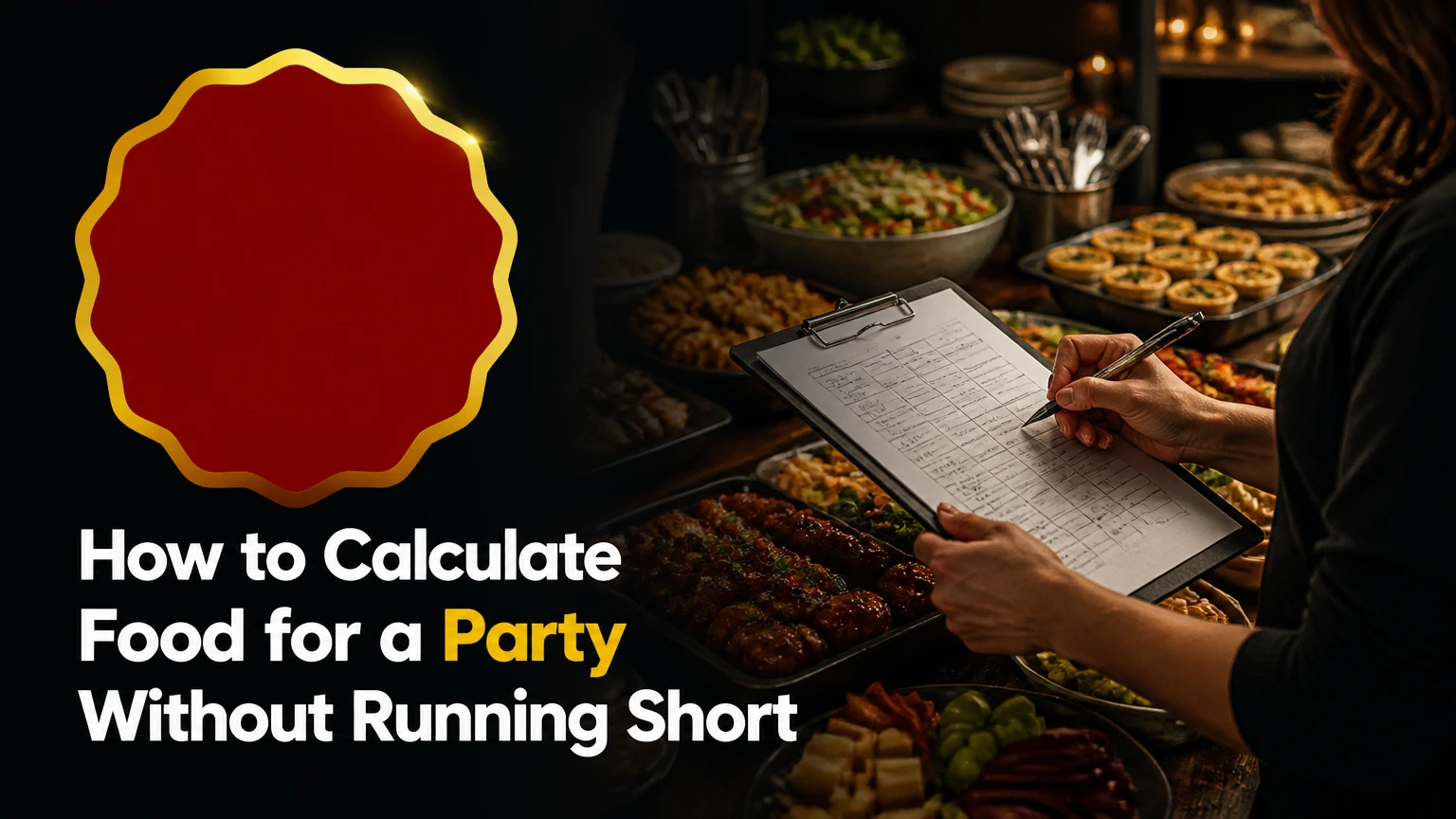
To calculate food for a party, convert the guest list into adult-equivalent servings, choose quantities for each menu category, and add a controlled buffer. For a full meal, plan roughly 1-1.5 pounds of total prepared food per adult equivalent, including the main dish, sides, salad, bread, and dessert, then adjust for party format and duration.
Key Facts at a Glance
- One adult-equivalent full meal usually requires 6-8 ounces of cooked main dish, 8-12 ounces of sides and salad, and one dessert serving.
- A teenager generally counts as one adult, while a child aged 4-10 commonly counts as one-half to three-quarters of an adult.
- A cocktail party needs 10-12 appetizer pieces per guest per hour when appetizers replace dinner.
- A 10% food buffer covers modest uncertainty; a 15% buffer fits open invitations, buffet service, or unusually hungry groups.
- Meat quantities must use either raw or cooked weight consistently because poultry, meat, and fish lose water and fat during cooking.
- Perishable food should not remain in the temperature danger zone for more than two hours, or one hour when ambient temperatures exceed 90°F (32°C), according to USDA guidance.
How Do You Calculate Food for a Party?
Use this formula: adult-equivalent guests × portion per guest × service adjustment × 1.10 buffer. Calculate the main dish, sides, appetizers, desserts, and drinks separately, because multiplying one total weight by fixed percentages can count the same food twice.
For example, a dinner for 20 adults with 7 ounces of cooked protein per guest requires 140 ounces, or 8.75 pounds, of cooked protein. With a 10% buffer, buy or prepare about 9.7 pounds cooked. If the recipe lists raw weight, divide by its expected yield instead of treating 9.7 pounds cooked as 9.7 pounds raw.
The largest planning variable is not the guest count. It is whether food replaces a meal, supplements a meal, or remains available throughout a long event. A two-hour plated dinner, a four-hour football buffet, and a three-hour cocktail reception need different calculations.
Before You Start
| Planning item | Typical requirement | Why it matters |
|---|---|---|
| Guest list | Confirmed adults, teens, children, toddlers | Creates adult-equivalent count |
| Planning time | 60-90 minutes | Covers menu, math, and shopping list |
| Food buffer | 10%, or 15% for uncertainty | Limits shortages without excessive waste |
| Kitchen capacity | 1 oven rack per 2-3 buffet dishes | Determines whether the menu is practical |
| Serving equipment | 1 serving utensil per dish | Prevents cross-contact and service delays |
Step 1: Build the Adult-Equivalent Count
Count adults and teenagers as one adult equivalent. Count children aged 4-10 as 0.5-0.75, toddlers aged 2-3 as 0.25-0.5, and infants according to their normal feeding arrangements rather than party portions.
Use the formula:
Adult equivalents = adults + teens + (older children × 0.75) + (young children × 0.5)
A guest list containing 14 adults, 4 teenagers, 4 children aged 5-9, and 2 toddlers becomes:
14 + 4 + (4 × 0.75) + (2 × 0.5) = 22 adult equivalents
You will know the conversion worked when the result reflects appetite, not merely headcount. Common mistake: treating a room of teenage athletes as the same as a daytime business luncheon.
Step 2: Identify the Meal Replacement Level
Classify the event as a full meal, light meal, snack reception, or cocktail meal replacement. The classification determines the base quantity more accurately than the party label.
| Service type | Main food baseline | Typical duration | Buffer |
|---|---|---|---|
| Full dinner | 14-20 oz total food | 2-3 hours | 10% |
| Light lunch or brunch | 10-14 oz total food | 2-3 hours | 10% |
| Afternoon snack | 6-10 appetizer pieces | 2-3 hours | 10% |
| Cocktail meal replacement | 10-12 pieces per hour | 2-4 hours | 15% |
| Dessert reception | 2-3 small pieces | 1.5-2 hours | 10% |
The 1-1.5-pound rule is a planning range, not a command to serve 24 ounces of edible food to every person. A 1.5-pound estimate makes more sense when the total includes bones, shells, bread, dessert, generous buffet choices, or a long event.
You will know the classification worked when every item has a role. Common mistake: adding a full appetizer spread to a full dinner without reducing the main-dish quantities.
Step 3: Assign Portions by Menu Category
For a full meal, begin with 6-8 ounces of cooked protein, 8-12 ounces of combined sides and salad, one bread serving where appropriate, and one dessert serving. Add appetizers only when guests will eat for more than 20-30 minutes before the meal.
| Menu category | Per adult equivalent | Practical unit | Example for 25 adults |
|---|---|---|---|
| Cooked boneless protein | 6-8 oz | 0.375-0.5 lb | 9.4-12.5 lb cooked |
| Cooked bone-in protein | 10-14 oz edible target | 0.625-0.875 lb edible | 15.6-21.9 lb edible |
| Starch side | 4-6 oz | 0.5-0.75 cup | 12.5-18.75 cups |
| Vegetable side | 3-4 oz | 0.375-0.5 cup | 9.4-12.5 cups |
| Salad | 2-3 oz | 1-1.5 cups leafy salad | 25-37.5 cups |
| Bread or rolls | 1.5-2 pieces | rolls or slices | 38-50 pieces |
| Dessert | 1 serving | slice or 2-3 bites | 25 servings |
These portions assume several menu choices. If the main dish is the only substantial food, increase cooked protein to 8-10 ounces and add 15% rather than relying on extra garnish.
You will know the category allocation worked when the main dish, sides, and dessert are calculated independently. Common mistake: using 40% protein, 40% sides, and 20% appetizers as a universal formula, because those percentages do not distinguish edible food from bones, sauces, or separate courses.
How Much Main Dish Should You Buy?
Plan 6-8 ounces of cooked boneless meat, poultry, fish, or a vegetarian main per adult equivalent for a meal with substantial sides. Convert that cooked target to raw purchasing weight using the ingredient’s expected yield, then add the buffer.
| Main dish | Cooked target | Typical raw purchase per guest | 25-adult raw estimate |
|---|---|---|---|
| Boneless chicken breast | 6-8 oz | 8-10 oz | 12.5-15.6 lb |
| Beef roast | 6-8 oz | 10-12 oz | 15.6-18.8 lb |
| Pulled pork shoulder | 6-8 oz | 12-16 oz | 18.8-25 lb |
| Bone-in ribs | 6-8 oz edible meat | 12-16 oz | 18.8-25 lb |
| Salmon fillet | 6-8 oz | 7-9 oz | 10.9-14.1 lb |
| Pasta as vegetarian main | 8-10 oz | 8-10 oz prepared | 12.5-15.6 lb prepared |
Cooking yield varies by cut, trimming, cooking method, and target temperature. USDA FoodData Central can help estimate ingredient nutrition, but it does not replace a recipe’s own yield because a braised pork shoulder and a trimmed chicken breast lose different amounts of weight.
A useful practitioner rule is to calculate high-cost protein at the lower end and inexpensive filling sides at the upper end. That approach protects the budget without making the table look sparse.
How Much Protein Is Needed for Multiple Mains?
Offer 5-6 ounces of each combined cooked protein when guests can choose between two main dishes, rather than serving 7 ounces of both. For 30 adults, chicken and salmon might each receive 5.5 ounces per guest, requiring 10.3 pounds cooked of each before the buffer.
Increase the share of the most familiar option when the alternatives have narrow appeal. For example, allocate 65% of the protein to chicken and 35% to a vegan entrée if only a few guests have requested the vegan option, while still preparing a separate, clearly labeled portion for those guests.
How Should You Calculate a Buffet?
A buffet for a full meal needs 6-8 ounces of cooked protein, 8-12 ounces of sides, and one dessert serving per adult equivalent, with a 10-15% buffer. Reduce quantities only when dishes overlap strongly, such as two potato sides that compete for the same appetite.
Buffet service creates variety-driven overconsumption. Guests take small portions of several dishes, and a popular item can disappear before everyone reaches the table. Use one substantial starch, one vegetable, one salad, one bread, and one or two mains as the most predictable structure.
| Buffet menu | Per adult equivalent | Quantity for 20 adults | Service note |
|---|---|---|---|
| Main protein | 7 oz cooked | 8.75 lb cooked | Split across two mains if needed |
| Potato or rice side | 5 oz | 6.25 lb prepared | One large pan |
| Vegetable side | 4 oz | 5 lb prepared | Refill in smaller pans |
| Green salad | 2.5 oz | 3.1 lb greens and toppings | Dress separately |
| Bread | 1.5 pieces | 30 pieces | Add 10% if bread is central |
| Dessert | 1 serving | 20 servings | Add 2-3 extra portions |
Put half of each hot dish out initially and replenish from covered backup containers. Smaller pans preserve texture, reduce exposure, and let the host respond to actual demand. The buffet is not successful merely because the total quantity is correct; food must remain safe and appetizing during service.
How Many Appetizers Should You Serve?
Serve 4-6 appetizer pieces per guest before a full meal, 6-8 pieces for a mid-afternoon event, and 10-12 pieces per person per hour when finger foods replace dinner. Multiply by the number of hours guests will actively eat, then add 10-15%.
For 18 guests arriving 45 minutes before dinner, plan 5 pieces each, or 90 pieces total. For a three-hour cocktail reception where appetizers are the meal, calculate 18 × 10 × 3 = 540 pieces, then add a 10% buffer for 594 pieces.
Use a mixture of filling and light items. A slider, dumpling, or small savory tart carries more satiety than a cucumber slice, so equal piece counts do not mean equal food value.
Which Appetizers Hold Well?
| Appetizer type | Quantity per guest | Holding window | Best service method |
|---|---|---|---|
| Sliders | 1-2 | 30-45 minutes hot | Covered tray, replenished |
| Crudités | 4-6 pieces | 2 hours chilled | Ice-lined platter |
| Cheese and crackers | 2-3 oz cheese | 2 hours chilled | Refill in small portions |
| Fried bites | 3-5 pieces | 15-25 minutes crisp | Oven rack, not sealed container |
| Dips | 2-3 tbsp | 2 hours chilled | Separate utensils |
Expert insight: fried foods lose quality faster than guests lose appetite. For a long reception, shift quantity toward skewers, stuffed vegetables, sandwiches, and chilled dips rather than doubling the fried-food count.
How Much Dessert Do You Need?
Plan one standard slice of cake or pie per guest, 4 ounces of ice cream per person, or 2-3 bite-sized desserts per guest. Add 10% when dessert is the only late-evening food or when guests have selected portions in advance.
For 25 guests, order 28 slices or buy a cake that yields at least 28 standard portions. A 9-inch round cake often produces fewer generous party slices than a caterer’s portion chart suggests, so confirm the bakery’s stated yield instead of relying on diameter alone.
Offer two dessert types by splitting the total, not by doubling it. A menu of 15 cake servings and 15 fruit-dessert servings for 25 guests gives choice and leaves a modest reserve, whereas 25 servings of each creates unnecessary waste.
How Many Drinks Should You Plan?
Plan two nonalcoholic drinks per guest in the first hour and one per guest per hour afterward, then provide water throughout the event. Alcohol requires a responsible-service plan, and a flat rule of one alcoholic drink per hour must not be used to encourage consumption or predict safe impairment.
For a three-hour party with 20 adults, the nonalcoholic baseline is 20 × 4 = 80 drink servings if the first hour includes two and the next two hours include one each. A 12-ounce serving makes that 960 fluid ounces, or 7.5 gallons, before adding water separately.
| Beverage | Per guest for 3 hours | 20-guest quantity | Container equivalent |
|---|---|---|---|
| Water | 24-36 oz | 3.75-5.6 gal | 1-2 five-gallon dispensers |
| Soft drinks or iced tea | 24-36 oz | 3.75-5.6 gal | 5-7 two-liter bottles |
| Coffee | 8-12 oz | 1.25-1.9 gal | 20-30 cups |
| Ice | 1-2 lb | 20-40 lb | 1-2 bags |
| Alcoholic servings | Varies by service plan | Confirm with venue rules | Avoid automatic refills |
Buy extra water when the event is outdoors, warm, or physically active. Coffee consumption rises during morning meetings, while alcohol demand can fall sharply when substantial food and nonalcoholic alternatives are readily available.
How Do Age and Appetite Change the Math?
Teenagers should usually count as adults, children aged 4-10 as one-half to three-quarters of an adult, and toddlers as one-quarter to one-half. Increase food by 10-20% for athletic groups, outdoor events, late-night meals, or menus dominated by grilled meat and bread.
For 10 adults, 6 teens, 8 children, and 4 toddlers, use:
10 + 6 + (8 × 0.75) + (4 × 0.5) = 25 adult equivalents
A child-focused party needs familiar, easy-to-hold food rather than adult portions of every dish. For 20 children, plan 1 small sandwich or 2-3 pizza slices, one fruit or vegetable portion, one snack portion, and one dessert, then adjust for the event’s age range and duration.
Do not reduce allergy-safe food according to the smaller appetite estimate. A child with celiac disease, a severe nut allergy, or a dairy allergy needs a complete safe meal, separate utensils, and protected serving space.
Which Party Format Uses Food Most Efficiently?
Plated dinners usually produce the most predictable portions, while buffets need the largest variety and the most careful replenishment. Cocktail receptions require the most detailed hourly calculation because guests consume food gradually and no single entrée defines a serving.
| Format | Food-control level | Typical main quantity | Labor or equipment need |
|---|---|---|---|
| Plated dinner | High | 6-8 oz cooked per guest | Plates, servers, timed kitchen |
| Family-style | Medium | 7-9 oz cooked per guest | Large platters, table space |
| Buffet | Medium-low | 7-9 oz cooked per guest | Chafers, labels, serving utensils |
| Cocktail reception | Low | 10-12 pieces per hour | Passed trays, frequent refills |
| Backyard barbecue | Low-medium | 8-10 oz cooked per guest | Grill capacity, holding space |
Choose plated service when attendance is fixed and portion control matters. Choose a buffet when guests need dietary choice or arrival times vary, but avoid offering multiple dishes from the same category unless you reduce each quantity.
Family-style service encourages second helpings because food remains visible on the table. A 10-15% buffer is more appropriate than the standard 10% when platters cannot be replenished quickly.
What Will the Food Cost?
Typical self-catered party food costs $10-$20 per person for a casual menu, drop-off catering costs $20-$45, and full-service catering commonly costs $75-$200 or more per person. Local labor rates, rental charges, staffing, tax, delivery, alcohol service, and premium proteins can move the final price outside those ranges.
| Service model | Typical food or service cost | Best fit | Main cost risk |
|---|---|---|---|
| Grocery self-catering | $10-$20 per person | Casual buffet | Labor and unused ingredients |
| Restaurant drop-off | $20-$45 per person | Office or home buffet | Delivery and minimum orders |
| Casual staffed catering | $45-$90 per person | Backyard or milestone event | Staff hours and rentals |
| Full-service catering | $75-$200+ per person | Formal reception | Labor, rentals, service charges |
| Premium plated menu | $150-$250+ per person | Weddings and galas | Multiple courses and staffing |
Compare quotes using the same guest count and service scope. A $35 drop-off quote may exclude plates, setup, chafing fuel, tax, delivery, and dessert, while a $90 staffed quote may include those items.
How Should You Handle Dietary Restrictions?
Create a complete substitute meal for each confirmed medical or ethical restriction, then calculate that food separately. Do not assume that removing cheese, meat, wheat, or nuts from a shared dish makes the dish safe, because shared utensils and preparation surfaces can cause cross-contact.
Label allergens in plain language, including milk, egg, wheat, soy, peanuts, tree nuts, fish, and shellfish. Keep substitute dishes covered until service, use separate serving utensils, and place them before the general buffet when accidental contact is most likely.
For a 30-person dinner with three vegan guests, prepare at least four vegan portions, not three, so one portion remains available if a guest’s plate is contaminated or a non-vegan guest selects the dish. The same principle applies to gluten-free meals and religious dietary requirements.
When Should You Shop and Prepare?
Buy shelf-stable ingredients 3-7 days before the party, fresh produce 1-3 days before, and fresh proteins 1-2 days before unless they are frozen. Finalize the menu four weeks ahead for catering, confirm the headcount about one week before, and make perishable preparation schedules 24-48 hours before service.
| Task | Recommended timing | Checkpoint |
|---|---|---|
| Confirm menu and dietary needs | 3-4 weeks before | Every guest category recorded |
| Place catering order | 1-3 weeks before | Delivery and service details written |
| Buy dry goods and drinks | 3-7 days before | Quantities checked against recipes |
| Buy produce and dairy | 1-3 days before | Refrigeration space available |
| Buy or thaw proteins | 1-2 days before | Raw weight and yield confirmed |
| Cook make-ahead dishes | 1 day before | Cooling containers prepared |
| Assemble cold dishes | 2-6 hours before | Chilled below 40°F |
| Reheat and serve | Event day | Hot food held at 140°F or above |
USDA Food Safety and Inspection Service guidance uses the phrase, “Keep hot food hot and cold food cold.” Use a food thermometer rather than judging safety by appearance, keep cold foods at 40°F or below and hot foods at 140°F or above, and discard perishable food left at room temperature beyond the applicable two-hour limit.
What Should You Do With Shortages and Leftovers?
If food runs short, serve the remaining protein in smaller portions with fast additions such as rice, pasta, bread, salad, beans, or a delivery order. If food remains, divide it into shallow containers, refrigerate it promptly, and label the container with the date and dish.
The safest shortage response is not to stretch food that has already sat out too long. A fresh pizza, prepared salad, canned beans, or quickly cooked pasta is safer than returning unrefrigerated meat to service.
The safest leftover response follows USDA timing: refrigerate perishable food within two hours, or within one hour above 90°F, and use clean containers. Reheat leftovers to 165°F, check with a thermometer, and freeze portions when they will not be eaten within several days.
Common Calculation Mistakes
- Counting raw weight as cooked weight: Apply the recipe yield before purchasing. A roast that yields 65% cooked meat needs substantially more raw weight than a boneless cut yielding 75-80%.
- Adding every category at full strength: Appetizers, bread, starch, and dessert can collectively exceed the meal requirement. Decide which foods replace calories and which foods provide variety.
- Ignoring service speed: A single large buffet pan may contain enough food but still create a shortage during a queue. Refill from backup pans.
- Using one buffer for every event: Use 10% for a confirmed guest list, 15% for uncertain attendance, and a larger operational reserve only when the menu is inexpensive and food safety can be maintained.
- Forgetting non-food supplies: Plates, napkins, cups, ice, serving utensils, foil, storage containers, and labels affect whether the calculated food can actually be served.
Worked Example: 25-Person Dinner
For 25 adults, calculate 175 ounces of cooked protein at 7 ounces each, or 10.9 pounds. Add 10% and prepare about 12 pounds cooked. If chicken yields 75% after cooking, purchase 16 pounds raw.
For sides, prepare 5 ounces of starch, 4 ounces of vegetables, and 2.5 ounces of salad per person. With the buffer, that becomes about 8.6 pounds of starch, 6.9 pounds of vegetables, and 4.3 pounds of salad. Add 28 dessert servings and at least 38 rolls if bread is part of the menu.
The Bottom Line
To calculate food for a party, convert the guest list into adult equivalents, classify the event, calculate each food category separately, convert cooked targets into raw purchasing quantities, and add a 10-15% buffer. Start with 6-8 ounces of cooked protein, 8-12 ounces of sides, one dessert, and a duration-based drink plan, then adjust for age, appetite, format, and dietary needs.
A reliable calculation is specific enough to create a shopping list but flexible enough to survive real guests. The most important safeguards are accurate headcount, consistent raw-to-cooked measurements, separate allergy-safe portions, and temperature-controlled service.
Frequently Asked Questions
How much food should I order for 10 people?
For 10 adult guests eating a full meal, plan 4.4-5 pounds of cooked main dish, 5-7.5 pounds of combined sides and salad, 11 dessert servings, and 15-20 rolls if bread is included. Add 10% before rounding, especially for buffet service or guests with unusually large appetites.
How many pizzas do I need for a party?
Plan two standard slices per adult for a light meal and three slices for a full meal, then add 10%. A 14-inch pizza commonly yields 8 standard slices, so 10 adults eating a full meal need about four 14-inch pizzas, with toppings divided according to dietary needs and appetite.
Should I count children as full guests?
Count teenagers as full guests in most meal calculations. Count children aged 4-10 as one-half to three-quarters of an adult, toddlers aged 2-3 as one-quarter to one-half, and infants according to their normal feeding plan rather than the party menu.
How much food should I prepare for a four-hour party?
For a four-hour full-meal party, use the normal meal quantities and add 10-15% if food remains available throughout the event. For a four-hour cocktail party, calculate 10-12 appetizer pieces per guest per hour, then add a 15% buffer and include substantial items such as sliders, wraps, or dumplings.
Can I use the 1.5-pound rule for every party?
The 1.5-pound rule works as a generous total-food estimate for a long buffet or meal with bones, bread, dessert, and several sides. It is too broad for precise plated dinners and should not replace separate calculations for cooked protein, sides, appetizers, dessert, and drinks.
How far in advance should I finalize a catering headcount?
Finalize the menu and dietary requirements three to four weeks before the event, then give the caterer the final headcount about one week before service unless the contract specifies another deadline. Ask whether the quote includes delivery, setup, rentals, staffing, tax, service charges, and leftovers.