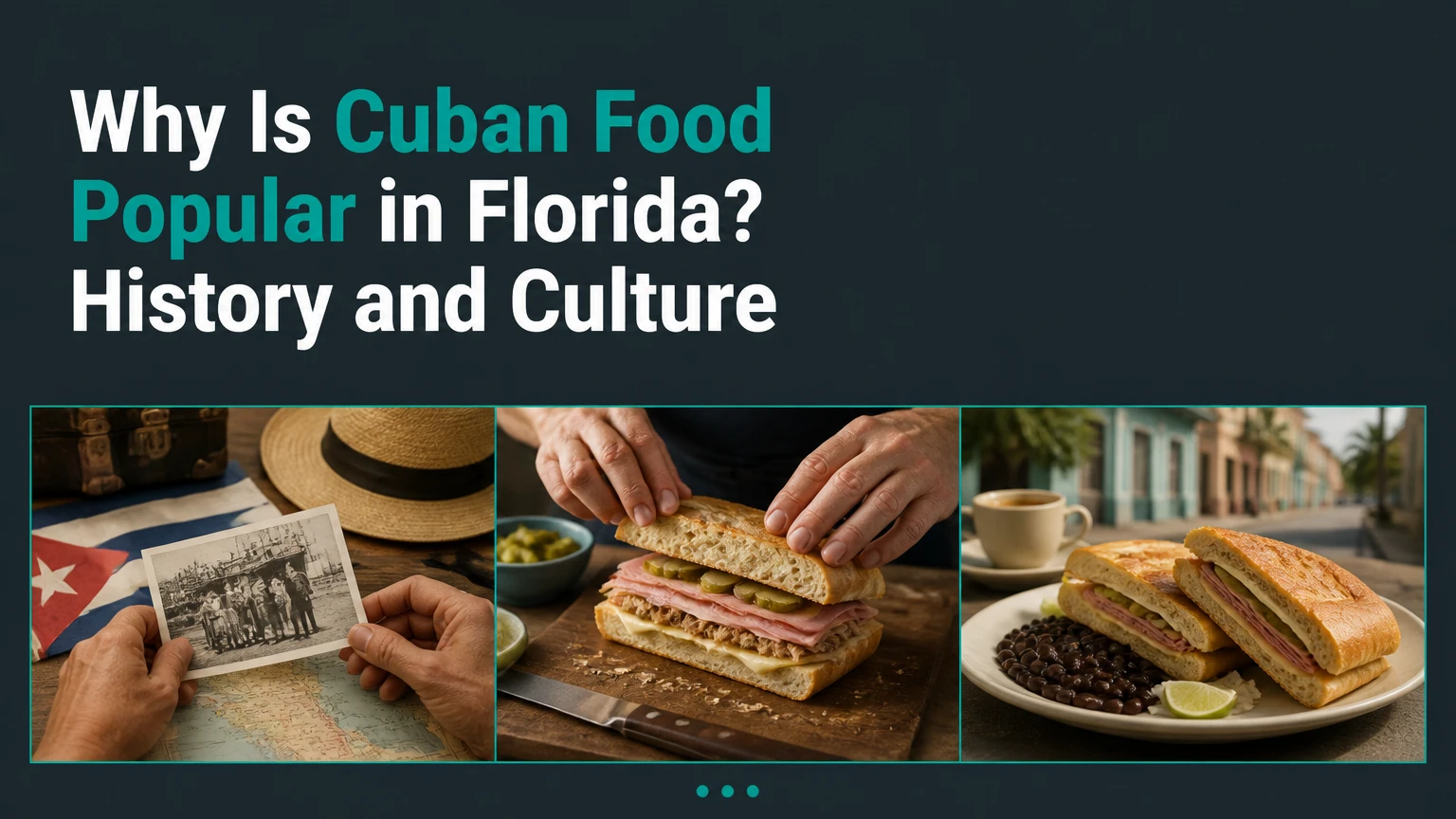
Cuban food is popular in Florida because geography, repeated immigration, and everyday affordability reinforced one another for more than a century. Cuban communities established bakeries, cafeterias, cigar-town neighborhoods, and coffee rituals in Key West, Tampa, and Miami, allowing dishes such as the Cuban sandwich, ropa vieja, and cafecito to become familiar to residents and visitors throughout the state.
Key Facts at a Glance
Florida’s closest point to Cuba is roughly 90 miles away, creating unusually durable maritime and family connections.
Cuban migration to Key West and Tampa expanded in the late 1800s, before the 1959 Cuban Revolution.
Miami’s Little Havana turned Cuban food into a daily public ritual through cafeterias, bakeries, and ventanitas.
Cuban cooking emphasizes garlic, onion, cumin, oregano, citrus, pork, beans, rice, and plantains rather than intense chile heat.
A typical cafecito costs about $1.50-$3, while a Cuban sandwich commonly costs about $10-$18 in Florida in 2025.
The Cuban sandwich has competing historical claims: Tampa traditionally includes salami, while Miami typically uses ham, roast pork, Swiss cheese, mustard, and pickles.
Why Did Cuban Food Take Root in Florida?
Cuban food took root in Florida because migration created permanent communities, and those communities built businesses that made traditional meals available every day. Geographic closeness helped people, ingredients, recipes, and news move between Cuba and Florida, but schools, workplaces, restaurants, and family kitchens transformed an immigrant cuisine into a statewide habit.
The first large culinary foundations appeared in Key West and Tampa’s Ybor City during the late nineteenth century. Cuban workers joined cigar manufacturing, particularly after cigar producers moved operations from Cuba to Florida. Food followed the workforce: bakeries supplied bread, cafés supplied coffee, and boardinghouses and households preserved familiar dishes.
The 1959 Revolution produced a much larger migration to Florida, especially Miami. Later arrivals, including people who came during the Mariel boatlift in 1980 and subsequent migration periods, expanded the Spanish-speaking customer base and added new family businesses. The result was cumulative rather than temporary. Each wave inherited institutions from earlier arrivals.
How Did Immigration Shape the Food Economy?
Cuban immigration shaped Florida’s food economy by creating both a ready customer base and a network of suppliers, workers, cooks, and restaurant owners. A panadería could sell bread and pastelitos in the morning, a cafeteria could serve lunch, and a ventanita could generate repeat coffee sales throughout the day.
That business model lowered the barrier to trying Cuban food. Customers did not need a reservation, a long explanation, or a large budget. A worker could buy a croqueta and café con leche before a shift, while a family could order rice, beans, pork, and plantains for dinner.
Food also transmitted language and social trust. Spanish-language menus, familiar service patterns, and neighborhood recommendations made Cuban establishments comfortable for Cuban Americans and accessible to other Floridians. Restaurants became practical community infrastructure, not merely places to eat.
Does Florida’s Proximity to Cuba Explain the Popularity?
Florida’s proximity to Cuba explains the strength of the connection, but proximity alone does not explain Cuban food’s popularity. Durable immigration, local employment, business ownership, tourism, and repeated exposure converted a geographic relationship into a food culture that non-Cuban residents could adopt.
Miami is about 90 miles from Cuba at its closest point, while Key West is even nearer. Those distances supported boat travel, family contact, commercial exchange, and a strong sense of cultural continuity. South Florida’s Caribbean climate also supports ingredients associated with Cuban cooking, including plantains, yuca, citrus, and tropical fruit.
Geography has limits, however. Other places are close to Cuba without developing Florida’s concentration of Cuban restaurants and institutions. Florida’s distinctive outcome came from the interaction of location with settlement history. Once Cuban communities became dense, restaurants could survive on local demand before tourism introduced the cuisine to a broader audience.
A useful rule of thumb is that proximity supplies access, while population density supplies continuity. Florida had both.
Which Florida Cities Are Most Important to Cuban Cuisine?
Miami, Tampa, and Key West are the three most important historic centers of Cuban food in Florida, but each city developed a different culinary identity. Miami is associated with post-1959 Cuban American life and Little Havana, Tampa with cigar-industry history and the salami-inclusive Cuban sandwich, and Key West with the earliest Florida-Cuba connection.
| City | Historical driver | Common food identity | Typical visitor setting |
|---|---|---|---|
| Key West | Cuban fishing, trade, and cigar links in the 1800s | Cuban bread, coffee, seafood-influenced dishes | Historic cafés and tourism corridors |
| Tampa | Ybor City cigar factories and immigrant labor | Tampa Cuban sandwich with Genoa salami | Cuban bakeries, lunch counters, neighborhood restaurants |
| Miami | Post-1959 migration and Cuban American institutions | Cafecito, croquetas, ropa vieja, pastelitos | Little Havana ventanitas and cafeterias |
| Orlando | Later population growth and tourism | Cuban sandwiches, bakery items, family restaurants | Suburban plazas and visitor districts |
| South Florida suburbs | Residential expansion beyond Miami | Home-style plates and bakery staples | Strip-mall cafeterias and takeout counters |
Why Is Miami Especially Associated With Cuban Food?
Miami is especially associated with Cuban food because Cuban migration created a concentrated social, commercial, and political center there after 1959. Little Havana’s restaurants, bakeries, coffee windows, markets, festivals, and Spanish-speaking institutions made Cuban cuisine visible to both residents and international visitors.
Calle Ocho became more than a restaurant district. It connected food with music, art, domino parks, religious traditions, family businesses, and public celebrations. A visitor might encounter a cafecito while walking between cultural attractions, then see the same dishes on menus in hotels and airports.
Miami also benefits from scale. A large customer base supports specialized bakeries, wholesale bread production, party catering, seafood restaurants, and businesses focused on regional Cuban dishes. That variety makes Cuban food easier to find and gives the cuisine more opportunities to adapt without losing its core identity.
Why Does Tampa’s Cuban Food Taste Somewhat Different?
Tampa’s Cuban food differs most visibly in the Cuban sandwich, which traditionally includes Genoa salami alongside ham, roast pork, Swiss cheese, mustard, and pickles. Tampa’s Italian and Spanish immigrant communities worked in the same cigar economy, so salami became part of the local version.
Miami restaurants generally omit salami. Neither version automatically represents the only authentic sandwich. The sandwich’s history is contested among Tampa and Miami traditions, and the ingredients reflect local labor communities rather than a single universally fixed recipe.
The bread and pressing method matter in both cities. Cuban bread is typically long, crisp on the outside, and soft inside; a plancha compresses the layered sandwich and warms the cheese. A restaurant using a different bread or adding lettuce and tomato is making a local variation, not necessarily serving the classic form.
What Makes Cuban Food Appealing to a Broad Florida Audience?
Cuban food appeals broadly because its flavor profile is savory, aromatic, citrusy, and moderately sweet rather than aggressively hot. Garlic, onion, cumin, oregano, black pepper, sour orange, pork, beans, and plantains create strong flavor without requiring tolerance for chile peppers.
Cuban cooking also offers recognizable formats. A pressed sandwich is easy to understand, while rice and beans create a filling plate familiar across many cuisines. Roast pork, shredded beef, fried plantains, and pastries provide distinct textures and price points for different appetites.
| Flavor or technique | Typical Cuban ingredient | Sensory effect | Common dish |
|---|---|---|---|
| Sofrito | Onion, green pepper, garlic | Aromatic, savory base | Black beans and stews |
| Mojo | Sour orange, garlic, oil | Tart, fragrant, rich | Lechón asado |
| Dry seasoning | Cumin, oregano, black pepper | Earthy, herbal warmth | Picadillo and meats |
| Plancha pressing | Heat and compression | Crisp bread, melted cheese | Cuban sandwich |
| Slow braising | Beef or pork with aromatics | Tender, concentrated flavor | Ropa vieja |
| Fried plantains | Green or ripe plantains | Starchy crunch or caramelized sweetness | Tostones or maduros |
Cuban food is also modular. Diners can choose a $2 pastry, a $12 sandwich, or a substantial entrée with rice and beans. That flexibility makes the cuisine suitable for commuters, families, tourists, and celebratory meals.
Is Cuban Food Spicy?
Traditional Cuban food is usually aromatic rather than chile-hot. Cuban recipes commonly build heat-free complexity with garlic, cumin, oregano, black pepper, citrus, and slow-cooked onions, although individual restaurants may offer hot sauce or pepper-based accompaniments.
This distinction helps explain the cuisine’s crossover appeal. Diners who avoid very spicy food can still experience layered seasoning. The food is not bland, but the dominant sensation comes from marinade, browning, salt, acidity, and sweetness rather than capsaicin.
Restaurants vary. A contemporary chef may add peppers or a spicy sauce, while a neighborhood cafeteria may keep the plate closer to family recipes. Asking for sauce on the side is the safest approach when heat level matters.
Which Cuban Foods Define Florida’s Food Culture?
Cuban foods that define Florida’s food culture include cafecito, pastelitos, croquetas, Cuban sandwiches, ropa vieja, lechón asado, black beans, rice, and plantains. These foods cover breakfast, work breaks, lunch, family dinner, celebrations, and late-night eating.
| Food | Core ingredients | Usual role | Typical Florida price in 2025 |
|---|---|---|---|
| Cafecito | Sweetened dark espresso | Morning or work-break drink | $1.50-$3 |
| Café con leche | Espresso and steamed milk | Breakfast | $3-$6 |
| Pastelito | Puff pastry with guava, cheese, or meat | Breakfast or snack | $1.50-$4 |
| Croqueta | Breaded ham, chicken, or cod mixture | Snack or appetizer | $1.25-$3 each |
| Cuban sandwich | Ham, roast pork, Swiss, mustard, pickles | Lunch | $10-$18 |
| Ropa vieja | Shredded beef, tomato, peppers, onion | Main plate | $16-$28 |
| Lechón asado | Mojo-marinated roast pork | Main plate or celebration | $16-$30 |
| Yuca con mojo | Cassava, garlic, citrus, oil | Side dish | $5-$10 |
How Do Cuban Coffee Rituals Spread Beyond Cuban Communities?
Cuban coffee rituals spread beyond Cuban communities because ventanitas made strong coffee inexpensive, fast, and social. The small serving format suited workdays, while a colada created a simple sharing ritual in offices, construction crews, salons, and neighborhood businesses.
A cafecito is a small, sweet espresso. A cortadito adds steamed milk. A café con leche pairs espresso with a larger quantity of hot milk, commonly alongside buttered Cuban bread at breakfast. A colada is a larger portion, often four to six small servings, intended for sharing.
A colada is not a normal individual coffee. Its caffeine content varies by roast, extraction, and serving size, but four to six espresso-sized portions can produce a substantial stimulant dose. Sharing the drink is part of the custom and also limits the practical problem of consuming several shots quickly.
What Is the Cuban Sandwich’s Florida History?
The Cuban sandwich became popular in Florida through cigar-town workplaces, immigrant communities, and tourism, but its precise origin remains disputed. Tampa claims an older local tradition linked to Ybor City, while Miami popularized a version without salami and helped make the sandwich an international symbol of Cuban American cuisine.
The sandwich’s basic architecture is consistent: Cuban bread, sliced ham, roast pork, Swiss cheese, yellow mustard, and dill pickles pressed on a hot plancha. Tampa’s traditional version adds Genoa salami, an ingredient associated with the city’s Italian immigrant population.
The disagreement is cultural and regional, not a reason to dismiss either version. Order the Tampa style in Tampa and the Miami style in Miami if you want to taste how local history changes one dish.
How Do Ventanitas Make Cuban Food Part of Daily Life?
Ventanitas make Cuban food part of daily life by placing coffee, pastries, croquetas, and sandwiches at a walk-up window with service commonly completed in one to seven minutes. The format combines low operating costs, high customer frequency, and public conversation.
| Dining format | Typical spend | Typical wait | Best use | Main limitation |
|---|---|---|---|---|
| Ventanita | $2-$18 | 1-10 minutes | Coffee, pastry, sandwich | Limited seating and menu |
| Cafeteria | $12-$30 per person | 10-25 minutes | Rice plates and family meals | Noisy, variable service |
| Bakery counter | $2-$20 | 2-12 minutes | Pastries and croquetas | Few hot entrée choices |
| Full-service restaurant | $25-$70 per person | 30-90 minutes | Dinner and celebrations | Higher prices and slower service |
| Tourist-oriented venue | $20-$85 per person | 30-100 minutes | Cultural outing | Premium pricing is common |
A ventanita also lowers social risk. Someone unfamiliar with Cuban cuisine can point to a pastry, order a coffee, and observe how regulars use the space. Repeated visits create familiarity faster than a formal tasting menu would.
The format is especially effective in Florida’s warm climate and car-oriented commercial areas, where strip-mall counters and street-facing windows can serve a high volume of customers without extensive dining rooms.
How Much Does Cuban Food Cost in Florida?
Cuban food in Florida typically costs $1.50-$6 for coffee or a pastry, $10-$18 for a Cuban sandwich, and $16-$30 for a full entrée in 2025. Miami tourist districts, waterfront locations, delivery orders, and upscale restaurants can exceed these ranges, while neighborhood cafeterias may charge less.
Prices vary with portion size and service model. A plate of rice, black beans, roast pork, and plantains may provide two modest meals, so the relevant value is not always the menu price alone. Cafeteria portions are often larger than fast-casual sandwich portions.
| Order scenario | Typical total per person | Service time | What the price usually includes |
|---|---|---|---|
| Coffee and pastry | $4-$9 | 2-8 minutes | Cafecito or café con leche plus one pastry |
| Sandwich lunch | $14-$25 | 8-20 minutes | Cuban sandwich and a drink |
| Cafeteria plate | $16-$30 | 15-30 minutes | Entrée, rice, beans, and one side |
| Family-style dinner | $25-$55 | 30-75 minutes | Main dish, sides, and nonalcoholic drink |
| Upscale dinner | $50-$100 | 60-120 minutes | Appetizer, entrée, dessert, and drink |
These are typical planning ranges, not statewide price controls. Check current menus before traveling, especially in Miami Beach, Key West, airport districts, and high-rent sections of Little Havana.
How Does Cuban Food Compare With Mexican and Puerto Rican Food?
Cuban food differs from Mexican and Puerto Rican food in its staple combinations, seasoning structure, and historical pathway, although the cuisines share ingredients such as rice, beans, pork, plantains, and citrus. Cuban cuisine usually centers garlic, oregano, cumin, sofrito, mojo, and pressed bread rather than tortillas, chiles, or heavy adobo.
| Cuisine in Florida | Common starch or bread | Typical seasoning emphasis | Signature examples | Common misconception |
|---|---|---|---|---|
| Cuban | Rice, beans, plantains, Cuban bread | Garlic, cumin, oregano, sour orange | Ropa vieja, Cuban sandwich | All Caribbean food is spicy |
| Mexican | Corn or flour tortillas, rice | Chiles, cilantro, lime, cumin | Tacos, mole, enchiladas | Mexican and Cuban sandwiches are interchangeable |
| Puerto Rican | Rice, plantains, yuca | Sofrito, oregano, sazón, adobo | Mofongo, pernil, arroz con gandules | Every sofrito has the same ingredients |
| Dominican | Rice, beans, plantains | Garlic, oregano, citrus, onions | Mangú, sancocho, pollo guisado | Plantain dishes are identical across islands |
The comparison matters because Florida diners often group Latin American cuisines together. Cuban food has its own culinary vocabulary and service culture, even where ingredients overlap.
Why Do Tourists and Non-Cuban Floridians Eat It?
Tourists and non-Cuban Floridians eat Cuban food because the cuisine offers a recognizable cultural experience at accessible prices and in highly visible locations. Visitors can encounter a historic neighborhood, hear Spanish, watch coffee preparation, and eat a complete meal without needing specialized culinary knowledge.
Tourism magnifies dishes that travel well. Cuban sandwiches, pastelitos, croquetas, and coffee require limited explanation, tolerate quick service, and photograph or describe easily in travel guides. Hotels, cruise areas, airports, and food tours then introduce those items to people who may never visit a Cuban household.
The relationship also works in reverse. Tourism brings revenue and attention, but local customers determine whether a restaurant survives. A venue dependent only on visitors may alter prices and recipes, while a neighborhood cafeteria must satisfy repeat customers who notice changes in bread, pork, coffee, and portion size.
What Should a First-Time Diner Order?
A first-time diner should order a Cuban sandwich, two ham croquetas, and a café con leche if the goal is to sample the cuisine’s main formats in one visit. The combination covers pressed bread, roast pork, cured meat, dairy, fried texture, and the sweet-bitter coffee tradition.
For a broader meal, choose ropa vieja or lechón asado with white rice, black beans, and maduros. Ropa vieja offers tender shredded beef with a tomato-based sauce, while lechón asado emphasizes citrus-garlic marinade and slow-roasted pork.
Which Order Fits Each Situation?
| Diner situation | Recommended order | Typical cost | Reason |
|---|---|---|---|
| Quick breakfast | Café con leche and guava-cheese pastelito | $5-$10 | Fast, portable, and mild |
| First lunch | Cuban sandwich and ham croqueta | $14-$25 | Introduces the best-known staples |
| Large appetite | Lechón asado, rice, beans, maduros | $20-$32 | High-protein, filling plate |
| Lower-fried option | Pollo a la plancha, beans, salad, yuca | $18-$30 | Grilled protein and boiled cassava |
| Sweet-savory preference | Elena Ruz sandwich or guava-cheese pastelito | $5-$18 | Combines fruit, dairy, and bread |
| Shared snack | Colada and assorted croquetas | $10-$22 | Uses the coffee-sharing tradition |
Traditional Cuban food is not automatically light. Fried pastries, croquetas, white rice, plantains, pork, and sweet coffee can produce a high-calorie meal. A diner seeking balance can choose grilled chicken, black beans, a smaller rice portion, salad, or boiled yuca with mojo, but preparation varies by restaurant.
What Ordering Mistakes Should Visitors Avoid?
Visitors should avoid treating Cuban food as a generic category, drinking a full colada alone, expecting chile-heavy seasoning, or changing a classic sandwich before tasting it. Small choices reveal local etiquette and prevent misunderstandings at busy cafeterias and ventanitas.
- Do not order a colada as a single serving by default. Ask how many small cups come with it and share the portions.
- Do not assume the Cuban sandwich includes lettuce and tomato. The classic structure uses ham, roast pork, Swiss cheese, mustard, pickles, and Cuban bread.
- Do not wait for a dining-room table when you only want coffee or pastries. Use the exterior ventanita when one is available.
- Do not equate Cuban food with Mexican chile heat. Ask for hot sauce separately rather than expecting it in the cooking.
- Do not judge authenticity solely by the presence of salami. Salami is a traditional Tampa feature and is usually absent from Miami versions.
- Do not ignore portion size. A cafeteria entrée with rice, beans, meat, and plantains may be substantially larger than a sandwich lunch.
An experienced ordering rule is to watch the counter before speaking. Regular customers often order in short, specific phrases, and the pace can be quick during breakfast and lunch rushes.
What Is Cuban Food in Florida Not Good For?
Cuban food in Florida is not ideal for diners seeking very spicy dishes, low-carbohydrate meals by default, or consistent statewide recipes. Traditional menus rely heavily on rice, bread, fried foods, pork, sweet plantains, and sugary coffee, although most restaurants offer practical substitutions.
Cuban food is also a poor choice when a diner needs strict allergen certainty without advance communication. Pastries and croquetas may share fryers, sauces can contain undisclosed ingredients, and bread-based dishes complicate gluten-free dining. Ask the restaurant directly about cross-contact and preparation.
Authenticity is another limitation if treated as a single standard. Tampa and Miami disagree about the Cuban sandwich, restaurants adapt recipes to local customers, and contemporary Cuban American chefs may reinterpret traditional dishes. Regional variation is evidence of cultural history, not automatically a defect.
Why Does Cuban Food Remain Popular Across Florida?
Cuban food remains popular across Florida because historical settlement created institutions, those institutions made the cuisine inexpensive and convenient, and tourism introduced the food to a much larger audience. Coffee windows, bakeries, family cafeterias, and signature sandwiches keep the cuisine embedded in ordinary routines rather than limiting it to heritage celebrations.
The strongest explanation for why is cuban food popular in florida is therefore cumulative: Florida is close to Cuba, but generations of migration supplied the people, businesses, recipes, and social habits that proximity alone could never create. The cuisine became both a marker of Cuban identity and a practical part of Florida’s public food economy.
Frequently Asked Questions
Did Cuban immigrants bring all Cuban food traditions directly from Cuba?
Cuban immigrants brought core recipes and techniques, but Florida Cuban food developed through adaptation. Local ingredients, American portion sizes, Italian influence in Tampa, restaurant economics, and changing migration waves shaped what appears on modern menus. Cuban American cuisine preserves continuity while also recording the history of the Florida communities that made it.
Is Cuban food healthier than other Latin cuisines?
Cuban food can support a balanced meal, but traditional preparations are not automatically low-calorie. Black beans, grilled chicken, yuca, and vegetables offer useful options, while fried pastries, roast pork, rice, plantains, and sweet coffee increase calories and saturated fat. Healthfulness depends more on preparation and portion size than cuisine labels.
Are Cuban sandwiches always pressed?
Classic Cuban sandwiches are pressed on a plancha, which warms the fillings, melts the Swiss cheese, and crisps the bread. Some cafés use a sandwich press or flat-top grill instead. An unpressed sandwich may still contain similar ingredients, but it lacks the texture and heat associated with the traditional preparation.
Where should someone go for Cuban food outside Miami and Tampa?
Outside Miami and Tampa, look for Cuban bakeries, cafeterias, and ventanitas in South Florida suburbs, Orlando, Fort Lauderdale, West Palm Beach, and areas with established Cuban American populations. Search menus for Cuban bread, cafecito, croquetas, lechón asado, and rice-and-bean plates rather than relying only on a restaurant’s name.
Why is Cuban coffee served so sweet?
Cuban coffee is served sweet because espresso is traditionally mixed with sugar during preparation to create espuma, a thick layer of sweet foam. The sweetness is part of the drink’s identity and balances the dark roast’s bitterness. Customers can request less sugar, but the customary cafecito is distinctly sweet.
What is the difference between maduros and tostones?
Maduros are ripe plantains fried until soft and caramelized, while tostones are green plantains cut, fried, pressed, and fried again until crisp. Maduros contribute sweetness to a meal; tostones provide savory crunch. Both are common sides, but they create noticeably different textures and flavor balances.