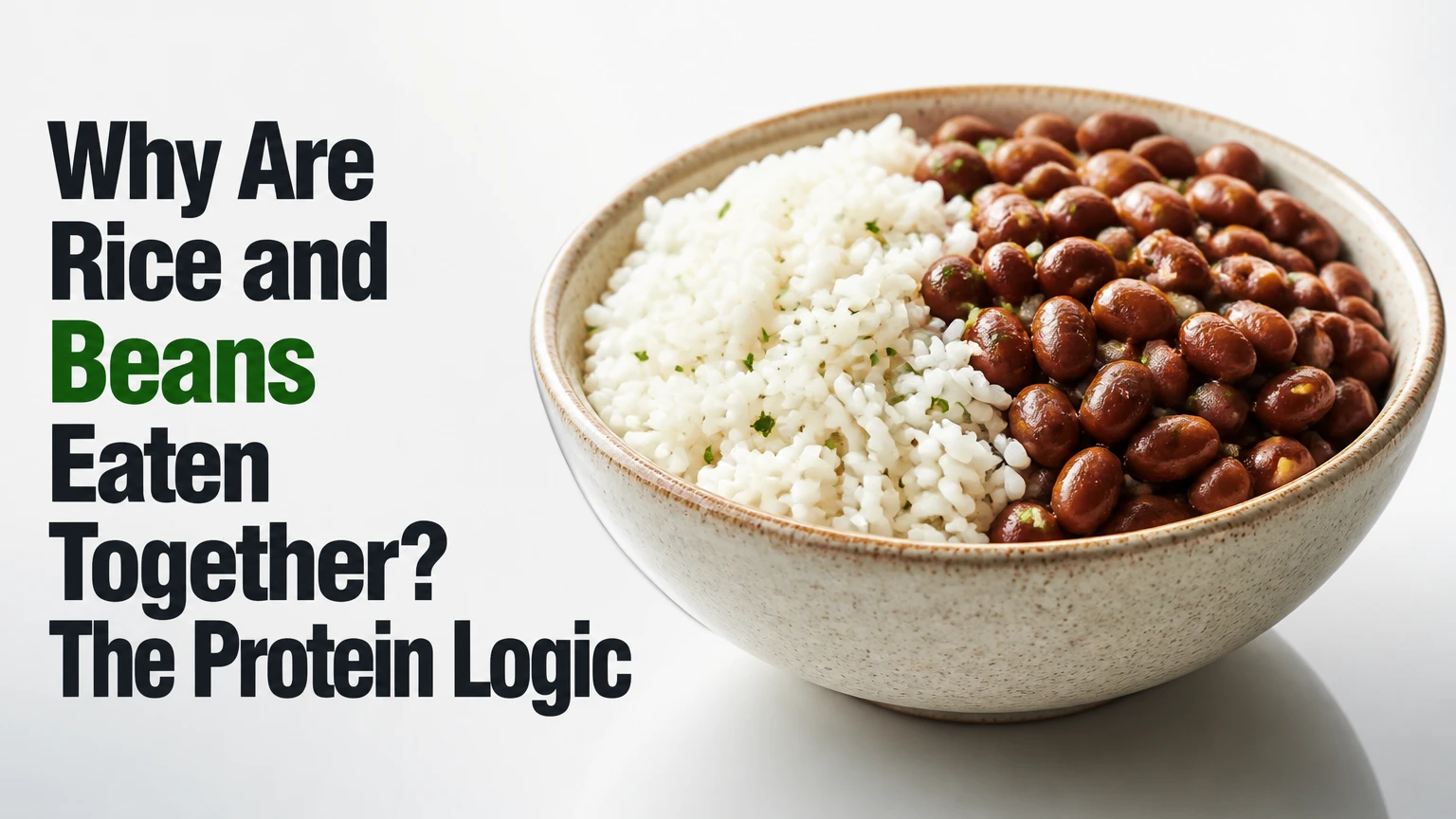
Rice and beans are eaten together because their amino acid patterns complement one another: rice contributes relatively more sulfur-containing amino acids, while beans contribute more lysine. Together, they can provide all nine essential amino acids, while also delivering affordable calories, plant protein, fiber, minerals, and long storage life.
Key Facts
Rice and beans complement each other because grains tend to be lower in lysine and legumes tend to be lower in methionine.
People do not need to combine complementary proteins in the same bite or meal; adequate variety across the day is usually enough.
A cup of cooked rice and beans commonly provides about 250-350 calories, 9-14 grams of protein, and 7-12 grams of fiber, depending on the ratio.
Dry rice and beans can cost roughly $0.25-$0.75 per serving in the United States, while prepared versions cost more.
Beans provide iron, potassium, magnesium, and fiber, but rice and beans do not supply vitamin B12 unless fortified foods or animal products are added.
Soaking beans can shorten cooking time and reduce some fermentable carbohydrates, but thoroughly cooking dry kidney beans is a food-safety requirement.
Why Are Rice and Beans Eaten Together?
Rice and beans are eaten together for four linked reasons: complementary protein, dependable calories, low cost, and practical storage. The pairing also fits agricultural traditions because rice grows well in some wet regions, beans grow in different soils, and both ingredients can be dried for months.
The nutritional logic is real, but the popular explanation is often oversimplified. Rice and beans do not become chemically fused into a new food, and the body does not require a perfect amino acid profile at every individual meal. Digestion breaks both foods into amino acids, which enter a shared metabolic pool.
The combination became culturally important because nutrition and logistics reinforced each other. A household could store sacks of rice and dried legumes, cook them with local aromatics, and produce a filling meal without buying meat. That pattern appears in dal chawal, gallo pinto, moros y cristianos, red beans and rice, and mujaddara, although the recipes and histories differ.
How Do Rice and Beans Complement Each Other?
Rice and beans complement each other through protein complementation: rice is generally limited by lysine, while beans contain more lysine but are relatively lower in sulfur-containing amino acids such as methionine. The pairing improves amino acid balance, although the amount of total protein and the rest of the diet still determine nutritional adequacy.
Proteins are built from 20 amino acids. Humans can synthesize some of them, but nine are essential because food must supply them:
- Histidine
- Isoleucine
- Leucine
- Lysine
- Methionine
- Phenylalanine
- Threonine
- Tryptophan
- Valine
A limiting amino acid is the essential amino acid present in the smallest proportion relative to human needs. In many cereal proteins, lysine is limiting. Legumes usually improve lysine intake but can be relatively less concentrated in methionine and cysteine.
The exact profile varies by species, cultivar, processing, and serving size. White rice, brown rice, lentils, black beans, kidney beans, and chickpeas are not nutritionally identical. The useful rule is directional, not absolute: grains and legumes often complement one another.
Nutrition guidance has moved away from the old requirement to combine proteins at every meal. The Harvard T.H. Chan School of Public Health explains that “you don’t need to get all the essential amino acids at every meal,” because the body maintains amino acid pools and a varied diet can supply them over time. Rice and beans remain a convenient combination, not a biological deadline.
What Does Rice Contribute?
Rice contributes carbohydrate energy, some protein, and relatively useful amounts of methionine compared with many legumes. Rice is not a high-protein food, however, and describing it as universally “rich” in methionine exaggerates differences that depend on the comparison and the variety.
One cup of cooked white rice typically contains about 200 calories and 4 grams of protein. Brown rice has a similar calorie range but more fiber, magnesium, and naturally occurring nutrients because the bran and germ remain intact. Enriched white rice may provide added folate, iron, and other nutrients.
Rice also supplies the starch that makes bean-based meals more calorie-dense. For people with high energy needs, that is useful. For someone managing blood glucose or portions, a large rice serving can dominate the meal’s carbohydrate load.
What Do Beans Contribute?
Beans contribute lysine-rich plant protein, dietary fiber, potassium, magnesium, folate, and iron. A half-cup of cooked beans commonly contains about 110-130 calories, 7-9 grams of protein, and 6-9 grams of fiber, with values changing by variety.
Bean fiber includes resistant starch and fermentable carbohydrates. Those compounds support gut bacteria for many people, but they can also cause gas, abdominal pressure, or loose stools when intake rises quickly. Gradual increases and smaller portions are more tolerable than suddenly eating a large bowl.
Beans also contain phytate, a compound that can bind some minerals during digestion. Soaking, sprouting, fermenting, and cooking reduce phytate, while vitamin C-rich foods such as tomatoes, peppers, citrus, and cabbage can improve non-heme iron absorption.
Do Rice and Beans Need to Be Eaten Together?
Rice and beans do not need to be eaten in the same meal to provide complementary amino acids. Eating varied protein foods over the same day is generally sufficient for healthy people, although combining them is convenient and creates a familiar, nutritionally balanced plate.
This distinction matters for meal planning. A person could eat oatmeal with nuts at breakfast, lentil soup at lunch, and rice with vegetables at dinner. The total daily pattern matters more than whether rice touches beans in one serving.
People with higher protein needs may still benefit from planning protein deliberately. Athletes, older adults, people recovering from illness, and anyone eating very few calories need enough total protein, not merely theoretical amino acid completeness. Rice and beans can contribute substantially, but a large volume may be necessary to reach a high protein target.
| Cooked portion | Calories | Protein | Fiber |
|---|---|---|---|
| 1 cup white rice | 190-210 | 4-5 g | 0.5-1 g |
| 1 cup brown rice | 210-220 | 5 g | 3-4 g |
| 1 cup black beans | 220-240 | 14-16 g | 14-16 g |
| 1 cup lentils | 220-240 | 17-18 g | 15-16 g |
| 1/2 cup rice plus 1/2 cup beans | 205-225 | 9-11 g | 7-9 g |
Are Rice and Beans a Healthy Everyday Meal?
Rice and beans can be a healthy everyday meal when portions, preparation, and accompanying foods fit the person’s needs. The pairing supplies fiber and plant protein at low cost, but it becomes less balanced if it is heavily salted, fried in large amounts of oil, or eaten without vegetables and a reliable vitamin B12 source.
A practical plate might contain one-half cup cooked rice, one-half to one cup beans, one cup vegetables, and a small amount of unsaturated fat. Salsa, cabbage, greens, tomatoes, peppers, onions, avocado, olive oil, or pumpkin seeds can improve flavor and fill nutritional gaps.
Rice and beans are especially useful when replacing processed meat or a meal built around refined snacks. They are less useful as a complete diet. The pair is low in vitamin B12, and its calcium, zinc, and protein density may not meet every person’s needs without other foods.
The U.S. Dietary Guidelines for Americans, 2020-2025, identifies beans, peas, and lentils as nutrient-dense foods that can fit within both vegetable and protein-food patterns. That classification supports the pairing’s role, but it does not mean every rice-and-bean preparation has the same health value.
How Much Rice and Beans Should You Eat?
A useful starting ratio is one-half cup cooked rice to one-half cup cooked beans, producing roughly 200-225 calories and 9-11 grams of protein before oils, sauces, meat, cheese, or toppings. Increase beans for more protein and fiber, or reduce rice when carbohydrate portions need tighter control.
| Goal | Rice portion | Bean portion | Typical additions |
|---|---|---|---|
| Light side dish | 1/3 cup | 1/3 cup | 1 cup leafy vegetables |
| Standard meal | 1/2 cup | 1/2-1 cup | Salsa and cabbage |
| Higher-protein meal | 1/2 cup | 1 cup | Tofu, yogurt, eggs, or seeds |
| High-energy meal | 1 cup | 1 cup | Oil, avocado, vegetables |
Serving needs vary with body size, activity, age, and total diet. A sedentary adult may find one cup of the mixture filling, while a manual worker or endurance athlete may need two cups plus additional protein and fat.
The portion is also a glycemic-management tool. Beans slow digestion because their fiber and protein reduce the meal’s carbohydrate concentration, but beans do not cancel the effect of a very large serving of white rice.
Why Is the Pairing Found Across Cultures?
Rice and legumes appear across cultures because the ingredients are inexpensive, storable, adaptable to local agriculture, and easy to season. Similar nutritional logic emerged independently in Latin America, the Caribbean, South Asia, the Middle East, Africa, and the Southern United States.
| Region or dish | Grain | Legume | Distinctive ingredients |
|---|---|---|---|
| Costa Rica, gallo pinto | Long-grain rice | Black or red beans | Lizano-style sauce, onion, pepper, cilantro |
| Brazil, arroz e feijão | White rice | Black or brown beans | Garlic, onion, collard greens, farofa |
| India, dal chawal | Basmati or regional rice | Lentils or pigeon peas | Turmeric, cumin, ginger, chili |
| Middle East, mujaddara | Rice or bulgur | Lentils | Caramelized onions, cumin |
| Southern United States, Hoppin’ John | Rice | Black-eyed peas | Onion, celery, pepper, smoked seasoning |
| Caribbean, rice and peas | Rice | Pigeon peas or kidney beans | Coconut milk, thyme, scallion |
These dishes should not be collapsed into one generic origin story. Gallo pinto, Brazilian arroz e feijão, and Indian dal chawal developed through different foodways, migrations, crops, and colonial histories.
The shared pattern is functional. Dry grains and legumes require little refrigeration, tolerate bulk purchasing, and absorb regional flavors. Their cultural meaning comes from those local histories, not from protein chemistry alone.
Which Grain Works Best With Beans?
White rice is the fastest and least expensive option, brown rice supplies more fiber, and quinoa offers more protein per cooked cup but usually costs more. The best grain depends on cooking time, texture, carbohydrate goals, budget, and the flavor profile of the dish.
| Grain | Cooked calories per cup | Protein | Typical cooking time |
|---|---|---|---|
| White rice | 190-210 | 4-5 g | 15-20 minutes |
| Brown rice | 210-220 | 5 g | 35-50 minutes |
| Wild rice | 160-170 | 6-7 g | 40-55 minutes |
| Quinoa | 220-230 | 8 g | 15-20 minutes |
| Bulgur | 150-160 | 5-6 g | 10-15 minutes |
Quinoa is botanically a seed rather than a true grain, and its protein profile is relatively strong. It is not automatically healthier, because calories, portion size, price, and the rest of the meal still matter.
Brown rice is not universally better. It can contain more inorganic arsenic than white rice because arsenic concentrates in the outer layers, according to the U.S. Food and Drug Administration’s rice research. Rinsing rice and cooking it in excess water, followed by draining, can reduce arsenic, though that method also removes some water-soluble nutrients.
Should You Use Dry Beans or Canned Beans?
Dry beans are usually cheaper and allow precise control over salt, while canned beans reduce preparation time from several hours to about 15-25 minutes. Canned beans are a sound choice when convenience prevents reliance on less nutritious takeout or packaged snacks.
| Factor | Dry beans | Canned beans |
|---|---|---|
| Typical U.S. cost | $0.20-$0.60 per cooked serving | $0.60-$1.50 per serving |
| Active preparation | 10-20 minutes | 5-10 minutes |
| Total cooking time | 1-2 hours after soaking, or longer without soaking | Already cooked |
| Sodium control | Complete control | 300-700 mg per cup before rinsing is typical |
| Storage | About 1-2 years in a dry pantry | About 2-5 years unopened, check the can |
| Texture control | High | Moderate |
Soaking overnight can shorten cooking and help beans cook more evenly. A quick soak involves boiling beans for about two minutes, resting them covered for one hour, draining, and then cooking in fresh water.
Salt does not always make beans tough. Research from food scientists has found that salting the cooking water can improve seasoning and sometimes produce creamier beans. Acidic ingredients, old beans, hard water, and insufficient cooking are more reliable explanations for stubborn texture. Add tomatoes, vinegar, or citrus after beans have softened if you want the most predictable result.
Never slow-cook dry red kidney beans without first boiling them vigorously. The U.S. Food and Drug Administration warns that raw kidney beans contain phytohaemagglutinin, a lectin that can cause severe gastrointestinal illness; boiling for at least 10 minutes destroys the toxin, followed by complete cooking.
Why Do Beans Cause Gas?
Beans cause gas because gut bacteria ferment raffinose-family oligosaccharides that human digestive enzymes do not fully break down. Soaking, discarding the soaking water, rinsing, increasing portions gradually, and choosing lentils or canned beans can reduce symptoms, but no method removes every fermentable carbohydrate.
An effective progression is:
- Start with one-quarter to one-half cup cooked beans.
- Increase the serving over one to two weeks.
- Drink enough fluid as fiber intake rises.
- Rinse canned beans under running water.
- Try lentils, split peas, or black-eyed peas if larger beans cause discomfort.
Epazote is traditional in some Mexican bean preparations, but evidence for a dramatic digestive effect is limited. Baking soda may soften beans, yet too much can produce a soapy flavor and reduce thiamine. It is not a substitute for soaking, rinsing, or thorough cooking.
Persistent pain, diarrhea, vomiting, blood in stool, or unexplained weight loss requires medical assessment. Gas alone is common; severe or continuing symptoms may indicate irritable bowel syndrome, inflammatory disease, or another condition.
Can Rice and Beans Help With Weight Management?
Rice and beans can support weight management when their fiber and protein improve fullness while portions keep total calories appropriate. The meal does not cause weight loss by itself, and adding generous oil, cheese, fried meat, or sugary drinks can erase its calorie advantage.
Beans are the more filling component because they supply substantially more fiber and protein than rice. Replacing one cup of rice with a half-cup rice and one-half cup beans often increases protein and fiber without greatly increasing calories.
For diabetes, pairing beans with a moderate rice portion usually produces a steadier meal than eating white rice alone, but individual glucose responses differ. A person using insulin or glucose-lowering medication should follow their clinician’s carbohydrate plan rather than assume that beans neutralize rice.
For kidney disease, potassium, phosphorus, protein, and fluid requirements can change by disease stage and treatment. Rice and beans may need portion adjustments, and canned beans may require extra attention to sodium. A renal dietitian can personalize the combination.
How Can You Make the Meal More Nutritious?
Make rice and beans more nutritious by adding vegetables, a vitamin C source, modest unsaturated fat, and a dependable vitamin B12 source elsewhere in the diet. The most useful upgrades improve micronutrient coverage rather than merely increasing the grain portion.
Practical additions include:
- Tomatoes, bell peppers, citrus, or cabbage to support non-heme iron absorption.
- Dark leafy greens for folate, vitamin K, and carotenoids.
- Avocado, olive oil, sesame, or pumpkin seeds for unsaturated fat and texture.
- Plain yogurt, eggs, fish, tofu, or fortified nutritional yeast when additional protein or B12 is needed.
- Garlic, onion, cumin, coriander, thyme, ginger, and chili for flavor without relying on heavy sodium.
One expert rule of thumb is to treat rice as the energy base and beans as the protein-fiber anchor. If the plate contains two cups of rice and only two tablespoons of beans, the meal keeps the appearance of a traditional pairing while losing much of its nutritional advantage.
Another is to season beans during cooking rather than attempting to correct blandness at the table with salt. Aromatics added early build flavor throughout the beans, while acid added near the end supplies brightness without prolonging softening.
Who Should Modify the Pairing?
People with diabetes, kidney disease, severe digestive sensitivity, or unusually high protein needs may need to modify rice and beans rather than avoid them automatically. Portion size, bean type, cooking method, and toppings determine whether the meal fits a specific medical or performance goal.
People with celiac disease can usually eat plain rice and beans because both are naturally gluten-free, but cross-contact can occur in shared kitchens, bouillon, spice blends, or restaurant preparation. Certified gluten-free ingredients matter when medically necessary.
People following a low-FODMAP elimination diet may need smaller portions or a tested serving of canned, drained beans. The Monash University FODMAP system treats bean tolerance as portion-dependent, not as a simple permitted-or-forbidden category.
People concerned about arsenic can rotate rice with oats, potatoes, corn, barley, quinoa, or wheat berries when gluten is appropriate. Washing and varied grain consumption reduce reliance on one staple without requiring the removal of rice.
People seeking muscle gain can keep the pairing and add a denser protein source. A rice-and-bean bowl may provide 10-15 grams of protein, while many active adults need substantially more across the day.
FAQ
Are rice and beans better than meat?
Rice and beans are not nutritionally identical to meat. The pairing provides fiber, folate, potassium, and plant protein, while meat generally provides more protein per calorie, vitamin B12, zinc, and highly absorbable iron. Choosing between them depends on dietary pattern, health needs, cost, ethics, and how the full meal is constructed.
Do black beans and white rice make a complete protein?
Black beans and white rice can collectively supply all nine essential amino acids in useful proportions, so the combination is commonly described as a complete protein. The term describes the amino acid pattern, not equal protein quality, equal digestibility, or sufficient protein for every person.
Are rice and beans good for children?
Rice and beans can be nutritious for children when prepared with low sodium, soft textures, and age-appropriate portions. Young children need varied foods, adequate fat, iron, and vitamin B12 sources. Whole beans may be a choking risk for very young children unless mashed or suitably modified.
Can you eat rice and beans cold?
Cooked rice and beans can be eaten cold if they were cooled, refrigerated, and handled safely. Refrigerate cooked rice within two hours, use shallow containers for rapid cooling, and consume refrigerated leftovers within about three to four days. Bacillus cereus can multiply in rice held at room temperature.
What is the healthiest way to season rice and beans?
The healthiest seasoning method combines herbs, spices, onions, garlic, peppers, tomatoes, and a measured amount of unsaturated oil instead of depending on bacon, sausage, or large quantities of salt. Rinsing canned beans lowers surface sodium, although it does not remove all sodium from the food.
The Bottom Line
Rice and beans are eaten together because grains and legumes offer complementary amino acid patterns while creating a cheap, filling, storable meal. Rice contributes energy and relatively more sulfur-containing amino acids; beans add lysine-rich protein, fiber, minerals, and greater satiety.
The combination does not need to be eaten at the same moment to work, and it is not automatically a complete diet. Use a moderate rice portion, make beans a substantial part of the serving, add vegetables and a vitamin C source, and account for vitamin B12, sodium, medical conditions, and total protein needs. That is why rice and beans remain both a biologically sensible pairing and a durable global food tradition.