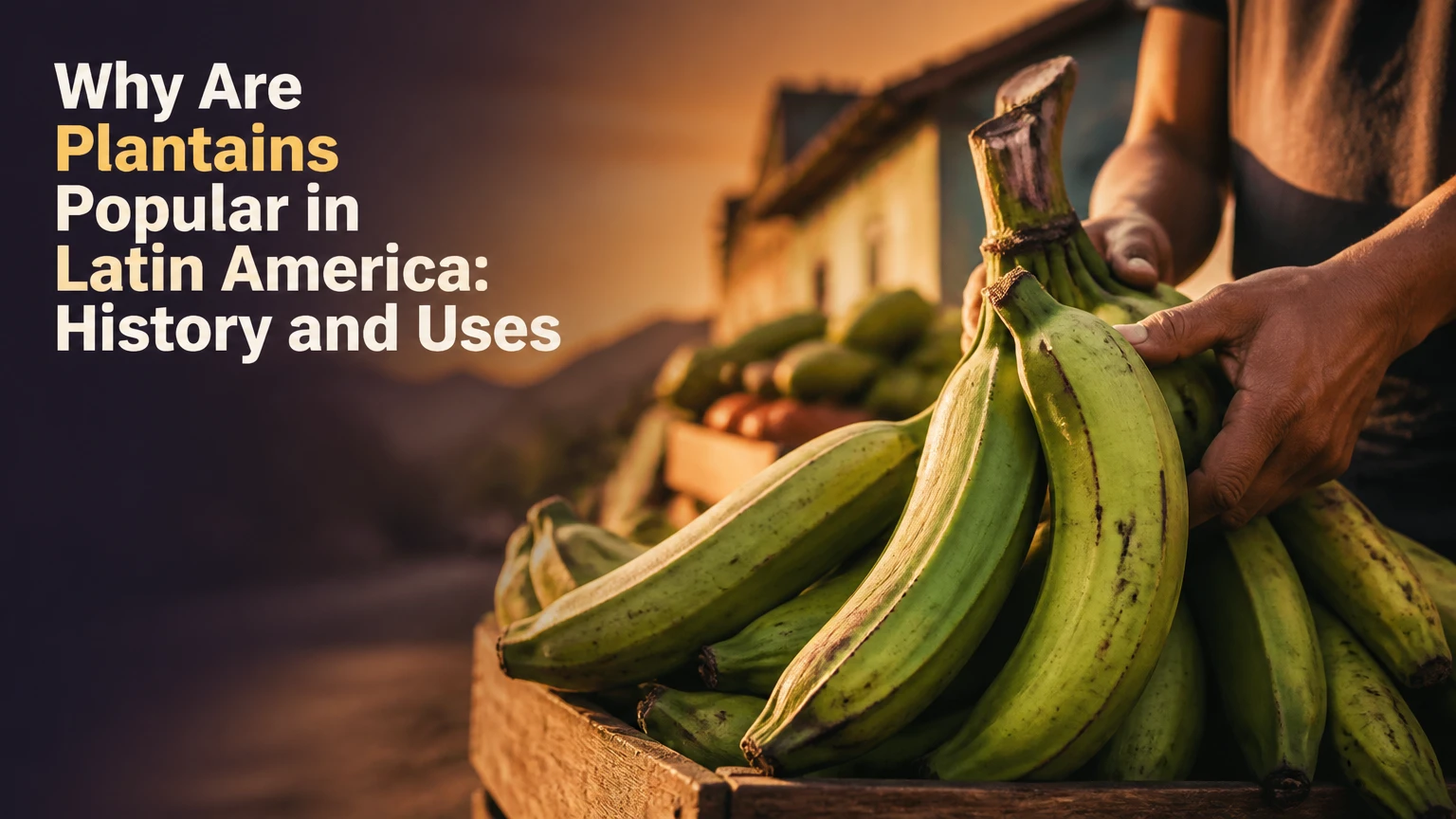
Plantains are popular in Latin America because they combine reliable tropical production, low cost, high starch content, and unusual culinary range. A single fruit can become a crisp tostone, a sweet maduros side dish, a mashed mofongo, or a component of soup, making plantains useful across regional cuisines, income levels, and stages of ripeness.
Key Facts at a Glance
Plantains are starchy cultivars and hybrids in the genus Musa, closely related to dessert bananas.
Green plantains provide a neutral, potato-like base for frying, boiling, mashing, and thickening.
Ripe plantains develop more sugar and become soft, sweet, and suitable for caramelizing.
Plantain cultivation expanded from Southeast Asia through Africa and later into the Caribbean and mainland Latin America.
Green plantains typically become yellow in about 3-5 days and heavily spotted in another 4-7 days at room temperature.
Tostones and patacones usually come from green plantains, while maduros use yellow-to-black, fully ripe fruit.
Why are plantains popular in Latin America?
Plantains are popular in Latin America because they are productive, filling, adaptable, and culturally embedded. Farmers can harvest them green for savory dishes or leave them to ripen for sweet preparations, while cooks can fry, boil, bake, grill, mash, or add them to stews.
Their affordability matters as much as flavor. Plantains grow in warm, humid areas including the Caribbean, Central America, Colombia, Ecuador, Venezuela, Peru, and Brazil. In places where rice, beans, cassava, maize, seafood, and pork form the meal’s foundation, plantains add carbohydrates and a contrasting texture without requiring expensive ingredients.
Plantains also fit many household cooking patterns. Green fruit can be prepared with garlic, salt, stock, or pork, while ripe fruit pairs with salty cheese, beans, rice, and roasted meats. This two-stage usefulness explains why plantains appear in breakfast plates, street foods, family meals, restaurant sides, and festive dishes.
They fit both everyday meals and special foods
Plantains can be purchased individually, in bunches, or at different ripeness stages. A household does not need to cook the entire bunch immediately, because green fruit can remain firm for several days while selected pieces mature.
That flexibility reduces waste and expands menu options. A cook who buys green plantains can prepare chips today, mofongo tomorrow, and sweet fried slices later in the week. The fruit therefore functions as both an ingredient and a small household pantry reserve.
Where did plantains come from?
Plantains originated through the domestication and movement of bananas in Southeast Asia, not in Latin America. Cultivated bananas and plantains moved westward into Africa before European expansion carried them across the Atlantic, where they became established in Caribbean and American farming systems.
The exact history differs by cultivar, and the word “plantain” covers several cooking bananas rather than one uniform botanical variety. Many commercially important types belong to hybrid groups involving Musa acuminata and Musa balbisiana, but local names and classifications vary.
| Historical stage | Approximate movement or period | Main consequence |
|---|---|---|
| Southeast Asian domestication | Several thousand years ago | Selection favored seedless, large-fruited bananas |
| Expansion into Africa | Before European colonization of the Americas | Plantains entered established tropical food systems |
| Atlantic transfer | Fifteenth to sixteenth centuries | Portuguese and Spanish networks moved plants and cultivation knowledge |
| Caribbean and mainland adoption | Sixteenth century onward | Plantains became part of Afro-Caribbean, Indigenous, European, and later national cuisines |
| Modern commercial production | Twentieth to twenty-first centuries | Export chains and immigrant markets widened availability |
Plantains became Latin American foods through cultural exchange rather than a single national tradition. African cooking techniques, Indigenous ingredients, European livestock and trade systems, and local agricultural knowledge all shaped the dishes now identified with countries such as Puerto Rico, Colombia, Ecuador, the Dominican Republic, and Venezuela.
Why historical origin does not reduce Latin American identity
A crop can originate elsewhere and still become deeply local. Rice, wheat, sugarcane, and citrus also arrived through migration and trade, yet their later preparation, symbolism, and agricultural importance developed within Latin American societies.
Plantains illustrate that process particularly clearly. The ingredient is transnational, but dishes such as Puerto Rican mofongo, Dominican mangú, Colombian patacones, and Venezuelan tajadas have distinct techniques, accompaniments, and cultural meanings.
How does plantain ripeness change its cooking behavior?
Plantain ripeness changes the ratio of starch to sugar, the firmness of the flesh, and the cooking method required. Green plantains remain dense and savory, yellow plantains become moderately sweet, and heavily spotted or black-skinned plantains develop a soft texture and pronounced sweetness.
Ripening enzymes convert part of the stored starch into simpler sugars. Heat then gelatinizes remaining starch in green fruit and browns sugars in ripe fruit, which explains why the same plantain can produce either a crisp savory disk or a tender caramelized slice.
| Ripeness stage | Typical appearance | Main chemical and texture change | Best uses |
|---|---|---|---|
| Green, verde | Bright green skin, very firm flesh | High starch, low sugar, dense texture | Tostones, patacones, mofongo, chips, soups |
| Yellow, pintón | Yellow skin with green or light black marks | Moderate starch conversion, semi-firm flesh | Baking, pan-frying, mixed savory dishes |
| Maduro | Yellow skin with many black spots | Higher sugar, softened cell structure | Tajadas, maduros, pastelón, desserts |
| Very ripe | Mostly black skin, soft interior | Maximum sweetness, fragile flesh | Baking, mashing, batters, sweet fillings |
Green plantains are not poisonous raw, but most people find them tough, dry, and astringent. Cooking makes their starch digestible and their texture practical. A ripe plantain can be eaten raw in a technical sense, yet cooking improves softness, aroma, and browning.
How can you identify the right stage at a market?
Choose green plantains for crisp or mashed savory dishes, yellow fruit for a less sweet side, and heavily spotted fruit for classic maduros. Skin color is useful, but firmness provides a better check because temperature and handling can alter appearance.
A green plantain should feel hard with no soft depressions. A maduro should yield slightly under gentle pressure without leaking liquid or showing mold. Black skin alone does not prove spoilage, but a sour odor, watery flesh, or fuzzy growth means the fruit should be discarded.
Which plantain dishes explain their regional popularity?
Plantain dishes vary by preparation, accompaniment, and local name, but the central pattern is consistent: green fruit supplies structure and ripe fruit supplies sweetness. Regional recipes turn the same crop into breakfast mash, fried side dishes, stuffed snacks, casserole layers, and street-food bases.
| Region or country | Common preparation | Ripeness | Typical accompanying foods |
|---|---|---|---|
| Puerto Rico | Mofongo | Green | Garlic, pork cracklings, broth, shrimp, chicken |
| Dominican Republic | Mangú | Green | Pickled onions, eggs, cheese, salami |
| Colombia | Patacones and tajadas | Green or ripe | Hogao, beef, chicken, fish, cheese |
| Ecuador | Chifles and bolón | Green | Peanuts, cheese, pork, seafood |
| Venezuela | Tajadas and mandocas | Ripe or mixed | Cheese, beans, meat, cornmeal |
| Brazil | Banana-da-terra preparations | Green or ripe | Fish, beans, meat, regional sauces |
| Cuba | Fufu de plátano | Green | Garlic, pork, broth, stewed meats |
The distinction between tostones and patacones is often regional rather than technical. Both commonly involve frying green plantain pieces, flattening them, and frying them again, although thickness, seasoning, shape, and accompanying sauces vary by country.
Plantains also balance meals effectively. A salty or garlicky green preparation adds crunch beside fish and ceviche, while sweet ripe slices soften the sharper flavors of black beans, cured meats, tomato sauces, and salty cheeses.
Why do green and ripe plantains pair with opposite foods?
Green plantains absorb savory flavors because their starch-heavy flesh has little sweetness. Ripe plantains contain enough sugar to brown and caramelize, so they counterbalance salty, acidic, smoky, or spicy foods.
That contrast is especially useful in plates built around rice and beans. The rice supplies mild starch, beans provide protein and earthiness, and plantain contributes either crispness or sweetness. The combination feels substantial without requiring a complicated sauce.
How are green plantains cooked into tostones?
Tostones require two frying stages, with flattening between them, and usually take about 20-30 minutes from peeling to serving. The most important factor is smashing the pieces while they are warm and pliable after the first fry.
Before you start
| Requirement | Typical specification |
|---|---|
| Green plantains | 2 medium fruits, about 350-450 grams total |
| Cooking oil | 500-750 milliliters for a small frying pan |
| First-fry temperature | 160°C, or 325°F |
| Second-fry temperature | 185-190°C, or 365-375°F |
| Total frying time | 3-4 minutes, then 1-2 minutes |
| Equipment | Knife, pan, tongs, flat glass or tostonera, paper towels |
Step 1: Peel and cut the plantain
Cut off both ends and score the skin lengthwise along its ridges. Pry the peel away with the knife tip or your thumb rather than pulling as though it were a dessert banana.
Cut the flesh into pieces about 2.5-4 centimeters thick. Pieces that are too thin can dry out before the center softens.
Step 2: Par-cook the pieces
Heat oil to approximately 160°C and fry the rounds for 3-4 minutes. Remove them when the flesh is softened and yellow but not deeply browned.
You will know the pieces are ready when a knife enters the center with moderate resistance. If the outside is brown while the center remains rigid, the oil is too hot.
Step 3: Flatten the warm pieces
Place each piece between parchment or plastic wrap and press it into a disk about 6 millimeters thick. Flatten the pieces immediately because cooled starch becomes firmer and more likely to crack.
A flat glass works for occasional cooking, while a wooden tostonera produces more uniform thickness. Uneven disks cook at different rates and create burnt edges beside undercooked centers.
Step 4: Fry and season
Raise the oil to 185-190°C and fry the disks for 1-2 minutes, turning once if needed. Drain them and season with salt, garlic water, or a light citrus-garlic sauce while they remain hot.
The finished tostone should have a rigid, crisp surface and a tender, starchy center. Excessive browning indicates prolonged frying, not superior texture.
How are ripe plantains cooked into maduros?
Maduros are ripe plantains sliced and pan-fried until their sugars brown, and the process usually takes 10-15 minutes. Medium heat works better than high heat because the exterior sugar can burn before the soft interior becomes hot.
Step 1: Select and peel ripe fruit
Use plantains with abundant black spots and a slight give. Cut off the ends, make one shallow lengthwise slit, and remove the peel carefully because ripe flesh bruises easily.
Step 2: Slice on a diagonal
Cut the plantain into diagonal pieces about 1-1.5 centimeters thick. The angled slices create a larger browning surface while retaining enough thickness for a soft center.
Step 3: Fry over medium heat
Heat a thin layer of neutral oil to approximately 175°C, or 350°F. Fry the slices for 2-3 minutes per side until they are golden brown with darker edges.
Maduros are ready when the center is soft and the surface has a glossy brown crust. If the edges darken in less than one minute, lower the heat and turn the slices more frequently.
Oven and air-fryer alternatives
For a lower-oil method, roast whole ripe plantains in their skins at approximately 200°C, or 400°F, for 20-30 minutes, then peel and slice them. Air-frying thin green slices at 200°C for 10-15 minutes can produce chips, but the result is drier and less rich than deep-fried tostones.
Are plantains healthier than bananas, potatoes, or rice?
Plantains are not automatically healthier than bananas, potatoes, or rice because preparation determines energy density, sodium, and oil content. Green plantains provide starch and some resistant starch, while fried preparations can absorb substantial oil and become much more calorie-dense.
USDA FoodData Central lists raw plantains at roughly 122 calories and 31 grams of carbohydrate per 100 grams, although values vary by cultivar and ripeness. Potassium is commonly around 490 milligrams per 100 grams raw, while cooked and fried values vary with water loss and added oil.
| Food or preparation | Typical calories per 100 g | Carbohydrate | Main practical difference |
|---|---|---|---|
| Raw plantain | About 122 kcal | About 31 g | Starchy, firm, usually cooked |
| Boiled plantain | About 115-145 kcal | About 28-35 g | Softer, little added fat |
| Fried plantain | Often 200-300+ kcal | About 30-40 g | Oil absorption raises energy density |
| Dessert banana | About 89 kcal | About 23 g | Sweeter and easier to eat raw |
| Boiled potato | About 80-90 kcal | About 18-21 g | Less sweet, lower energy density |
| Cooked white rice | About 125-135 kcal | About 27-30 g | Neutral grain-based starch |
Green plantains may retain more resistant starch than ripe fruit, but the amount changes with ripeness, cooking, cooling, and reheating. Resistant starch is fermented by some gut bacteria, yet plantains should not be treated as a guaranteed treatment for digestive or metabolic conditions.
Plantains are also not ideal for every diet. People managing carbohydrate intake should count a plantain as a substantial starch portion, and anyone limiting fried foods should choose boiling, baking, or roasting more often.
How much do plantains cost, and why are they accessible?
Plantain prices vary by country, season, transport distance, and retail channel, but United States supermarket prices commonly fall around $0.60-$1.25 per pound. Local Latin American markets may offer lower per-fruit prices, while imported fruit in colder regions can cost more.
The crop’s accessibility comes from more than retail price. Plantains can remain green during transport, tolerate ordinary room-temperature storage, and provide several meals from one bunch. Their thick peel also protects the edible flesh better than many delicate fruits.
| Buying situation | Typical price range | Storage period | Main variable |
|---|---|---|---|
| U.S. supermarket, individual fruit | $0.50-$1.50 each | 3-14 days | Weight and ripeness |
| U.S. Latin market | $0.60-$1.25 per pound | 3-14 days | Import and regional supply |
| Latin American local market | Often lower than imported retail | 2-10 days | Season and farm distance |
| Wholesale bunch | Price varies widely by weight | 3-7 days green | Bunch size and transport |
| Frozen peeled pieces | Often $2-$5 per pound | Several months frozen | Brand and processing |
Store green plantains at room temperature away from direct sun. Refrigeration can slow ripening, but it may darken the skin and alter texture, so it is better used after the desired stage has been reached.
To speed ripening, place plantains in a paper bag with a ripe banana or apple for 24-48 hours. Ethylene accumulates in the bag, although temperature still controls the overall rate.
What makes plantains agriculturally useful?
Plantains provide dependable carbohydrate production in tropical farming systems because perennial plants can produce repeated harvests from underground structures. They grow best in warm conditions with moisture, fertile soil, and protection from strong winds, although exact yields vary by cultivar and farm management.
The plant is not a tree. It is a large herb whose apparent trunk consists of tightly packed leaf bases. After a fruiting shoot is harvested, farmers manage new shoots from the underground corm or rhizome.
Plantains have limits. They are vulnerable to wind damage, drought, flooding, soil depletion, and diseases affecting banana relatives, including Black Sigatoka. A farm’s resilience depends on cultivar choice, drainage, field sanitation, crop diversity, and access to healthy planting material.
That limitation matters for food security. Plantains are reliable in suitable environments, but they are not a risk-free crop that can replace all other staples. Monoculture increases exposure to pests, weather shocks, and market disruption.
What are the main differences between plantains and bananas?
Plantains are generally larger, starchier, thicker-skinned, and less sweet than dessert bananas, although the two groups overlap botanically. Plantains are usually cooked, while dessert bananas are selected for soft texture and sweetness when eaten raw.
| Attribute | Plantain | Dessert banana | Practical result |
|---|---|---|---|
| Typical green texture | Hard and dense | Firm but softer | Plantain needs stronger cooking |
| Sugar when unripe | Low | Higher | Plantain tastes more savory |
| Skin | Thick and tightly attached | Thin and easy to peel | Green plantain needs knife scoring |
| Mature use | Fried, boiled, mashed, baked | Raw, baked, blended | Plantain has broader savory use |
| Common size | About 200-400 g | About 100-180 g | One plantain can supply multiple portions |
| Browning behavior | Strong when ripe | Moderate | Maduros develop a darker crust |
Cassava, potatoes, and rice can replace plantains as carbohydrate sources, but they do not reproduce the same combination of crisp exterior, soft starch, and ripe-fruit sweetness. Substitutions work best when the recipe’s function is considered rather than the ingredient’s name alone.
Which substitute works when plantains are unavailable?
Use potatoes for boiled or fried green-plantain texture, cassava for dense starchy preparations, and sweet potatoes for some ripe-plantain applications. None is a perfect replacement for tostones because plantain flesh flattens and crisps differently.
| Needed function | Best substitute | Adjustment required | Expected result |
|---|---|---|---|
| Crisp green rounds | Thick potato slices | Parboil before frying | Crisp outside, less dense center |
| Mashed mofongo base | Cassava or potato | Add less liquid initially | Softer, less fibrous mash |
| Sweet fried side | Sweet potato | Slice thinner and lower heat | Sweeter, less fruit-like |
| Casserole layer | Sweet potato or potato | Pre-cook until barely tender | Similar structure, different flavor |
| Soup thickener | Potato or cassava | Adjust cooking time | Neutral starch, less plantain aroma |
What mistakes make plantain dishes fail?
The most common failures involve choosing the wrong ripeness, using uncontrolled oil temperature, or waiting too long before flattening green pieces. Plantain cooking rewards timing more than complicated equipment.
- Peeling green fruit like a banana: Score the ridges first and remove the peel in sections.
- Flattening cooled pieces: Smash tostones immediately after the first fry while the starch remains pliable.
- Using high heat for maduros: Medium heat allows the center to soften before sugar burns.
- Cutting inconsistent pieces: Keep rounds or slices similar in thickness so they finish together.
- Overcrowding the pan: Cook in batches because a crowded pan lowers oil temperature and produces greasy food.
- Judging doneness by color alone: Check softness with a knife or fork, especially when dark skins hide bruising.
A practitioner rule is to control the center before chasing color. Green plantains need internal softening during the first fry, while ripe plantains need gentle heating that protects their sugar-rich surface.
Another counterintuitive point is that black skin does not always mean a spoiled plantain. Fully ripe plantains can have nearly black peels and sound, fragrant flesh; mold, leaking liquid, and fermentation odors provide stronger discard signals.
Plantains are also poorly suited to recipes requiring raw crispness or quick peeling. They are not a convenient substitute for a banana in smoothies when green, and ripe fruit can collapse in dishes where firm chunks must hold their shape.
Why do plantains remain important beyond nutrition?
Plantains remain important because food value includes familiarity, identity, labor, trade, and flavor, not only calories. A dish carries regional technique and family practice when the ingredient appears in a recognizable form such as mangú, mofongo, patacones, or maduros.
The crop also connects different food traditions without making them identical. Garlic and pork may dominate one preparation, peanuts or cheese another, while seafood, beans, eggs, and stewed meat change the meal’s balance.
Plantains therefore occupy an unusual position. They are inexpensive enough for everyday use, flexible enough for restaurant menus, and culturally specific enough to signal place and heritage.
FAQ
Are plantains bananas?
Plantains belong to the banana genus Musa and are closely related to dessert bananas, but culinary plantains are typically starchier, larger, and less sweet. The term covers several cultivars and hybrids, so no single botanical trait separates every plantain from every banana.
Can you eat a plantain raw?
A ripe plantain is technically edible raw, although cooking makes it softer and sweeter. A green plantain is technically safe for most people when raw but is hard, starchy, and astringent, which is why Latin American cuisines normally fry, boil, roast, or mash it.
Are tostones and patacones the same food?
Tostones and patacones are closely related preparations made from green plantains that are fried, flattened, and fried again. “Tostones” is especially common in the Caribbean, while “patacones” is widely used in Colombia, Ecuador, Venezuela, and parts of Central America; thickness and toppings vary regionally.
How long do plantains take to ripen?
Green plantains commonly take 3-5 days to become yellow at room temperature and another 4-7 days to become heavily spotted. Warm conditions and an ethylene-producing fruit in a paper bag can accelerate ripening, while cool storage slows it.
Why are ripe plantains served with salty foods?
Ripe plantains contain more sugar and develop caramelized edges during cooking, so their sweetness contrasts with salty cheese, beans, pork, seafood, and seasoned meats. The pairing creates flavor and texture contrast without requiring a sweet sauce or added sugar.
Can potatoes replace plantains in mofongo?
Potatoes can replace plantains when the goal is a mashed starchy side, but the flavor and structure will change. Cassava gives a denser alternative, while potatoes produce a softer mash; neither reproduces the characteristic fried plantain aroma and chew of traditional mofongo.
The Bottom Line
Plantains are popular in Latin America because one affordable tropical crop supports several cooking stages, textures, and meal roles. Historical movement introduced plantains to the region, but local farmers and cooks made them culturally distinctive through dishes such as mofongo, mangú, patacones, chifles, tajadas, and maduros.
Green fruit provides a savory starch for frying and mashing. Ripe fruit supplies caramelized sweetness for balancing beans, rice, meat, fish, and salty cheese. That combination of agricultural reliability, price, storage flexibility, and culinary range explains why plantains remain central to Latin American foodways. Knowing why are plantains popular in Latin America also means recognizing that their popularity comes from both practical value and cultural adaptation.