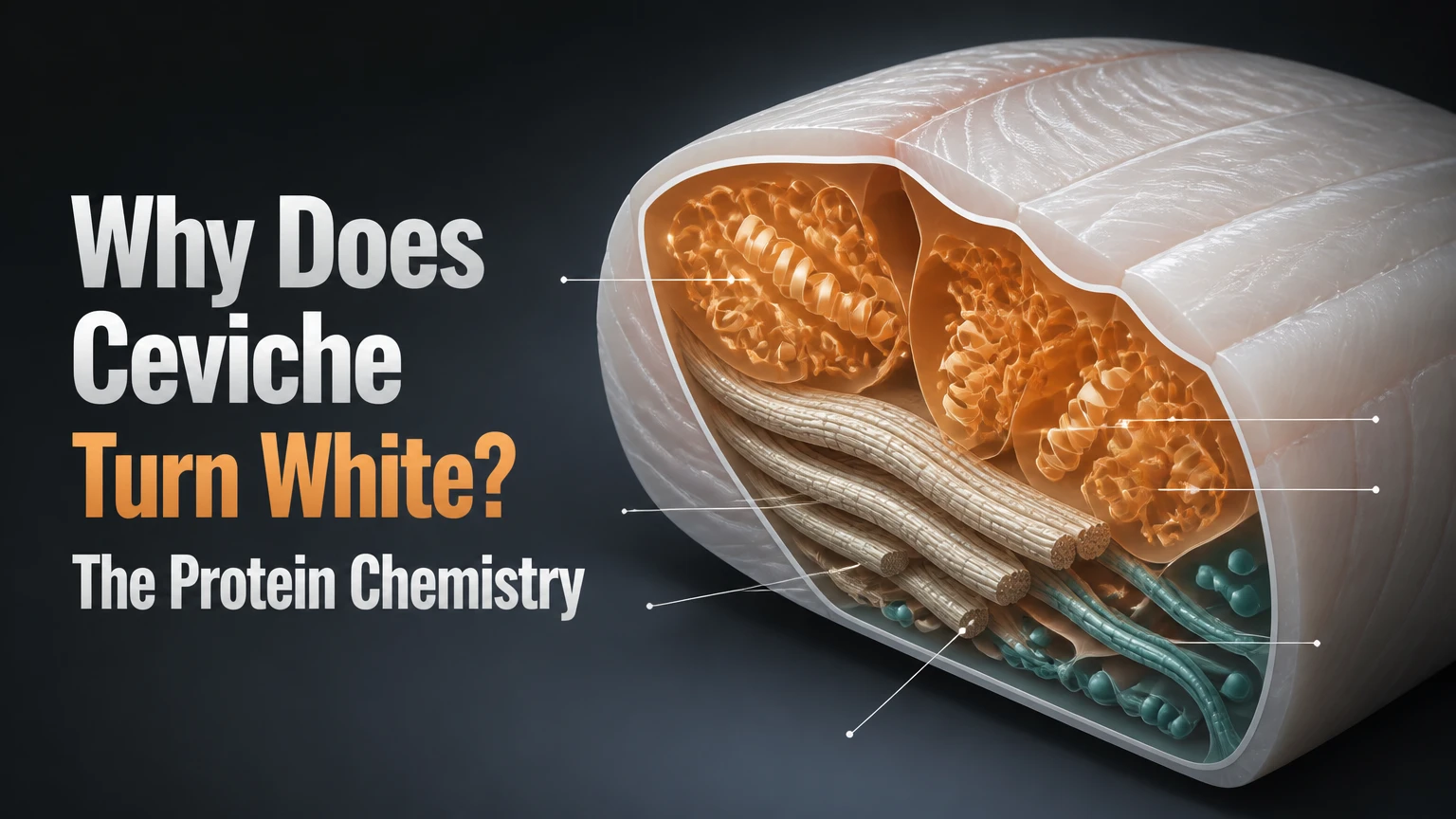
Ceviche turns white because citrus acid denatures and aggregates proteins in the fish muscle. Hydrogen ions disrupt the proteins’ original folded structure, causing them to unfold and form a new network that scatters light, changing translucent raw flesh into opaque white or pale colored flesh.
Key Facts at a Glance
- Citrus acid changes fish protein structure, but it does not cook fish with heat.
- Whitening begins at the exposed surface and moves inward as acid penetrates the flesh.
- A white exterior does not prove that the center is fully acid-treated or microbiologically safe.
- Typical ceviche cubes begin showing surface whitening within 2-10 minutes, depending on size, fish, temperature, and juice acidity.
- Prolonged exposure, especially with salt, can make fish firm, chalky, dry, or stringy.
- FDA Food Code requirements for parasite destruction rely on specified freezing controls or cooking, not on the fish becoming white in lime juice.
Why Does Ceviche Turn White?
Ceviche turns white when citric acid lowers the local pH around fish muscle and changes the arrangement of proteins. The acid disrupts weak chemical interactions that maintain proteins such as myosin in their native shape; unfolded proteins then associate into a less transparent matrix that reflects and scatters incoming light.
Raw fish muscle contains water, proteins, pigments, connective tissue, and small spaces between muscle fibers. Those components allow more light to pass through the tissue, producing a translucent grey, pink, or glassy appearance. Acid-treated proteins form a denser-looking structure, so more light returns to the eye as white or opaque color.
The visual change resembles heat-cooked fish, but the energy source differs. Heat raises molecular motion and changes proteins through thermal denaturation, while ceviche uses hydrogen-ion activity and related chemical effects at low temperature.
Is White Ceviche Actually Cooked?
Ceviche is chemically cured or acid-denatured, not thermally cooked. The distinction matters because acid changes texture and appearance without providing the same validated pathogen-control step as heating fish to a safe internal temperature.
The phrase “cooked in lime juice” describes the eating experience rather than a food-safety process. A lime marinade can reduce the viability of some organisms under particular conditions, but its acidity, exposure time, salt level, fish thickness, and microbial load vary too widely for whitening to function as a reliable safety test.
What Changes Inside the Fish?
Fish proteins lose their native three-dimensional arrangement, then aggregate into a network that changes firmness and light transmission. Myosin is especially important in the texture of fish muscle, while actin and connective-tissue proteins also contribute to the final bite.
The process is not a clean five-step reaction that occurs at identical speeds in every bowl. A useful kitchen model is:
- Acid contact: Citrus juice wets the cut surface.
- Surface denaturation: Exposed proteins begin unfolding.
- Protein aggregation: Unfolded strands associate with neighboring proteins.
- Moisture redistribution: Salt and acid alter water movement around the muscle fibers.
- Optical change: The surface becomes less translucent and more opaque.
- Texture progression: Firmness increases until prolonged curing begins removing moisture and weakening the eating quality.
The acid does not need to penetrate the entire piece before whitening appears. The outside can look fully opaque while the center remains translucent. That gradient explains why a large fish cube can have a white rim and a raw-looking middle.
Why Does Protein Denaturation Scatter Light?
Protein aggregation creates microscopic boundaries between protein, water, and tissue structures that redirect visible light. A raw fillet transmits more light through relatively organized, hydrated muscle, whereas a denatured surface reflects and scatters more light in multiple directions.
Whitening therefore indicates an optical and structural change, not a precise measurement of acidity. Two pieces can look equally white while having different internal pH values, moisture levels, and microbial risks.
How Acidic Is Ceviche?
Fresh lime and lemon juice commonly have a pH near 2-3, but the exact value varies by fruit, ripeness, dilution, storage, and measurement method. A bowl of ceviche does not automatically reach the same pH as undiluted juice because fish moisture, onion juice, chili, salt, and other ingredients dilute and buffer the acid.
A pH meter measures acidity, not safety by itself. It also cannot tell a home cook whether acid has reached the center of a thick piece, whether parasites are present, or whether contamination occurred during handling.
| Variable | Typical kitchen range | Effect on whitening | Practical implication |
|---|---|---|---|
| Fresh lime juice | pH 2.0-2.6 | Rapid surface denaturation | Strong flavor and fast visible change |
| Fresh lemon juice | pH 2.0-2.6 | Similar protein effect | Less traditional in some styles, often more sharply sour |
| Juice diluted with water | pH depends on dilution | Slower local acid exposure | Longer curing and weaker flavor |
| Fish flesh interior | Often above juice pH initially | Delays center denaturation | A white exterior may conceal translucent flesh |
| Salted marinade | Variable | Pulls water and firms tissue | Can accelerate a dry or dense texture |
Acidity alone does not predict timing. The acid must contact the tissue, and the tissue must allow diffusion through its structure.
How Long Does Whitening Take?
Small ceviche pieces can begin whitening in 2-10 minutes, while large or cold pieces may need 15-30 minutes for a pronounced opaque exterior. Full opacity may take 30-60 minutes, but the timing is a texture choice rather than a guaranteed chemical schedule.
The most influential variables are cube thickness, fish temperature, surface area, juice-to-fish ratio, stirring, species, and whether the marinade contains salt. A thin slice exposes more surface area than a 1/2-inch cube, so tiradito-style fish can change quickly even when a thick cube remains translucent inside.
| Fish preparation | Typical size | First visible whitening | Common serving window |
|---|---|---|---|
| Tiradito slices | 2-4 mm thick | 1-5 minutes | 3-10 minutes |
| Small cubes | 6-10 mm | 2-8 minutes | 5-15 minutes |
| Medium cubes | 12-15 mm | 5-15 minutes | 10-30 minutes |
| Large cubes | 20-25 mm | 10-25 minutes | 20-45 minutes |
| Whole small scallops | 15-25 mm | 10-30 minutes | 15-40 minutes |
These are typical practitioner ranges, not validated safety times. Refrigerated fish changes more slowly at first than fish held at warmer temperatures, but fish should remain refrigerated throughout preparation.
Does the Center Stay Raw?
The center can remain translucent after the outside turns white, especially in pieces thicker than 15 millimeters. Acid penetration is gradual and uneven, so the color boundary moves inward rather than appearing throughout the cube at once.
A translucent center is not automatically a defect. Many cooks prefer a white exterior with a tender, slightly translucent core because it preserves a softer texture. Other cooks prefer a uniformly opaque piece and accept the firmer texture that comes with longer exposure.
Which Seafood Whitens Fastest?
Lean, finely cut white fish usually whitens faster than dense or fatty fish because acid reaches more exposed muscle surface with less fat-related interference. Shrimp and scallops also become opaque quickly, although shellfish texture and safety handling differ from finfish.
Fat does not literally insulate every protein molecule from acid. Fish structure, thickness, connective tissue, temperature, and surface area usually matter more than fat percentage alone. Salmon may remain visibly pink after denaturation, while tuna can turn beige, rose-grey, or cream rather than bright white.
| Seafood | Typical visual change | Typical serving cure | Main texture risk |
|---|---|---|---|
| Corvina or sea bass | Grey-translucent to white | 5-15 minutes | Softening if cut too small |
| Halibut or mahi-mahi | Firm flesh to opaque white | 10-25 minutes | Dry edges after long curing |
| Fluke or snapper | Pale translucent to white | 5-15 minutes | Uneven center in thick cubes |
| Salmon | Orange-pink to pale opaque pink | 10-25 minutes | Fatty, soft mouthfeel or surface firmness |
| Tuna | Red to muted rose or beige | 10-20 minutes | Color darkening and dense bite |
| Shrimp | Grey to opaque white with pink | 15-30 minutes | Rubbery texture and safety concerns |
| Scallops | Glassy cream to opaque ivory | 10-20 minutes | Mushy surface if over-marinated |
| Squid | Translucent white to opaque white | 10-20 minutes | Chewy texture without thermal cooking |
Retail prices vary substantially by city, season, and species. As a typical United States grocery range, farmed salmon may cost $10-$20 per pound, mahi-mahi $12-$25, halibut $18-$35, and premium corvina or sea bass $15-$30. Price does not establish freshness or parasite control.
What Fish Should You Buy?
Buy fish from a supplier who can explain its handling history and whether it underwent a parasite-destruction freezing process. “Sashimi-grade” and “sushi-grade” are widely used retail terms, but they are not universal U.S. government grades that guarantee identical controls from one seller to another.
Ask whether the fish is intended for raw consumption, how it was frozen, and when it was thawed. FDA Food Code provisions commonly recognize freezing options such as -4°F (-20°C) for seven days, -31°F (-35°C) until solid and for 15 hours, or -31°F until solid followed by -4°F for 24 hours, depending on the applicable procedure and equipment.
Those controls address parasites, not every bacterial hazard. Keep fish at 40°F (4°C) or below, prevent cross-contamination, and use clean knives, boards, bowls, and hands.
Does Ceviche Style Change the Timing?
Peruvian-style preparations often use short acid exposure to preserve a tender center, while many home cooks leave fish in juice for 20-60 minutes to produce a more uniformly opaque appearance. Neither timing defines every Peruvian or Mexican ceviche, because regional recipes, fish sizes, seasoning, and serving customs differ.
| Preparation approach | Typical acid exposure | Desired center | Best operational choice |
|---|---|---|---|
| Short Peruvian-style cure | 3-15 minutes | Tender or slightly translucent | Add juice close to serving |
| Longer home-style cure | 20-45 minutes | Mostly opaque | Use consistent 10-15 mm pieces |
| Tiradito | 1-10 minutes | Thin, tender center | Slice immediately before dressing |
| Aguachile | 5-15 minutes | Rawer center with intense marinade | Keep slices thin and very cold |
| Cooked shrimp ceviche | 10-30 minutes after cooking | Fully cooked | Chill cooked shrimp before dressing |
Acid timing also changes with workflow. If guests will arrive in 30 minutes, keep the cut fish refrigerated and add most of the citrus shortly before serving rather than allowing the fish to sit in juice for the entire preparation period.
How Should You Cure Ceviche?
For a controlled home batch, cut refrigerated fish into uniform 10-15 millimeter pieces, use enough fresh citrus to coat them, season near serving time, and check the thickest piece rather than judging only the surface color. The process usually takes 15-30 minutes of active and waiting time.
Step 1: Prepare the Fish
Remove skin, pin bones, bloodline, and visibly damaged tissue, then cut the fish into pieces of equal thickness. Place approximately 1 pound (450 grams) of fish in a chilled glass or food-safe stainless-steel bowl.
Success checkpoint: Pieces should have clean, flat surfaces and similar dimensions.
Common mistake: Mixing thin scraps with thick cubes creates inconsistent curing.
Step 2: Add Citrus
Add enough fresh lime or lemon juice to contact most surfaces, typically 1/2-1 cup for 1 pound of fish, depending on the bowl shape and desired acidity. Turn the pieces gently so the juice reaches all sides.
Success checkpoint: No large dry surfaces remain above the liquid.
Common mistake: Adding a small splash to a deep pile leaves the upper pieces underexposed.
Step 3: Chill and Time the Cure
Refrigerate the bowl and begin checking after 5 minutes for small pieces or 10 minutes for medium cubes. Stir gently once so the acid exposure remains even without breaking the fish.
Success checkpoint: The surface looks opaque while the center matches the texture you want.
Common mistake: Treating a timer as proof of safety or doneness.
Step 4: Season Near Serving
Add salt, onion, chili, cilantro, and other ingredients according to the recipe. Salt can draw moisture from fish and intensify firmness, so adding it early may shorten the ideal texture window.
Success checkpoint: The fish remains moist and holds its shape when lifted.
Common mistake: Salting several hours ahead, then blaming citrus for all the dryness.
Step 5: Serve Promptly
Drain excess juice if the fish has reached the intended texture, then serve cold. Discard ceviche that has spent more than two hours above 40°F (4°C), or one hour above 90°F (32°C), using the conservative time limits commonly applied by USDA food-safety guidance.
Success checkpoint: The fish smells clean and ocean-fresh, with no sour, ammonia-like, or rotten odor.
Common mistake: Trying to rescue questionable fish with more lime.
Can Ceviche Turn Too White?
Ceviche can become excessively opaque, firm, and dry when acid exposure continues after the preferred texture has developed. The protein network tightens, liquid leaves the muscle, and the surface can become chalky or stringy, especially when salt and small pieces increase the rate of moisture loss.
Over-curing does not make unsafe fish reliably safe. It only changes the texture and appearance. Once the fish has reached the desired level of opacity, drain it or serve it rather than keeping it submerged.
How Do You Fix Uneven Curing?
Uneven curing usually comes from inconsistent piece size, inadequate juice contact, an overcrowded bowl, or fish that was partially frozen. Cut the largest pieces smaller, spread the fish in a shallow layer, add enough juice to coat the surfaces, and stir once gently.
A white rim with a translucent center is often correct for a short cure. If a uniformly opaque result is required, use smaller pieces or a longer refrigerated cure, understanding that the outside will become firmer before the center matches it.
Why Is My Ceviche Rubbery?
Rubbery ceviche usually results from excessive acid exposure, too much salt, dense seafood, or a preparation that sat in juice after reaching its target texture. Shrimp and squid are especially prone to a firm, springy bite when their raw proteins are exposed to acid for too long.
For a better next batch, use smaller exposure windows, chill the seafood, reduce early salting, and separate seafood from the marinade once the texture is right. Cooked shrimp can provide a more predictable texture when serving children, older adults, pregnant guests, or people with elevated food-safety risk.
Does Lime Juice Type Matter?
Fresh lime juice and bottled lime juice can both provide enough acid to denature fish proteins, but they do not always produce the same flavor or aroma. Bottled products may contain preservatives, oxygen-related flavor changes, or less fresh citrus character; they are not automatically incapable of curing fish.
Fresh citrus also varies. A dry lime may provide less juice, while a very acidic batch may produce faster surface whitening. Taste the juice, measure the amount, and judge the fish by texture and thickness rather than assuming every lime behaves identically.
Lemon juice, orange juice, and passion-fruit juice can be used in variations, but sweeter or less acidic juices may need to be combined with lime or lemon. Vinegar can denature proteins strongly, yet its sharper flavor usually changes the character of the dish.
Does White Fish Mean Safe Fish?
White fish is not automatically safe to eat raw or acid-cured. Whitening shows that proteins changed at the surface; it does not verify parasite destruction, bacterial reduction, internal acidity, cold-chain integrity, or hygienic handling.
The FDA Food Code uses validated freezing specifications for parasite control in many raw or raw-marinated fish preparations. The FDA also distinguishes parasite hazards from bacterial hazards, which means freezing and acidification do not eliminate every risk in every species.
The safest choice is to use fish specifically handled for raw consumption, maintain refrigeration at 40°F (4°C) or below, avoid raw fish with uncertain storage history, and serve the finished dish promptly. People who are pregnant, immunocompromised, older, or very young should follow medical and public-health guidance about raw seafood.
Ceviche Versus Heat-Cooked Fish
Acid-cured fish and heat-cooked fish can look similarly white, but heat provides a more predictable and validated protein and pathogen-control process. Ceviche offers a fresh texture and bright acidity, while conventional cooking offers greater control over internal temperature.
| Feature | Acid-cured ceviche | Heat-cooked fish | Sashimi-style raw fish |
|---|---|---|---|
| Main treatment | Citrus acid at about 2-3 pH | Heat to recipe-specific internal temperature | No cooking treatment |
| Surface appearance | Opaque white or species-colored | Opaque and flaky | Translucent and glossy |
| Center appearance | May remain translucent | Usually opaque | Translucent |
| Parasite control | Not reliably established by whitening | Cooking controls parasites | Requires approved freezing controls |
| Texture | Firm, fresh, acidic | Flaky, tender, cooked | Soft, clean, raw |
| Timing sensitivity | Minutes can change texture | Internal temperature matters most | Cold-chain handling matters most |
Ceviche is therefore a preparation with a specific sensory goal, not a substitute for a validated cooking process. That limitation should guide ingredient selection and who receives the dish.
Frequently Asked Questions
Why does ceviche turn gray instead of white?
Ceviche can turn grey because fish pigments, bloodline tissue, skin-side muscle, tuna color, or oxidation remain visible after protein denaturation. Grey does not automatically indicate spoilage, but a sour-ammonia odor, slimy surface, or damaged cold chain requires discarding the fish rather than adding more citrus.
Does washing fish make ceviche safer?
Washing fish does not reliably make ceviche safer and can spread contaminated droplets around the sink. Use commercially handled fish, clean equipment, refrigeration, and validated parasite-control practices instead. If washing is part of a recipe tradition, dry the fish thoroughly and sanitize surfaces immediately afterward.
Is ceviche safe after sitting overnight?
Overnight ceviche is not a preferred practice because prolonged acid and salt exposure damages texture, while refrigeration does not reverse contamination or guarantee safety. Prepare the fish shortly before serving, keep it at 40°F (4°C) or below, and discard leftovers with uncertain storage time.
Why does lime juice make fish firm?
Lime juice makes fish firm because acid denatures and aggregates muscle proteins, creating a tighter structure. Salt can increase firmness by drawing water from the tissue, while prolonged curing contracts the protein network and produces a dry, rubbery, or chalky bite.
Can I use frozen fish for ceviche?
Frozen fish can work well for ceviche when it was frozen under a parasite-control procedure, thawed safely in a refrigerator, and kept cold afterward. Freezing may soften texture by forming ice crystals, but that texture change is usually preferable to using fish with an unknown raw-consumption history.
Does every piece need to become completely white?
Every piece does not need to become completely white for a short-cured ceviche style. A white exterior with a slightly translucent center is common in thin, fresh preparations, but complete opacity requires smaller pieces or more time and produces a firmer texture. Color alone cannot establish food safety.
The Bottom Line
Ceviche turns white because citrus acid denatures and aggregates fish proteins, changing the tissue’s light-scattering behavior from translucent to opaque. The change begins at the surface, varies by species and cut size, and can progress from tender to dry when the fish remains in acid too long.
Use uniformly cut, properly handled seafood, keep it refrigerated, and choose the cure time for the texture you want. White ceviche is evidence of chemical protein change, not proof that the fish is thermally cooked or free of parasites and bacteria.