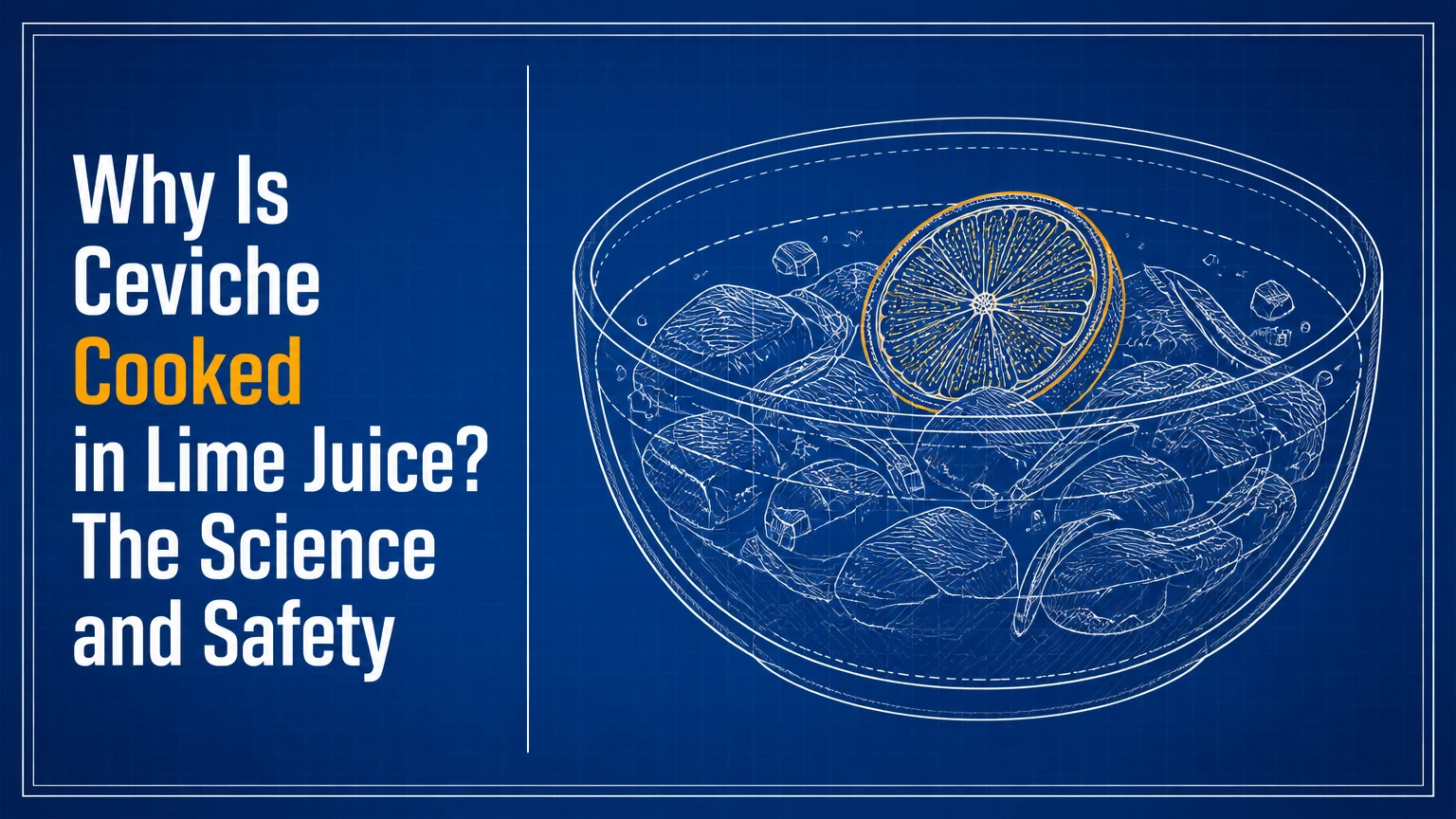
Ceviche is “cooked” in lime juice because citric acid denatures seafood proteins, changing translucent muscle into an opaque, firmer texture without applying heat. The fish remains uncooked in the food-safety sense: lime juice can alter proteins and reduce some microbes, but it cannot reliably eliminate all bacteria, viruses, or parasites.
Key facts at a glance
Ceviche changes texture through acid denaturation, not thermal cooking.
Lime juice commonly has a pH around 2.0-2.5 before it is diluted by seafood and other ingredients.
A 1-2 cm fish cube often develops a firm exterior within 5-15 minutes in fresh lime juice.
Lime juice does not reliably destroy pathogens such as Vibrio, Listeria, Salmonella, or parasites.
“Sushi-grade” is a retail description, not a universally regulated legal safety standard in the United States.
Refrigeration, safe sourcing, and parasite-control procedures matter more than marinating time.
What Does “Cooked” Mean in Ceviche?
Ceviche is raw seafood treated with an acidic marinade, usually lime juice, lemon juice, or another citrus mixture. Culinary writers call the result “cooked” because the flesh becomes white, firm, and opaque, but the process does not reach the temperatures associated with cooking fish.
Heat cooking changes proteins through thermal energy. Acid curing changes proteins through hydrogen-ion activity. The appearance overlaps, while the food-safety outcome does not.
Peruvian ceviche often uses firm ocean fish, red onion, chili, cilantro, salt, and leche de tigre, a seasoned citrus-based liquid. Mexican versions commonly add tomato, cucumber, avocado, and jalapeño. Ecuadorian preparations may use shrimp or shellfish in a more liquid mixture containing tomato and bitter orange.
The term “ceviche” covers a family of preparations rather than one fixed recipe. Seafood type, cube size, juice concentration, salt level, temperature, and holding time all change the final result.
Why Does Lime Juice Change Fish Texture?
Lime juice changes fish texture because its acidity disrupts the weak chemical interactions that keep muscle proteins folded. Myosin and other proteins partially unfold, aggregate, and scatter light, making the surface look white and feel firmer.
Fresh fish muscle contains water, myofibrillar proteins, connective tissue, minerals, and small amounts of fat. In its raw state, the muscle is translucent because light passes through its relatively organized structure. Acid alters that structure, so light scatters through the flesh instead.
The effect begins at the surface and moves inward. A small cube therefore develops a white outer layer before its center changes. Fish thickness determines the visible gradient more than clock time alone.
Salt intensifies the textural change by drawing water toward the surface and influencing protein interactions. Salt also seasons the fish, but it does not make raw seafood safe. Ceviche marinade acidity can fall when fish exudes water or when tomato, onion, stock, and other ingredients dilute the juice.
Food scientist Harold McGee summarizes the relevant distinction in On Food and Cooking: “Acids can denature proteins without heat.” That statement explains the texture, not a guarantee of pathogen destruction.
Does lime juice kill bacteria and parasites?
Lime juice does not reliably make raw seafood microbiologically safe. Acid exposure may injure or reduce some organisms, but survival varies by species, concentration, exposure time, seafood tissue, and temperature.
Vibrio species, Listeria monocytogenes, Salmonella, norovirus, and hepatitis A virus require separate safety controls. Anisakis and other parasites also cannot be assumed dead because fish sat in lime juice.
The FDA Food Code uses specific freezing controls for fish intended to be eaten raw or raw-marinated, including -20°C (-4°F) for 7 days or -35°C (-31°F) for 15 hours for parasite destruction, with detailed equipment and process requirements. A household freezer may not maintain the required temperature consistently, so the fishmonger or supplier must confirm the control.
Acid is a culinary treatment. It is not a substitute for a validated parasite-control process or adequate cooking.
How Long Should Fish Sit in Lime Juice?
A 1-2 cm fish cube typically needs 10-15 minutes for a firm exterior and a tender center, while 30 minutes produces a more uniformly opaque texture and 1-2 hours often creates a dry, chalky surface.
The timeline below is a practical kitchen guide, not a food-safety schedule. Refrigerator temperature, fish species, cut size, juice coverage, and salt change the rate.
| Marinating time | Typical appearance | Texture outcome | Best use |
|---|---|---|---|
| 0-2 minutes | Translucent surface | Sashimi-like and slippery | Very fresh Peruvian-style preparation |
| 5 minutes | White outer 1-3 mm | Surface firm, center raw | Thin slices or small scallops |
| 10-15 minutes | Opaque edges, translucent center | Tender center with defined bite | 1-2 cm white-fish cubes |
| 20-30 minutes | Mostly opaque interior | Firmer, less delicate | Shrimp, thicker fish, casual service |
| 60-120 minutes | Fully opaque and pale | Dry, chalky, or flaky | Generally too long for lean fish |
A chef may drain the fish after the desired curing interval and add fresh leche de tigre immediately before serving. That approach controls texture better than leaving seafood submerged overnight.
Does fish cube size change the curing time?
Fish cube size changes the curing time because acid must diffuse from the exterior toward the center. A 1 cm cube changes far faster than a 3 cm cube, even when both sit in identical lime juice.
| Cut size | Typical first visible change | Typical serving window | Main risk |
|---|---|---|---|
| 5 mm dice | 2-4 minutes | 5-8 minutes | Mushy texture |
| 1 cm cubes | 3-5 minutes | 8-12 minutes | Overcuring after 20 minutes |
| 2 cm cubes | 5-8 minutes | 10-20 minutes | Raw-looking center if served immediately |
| 3 cm cubes | 8-12 minutes | 20-35 minutes | Uneven texture and weak seasoning |
Lean white fish, such as sea bass, corvina, snapper, flounder, and halibut, usually shows the clearest acid-induced opacity. Fatty fish can remain visually darker and softer because its muscle composition differs.
Which Seafood Works Best for Ceviche?
Firm, mild, low-fat fish with clean odor and intact flesh usually works best for ceviche. Sea bass, corvina, snapper, halibut, flounder, and similar species hold their shape better than delicate, oily, or heavily connective cuts.
“Fresh” does not mean safe by itself. Fish can look and smell acceptable while carrying pathogens or parasites. Buy seafood from a supplier who can identify the species, maintain cold storage, and explain whether an appropriate parasite-control process was used.
| Seafood | Typical cut or preparation | Approximate lime exposure | Practical result |
|---|---|---|---|
| Sea bass or corvina | 1.5-2 cm cubes | 10-15 minutes | Clean bite and pale exterior |
| Snapper or halibut | 1.5-2 cm cubes | 12-20 minutes | Firm, mild, moderately flaky |
| Scallops | 5-10 mm slices | 5-10 minutes | Delicate, quick-curing texture |
| Shrimp | Peeled, butterflied, or pre-cooked | 10-20 minutes | Acid seasons; heat improves safety |
| Octopus | Fully cooked slices | 10-15 minutes | Marinade adds flavor, not cooking |
| Tuna or salmon | Small cubes, optional citrus | 5-10 minutes | Softer, darker, more pronounced flavor |
Shrimp, octopus, and squid are commonly used in ceviche-style dishes, but many professional kitchens cook them first. Their muscular texture benefits from heat, and cooking provides a more dependable safety barrier.
Is “sushi-grade” fish required?
“Sushi-grade” fish is not a uniform federal grade or guarantee in the United States. The phrase usually indicates that a seller considers the fish suitable for raw consumption, but the buyer still needs information about handling, freezing, species, harvest, and storage.
Ask four direct questions:
- Was the fish intended for raw consumption?
- Was it frozen under a parasite-control protocol?
- When was it thawed?
- Has it remained at or below 4°C (40°F)?
Avoid fish with sour, ammonia-like, or strongly “fishy” odor, sticky slime, gaping flesh, damaged packaging, or unknown cold-chain history. Keep seafood on ice or refrigerated, and prepare it on a sanitized board with a clean knife.
How Do Peruvian, Mexican, and Ecuadorian Ceviches Differ?
Peruvian ceviche emphasizes raw fish, freshly squeezed citrus, red onion, chili, salt, and leche de tigre. Mexican ceviche commonly mixes fish or shrimp with tomato, cilantro, cucumber, avocado, and jalapeño, while Ecuadorian versions often use cooked shrimp or shellfish in a tomato-citrus broth.
| Regional style | Common seafood | Acid and liquid | Typical accompaniments |
|---|---|---|---|
| Peruvian | Sea bass, corvina, flounder | Lime, fish trimmings, chili, onion | Choclo, sweet potato, cancha |
| Mexican | Tilapia, snapper, shrimp | Lime, tomato juice, herbs | Tostadas, avocado, cucumber |
| Ecuadorian | Shrimp, black clams, fish | Lime, bitter orange, tomato base | Popcorn, chifles, toasted corn |
| Nikkei-inspired | Tuna, salmon, white fish | Lime, yuzu, soy, ginger | Sesame, cilantro, daikon |
Regional labels describe flavor architecture and serving customs, not a single legally fixed formula. A Peruvian-style preparation may be served soon after tossing, whereas a Mexican home recipe may rest longer with vegetables and tomato.
Onion, cilantro, chili, and watery vegetables should usually be added close to service. Early salting draws water from vegetables and dilutes the marinade, creating a weaker acid environment and a softer fish surface.
Which Acid Can Replace Lime Juice?
Lemon, bitter orange, grapefruit, passion fruit, and yuzu can replace part or all of lime juice, but each changes acidity, sweetness, bitterness, and curing speed. The replacement should be chosen for flavor first, then adjusted for sufficient liquid coverage and balanced seasoning.
| Acid option | Flavor profile | Typical proportion | Best pairing |
|---|---|---|---|
| Persian lime | Sharp, floral, direct acidity | 100% of citrus | Peruvian and Mexican fish ceviche |
| Key lime | More aromatic, smaller fruit | 75-100% | Lean white fish and scallops |
| Lemon | Brighter, less tropical | 50-100% | Halibut, shrimp, herbs |
| Bitter orange | Tart, bittersweet | 25-50% with lime | Ecuadorian-style preparations |
| Grapefruit | Floral with bitterness | 25-50% with lime | Scallops and mild fish |
| Passion fruit | Sweet, aromatic, seeded | 10-30% with lime | Fusion and Nikkei-style dishes |
| Yuzu | Fragrant, complex, expensive | 10-25% with lime | Tuna, salmon, soy-based marinades |
Bottled lime juice can work when fresh fruit is unavailable, but it often has flatter aroma and more variable acidity. Fresh juice should be squeezed shortly before use, strained if necessary, and refrigerated rather than left at room temperature.
Avoid squeezing limes aggressively against the peel. Excess pressure can extract bitter compounds from the pith and rind, especially when a handheld reamer crushes the skin.
Is Acid-Cured Fish Safer Than Heat-Cooked Fish?
Heat-cooked fish is safer than traditional raw ceviche because an adequate internal temperature-time combination reduces viable pathogens more reliably than lime juice. Acid-cured fish offers a raw-style texture, but it requires stronger sourcing and handling controls.
| Safety and quality factor | Acid-cured ceviche | Heat-cooked seafood |
|---|---|---|
| Main transformation | Protein denaturation by low pH | Protein denaturation by heat |
| Typical treatment | Lime for 5-30 minutes | Heat until opaque and properly cooked |
| Parasite control | Supplier freezing or validated control needed | Adequate heat destroys parasites |
| Bacterial control | Unreliable across organisms | Much more dependable when properly cooked |
| Texture | Tender center, firmer exterior | Uniformly firm or flaky |
| Best audience | Healthy adults accepting raw-food risk | Pregnant, older, immunocompromised, or cautious diners |
The comparison is not simply culinary. Pregnant people, young children, older adults, and immunocompromised people face higher consequences from foodborne illness, so a cooked ceviche-style dish is the better choice.
The safest hybrid is to poach shrimp, squid, octopus, or fish first, chill it rapidly, then dress it with lime, onion, chili, cilantro, and salt. Blanching fish for 30-60 seconds may reduce some surface contamination, but it does not guarantee that the center meets a validated safety standard.
How Do You Prepare Ceviche Safely?
Prepare ceviche by keeping seafood at 4°C (40°F) or colder, using supplier-verified raw-service fish, cutting it with sanitized equipment, and marinating it only until the intended texture develops. Serve immediately and discard leftovers that have warmed or remained unrefrigerated.
Before you start
- Typical active time: 20-30 minutes
- Marinating time: 5-20 minutes
- Typical yield: 4 servings from 450-500 g seafood
- Typical home cost: $20-$45, depending on fish and market
- Equipment: glass, ceramic, or stainless-steel bowl; sharp knife; sanitized board; refrigerator; citrus squeezer
- Ingredients: 450 g fish, 120-180 ml fresh lime juice, 6-8 g salt, 60-100 g red onion, chili, and herbs
Step 1: Chill and inspect the seafood
Keep the fish refrigerated until cutting, and reject seafood with damaged packaging, warm temperature, abnormal odor, or unclear handling history. You will know the seafood is ready when it is cold, firm, and free of visible bruising or excess liquid.
Common mistake: Washing fish under the tap spreads contamination through splashes. Pat it dry with disposable towels instead.
Step 2: Cut uniform pieces
Cut fish into 1-2 cm cubes with a clean, sharp knife. Uniform pieces cure at similar speeds, so diners do not receive a mixture of chalky fragments and nearly untouched centers.
Common mistake: Cutting irregular chunks creates an uneven texture. Separate thin trimmings for leche de tigre rather than mixing them with large cubes.
Step 3: Season immediately before curing
Add salt shortly before the lime juice, then toss gently so the seasoning reaches all surfaces. Add sliced onion and chili later if you want crispness and a less diluted marinade.
Common mistake: Salting vegetables 30 minutes early pulls water into the bowl and weakens the citrus mixture.
Step 4: Add fresh lime juice and monitor time
Use enough lime juice to coat the seafood, typically 120-180 ml for 450 g of fish, then refrigerate for 5-20 minutes according to cube size and desired center texture. You will know the fish is ready when the surface is opaque and the center matches your chosen firmness.
Common mistake: Leaving fish overnight produces a dry, chalky texture. Drain it once the desired cure develops.
Step 5: Finish and serve cold
Fold in cilantro, onion, chili, and other garnishes immediately before serving. Serve the ceviche cold, ideally within the same meal, and do not treat leftover marinade as a safety-certified sauce.
Common mistake: Holding the bowl on a warm counter allows bacterial growth even while the fish remains acidic.
What Are the Most Common Ceviche Failures?
Most ceviche failures come from uncontrolled temperature, oversized or inconsistent cuts, excessive marinating, diluted juice, or seafood that was unsuitable for raw service. Lime quantity alone cannot correct poor sourcing or a broken cold chain.
| Failure | Likely cause | Correction for next batch |
|---|---|---|
| Fish remains translucent | Large cubes or short exposure | Use 1-2 cm pieces and add 5-10 minutes |
| Fish becomes chalky | 60-120 minute marinade | Drain at 10-20 minutes and dress at service |
| Marinade tastes bitter | Rind or pith pressed into juice | Squeeze gently and strain the juice |
| Dish tastes watery | Tomato, onion, or stock released liquid | Salt vegetables later and drain excess |
| Fish smells strongly fishy | Old or mishandled seafood | Discard it, do not mask odor with lime |
| Texture turns mushy | Delicate fish, tiny dice, or enzymes | Use firm fish and larger pieces |
| Bowl tastes metallic | Reactive aluminum or copper | Use glass, ceramic, or stainless steel |
Stainless steel is generally suitable for acidic foods during normal preparation. Aluminum, copper, and unlined reactive metals are less suitable because acid can interact with the surface and create off-flavors or discoloration.
A refrigerator slows microbial growth but does not reverse spoilage. If seafood has exceeded 4°C (40°F) for more than two hours, or one hour in ambient temperatures above 32°C (90°F), discard it rather than adding more citrus.
How Much Does Homemade Ceviche Cost?
A four-serving batch typically costs $20-$45 at home, with seafood accounting for most of the variation. Premium raw-service fish can exceed $20-$40 per pound, while cooked shrimp or locally available firm fish may reduce the total.
| Seafood choice | Typical price per pound | Four-serving seafood cost | Texture profile |
|---|---|---|---|
| Local firm white fish | $12-$22 | $13-$25 | Mild and moderately firm |
| Verified raw-service snapper | $18-$35 | $20-$39 | Clean, firm, delicate |
| Scallops | $20-$40 | $22-$45 | Soft and sweet |
| Raw-service tuna | $18-$35 | $20-$39 | Dense and meaty |
| Cooked shrimp | $10-$24 | $11-$27 | Firm, convenient, safer |
Additional lime, onion, chili, herbs, and garnishes usually add $5-$12 per batch. Restaurant pricing is substantially higher because it includes labor, cold-chain management, supplier controls, waste, and service.
Who Should Avoid Traditional Raw Ceviche?
People at elevated risk from foodborne illness should avoid traditional raw seafood ceviche unless a qualified healthcare professional gives different advice. Pregnant people, young children, older adults, and immunocompromised diners should choose fully cooked seafood dressed with the same citrus ingredients.
A safe alternative uses poached shrimp, cooked crab, thoroughly cooked fish, or cooked octopus. Chill the seafood promptly, store it at 4°C (40°F) or colder, and add lime only after cooling so the citrus provides flavor rather than a false impression of safety.
Healthy adults also need to accept that supplier controls reduce risk without making raw seafood risk-free. The strongest practical safeguards are verified sourcing, parasite control, cold storage, clean equipment, and prompt service.
Frequently Asked Questions
Can lemon juice cook fish the same way as lime juice?
Lemon juice can denature fish proteins in the same general way as lime juice because both contain organic acids. Lemon often tastes less tropical and may have different acidity, so use the same 5-20 minute starting range, then adjust for cube size, seafood species, and preferred texture.
Can I make ceviche with frozen fish?
Frozen fish can work well when it was frozen under an appropriate parasite-control process and thawed safely in the refrigerator. Freezing does not eliminate every bacterial hazard, and a home freezer may not meet commercial time-temperature standards, so supplier documentation remains important.
Is ceviche healthy?
Ceviche can provide protein, omega-3 fats, vitamin B12, and minerals with little added fat. Nutritional value depends on the seafood and garnishes, while food-safety risk depends on sourcing and handling rather than lime juice, calories, or the amount of onion.
Can I marinate ceviche overnight?
Overnight marinating is usually poor for texture because acid continues changing the fish after the surface becomes opaque. Seafood often becomes chalky, dry, or flaky after 60-120 minutes, especially when cut into small pieces, although a cooked shellfish salad may tolerate longer dressing.
Why is leche de tigre added to ceviche?
Leche de tigre is a seasoned citrus liquid that may contain fish trimmings, onion, chili, cilantro, stock, and lime juice. It adds salinity, aroma, heat, and body, but its acidity does not make raw fish sterile or replace safe seafood handling.
Can I reuse leftover ceviche marinade?
Leftover marinade should not be reused as a raw sauce because it has contacted uncooked seafood and may contain pathogens. If you want a serving sauce, reserve clean lime juice and aromatics before adding fish, or boil the used marinade thoroughly before using it in another cooked dish.
The Bottom Line
Why is ceviche cooked in lime juice? Lime juice acid-denatures fish proteins, producing the opaque color and firmer texture associated with cooked seafood without thermal heat. Ceviche therefore remains raw from a food-safety perspective.
Use verified seafood, confirmed parasite controls, clean equipment, refrigeration at 4°C (40°F) or colder, and a short 5-20 minute curing window for typical 1-2 cm pieces. For vulnerable diners or anyone unwilling to accept raw-seafood risk, cook the seafood first and add lime afterward.