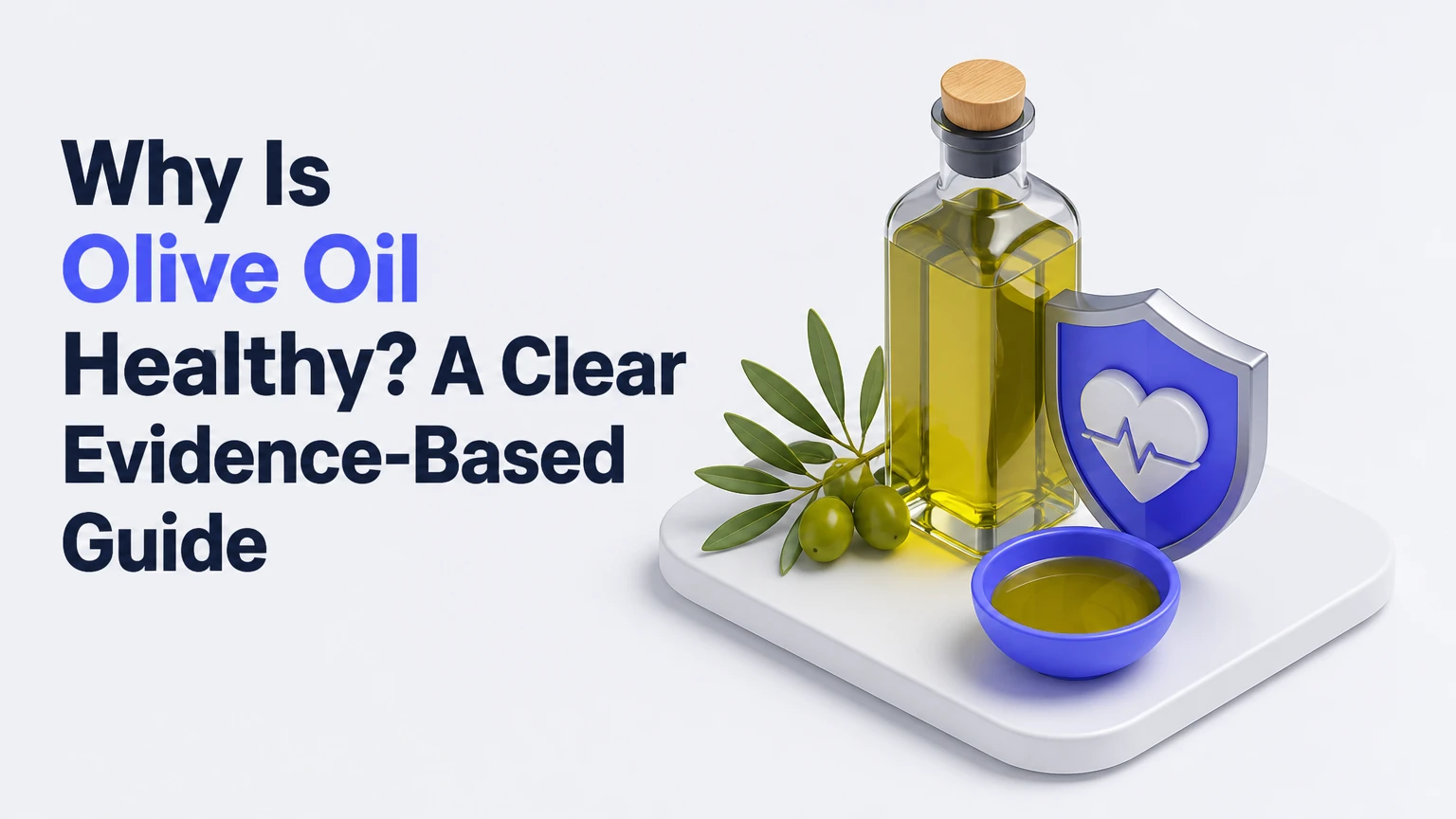
Olive oil is healthy mainly because its monounsaturated oleic acid and, in extra virgin olive oil, polyphenols can improve the fat profile of meals when they replace butter or other saturated fats. The strongest evidence supports olive oil within a Mediterranean-style eating pattern, especially for cardiovascular risk, rather than treating it as a medicine or calorie-free supplement.
Key Facts at a Glance
- Extra virgin olive oil contains mostly monounsaturated fat, with oleic acid commonly making up about 55-83% of its fatty acids.
- Extra virgin olive oil retains more phenolic compounds than refined olive oil because it is produced without the same intensive refining.
- Replacing saturated fat with olive oil is more evidence-based than adding unlimited olive oil to an already high-calorie diet.
- The FDA describes limited, nonconclusive evidence for about 1.5 tablespoons, or 20.5 grams, of high-oleic oil daily when it replaces fats higher in saturated fat.
- PREDIMED used about 1 liter of extra virgin olive oil per week for a household of up to five people, not a medicinal shot taken on an empty stomach.
- Olive oil contains about 119 calories per tablespoon, so portion size still matters for body weight and blood glucose management.
Why Is Olive Oil Healthy?
Olive oil is healthy because it combines a favorable fatty-acid pattern with plant compounds, and because people typically use it to replace less favorable fats. Oleic acid is more resistant to oxidation than polyunsaturated fatty acids, while extra virgin olive oil supplies phenolics such as hydroxytyrosol derivatives and oleuropein-related compounds.
The practical benefit depends on the substitution. Replacing 1 tablespoon of butter with 1 tablespoon of olive oil changes the meal’s fat profile; pouring olive oil over the same butter-heavy diet adds approximately 119 calories without removing saturated fat. The dietary pattern around the oil also matters. Mediterranean diets include vegetables, beans, fruit, whole grains, fish, and nuts, which contribute independent nutritional benefits.
A 2022 analysis in the Journal of the American College of Cardiology associated higher olive oil intake with lower cardiovascular and all-cause mortality, but observational research cannot prove that olive oil alone caused the difference. The strongest causal evidence comes from controlled dietary interventions in which olive oil replaced or accompanied other dietary fats.
Which compounds make olive oil different?
Oleic acid supplies the main structural advantage, but extra virgin olive oil’s minor compounds help explain why processing grade matters. Phenolic concentration varies widely with olive variety, harvest timing, climate, milling, filtration, and storage, so a “high-polyphenol” label is not a universal nutritional guarantee.
| Component | Typical characteristic | Potential relevance | Important limitation |
|---|---|---|---|
| Oleic acid | About 55-83% of fatty acids | Replaces saturated fat and supports a favorable lipid pattern | Still provides 9 calories per gram |
| Linoleic acid | Commonly about 3.5-21% | Essential polyunsaturated fatty acid | Amount varies by origin and cultivar |
| Vitamin E | About 1.9 mg per tablespoon in USDA data | Antioxidant nutrient | One tablespoon is not a large vitamin supplement |
| Vitamin K | About 8.1 micrograms per tablespoon in USDA data | Normal blood clotting and bone metabolism | Warfarin users need consistent intake |
| Phenolic compounds | Often tens to several hundred mg/kg, depending on oil | Antioxidant and sensory activity | Concentration declines with age, heat, light, and oxygen |
| Squalene and phytosterols | Minor unsaponifiable fractions | May contribute to the oil’s biological profile | Human outcome evidence is less established |
The AI Overview’s claim that polyphenols make up roughly 2% of olive oil’s mass is misleading. Phenolics are minor constituents, generally measured in milligrams per kilogram or milligrams per liter, not as a percentage approaching 2% in ordinary extra virgin olive oil.
How does olive oil affect heart health?
Olive oil supports heart health most reliably when it replaces butter, lard, coconut oil, or other fats higher in saturated fatty acids. Oleic acid can help maintain or improve LDL cholesterol compared with saturated fat, while extra virgin olive oil phenolics may reduce oxidative stress markers, but olive oil does not directly dissolve arterial plaque.
The PREDIMED trial, published in 2013 and reanalyzed in 2018 after methodological concerns, assigned adults at high cardiovascular risk to a Mediterranean diet supplemented with extra virgin olive oil, a Mediterranean diet supplemented with nuts, or a reduced-fat control diet. The olive-oil group received approximately 1 liter weekly per household of up to five people. The original analysis found fewer major cardiovascular events with the olive-oil and nut interventions than with the control diet.
The intervention tested a complete dietary pattern. It did not establish that taking a spoonful of oil independently prevents heart attacks. The FDA’s qualified health-claim language is appropriately cautious: “limited and not conclusive scientific evidence suggests” that daily oleic-acid-rich oil may reduce coronary heart disease risk when it replaces fats higher in saturated fat.
Does olive oil raise HDL or lower LDL?
Olive oil may modestly improve the balance of blood lipids when it replaces saturated fat, but it should not be described as a reliable HDL-raising or plaque-clearing treatment. LDL response depends on the entire diet, genetics, baseline cholesterol, weight, and the specific fat being replaced.
A useful clinical comparison is substitution:
| Substitution | Likely dietary effect | Practical interpretation |
|---|---|---|
| 1 tablespoon butter to olive oil | Less saturated fat, similar calories | Strongest everyday rationale |
| 1 tablespoon coconut oil to olive oil | Less saturated fat, similar calories | Usually favorable for LDL management |
| 1 tablespoon canola oil to olive oil | Similar calories and broadly favorable fat profile | Difference may be smaller |
| 1 tablespoon olive oil added to a meal | Adds about 119 calories | Not automatically heart-protective |
| Olive oil replacing a sugary sauce | Less added sugar, more fat | Benefit depends on total calories and meal quality |
Does olive oil reduce inflammation like ibuprofen?
Olive oil does not work like an ibuprofen dose, although oleocanthal in some extra virgin olive oils can inhibit cyclooxygenase enzymes in laboratory experiments. The throat-stinging sensation from oleocanthal-containing oil is a sensory marker of pungency, not proof that the oil provides a clinically equivalent anti-inflammatory treatment.
Beauchamp and colleagues reported in Nature in 2005 that oleocanthal produced a throat irritation similar to the sensory response associated with ibuprofen and inhibited COX enzymes in vitro. The researchers did not show that a normal serving of olive oil matches ibuprofen’s analgesic or anti-inflammatory dose in humans.
The distinction matters. Nonsteroidal anti-inflammatory drugs have defined doses, pharmacokinetics, contraindications, and clinically measured effects. Olive oil has variable oleocanthal concentrations, and many oils contain little of it. Extra virgin olive oil can contribute to an anti-inflammatory dietary pattern, but it cannot replace prescribed treatment for arthritis, injury, fever, or cardiovascular disease.
A peppery finish is usually a positive freshness and phenolic sign when the flavor is balanced. Rancid oil tastes or smells like crayons, stale nuts, putty, or old cooking fat. Bitterness and pungency are not the same as spoilage.
Can olive oil help the brain and gut?
Olive oil may support brain and gut health as part of a Mediterranean dietary pattern, but human evidence is stronger for overall dietary associations than for isolated polyphenol actions. Laboratory findings about blood-brain-barrier penetration, microbiome changes, and amyloid processing remain biologically interesting but should not be presented as proven Alzheimer’s prevention.
Phenolic compounds can be metabolized by intestinal microbes, and their metabolites may influence inflammatory and oxidative pathways. However, the claim that 90-95% of olive-oil polyphenols escape digestion and arrive intact in the colon is not a dependable general rule. Absorption and metabolism vary substantially by compound, dose, meal composition, and individual microbiota.
For the brain, observational studies have linked Mediterranean-style diets and olive oil intake with better cognitive outcomes in some populations. These studies face confounding because frequent olive-oil users may also eat more produce, fish, legumes, and whole grains. No major clinical guideline recommends high-phenolic olive oil as a standalone treatment for dementia.
How much olive oil should you eat?
A practical amount is 1-2 tablespoons daily as a replacement for less healthy fats, adjusted for calorie needs and the rest of the diet. The FDA qualified-claim benchmark is about 1.5 tablespoons, or 20.5 grams, of high-oleic oil per day when replacing fats that contain more saturated fat, but the statement is not a treatment dose.
PREDIMED used a much larger pattern-level exposure, approximately 1 liter per week for a household of up to five participants. That design should not be converted into a universal personal prescription. Four tablespoons provide roughly 476 calories, which can undermine weight-loss goals if added without reducing other foods.
| Use case | Typical amount | Best application | Main caution |
|---|---|---|---|
| Salad dressing | 1-2 teaspoons per serving | Emulsified dressing with vinegar or lemon | Measure if calories matter |
| Vegetable sauté | 1-2 teaspoons per cup of vegetables | Medium heat cooking | Avoid prolonged smoking |
| Bread dip | 1 tablespoon per person | Flavor and satiety | Easy to exceed the portion |
| Fat replacement | 1 tablespoon instead of butter | Toast, beans, potatoes, grains | Benefit comes from substitution |
| Higher-calorie maintenance diet | 1-2 tablespoons daily | Several meals | Total energy still matters |
People with gallbladder symptoms, digestive intolerance, or medically prescribed fat restrictions should follow individualized clinical advice. Olive oil is not a required food; canola, peanut, avocado, and other unsaturated oils can also support a healthy dietary pattern.
Which olive oil is healthiest?
Extra virgin olive oil is generally the best choice when flavor, phenolic retention, and minimal processing matter. Refined olive oil remains a reasonable cooking fat when a neutral flavor or higher smoke point is useful, but refining removes many of the phenolic compounds that distinguish fresh extra virgin oil.
| Olive oil grade | Processing and standard | Phenolic expectation | Best use | Typical retail range |
|---|---|---|---|---|
| Extra virgin | Mechanical extraction; free acidity no higher than 0.8% | Variable, often higher than refined oil | Dressings, finishing, sautéing | $10-$25 per liter |
| Virgin | Mechanical extraction; free acidity no higher than 2.0% | Variable, usually less than premium EVOO | Everyday cooking | $8-$18 per liter |
| Refined olive oil | Refined oil blended or sold with limited virgin oil | Low after refining | Neutral baking and higher-heat cooking | $7-$15 per liter |
| Olive-pomace oil | Solvent-extracted pomace, then refined | Low | High-heat commercial cooking | $6-$13 per liter |
| High-phenolic EVOO | Extra virgin oil with a laboratory-reported result | May exceed ordinary grocery oils | Raw finishing in small quantities | $25-$70 per 500 ml |
Free acidity is a quality classification measure, not a complete freshness score. A bottle can meet the extra virgin acidity limit and still taste stale after poor storage. Sensory defects, peroxide value, ultraviolet absorption, and chemical testing also affect official grading.
Is extra virgin olive oil safe for cooking?
Extra virgin olive oil is suitable for sautéing, roasting, baking, and pan-frying when the oil is not overheated. Smoke point commonly falls around 175-210°C, or 347-410°F, depending on free fatty acids, impurities, age, and the specific oil, so published single-number smoke-point claims should be treated as approximations.
Heating can reduce volatile aromas and some phenolic compounds, but cooking does not instantly make EVOO unhealthy. The relevant failure signal is visible smoking, which indicates excessive temperature and degraded flavor. Refined olive oil often tolerates higher heat and has a milder taste, although its antioxidant content is lower.
Use medium heat for stovetop cooking, add food before the oil smokes, and choose a refined product for repeated high-temperature frying. Deep-frying also depends on filtration, food moisture, reuse cycles, and temperature control, not smoke point alone.
How do you buy and store olive oil?
Buy the freshest extra virgin olive oil available in a dark glass bottle, metal tin, or opaque container, and prioritize a harvest date, producer traceability, and sensible storage over flags, medals, or the phrase cold pressed. Store olive oil tightly capped in a cool, dark cupboard away from the stove.
Harvest date is more useful than a distant best-before date because olive oil is agricultural juice, not an indefinitely stable pantry product. A typical unopened bottle may retain good quality for roughly 12-24 months after harvest under suitable storage, while an opened bottle is often best used within 2-ting? 3 months, depending on headspace, temperature, and packaging. Do not treat 30-60 days as a universal safety deadline.
Use this buying checklist:
- Choose extra virgin for salads, finishing, and general household use.
- Look for a harvest date and a producer or lot identification.
- Prefer a specific origin over vague claims such as bottled in Italy.
- Select dark glass, tin, or an opaque package.
- Buy a size you can use within a few months after opening.
- Taste for fresh grass, fruit, bitterness, or pepper rather than relying on label color.
- Return oil that smells like crayons, varnish, stale nuts, or old frying fat.
Clear bottles are not automatically defective, but they provide less protection from light. Refrigeration can slow oxidation but may cloud or solidify the oil; warming it gently returns it to liquid without damaging it.
What are olive oil’s limitations and alternatives?
Olive oil is not a complete source of omega-3 fat, a protein food, a vegetable serving, or a replacement for cardiovascular medication. Olive oil also does not become healthier merely because it is expensive, cold pressed, imported, or described as therapeutic.
Canola oil supplies more alpha-linolenic acid, a plant omega-3, and often costs less. Avocado oil offers a mild flavor and a high monounsaturated-fat content, although quality and adulteration concerns also apply. Nuts, seeds, oily fish, and legumes contribute nutrients that olive oil lacks.
People taking warfarin should keep vitamin K intake consistent rather than abruptly changing olive-oil consumption. Anyone with a diagnosed lipid disorder, diabetes, hypertension, or cardiovascular disease should use olive oil within a treatment plan, not instead of prescribed statins, blood-pressure medication, or dietary counseling.
Two practitioner rules prevent most mistakes:
- Measure oil during weight loss. A free-poured tablespoon can easily become two, adding about 119 extra calories.
- Use one affordable EVOO for cooking and a smaller, fresher bottle for finishing only if the flavor difference justifies the cost.
- Treat a laboratory polyphenol number as a quality attribute, not a clinically validated dosage.
Frequently Asked Questions
Is olive oil healthier than butter?
Olive oil is generally healthier than butter because it contains mostly unsaturated fat, while butter contains substantially more saturated fat. Replacing butter with olive oil can improve the meal’s fatty-acid profile, but both fats are calorie-dense. The comparison favors olive oil most clearly when the serving size stays similar.
Is olive oil good for high cholesterol?
Olive oil can fit a cholesterol-lowering diet when it replaces butter, lard, coconut oil, or other saturated-fat sources. Olive oil alone will not reliably normalize high LDL cholesterol, and people with diagnosed hypercholesterolemia may still need medication, soluble fiber, weight management, and medical follow-up.
Can you drink olive oil on an empty stomach?
Drinking olive oil on an empty stomach has no established advantage over using the same amount with food. The practice adds approximately 119 calories per tablespoon and may cause nausea, reflux, or loose stools in some people. Use olive oil in meals unless a clinician has given a specific reason otherwise.
Does olive oil expire?
Olive oil loses freshness through oxidation rather than becoming suddenly unsafe on one precise date. Heat, oxygen, and light accelerate deterioration. A typical opened bottle is best used within 2-3 months for peak flavor, while unopened oil may remain high quality for 12-24 months after harvest when stored properly.
Is cloudy olive oil healthier?
Cloudiness does not prove that olive oil is healthier. Unfiltered oil may contain suspended water and olive particles, which can shorten storage life. Clear filtered extra virgin olive oil can retain excellent quality, and freshness, sensory quality, harvest date, and proper storage matter more than appearance.
The Bottom Line
Olive oil is healthy primarily because its oleic-acid-rich fat replaces saturated fat, with extra virgin olive oil adding variable phenolic compounds and a fresh-food sensory advantage. The best-supported pattern is moderate use in Mediterranean-style meals, not unlimited consumption, ibuprofen-like dosing, or claims that olive oil independently removes plaque.
For most households, choose a traceable extra virgin olive oil in a dark container, use it for dressings and ordinary cooking, measure portions when calories matter, and replace less favorable fats rather than simply adding more oil. That is the evidence-based answer to why is olive oil healthy.