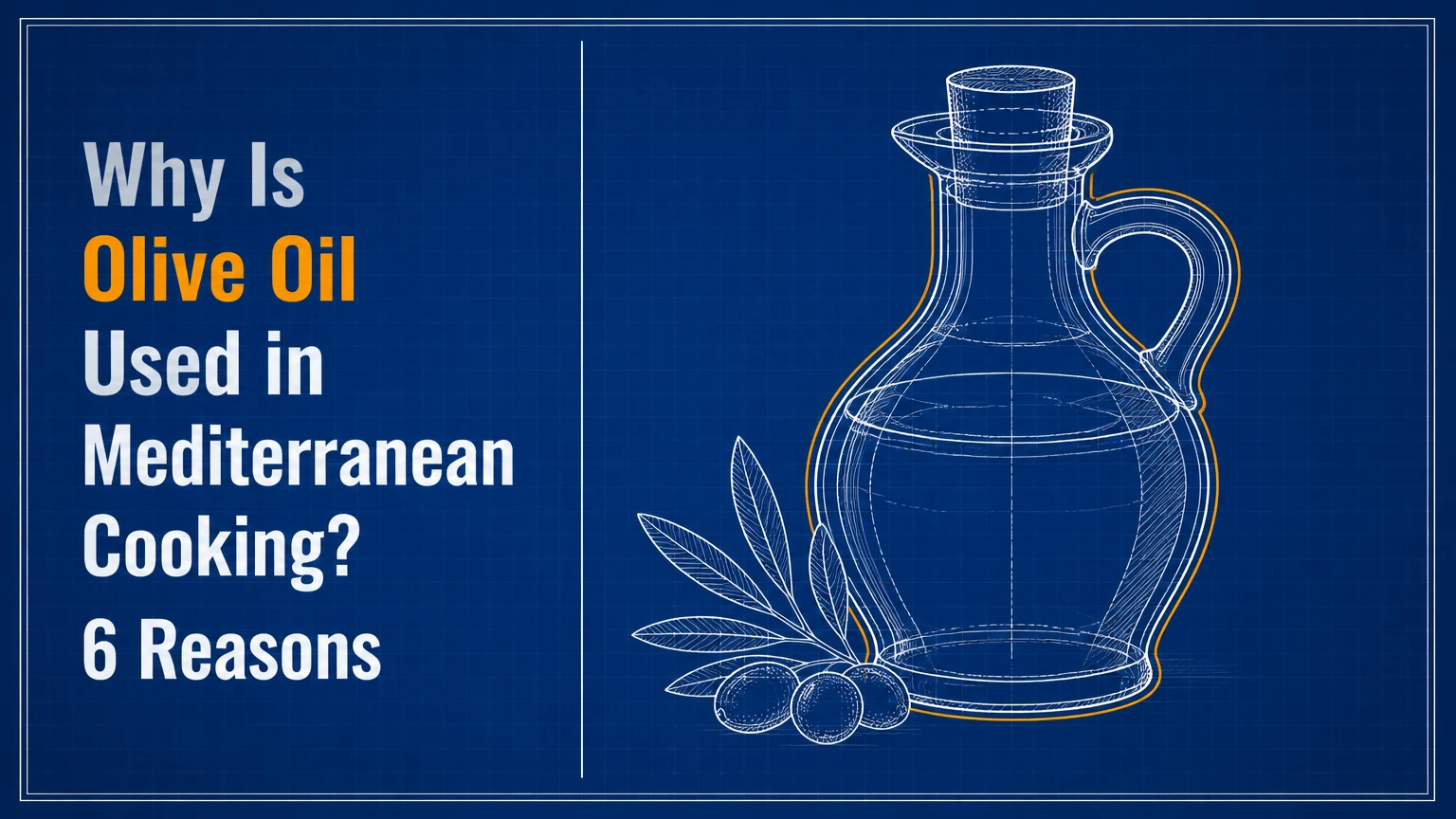
Olive oil is used in Mediterranean cooking because it is locally available, nutritionally useful, chemically stable, and exceptionally effective at carrying flavor. For thousands of years, Mediterranean communities used olive oil to cook vegetables, dress grains and legumes, preserve foods, and finish dishes, making the oil both a practical fat and a defining sensory ingredient.
Key Facts at a Glance
- Olive oil is a fruit oil extracted from the flesh of the olive, Olea europaea, rather than from a seed.
- Extra virgin olive oil contains mostly monounsaturated oleic acid, commonly around 70-80% of its fatty acids.
- Olive oil dissolves and distributes many aromatic compounds from garlic, herbs, spices, and vegetables.
- Extra virgin olive oil can be used for sautéing, roasting, and many frying applications when cooking temperatures remain controlled.
- Olive oil quality depends on cultivar, harvest date, extraction, packaging, storage, and age, not on country name alone.
- Mediterranean cuisines use different oils for cooking, dressing, dipping, baking, preservation, and final drizzling.
Why Is Olive Oil Used in Mediterranean Cooking?
Olive oil became central to Mediterranean cooking because olive trees tolerate dry summers, rocky soils, and irregular rainfall better than many competing oil crops. The oil also supplies concentrated energy, protects some foods from air exposure, and adds fruitiness, bitterness, and peppery heat to otherwise simple ingredients.
The Mediterranean basin includes distinct food cultures rather than one uniform cuisine. Greek, southern Italian, Spanish, Levantine, North African, Turkish, and Balkan traditions use olive oil differently, but they share a strong relationship with olives, wheat, vegetables, pulses, herbs, and seafood.
Olive oil therefore solved several problems at once. A household could cook onions in it, dress tomatoes with it, preserve cheese or vegetables under it, and use it as a dip for bread. That versatility helped make the oil a daily staple rather than an occasional seasoning.
The International Olive Council describes olive oil as the oil obtained from the fruit of the olive tree through mechanical or other physical means that do not cause oil alteration. The definition matters because olive oil begins as an agricultural product with its own cultivar, harvest, and freshness characteristics.
How did geography and history shape olive oil use?
Olive cultivation developed around the Mediterranean thousands of years ago, where long, hot summers favored the crop and winter rainfall supported tree growth. Ancient societies used olives and olive oil for food, lamps, medicine, trade, religious practices, and taxation.
Olive trees also provide a durable food system. Mature trees can produce fruit for decades, while olives can be stored temporarily before milling or preserved through brining. Oil offered a shelf-stable way to transport calories across seasons, although fresh oil itself gradually oxidizes.
Traditional food systems reinforced the pairing of olive oil with inexpensive staple foods. Beans, chickpeas, lentils, greens, bread, tomatoes, onions, and grains become more satisfying when cooked or dressed with a flavorful fat. Modern nutrition research often evaluates the whole dietary pattern, not olive oil in isolation.
What Is Olive Oil Chemically and Culinary?
Olive oil is a liquid fat made mainly of triacylglycerols, with smaller quantities of free fatty acids, pigments, sterols, tocopherols, phenolic compounds, and volatile aroma molecules. Its high oleic-acid content gives olive oil a relatively stable fatty-acid structure, while minor compounds create its taste and potential antioxidant activity.
| Component or attribute | Typical olive-oil value | Culinary consequence |
|---|---|---|
| Oleic acid | 70-80% of fatty acids | Relatively oxidation-resistant cooking fat |
| Saturated fatty acids | About 10-15% | Firmer structure than many seed oils at cool temperatures |
| Polyunsaturated fatty acids | About 8-15% | More oxidation-sensitive than oleic acid |
| Vitamin E, mainly tocopherols | Variable by oil and harvest | Supports shelf stability and contributes micronutrients |
| Phenolic compounds | Highly variable | Bitterness, pungency, and antioxidant activity |
| Free acidity in EVOO | No more than 0.8% by IOC standard | Chemical quality limit, not a direct flavor score |
Extra virgin olive oil is the least processed commercial grade. It must be obtained by mechanical means and meet chemical and sensory requirements, including no sensory defect detected by an approved panel. Low acidity alone does not prove that an oil tastes fresh, because flavor, oxidation, and defects require separate evaluation.
How Does Olive Oil Change Flavor?
Olive oil changes flavor by dissolving, transporting, and coating aromatic compounds while adding its own fruity, bitter, and pungent notes. Fat-soluble molecules from garlic, rosemary, basil, chili, citrus peel, and many vegetables disperse more evenly when oil carries them through a dish.
When garlic warms in olive oil, the oil becomes an aromatic medium before the garlic browns. When tomato is cooked with olive oil, the fat improves mouthfeel and helps distribute tomato flavor across the sauce. When a bean soup receives a final drizzle, the uncooked oil supplies volatile aromas that would be muted by prolonged heating.
Olive oil also creates texture. Oil coats the tongue, softens the perception of acidity, and helps emulsify water-based ingredients in vinaigrettes, sauces, and purées. In hummus, aioli, romesco, pesto, and skordalia, the oil contributes body as well as flavor.
Why does finishing oil taste different from cooking oil?
Finishing oil retains more delicate volatile compounds because it is added after high heat. A robust Picual or Koroneiki may taste grassy, bitter, and peppery over beans or grilled vegetables, whereas a mild Arbequina can complement white fish or a delicate cake.
Cooking removes or changes some volatile aromas, but it does not make olive oil useless. A value-oriented EVOO can provide a savory base for sautéed onions, roasted eggplant, braises, and tomato sauces. Use a fresher, more distinctive bottle when the oil remains uncooked and prominent.
What Nutritional Role Does Olive Oil Play?
Olive oil contributes mostly unsaturated fat, and replacing butter or other fats high in saturated fatty acids with olive oil can improve the overall fatty-acid profile of a meal. Olive oil remains energy-dense at about 119 calories per U.S. tablespoon, so health benefits depend on substitution and total intake rather than unlimited addition.
The PREDIMED trial, published in the New England Journal of Medicine in 2018 after correction and republication, found that a Mediterranean diet supplemented with extra virgin olive oil or nuts reduced major cardiovascular events compared with a reduced-fat advice group among adults at high cardiovascular risk. The finding supports a dietary pattern, not a promise that olive oil alone prevents disease.
The oil’s polyphenol content varies widely. Early harvest, certain cultivars, rapid milling, and careful storage often produce more pungency and phenolic compounds, while refining and age generally reduce these components. Bitter or peppery flavor can signal phenolic compounds, but taste intensity is not a complete laboratory measure of health value.
Olive oil can also support absorption of fat-soluble compounds from vegetables. Dietary fat helps the body absorb carotenoids such as beta-carotene and lycopene, but the amount absorbed depends on the vegetable, meal composition, preparation, digestion, and individual physiology. Olive oil improves the conditions for absorption; it does not turn every vegetable into a nutritional supplement.
Can You Cook With Extra Virgin Olive Oil?
Extra virgin olive oil is suitable for sautéing, roasting, pan-frying, and many shallow-frying tasks when the oil is not allowed to smoke continuously. The most useful practical test is temperature control, because smoke point varies with cultivar, refinement, freshness, free fatty acids, and impurities.
Published smoke-point figures are inconsistent. Typical estimates for extra virgin olive oil fall roughly between 190°C and 210°C, or 374°F and 410°F, while some laboratory and industry measurements report higher values. Smoke point should not be treated as a fixed legal specification or as a safety guarantee.
Olive oil’s high proportion of monounsaturated fat helps it resist oxidation better than oils dominated by polyunsaturated fatty acids. Natural phenolic compounds can also improve oxidative stability, especially in fresh EVOO. However, repeated heating, prolonged frying, food particles, oxygen, and excessive temperature degrade any edible oil.
| Cooking application | Typical temperature | Best olive-oil choice | Practical guidance |
|---|---|---|---|
| Salad dressing | 15-25°C | Fresh EVOO | Choose flavor intensity to match greens and vinegar |
| Gentle sautéing | 120-160°C | EVOO or virgin olive oil | Add food before oil smokes |
| Roasting vegetables | 180-220°C oven | EVOO | Use moderate coating and avoid prolonged empty-pan heating |
| Shallow frying | 160-190°C oil | EVOO or refined olive oil | Filter crumbs between batches |
| Deep frying | 160-180°C oil | Refined olive oil or stable EVOO | Do not repeatedly reuse dark, foamy oil |
| High-temperature searing | About 200°C or higher | Refined olive oil for neutral flavor | Use ventilation and monitor smoke closely |
A pan that smokes is too hot for the food and the oil, regardless of the label. Add ingredients earlier, lower the burner, or choose refined olive oil if the dish requires a neutral flavor and sustained high heat.
How Is Olive Oil Made?
Olive oil production usually takes place within hours of harvest: olives are cleaned, crushed, mixed, separated by centrifuge, and stored away from oxygen and light. Fast processing limits fermentation and preserves the fresh aromas associated with high-quality extra virgin oil.
- Harvest the olives. Producers pick fruit by hand, vibration, or mechanical harvesters. Green, early-harvest olives often yield more bitterness and pungency, while riper fruit generally produces a softer, fruitier oil and greater volume.
- Clean and mill the fruit. Leaves and debris are removed, then the whole olive is crushed into paste. Modern hammer mills or crushers replace many traditional stone mills.
- Malax the paste. Producers slowly mix the paste, often for about 20-45 minutes. Excessive time or heat can increase oxidation and reduce delicate aromas.
- Separate the phases. A horizontal centrifuge separates oil, vegetation water, and solid pomace. Vertical centrifuges or settling tanks remove remaining water and particles.
- Filter and store. Filtration removes suspended moisture and solids that can shorten stability. Tanks are commonly kept cool and protected with inert gas before bottling.
- Package and label. Dark glass, tins, or other light-resistant containers protect the oil better than clear bottles. Harvest date, origin, lot information, and grade help buyers assess freshness.
“Cold extraction” is useful only when the producer also provides credible quality and freshness information. The phrase refers to processing below a specified temperature, but it does not automatically indicate superior flavor, high polyphenols, or recent harvest.
Which Type of Olive Oil Should You Use?
Extra virgin olive oil is the best default for Mediterranean dressings, dips, finishing, and ordinary home cooking when you want recognizable olive flavor. Refined olive oil is more neutral and often more economical for high-temperature cooking, while pomace oil is a separate product made from olive-processing residues.
| Olive-oil category | Production and standard | Flavor profile | Appropriate uses |
|---|---|---|---|
| Extra virgin olive oil | Mechanical extraction; acidity no higher than 0.8%; no sensory defects | Fruity, bitter, peppery, or mild | Dressings, dips, sautéing, roasting, finishing |
| Virgin olive oil | Mechanical extraction; acidity no higher than 2.0% | Less refined sensory quality; possible minor defects | General cooking and sauces |
| Refined olive oil | Refined to remove defects, color, and odor | Mild and relatively neutral | Frying, baking, high-heat applications |
| Olive oil blend | Usually refined olive oil blended with virgin oil | Mild olive character | Everyday cooking when flavor and price matter |
| Olive pomace oil | Oil recovered from olive solids, commonly with solvent extraction and refining | Mild, limited olive aroma | Commercial frying and budget cooking |
“Pure olive oil” is a marketing term rather than a grade equivalent to extra virgin olive oil. In many markets, a bottle labeled simply “olive oil” contains refined olive oil blended with virgin oil. Read the legal category and ingredient statement instead of treating front-label adjectives as quality proof.
How Does Olive Oil Compare With Butter and Seed Oils?
Olive oil offers a distinctive flavor and a predominantly monounsaturated profile, while butter provides milk solids and saturated fat, and many seed oils provide neutral flavor at low cost. The best choice depends on whether the dish needs olive aroma, dairy richness, a neutral base, or a specific baking texture.
| Fat | Dominant fatty-acid pattern | Typical smoke-point range | Strongest culinary use | Main limitation |
|---|---|---|---|---|
| Extra virgin olive oil | Mostly monounsaturated | 190-210°C | Dressings, vegetables, sauces, roasting | Distinct flavor can dominate |
| Refined olive oil | Mostly monounsaturated | About 220-240°C | Frying and neutral cooking | Fewer native phenolics and aromas |
| Butter | About 50-65% saturated fat | About 150°C | Pastry, browning, creamy sauces | Milk solids brown and burn |
| Canola oil | Low saturated, mixed mono and polyunsaturated | About 200-240°C | Neutral frying and baking | Little olive character or phenolic content |
| Sunflower oil | Often polyunsaturated, cultivar-dependent | About 220-230°C | Frying and neutral dressings | High-linoleic versions oxidize more readily |
| Coconut oil | Predominantly saturated | About 175-205°C | Specific baking and tropical dishes | Solid at room temperature and high in saturated fat |
Olive oil is not automatically superior in every cooking task. Butter remains useful when milk solids, browning, and pastry structure matter, while a neutral refined oil may be better for a cake whose flavor profile should remain unobtrusive.
How Should You Match Olive Oil to a Dish?
Match olive-oil intensity to the dominant ingredient: mild oils suit delicate foods, medium oils fit general cooking, and bitter, peppery oils work with assertive vegetables, legumes, meat, and acidic sauces. The cultivar provides a more useful flavor clue than the country name alone.
| Olive cultivar | Typical sensory profile | Suitable Mediterranean foods | Best timing |
|---|---|---|---|
| Arbequina | Mild, sweet, apple-like | White fish, cakes, mild greens | Cooking or light finishing |
| Picual | Green, bitter, peppery, grassy | Beans, tomato, grilled meat, soups | Cooking and finishing |
| Koroneiki | Herbal, pungent, high-intensity | Greek salads, legumes, bread, braises | Finishing and dressings |
| Hojiblanca | Herbaceous, moderately bitter | Chicken, vegetables, rice dishes | General cooking |
| Frantoio | Green fruit, artichoke, pepper | Pasta, bruschetta, roasted vegetables | Finishing |
A practical two-bottle system works well. Keep a larger bottle of dependable EVOO or refined olive oil for cooking, then reserve a smaller, fresher bottle for bread, salads, soups, and final drizzling. This approach reduces cost without hiding the oil’s best aromas in a hot pan.
How Should You Buy and Store Olive Oil?
Buy the freshest credible oil you can use within several months, preferably in a dark bottle or tin with a harvest date and a traceable producer. Store olive oil tightly closed in a cool, dark cupboard, because heat, light, oxygen, and repeated opening accelerate oxidation.
| Storage condition | Typical consequence | Better practice |
|---|---|---|
| Clear bottle in direct sunlight | Rapid light oxidation | Choose dark glass or a tin |
| Beside a stove at 30-35°C | Faster flavor loss | Store in a cool pantry |
| Half-full bottle with air space | More oxygen exposure | Use a smaller container for leftovers |
| Unopened, cool, dark bottle | Often stable for 12-24 months | Follow best-before and harvest information |
| Opened bottle used regularly | Quality commonly declines over several months | Buy a size consumed in 2-6 months |
| Sediment and moisture in unfiltered oil | Shorter practical life | Use promptly and keep sealed |
The often-repeated advice to finish an opened bottle within 30-60 days is conservative rather than universal. A well-stored bottle may remain usable longer, but its aroma and phenolic intensity decline at different rates. Taste and smell provide better evidence than an arbitrary calendar alone.
How can you identify rancid olive oil?
Rancid olive oil commonly smells like stale nuts, crayons, old cooking fat, putty, or cardboard, and it lacks the fresh fruit, bitterness, or peppery finish expected from its style. Warm a small teaspoon in your hands, smell it, and taste a tiny amount before using an old bottle in a recipe.
Cloudiness is not automatically a defect. Unfiltered oil can contain suspended particles, and refrigerated oil may become cloudy or solid. Moldy, fermented, muddy, or musty aromas indicate different defects and should not be confused with normal bitterness or pungency.
What Are Olive Oil’s Limitations?
Olive oil does not make a poor diet healthy, does not provide unlimited heat resistance, and does not guarantee superior nutrition when simply poured over an already calorie-dense meal. Extra virgin olive oil also varies greatly in flavor and stability, so a high price or attractive origin story cannot replace freshness and sensory quality.
The oil is a poor choice when its flavor conflicts with the food. Delicate sponge cakes, some Asian stir-fries, and dishes requiring a clean neutral profile may work better with refined olive oil or another neutral fat. Extra virgin oil can also become bitter if a very intense cultivar is paired with delicate ingredients.
Health claims require similar restraint. The strongest evidence concerns replacing less favorable fats within a Mediterranean dietary pattern that includes vegetables, legumes, whole grains, fish, and moderate portions. No authoritative dietary guideline requires two raw tablespoons of olive oil daily for every person, and extra oil still contributes calories.
What Mistakes Reduce Olive Oil’s Benefits?
Four practical mistakes account for most avoidable quality loss:
- Buying by country alone: Spain, Italy, Greece, Tunisia, and other regions produce excellent and mediocre oils. Check grade, harvest information, packaging, and sensory freshness.
- Heating until smoke appears: Smoke indicates excessive temperature and flavor damage. Preheat briefly, add food promptly, and lower the heat.
- Saving every bottle indefinitely: Olive oil is a fresh agricultural product, not an immortal pantry staple. Buy quantities that match household use.
- Using only one intensity: A peppery Picual may overpower delicate fish, while a mild Arbequina may disappear over lentils. Match strength to the dish.
- Reusing degraded frying oil: Discard oil that becomes dark, foamy, sticky, or strongly stale, particularly after repeated frying with crumbs and moisture.
An experienced cook also tastes the oil plain. Bread can hide defects, so use a small spoon or neutral piece of food when assessing whether a bottle is fresh, bitter, pungent, rancid, or defective.
Frequently Asked Questions
Is olive oil healthier than butter?
Olive oil generally provides more unsaturated fat and less saturated fat than butter, so replacing butter with olive oil can improve a meal’s fatty-acid profile. Butter remains useful for dairy flavor, browning, and pastry. The comparison concerns substitution, because adding olive oil without reducing another calorie source does not automatically improve the diet.
Does cooking destroy olive oil’s antioxidants?
Heating can reduce some volatile compounds and phenolics, especially during prolonged or repeated high-temperature cooking, but it does not instantly eliminate all nutritional value. Fresh EVOO often retains useful stability during ordinary sautéing and roasting. Use a flavorful finishing oil raw when preserving maximum aroma is the priority.
Why is olive oil drizzled over soup and beans?
A final drizzle adds fresh volatile aromas, mouth-coating texture, bitterness, and peppery contrast after the cooking process has finished. Olive oil also connects the flavors of legumes, greens, garlic, lemon, and spices. Robust oils work particularly well with lentil soup, white beans, chickpeas, and vegetable purées.
Can olive oil replace vegetable oil in baking?
Olive oil can replace vegetable oil in many muffins, quick breads, cakes, and savory bakes, usually at a one-to-one volume ratio when the recipe uses liquid oil. Mild Arbequina or refined olive oil produces the least noticeable flavor. Butter-based recipes require more adjustment because butter contains water and milk solids.
How much olive oil should a Mediterranean meal use?
A practical amount ranges from 1-2 teaspoons for coating a serving of vegetables to 1-2 tablespoons for a dressing shared across a meal, depending on the recipe and calorie needs. Mediterranean cooking does not require a fixed universal quantity. Measure oil when calories matter, especially in dressings and finishing.
Is expensive olive oil always better?
Expensive olive oil is not always better because price can reflect packaging, certification, shipping, scarcity, and branding rather than sensory quality. A moderately priced, recently harvested EVOO in a light-resistant container can outperform an older premium bottle. Buy a small bottle first, taste it, and repurchase only if the flavor suits your food.
The Bottom Line
Olive oil is used in Mediterranean cooking because it links agriculture, history, nutrition, preservation, texture, and flavor in one versatile ingredient. Its oleic-acid-rich composition supports everyday cooking, while its aromatic compounds make vegetables, legumes, grains, seafood, herbs, and sauces more expressive.
The best choice is usually fresh extra virgin olive oil for dressings, finishing, and ordinary home cooking, with refined olive oil available when a neutral flavor or sustained high heat is more appropriate. Storage matters as much as the label: protect the bottle from light, heat, oxygen, and long delays after opening. That combination of practicality and sensory range explains why olive oil remains the defining fat of Mediterranean cooking.