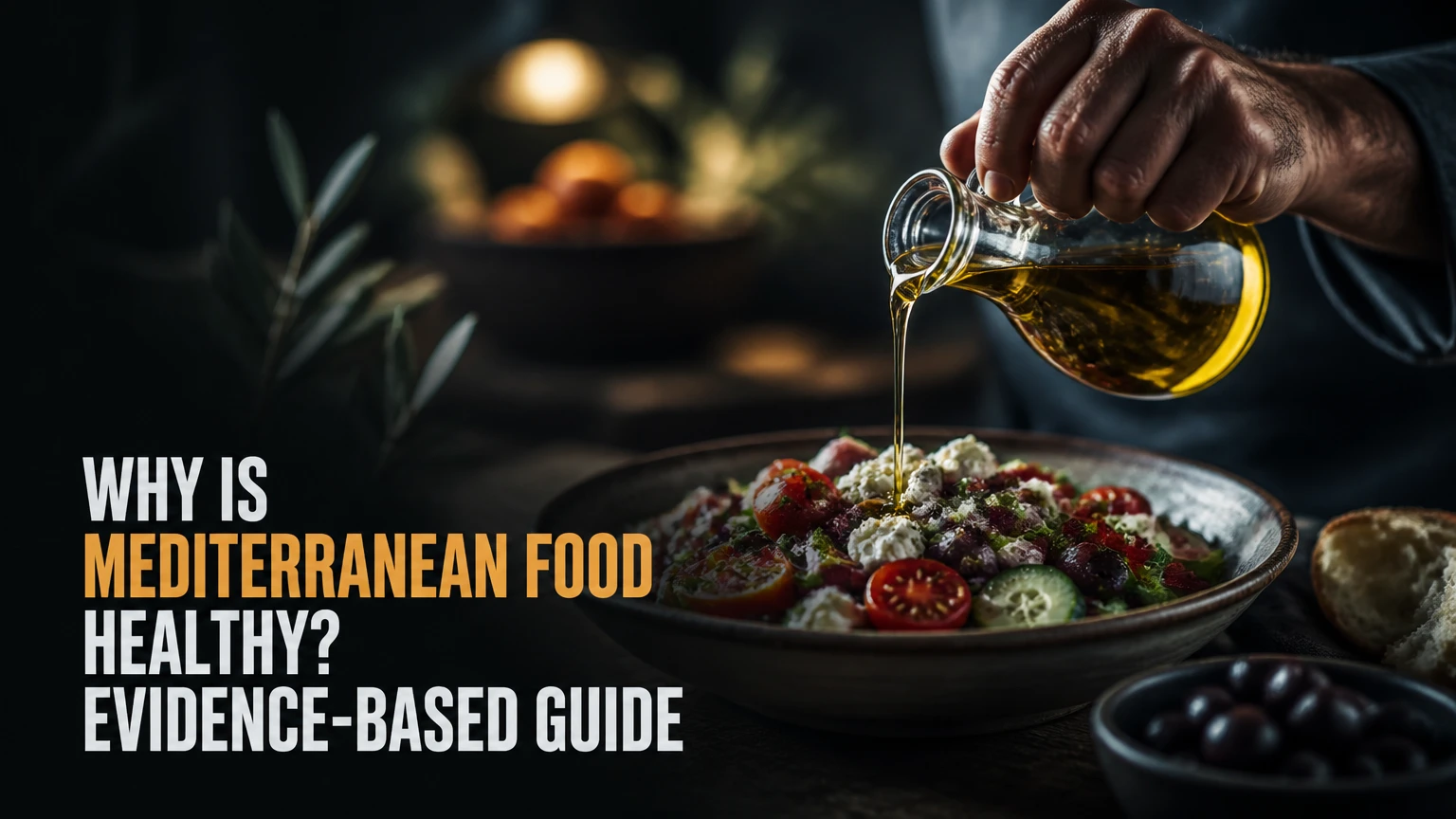
Mediterranean food is healthy because its overall pattern replaces refined carbohydrates, processed meats, and excess saturated fat with vegetables, legumes, whole grains, nuts, fish, and extra-virgin olive oil. That combination supplies fiber, unsaturated fat, minerals, and plant compounds that can improve cardiovascular risk factors while remaining flexible enough for long-term adherence.
Key Facts at a Glance
- The Mediterranean diet is a plant-forward eating pattern, not a fixed menu or single regional cuisine.
- Extra-virgin olive oil replaces butter and other fats high in saturated fat; it does not make unlimited calories disappear.
- Beans, lentils, vegetables, fruit, and whole grains provide fiber that supports bowel regularity, blood glucose control, and gut microbial activity.
- PREDIMED found about a 30% lower risk of major cardiovascular events in high-risk adults assigned to a Mediterranean diet supplemented with olive oil or nuts.
- Fish commonly appears at least twice weekly, while red meat, processed meat, and sweets appear less often.
- Wine is optional, and people who do not drink should not start for perceived health benefits.
What Does Mediterranean Food Mean?
Mediterranean food refers to a dietary pattern historically associated with countries bordering the Mediterranean Sea, including Greece, southern Italy, Spain, Turkey, Lebanon, and parts of North Africa. The pattern varies substantially by location, but its common structure is consistent: plants form the foundation, olive oil is the principal added fat, and animal foods appear in smaller or less frequent portions.
Traditional Mediterranean eating also includes beans, lentils, chickpeas, tomatoes, leafy greens, onions, garlic, fruit, whole or minimally refined grains, nuts, seeds, yogurt, seafood, and herbs. A restaurant meal labeled “Mediterranean” may instead contain large portions of white bread, salty cheese, fried meat, or creamy sauces, so the label alone does not establish nutritional quality.
The pattern is healthy because foods work together. Olive oil improves the fat profile of a meal, but vegetables and legumes supply the fiber that olive oil lacks. Fish adds EPA and DHA omega-3 fats, while herbs, fruit, and vegetables add potassium and polyphenols.
Which Foods Make the Pattern Healthy?
The healthiest Mediterranean choices are frequent plant foods, moderate portions of unsaturated fats and protein, and infrequent ultra-processed foods. The table below shows the usual hierarchy rather than a rigid prescription.
| Food category | Typical frequency | Specific examples | Main contribution |
|---|---|---|---|
| Vegetables | 2-4 servings daily | Tomatoes, spinach, peppers, eggplant | Fiber, potassium, carotenoids |
| Legumes | 3-5 times weekly | Lentils, chickpeas, white beans | Fiber, plant protein, folate |
| Whole grains | 1-3 servings daily | Oats, barley, bulgur, whole-wheat bread | Fiber, magnesium, slower digestion |
| Fruit | 1-3 servings daily | Oranges, apples, berries, grapes | Fiber, vitamin C, polyphenols |
| Nuts and seeds | 20-30 g most days | Walnuts, almonds, sesame, pumpkin seeds | Unsaturated fat, protein, minerals |
| Fish and seafood | At least 2 times weekly | Sardines, salmon, trout, mussels | EPA, DHA, protein, vitamin D |
| Yogurt and cheese | Small portions several times weekly | Plain yogurt, feta, kefir | Calcium, protein, fermentation |
| Red and processed meat | Occasional | Beef, lamb, bacon, sausage | Less frequent saturated fat and sodium exposure |
Why Is Mediterranean Food Healthy for the Heart?
Mediterranean food supports heart health mainly by improving the quality of dietary fat, increasing fiber and potassium, and reducing processed meat and refined food intake. Replacing butter, fatty processed meat, and trans-fat-containing products with olive oil, nuts, legumes, and fish can lower LDL cholesterol and improve the broader cardiovascular risk profile.
Extra-virgin olive oil contains mostly monounsaturated fat, especially oleic acid. Its polyphenols vary by olive variety, harvest, storage, and processing, so “olive oil” is not a guarantee of identical biological effects. Nuts and seeds add unsaturated fat, magnesium, and fiber, while oily fish supplies EPA and DHA.
The strongest evidence concerns cardiovascular disease. In the original PREDIMED trial, published in the New England Journal of Medicine in 2013, adults at high cardiovascular risk had approximately 30% fewer major cardiovascular events when assigned to a Mediterranean diet supplemented with extra-virgin olive oil or mixed nuts than those assigned to a reduced-fat control diet. The trial was later reanalyzed after methodological concerns, with the main conclusion remaining broadly supportive.
How Do Healthy Fats Affect Cholesterol?
Unsaturated fats improve cholesterol mainly when they replace saturated fats, rather than when they are simply added to an existing diet. A tablespoon of olive oil contains roughly 120 calories, so pouring more oil over a high-calorie diet can increase body weight even while improving fat quality.
| Substitution | Approximate dietary effect | Better Mediterranean option | Practical limit |
|---|---|---|---|
| Butter to olive oil | Less saturated fat per tablespoon | Extra-virgin olive oil | 1-2 teaspoons for a small serving |
| Sausage to lentils | Less processed meat and sodium | Lentil soup or bean stew | 1-1.5 cups cooked legumes |
| Chips to walnuts | More fiber and unsaturated fat | Unsalted walnuts or almonds | 20-30 g |
| Cream sauce to tomato sauce | Fewer saturated-fat calories | Tomatoes, garlic, herbs, olive oil | 1/2-1 cup sauce |
| Fatty beef to sardines | More EPA and DHA, less red meat | Sardines, salmon, trout | 85-140 g fish |
A practical rule is to ask what the olive oil or nuts are replacing. The cardiovascular advantage is clearest when the replacement is butter, shortening, processed meat, or a refined snack.
Can Mediterranean Food Improve Blood Sugar Control?
The Mediterranean pattern can improve blood sugar control because legumes, vegetables, whole grains, nuts, and intact fruit provide fiber and because meals usually combine carbohydrate with protein or unsaturated fat. Those features slow digestion and reduce the sharp glucose rise that often follows sugary drinks, sweets, or refined starch eaten alone.
A bowl of lentils with vegetables produces a different glucose response from a large serving of white pasta with sweetened sauce, even though both contain carbohydrate. Whole grains still raise blood glucose, and portion size remains relevant for people with diabetes. Mediterranean eating is not a low-carbohydrate diet.
Randomized trials and systematic reviews generally find modest improvements in hemoglobin A1c, insulin sensitivity, or fasting glucose, especially when the pattern replaces refined carbohydrates and excess calories. The effect varies with medication, baseline weight, sleep, activity, and adherence. People taking insulin or sulfonylureas may need medication monitoring when carbohydrate intake changes.
What Does Fiber Do in the Gut?
Fiber from beans, vegetables, fruit, barley, oats, and seeds reaches the large intestine partly undigested, where gut bacteria ferment some types into short-chain fatty acids such as acetate, propionate, and butyrate. These compounds contribute to colon-cell energy, gut barrier function, and metabolic signaling.
The microbiome response is individual and should not be oversold. A Mediterranean diet does not “detox” the body, and no single bacterial species proves that a person is healthy. A gradual increase toward roughly 25-30 grams of fiber daily for many adults, paired with adequate fluids, is more useful than buying a probiotic marketed around Mediterranean foods.
How Does the Pattern Reduce Inflammation?
Mediterranean food may reduce chronic inflammatory signaling through several overlapping changes: higher fiber intake, greater consumption of polyphenol-rich plants, improved body weight in some people, and lower intake of processed meat and refined foods. The mechanism is a whole-diet effect, not a result of antioxidants acting like a universal shield.
Tomatoes, leafy greens, berries, citrus, herbs, cocoa, and extra-virgin olive oil contain different compounds with different absorption and metabolism. Vitamin C and carotenoids are nutrients, while polyphenols include diverse molecules such as oleuropein and flavonoids. Laboratory effects on pathways such as NF-κB do not automatically predict a specific clinical outcome in a person.
Inflammation markers can change for reasons unrelated to diet, including infection, smoking, sleep deprivation, obesity, and exercise load. A lower C-reactive protein value is useful context, but it is not a standalone diagnosis or proof that a particular food cured inflammation.
How Can You Build a Mediterranean Plate?
Build a Mediterranean plate with half non-starchy vegetables, one-quarter protein-rich food, one-quarter whole grain or starchy vegetable, and a measured amount of olive oil. This formula takes about 10-15 minutes with prepared ingredients and prevents the common mistake of turning the diet into an oversized bowl of pasta and oil.
Use one of these combinations:
- Fast lunch: 2 cups salad greens, 3/4 cup chickpeas, 1/2 cup cooked bulgur, tomatoes, and 2 teaspoons olive oil with lemon.
- Fish dinner: 120 g baked salmon, 1 cup roasted vegetables, 1/2 cup barley, and plain yogurt.
- Vegetarian dinner: 1 cup lentil stew, sautéed spinach, 1 slice whole-grain bread, and fruit.
- Breakfast: Plain Greek yogurt, oats, berries, walnuts, and cinnamon, with no added sugar.
A meal works better when the plate contains recognizable ingredients. Hummus, canned beans, frozen vegetables, canned sardines, whole-grain bread, and unsalted nuts can reduce preparation time without undermining the pattern.
How Often Should You Eat Fish and Legumes?
A practical Mediterranean schedule includes legumes three or more times weekly and fish or seafood at least twice weekly, with one or two servings of oily fish when possible. Poultry, eggs, yogurt, and cheese can appear in moderate portions, while red meat and processed meat remain occasional foods rather than daily staples.
| Food | Typical serving | Weekly pattern | Useful nutrient |
|---|---|---|---|
| Lentils or beans | 3/4-1 cup cooked | 3-5 meals | Fiber and plant protein |
| Fish | 85-140 g cooked | 2 meals | EPA, DHA, protein |
| Eggs | 1-2 eggs | 2-4 meals | Protein, choline |
| Plain yogurt | 150-200 g | 3-7 servings | Calcium and protein |
| Poultry | 85-120 g cooked | 0-3 meals | Protein |
| Red meat | 85-120 g cooked | 0-2 meals | Iron and protein |
| Processed meat | 0-60 g | As rarely as practical | High sodium and preservatives |
Fish choices should account for mercury. The US Food and Drug Administration advises choosing a variety of lower-mercury fish and limiting high-mercury species such as shark, swordfish, king mackerel, and tilefish. Canned salmon, sardines, trout, shrimp, and pollock are practical lower-mercury options.
When Might Health Changes Appear?
Blood pressure and glucose readings may respond within weeks, while cholesterol changes usually become clearer after about 6-12 weeks of consistent eating. Long-term outcomes such as heart attacks, stroke, cognitive decline, and mortality require years of observation and cannot be promised from a short meal plan.
Typical practical timeframes differ by outcome:
| Outcome | Plausible observation period | What to measure | Important condition |
|---|---|---|---|
| Bowel regularity | 3-14 days | Stool frequency and comfort | Increase fiber gradually |
| Home blood pressure | 2-8 weeks | Seven-day average | Keep sodium and medication stable |
| Fasting glucose | 2-12 weeks | Repeated readings | Medication may alter results |
| LDL cholesterol | 6-12 weeks | Lipid panel | Depends on replacement foods |
| Body weight | 4-12 weeks | Weekly average | Portion size determines calories |
| Cardiovascular events | Years | Clinical outcomes | Trial results are population-level |
Do not expect a dramatic four-day “microbiome reset.” Gut microbes can respond quickly to fiber changes, but the clinical importance of a short-term shift is not established well enough to use as a health promise.
Is Mediterranean Food Expensive?
Mediterranean eating can cost about $45-$90 per adult per week for basic groceries in many US regions, excluding restaurant meals, specialty products, and unusually expensive fresh seafood. Dry beans, lentils, oats, frozen vegetables, canned fish, seasonal produce, and whole grains usually provide the lowest-cost foundation.
Extra-virgin olive oil and nuts can raise the bill, but a small bottle of oil lasts weeks and a 28 g nut portion is enough for a snack. Buying salmon fillets every week is unnecessary when canned sardines, canned salmon, mussels, frozen pollock, and beans provide lower-cost alternatives.
Restaurant “Mediterranean” meals can be expensive and sodium-heavy. A plate with grilled fish, vegetables, hummus, and whole grains is usually a better fit than a large gyro with fries, creamy sauce, and several pieces of white pita.
How Does It Compare With Keto and Vegan Diets?
Mediterranean eating is usually easier to sustain than ketogenic dieting because it permits fruit, legumes, and whole grains, while it is less restrictive than vegan eating because it allows fish, eggs, yogurt, and occasional meat. Neither comparison makes one pattern universally superior; medical goals, preferences, nutrient planning, and adherence determine the better choice.
| Pattern | Carbohydrate rule | Animal foods | Fiber potential | Main trade-off |
|---|---|---|---|---|
| Mediterranean | Whole grains and legumes allowed | Fish, dairy, eggs, poultry | High, often 25-35 g/day | Weight loss requires portion control |
| Keto | Usually below 20-50 g/day | Often included | Variable, often lower | Legumes and many fruits are restricted |
| Vegan | No animal foods | None | High if minimally processed | B12 supplementation is required |
| DASH | No strict carbohydrate limit | Lean meat and dairy allowed | Moderate to high | Less emphasis on olive oil and seafood |
| Western diet | Refined foods common | Meat and processed foods frequent | Often low | Higher sodium, sugar, and saturated fat |
Michael Pollan’s concise rule from In Defense of Food is “Eat food. Not too much. Mostly plants.” The Mediterranean pattern applies that principle without requiring every meal to be vegetarian or every carbohydrate to be eliminated.
Does Red Wine Make the Diet Healthier?
Red wine is not required and should not be added for cardiovascular protection. Alcohol can increase the risk of several cancers, liver disease, high blood pressure, sleep disruption, and dependence; people who drink should follow local low-risk guidance, and people who abstain should continue abstaining.
Older observational studies often associated moderate wine intake with lower cardiovascular risk, but abstainers and moderate drinkers differ in many other ways, including income, smoking, exercise, and healthcare access. Those differences make alcohol benefits difficult to separate from lifestyle confounding.
The safer Mediterranean choice is grape juice, whole grapes, or another alcohol-free beverage. Pregnant people, people with liver disease, anyone taking interacting medicines, and people with a history of alcohol-use disorder should avoid alcohol.
Who Needs to Modify the Pattern?
People with diabetes, kidney disease, celiac disease, food allergies, or prescribed sodium restrictions can often adapt Mediterranean eating, but the standard pattern is not automatically safe for every diagnosis. Kidney disease may require limits on potassium, phosphorus, protein, or fluids, while diabetes treatment may require carbohydrate and medication adjustments.
Useful adaptations include:
- Celiac disease: choose certified gluten-free oats, quinoa, rice, buckwheat, beans, vegetables, and fruit; avoid ordinary wheat, barley, and bulgur.
- Vegetarian eating: use lentils, tofu, beans, eggs, yogurt, and fortified foods; monitor vitamin B12, iron, iodine, zinc, and omega-3 intake.
- Dairy-free eating: use calcium-fortified soy milk or yogurt and select calcium-rich foods.
- Nut allergy: replace nuts with seeds only if tolerated, such as pumpkin or sunflower seeds.
- Kidney disease: obtain individualized potassium, phosphorus, protein, and sodium targets from a renal dietitian.
- High blood pressure: favor unsalted beans and nuts, rinse canned foods, and limit feta, olives, cured fish, and packaged sauces.
What Common Mistakes Reduce the Benefits?
The most common failure is copying individual ingredients without copying the pattern. Olive oil, feta, pasta, hummus, and bread can all fit, but unlimited portions can produce excess calories or sodium.
Mistake 1: Treating Olive Oil as Unlimited
Measure 1-2 teaspoons for a single serving or 1-2 tablespoons for a shared recipe. Use olive oil to replace butter or refined fats, not as an extra pour on top of the original meal.
Mistake 2: Choosing Refined Mediterranean-Style Foods
White pita, sweetened yogurt, fried falafel, processed deli meat, and salty prepared sauces can dominate a meal labeled Mediterranean. Compare the ingredient list, fiber content, sodium, and cooking method rather than relying on cuisine names.
Mistake 3: Eating Too Little Protein
Older adults and athletes may need deliberate protein distribution across meals. Pair legumes, fish, eggs, yogurt, poultry, or tofu with vegetables and grains instead of building meals almost entirely from salad.
Mistake 4: Ignoring Sodium
Feta, olives, canned soups, cured seafood, and restaurant hummus may provide substantial sodium. Choose no-salt-added beans, rinse canned foods, and use lemon, garlic, oregano, cumin, and vinegar for flavor.
Mistake 5: Expecting a Single Food to Treat Disease
Olive oil cannot reverse coronary artery disease, and salmon cannot replace prescribed statins or blood-pressure medicine. Use Mediterranean eating as a risk-reduction pattern alongside clinical care.
The Bottom Line
Why is Mediterranean food healthy? The strongest answer is that Mediterranean eating combines several protective features: high plant-food and fiber intake, unsaturated fats replacing saturated fats, regular seafood and legume consumption, moderate portions, and fewer ultra-processed foods. PREDIMED provides strong cardiovascular evidence, while evidence for diabetes, cognition, inflammation, and longevity is supportive but varies in strength.
The pattern is not healthy because every traditional dish is low-calorie or because wine is beneficial. It works when vegetables, legumes, whole grains, nuts, fish, and olive oil replace processed meat, refined snacks, excess sodium, and sugary foods. Start with one legume meal, two fish meals, daily vegetables, and measured oil, then adjust for medical needs and budget.
Frequently Asked Questions
Is Mediterranean food good for weight loss?
Mediterranean food can support weight loss when portions produce a calorie deficit, especially when high-fiber legumes, vegetables, and whole grains replace refined snacks and processed meat. Olive oil, nuts, cheese, and restaurant portions remain calorie-dense, so a healthy food pattern does not guarantee weight loss without portion awareness.
Can I follow a Mediterranean diet without eating fish?
You can follow a vegetarian Mediterranean pattern using lentils, beans, chickpeas, eggs, yogurt, tofu, and fortified foods. People avoiding fish should pay attention to vitamin B12, iron, iodine, and omega-3 intake. Algae-based DHA supplements may be appropriate for some people, but medical advice is useful.
Are potatoes allowed in Mediterranean eating?
Potatoes are allowed, particularly boiled, baked, or roasted potatoes served with vegetables, legumes, fish, or yogurt. A practical portion is about one medium potato or 1 cup cooked. French fries and heavily salted packaged potato products do not represent the same dietary pattern.
Is Mediterranean food anti-inflammatory?
Mediterranean eating is associated with lower inflammatory markers in many studies, but “anti-inflammatory” does not mean that one meal or ingredient suppresses every inflammatory disease. Benefits likely arise from fiber, plant compounds, healthier fat replacement, improved metabolic health, and lower processed-food intake.
How much olive oil should I use daily?
A typical amount is 1-2 tablespoons daily, adjusted for total calories and the amount used in cooking. The correct quantity depends on what olive oil replaces, body-size and energy needs, and whether nuts, avocado, cheese, or other fats are also present.
Is Mediterranean food suitable for children?
A Mediterranean-style family diet can suit children when meals include sufficient calories, protein, iron, calcium, vitamin B12, and healthy fats for growth. Children should not follow adult weight-loss portions or restrictive versions of the pattern without a pediatric clinician or dietitian.