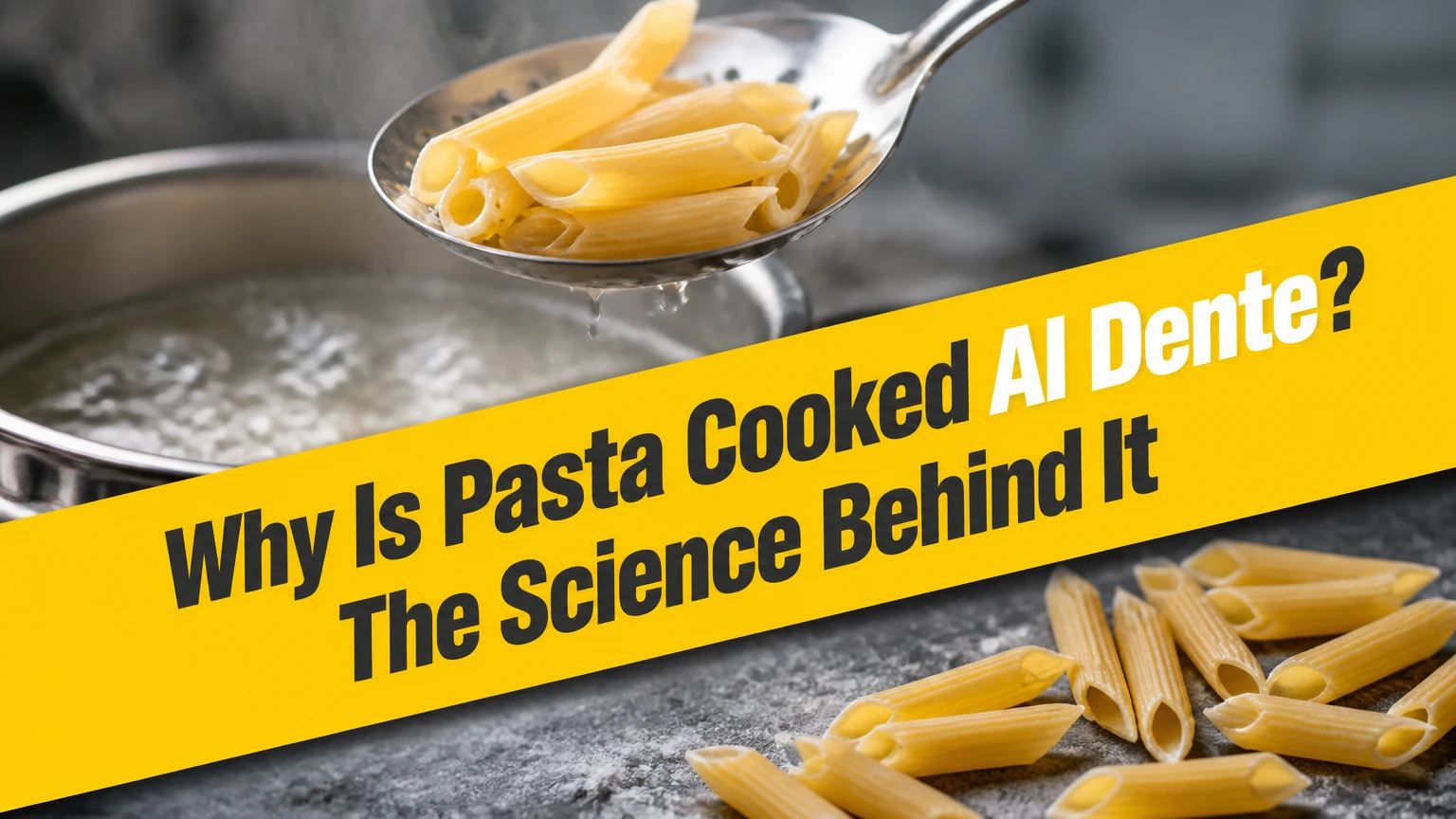
Pasta is cooked al dente because a firm, resilient structure gives the noodle better texture, keeps it intact during sauce finishing, and limits the watery softness caused by excess hydration. Al dente means “to the tooth”: the pasta is fully hydrated and edible, yet still offers resistance when bitten rather than collapsing into mush.
Key Facts at a Glance
- Al dente pasta has a hydrated interior with a firm, springy bite, not a raw or chalky center.
- Dried durum-wheat pasta commonly reaches al dente about 1-2 minutes before the package’s maximum time.
- Pasta continues cooking after draining, especially when transferred directly into hot sauce.
- Reserved pasta water contains dissolved starch that helps sauce cling and emulsify with fat.
- Al dente pasta may produce a slower blood-glucose response than very soft pasta, but no universal GI value applies to every recipe or person.
- Fresh egg pasta becomes tender much faster and should be judged by suppleness, not by the same center test used for dried semolina pasta.
What Does Al Dente Mean?
Al dente means pasta cooked until tender enough to eat while retaining noticeable resistance at the center. The Italian phrase translates as “to the tooth,” describing the sensory test: the teeth meet a resilient noodle rather than a brittle, floury strand or a limp one.
Dried pasta is al dente when its center no longer tastes raw, dusty, or starchy, but the noodle still springs back slightly under pressure. A tiny pale core can occur in thicker shapes, although a broad, opaque white center usually indicates undercooking. Color alone is less reliable than the combined bite, appearance, and resistance.
Marcella Hazan described the standard as pasta that is “tender but firm to the bite” in The Essentials of Classic Italian Cooking. That phrase captures the balance better than a fixed number of minutes, because pasta thickness, wheat composition, water temperature, altitude, and finishing method all change the cooking rate.
The phrase does not mean crunchy pasta. Crunch indicates that the center remains insufficiently hydrated. Al dente pasta has completed the transition from dry starch to cooked starch, while preserving enough internal structure to resist mechanical breakdown.
Why Is Pasta Cooked Al Dente?
Pasta is cooked al dente because moderate firmness preserves its structure, improves the contrast between noodle and sauce, and gives cooks enough time to finish the pasta without overhydrating it. The method is especially valuable in Italian dishes where pasta cooks for another 1-2 minutes in a pan of sauce.
How Do Starch and Gluten Change in Boiling Water?
Dried pasta contains starch granules embedded in a protein-rich matrix formed mainly by gluten. Heat and water first soften the outer layer; water then moves inward while starch granules swell and gelatinize, making the pasta flexible and digestible.
The protein network slows that movement. A properly dried durum pasta has a dense structure that hydrates from the surface toward the center, which creates a useful cooking gradient. The outside becomes pliable first, while the interior remains firmer for longer.
Overcooking extends hydration beyond the useful point. The protein network weakens, swollen starch escapes into the water, and the outer surface becomes soft enough to smear or tear. The resulting pasta may feel sticky even when the cooking water itself is not unusually starchy.
Al dente cooking stops near the point where the center is cooked but the noodle still has mechanical strength. The exact stopping point varies by shape and whether the pasta will be finished in sauce.
Does Al Dente Pasta Hold More Nutrients?
Al dente pasta can preserve more texture and some heat-sensitive compounds than pasta cooked for a much longer period, but the main nutritional difference comes from the flour, portion, sauce, and cooking water rather than firmness alone. Dried semolina pasta remains a carbohydrate-rich food at every doneness level.
Longer boiling can increase the amount of soluble material lost to the cooking water, particularly when pasta is cooked in a large volume and then discarded. The effect is usually smaller than the nutritional difference between plain pasta and a meal containing vegetables, legumes, cheese, or meat.
Claims that al dente pasta always has a GI of 45 and overcooked pasta always exceeds 65 are too precise. Glycemic index depends on wheat variety, milling, shape, cooking time, cooling, reheating, serving temperature, portion size, and the rest of the meal. A firmer texture may slow digestion relative to very soft pasta, but it does not create a guaranteed low-GI food.
People managing diabetes or another metabolic condition should follow advice from a registered dietitian or clinician rather than treating al dente texture as a medical intervention.
How Does Al Dente Pasta Improve Sauce?
Al dente pasta improves sauce because its surface remains intact during tossing, while dissolved surface starch helps bind water, fat, and sauce ingredients. A rough bronze-die surface can increase physical grip, but sauce adhesion also depends on shape, starch concentration, emulsification, and finishing technique.
Pasta should usually be drained before it becomes fully tender, then moved into a pan containing simmering sauce. The pasta absorbs some sauce liquid as it finishes, while agitation releases additional starch. That combination produces a coating rather than a watery layer sitting around the noodle.
Reserved pasta water is useful because it contains starch released during boiling. Add it gradually, often 30-120 milliliters at a time, while tossing with olive oil, butter, cheese, or another fat. Too much water can dilute the sauce, while too little can prevent a smooth emulsion.
Bronze-die pasta has a textured exterior created by extrusion through a bronze die. Smooth, Teflon-die pasta can still hold sauce effectively, especially when finished in the pan, so bronze-die extrusion is an advantage rather than a requirement.
What Is the Best Cooking Method for Al Dente Pasta?
The most reliable method is to cook pasta in generously salted boiling water, begin tasting before the package time ends, and finish the pasta in its sauce. For a standard dried shape, the complete process usually takes 8-14 minutes, with only 5 minutes of active attention.
Before You Start
| Item | Typical amount or setting | Practical purpose |
|---|---|---|
| Dried pasta | 75-100 g per person | Standard main-course portion |
| Water | 2-4 L per 250-400 g pasta | Prevents excessive temperature loss |
| Salt | 8-10 g per liter of water | Seasons the pasta water |
| Sauce | 120-200 g per 100 g pasta | Provides finishing liquid |
| Reserved water | 120-240 ml | Adjusts sauce consistency |
| Cooking time | Package time minus 1-2 minutes | Allows pan finishing |
The traditional 1:10:100 rule means 1 liter of water and 10 grams of salt for every 100 grams of pasta. It is a practical reference, not a strict culinary law. Smaller water volumes work when the pot is wide enough, the pasta is stirred, and the water remains at a strong simmer.
Step 1: Boil the Water
Bring the water to a vigorous boil before adding dried pasta. A full boil matters because adding pasta temporarily lowers the temperature, and a weak simmer can extend the time pasta spends absorbing water at the surface.
Step 2: Salt the Water
Add salt once the water is boiling, then stir until it dissolves. Salt seasons the pasta water and contributes modestly to the pasta’s flavor; it does not penetrate deeply enough to replace seasoning in the sauce.
Oil is unnecessary. Oil floats on water and does little to prevent pasta from sticking during boiling. Stirring provides the useful protection.
Step 3: Add and Stir the Pasta
Add the pasta, submerge long strands as they soften, and stir immediately. Stir again several times during the first minute, when surface starch makes pieces most likely to adhere.
Step 4: Start Tasting Early
Set a timer for 1-2 minutes less than the package’s al dente or standard time. Begin testing then, but treat the package instruction as a starting estimate because brands and shapes differ.
Step 5: Check the Center
Bite a strand or cut a piece through its thickest section. Undercooked pasta has a hard, floury bite and often shows a wide chalk-white center; al dente pasta has a tender exterior, a resilient center, and no strong raw-flour taste.
Step 6: Finish in the Sauce
Transfer the pasta to the sauce while it remains slightly firmer than the final target. Toss over medium-high heat for 1-2 minutes, adding reserved water in small amounts until the sauce coats the pasta.
You will know the finish is correct when the sauce clings to the noodle, the pasta bends without breaking, and the center offers resistance without crunch. The most common mistake is waiting for the pasta to reach final doneness in the boiling pot.
How Long Should Different Pasta Types Cook?
Cooking time depends more on thickness, moisture, and ingredients than on the pasta’s shape name alone. The following ranges are typical starting points, not universal guarantees.
| Pasta type or example | Typical boiling time | Al dente checkpoint | Main risk |
|---|---|---|---|
| Spaghetti, 1.8 mm | 8-11 minutes | 1-2 minutes early | Clumping |
| Bucatini, 2.6 mm | 9-12 minutes | 2 minutes early | Firm hollow center |
| Penne rigate, 11 mm | 10-13 minutes | 2 minutes early | Raw inner wall |
| Rigatoni, 19 mm | 12-15 minutes | 2 minutes early | Uneven tube hydration |
| Fusilli, 7-9 mm | 9-12 minutes | 1-2 minutes early | Sauce trapped in grooves |
| Fresh tagliatelle | 2-4 minutes | Taste after 2 minutes | Rapid softening |
| Fresh ravioli | 3-6 minutes | Test one filled piece | Filling rupture |
| Chickpea pasta | 6-9 minutes | Test every 30-60 seconds | Splitting |
| Brown-rice pasta | 7-11 minutes | Test near package minimum | Surface disintegration |
Fresh egg pasta does not develop the same firm, elastic bite as dried durum pasta. Fresh pasta’s ideal texture is tender and supple, with enough resistance to avoid a gummy or waterlogged mouthfeel.
Gluten-free pasta requires closer monitoring because rice, corn, quinoa, lentil, and chickpea formulas have different binders and starch behavior. Some become fragile when stirred aggressively, while others need frequent stirring to prevent clumping.
Al Dente Versus Other Pasta Textures
Al dente is usually the best choice for pasta finished in sauce, but softer or firmer textures can be appropriate in other situations. The correct decision depends on the dish’s remaining heat, cooking time, and service delay.
| Texture | Center and bite | Best application | Typical timing |
|---|---|---|---|
| Undercooked | Chalky, hard, floury | Rarely appropriate | 2-4 minutes early |
| Al dente | Resilient, tender, non-chalky | Pan-finished pasta | 1-2 minutes early |
| Soft | Low resistance, intact shape | Soups and sensitive diners | Package maximum |
| Overcooked | Limp, swollen, easily torn | Generally undesirable | 2+ minutes late |
| Reheated | Firm after cooling, softer when hot | Meal preparation | Reheat 2-4 minutes |
Is Firmer Pasta Always Better?
Firmer pasta is not always better. Al dente pasta is usually superior for spaghetti with tomato sauce, carbonara, cacio e pepe, and other dishes finished in a pan, while softer pasta may work better in brothy soups or for people who have difficulty chewing.
Baked pasta is a special case. Pasta added to a casserole should be undercooked by roughly 2-3 minutes because it continues absorbing sauce in the oven. Cooking it fully al dente before baking can produce a soft final texture after 20-40 minutes of oven time.
What Mistakes Make Pasta Too Soft or Sticky?
Pasta becomes too soft when cooks use the package maximum time without accounting for carryover cooking, leave it sitting in hot water, or boil it directly in an overly watery sauce for too long. Sticky pasta usually results from insufficient stirring, a prolonged wait after draining, or inadequate sauce movement.
Common failure modes and fixes
- The pasta is crunchy after draining.
Add it to the sauce with 60-120 milliliters of water and cook for 1-2 minutes. Direct sauce finishing hydrates the center more evenly than returning a small amount of pasta to a large pot. - The pasta is mushy.
Stop adding heat and drain immediately. A sharp sauce, grated cheese, toasted breadcrumbs, or vegetables can add contrast, but no method restores the lost internal structure. - The strands stick together.
Stir during the first minute and keep the pasta moving while the water returns to a boil. For a finished dish, add sauce immediately rather than tossing drained pasta with oil. - The sauce slides off.
Avoid rinsing, reserve cooking water, and toss the pasta in the sauce for 1-2 minutes. A very oily sauce can also resist water-based starch, so emulsify gradually rather than adding oil in a large amount. - The pasta breaks in the pot.
Reduce aggressive stirring for fragile gluten-free or filled pasta. Use a wide pot and a wooden spoon, especially with ravioli. - The final dish is too salty.
Do not add all reserved water at once. Pasta water varies in salt concentration, so dilute with unsalted water or sauce if the dish becomes excessive.
Rinsing is appropriate for cold pasta salad, noodle salads, and some stir-fried preparations where cooks need to halt cooking and remove surface starch. Rinsing is usually counterproductive for hot sauced pasta because it cools the noodles and removes starch that helps the sauce coat them.
Does Pasta Shape Change the Ideal Bite?
Pasta shape changes the ideal bite because thickness, surface area, grooves, and hollow spaces determine how heat and water move through the dough. A thin strand can reach the target quickly, while a thick tube may appear cooked outside while retaining a dense interior.
| Shape | Useful sauce pairing | Cooking consideration | Portion guide |
|---|---|---|---|
| Spaghetti | Tomato, aglio e olio | Taste strands individually | 75-100 g |
| Penne rigate | Arrabbiata, baked sauce | Check tube wall and center | 75-100 g |
| Rigatoni | Ragù, cream sauce | Needs longer hydration | 80-110 g |
| Fusilli | Pesto, vegetable sauce | Inspect grooves for firmness | 75-100 g |
| Orecchiette | Broccoli, sausage sauce | Cup shape retains water | 75-100 g |
| Lasagne sheets | Ragù and béchamel | Parboil or use sauce-rich bake | 3-5 sheets |
Short shapes can appear firm because their ridges or curves provide resistance. Bite through the thickest area rather than judging only the outer surface. Tubular pasta may also trap hot sauce, so allow a brief rest before eating.
Is Al Dente Pasta Better for Digestion?
Al dente pasta may digest more slowly than very soft pasta because the cooked starch remains in a denser structure, but the effect is variable and does not make pasta universally healthier. Portion size, fiber, protein, fat, cooling, reheating, and personal glucose response usually matter more than a one-minute timing difference.
Cooling cooked pasta can create some retrograded starch, a form that resists digestion more than freshly cooked starch. Reheating does not remove all of that effect, but the amount varies substantially by recipe and storage conditions.
Al dente pasta is also not automatically easier to digest. Some people find very firm wheat pasta uncomfortable, while others tolerate it well. Gluten sensitivity, wheat allergy, irritable bowel syndrome, and diabetes require individualized dietary decisions.
A practical nutrition rule is to choose a sensible portion, add protein or legumes and fiber-rich vegetables, and avoid relying on a claimed GI number printed without a defined test method. Texture is a culinary variable, not a substitute for medical nutrition guidance.
When Should You Not Cook Pasta Al Dente?
Do not use a firm al dente target when the recipe requires substantial continued hydration or when the diner needs a softer texture. Soups, baked casseroles, slow-held buffet pasta, and some reheated meals usually need adjustments.
| Situation | Initial cooking adjustment | Final texture target |
|---|---|---|
| Pasta soup | 2-4 minutes early | Soft but intact |
| Oven-baked casserole | 2-3 minutes early | Tender after 20-40 minutes |
| One-pot pasta | Add liquid gradually | Firm after 8-15 minutes |
| Cold pasta salad | Cook to firm tender | Cooled, non-chalky |
| Meal prep | 1-2 minutes early | Firm after refrigeration |
| Elderly or chewing-sensitive diner | Package time or longer | Soft, intact, easy to chew |
One-pot pasta needs special attention because the pasta absorbs the cooking liquid rather than being drained. Stir more often, use the recipe’s liquid ratio, and test before the stated endpoint. The sauce thickens as starch enters it, so stopping too late can create both mushy pasta and a gluey sauce.
For meal preparation, slightly undercook the pasta, cool it promptly, and reheat it in sauce. Food safety still requires rapid cooling and refrigeration according to local food-safety guidance; texture considerations do not override safe storage.
How Much Water, Salt, and Pasta Do You Need?
For four portions, use approximately 300-400 grams of dried pasta, 3-4 liters of water, and 24-40 grams of salt, depending on the salt’s density and the final sauce. Smaller quantities can work in a 2-liter pot if the pasta is stirred and the water remains hot.
| Quantity of dried pasta | Water range | Salt range | Typical servings |
|---|---|---|---|
| 100 g | 1-1.5 L | 8-10 g | 1 |
| 250 g | 2-3 L | 16-25 g | 2-3 |
| 400 g | 3-4 L | 24-40 g | 4 |
| 500 g | 4-5 L | 32-50 g | 5-6 |
Salt measurements vary because one tablespoon of fine table salt weighs more than one tablespoon of coarse kosher salt. Weighing salt produces a more repeatable result than measuring by volume.
Typical grocery costs range from approximately $1-$2.50 per pound for standard dried semolina pasta and $4-$7 per pound for premium imported or bronze-die products. Fresh filled pasta commonly costs more per serving because eggs, filling, refrigeration, and labor add expense.
Expert Rules for Better Results
- Finish earlier for wet sauces. A sauce containing wine, tomatoes, stock, or cream continues transferring heat and moisture after the pasta enters the pan. Drain 2 minutes early when the sauce is actively simmering.
- Use the bite test over the white-core test. A narrow pale line can remain in thick pasta without a raw taste, while some pasta turns soft before the center color changes clearly.
- Do not confuse roughness with starch. Bronze-die texture can help grip, but an emulsified sauce coats smooth pasta too. Pan movement and gradual water addition often matter more.
- Taste at serving temperature. Very hot pasta feels firmer and less aromatic than pasta that has rested for 1-2 minutes. Judge the final dish after the sauce and pasta have equilibrated.
- Reserve water before draining. Once pasta leaves the pot, recovering the same starchy liquid is impossible. A small measuring cup prevents a common finishing failure.
Frequently Asked Questions
Why Does My Pasta Become Soft After Draining?
Pasta remains hot after draining, so residual heat continues hydrating the starch. Pasta also softens when it sits without sauce because heat and moisture remain trapped on its surface. Drain slightly early and transfer immediately to a hot sauce to control that carryover cooking.
Can You Make Gluten-Free Pasta Al Dente?
Gluten-free pasta can be cooked al dente, but the texture depends on its starch blend and binder. Corn and rice formulas often become soft quickly, while chickpea and lentil pastas may retain a firmer bite but split more easily. Start testing 1-2 minutes before the package minimum.
Should Pasta Water Be at a Rolling Boil the Entire Time?
Pasta water should return to a strong simmer soon after the pasta enters, but it does not need violent bubbling for the entire cooking period. Excessive boiling can break fragile shapes and waste energy. Maintain enough heat to keep the pasta moving and the water consistently hot.
Why Is My Pasta Sticky Even With Plenty of Water?
Water volume alone does not prevent stickiness. Pasta releases surface starch immediately after entering the pot, so stirring during the first 30-60 seconds matters most. Sticky pasta can also result from draining it and leaving it idle, especially without sauce or a small amount of finishing liquid.
Is Fresh Pasta Supposed to Be Al Dente?
Fresh pasta has a softer, more tender version of al dente rather than the pronounced chew of dried durum pasta. Fresh tagliatelle often cooks in 2-4 minutes, while filled shapes may need 3-6 minutes. Test one piece for a supple center and intact filling.
Can Overcooked Pasta Be Saved?
Overcooked pasta cannot regain its original firm structure, but it can be repurposed. Drain it promptly, cool it, and use it in a frittata, baked dish, soup added at the last moment, or a salad with crisp vegetables. Strong seasoning can improve flavor, not texture.
The Bottom Line
Why is pasta cooked al dente? Pasta is cooked al dente because a hydrated but resilient noodle tastes better, survives pan finishing, and carries sauce more effectively than pasta whose starch and protein structure have collapsed. Use package timing as a starting point, taste early, reserve cooking water, and finish dried pasta in its sauce. For soup, baking, meal preparation, or sensitive diners, adjust the endpoint rather than following al dente rules mechanically.