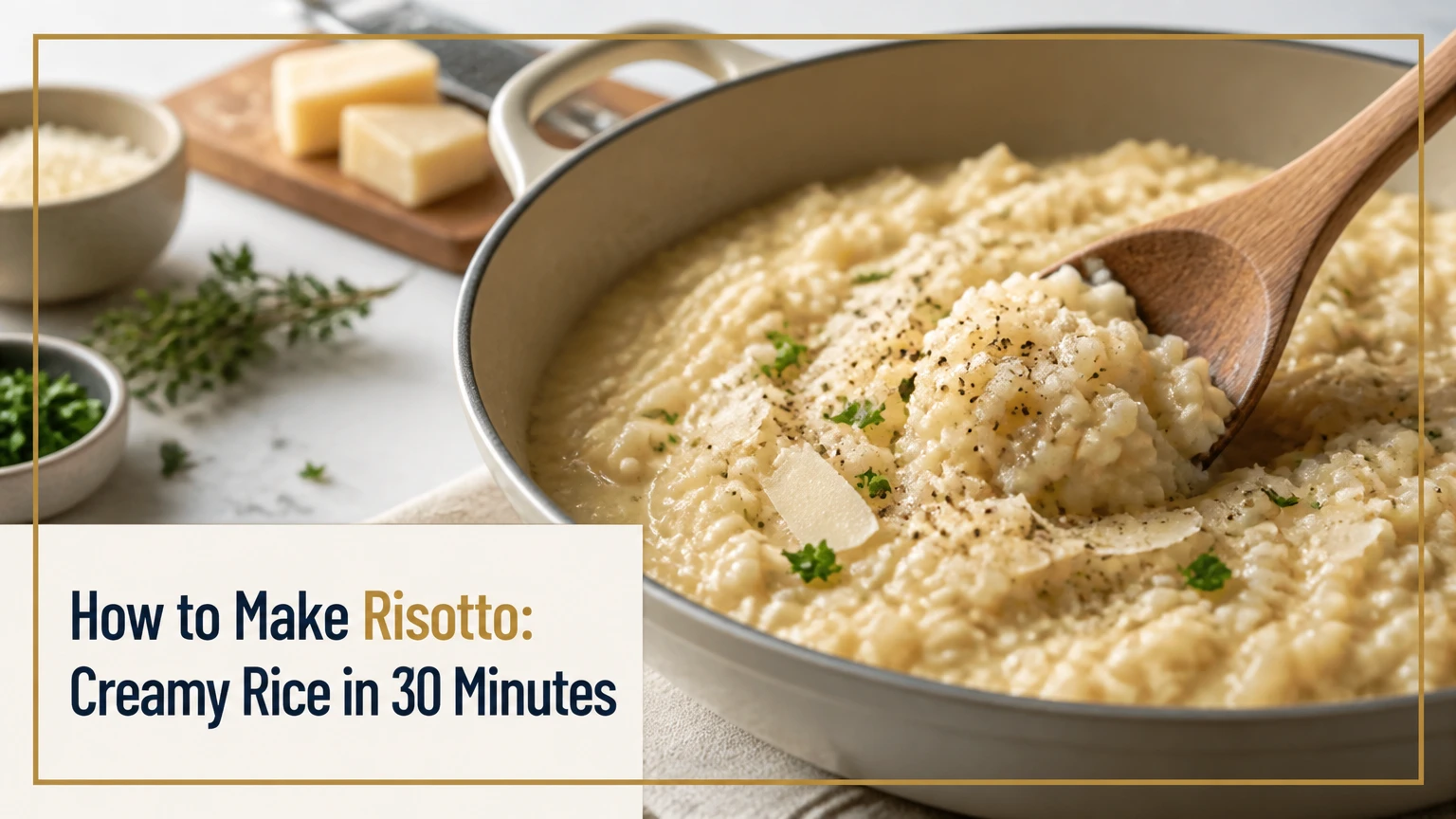
Risotto is made by gently cooking short-grain rice in hot stock, adding the liquid gradually while stirring, then emulsifying the finished rice with cold butter and grated Parmesan off the heat. The complete stovetop method takes 30-45 minutes, uses about 3.5-4 cups of stock per cup of rice, and produces creamy sauce around grains that remain al dente.
Key Facts at a Glance
- One cup of uncooked risotto rice makes approximately 3-4 main-course servings.
- Use 3.5-4 cups of hot stock per cup of rice, plus about ½ cup extra for adjustments.
- Arborio is forgiving for beginners; Carnaroli preserves an al dente center more reliably.
- Risotto cooks in approximately 18-22 minutes after the first ladle of stock.
- Risotto becomes thicker as it cools, so serve it immediately while it flows slowly across the plate.
- Cream is optional and usually unnecessary because released rice starch creates the sauce.
Before You Start
A wide, heavy-bottomed sauté pan, a saucepan for stock, a wooden spoon, a ladle, a fine grater, and a measuring cup are enough equipment for stovetop risotto. A 10-12 inch pan gives 1 cup of rice room to cook in a shallow layer, which improves evaporation and makes liquid absorption easier to judge.
Basic Ingredients for Four Servings
| Ingredient | Quantity | Practical specification | Typical cost |
|---|---|---|---|
| Arborio or Carnaroli rice | 1½ cups, 300 g | Unwashed, short-grain rice | $3-$8 |
| Chicken or vegetable stock | 5½-6 cups | Low-sodium, kept at 80-95°C | $3-$6 |
| Onion or shallot | ½ medium onion, 75 g | Finely minced, 2-3 mm pieces | $0.50-$1 |
| Dry white wine | ½ cup, 120 ml | Pinot Grigio, Sauvignon Blanc, or water | $1-$4 |
| Unsalted butter | 4 tablespoons, 57 g | 2 tablespoons for cooking, 2 for finishing | $1-$2 |
| Parmigiano-Reggiano | ¾ cup, 60 g | Finely grated, not pre-shredded | $3-$6 |
| Olive oil | 1 tablespoon, 15 ml | Optional for the soffritto | $0.20-$0.60 |
The quantities above produce a rich Risotto Bianco. For a vegetarian version, use vegetable stock and check that the Parmesan is made with a suitable vegetarian rennet if that restriction matters. For a dairy-free version, replace butter with olive oil and Parmesan with a measured spoonful of nutritional yeast or a dairy-free hard cheese, accepting a less classic emulsion.
What Makes Risotto Creamy?
Risotto becomes creamy because rice starch dissolves into hot stock while the grains move against one another and the finishing fat is mixed into the liquid. Amylopectin contributes viscosity, while amylose helps the cooked grain retain a firm center, so the sauce can be smooth without turning every grain into paste.
The surface starch matters most. Washing risotto rice removes some of the starch that helps thicken the cooking liquid, so rinse rice only when a specific recipe requires it. Toasting the dry grains in fat also develops nutty flavor and gives the grains a more resilient exterior, although the idea that tostatura creates a completely waterproof “shell” is an oversimplification.
Stirring should be frequent and gentle rather than violent or continuous. Each pass redistributes heat and releases starch, but aggressive scraping can break grains and create a gluey texture. The finished sauce is an emulsion of stock, rice starch, butter, and cheese, which is why mantecatura must happen off the heat.
What Does All’Onda Mean?
All’onda means “like a wave,” describing risotto that moves when the pan is shaken and spreads slowly on a warm plate. Proper all’onda risotto is looser than a mound of cooked rice but thicker than soup; a spoon dragged through the pan should leave a path that closes within a few seconds.
A practical test is to tilt the pan. The rice should flow together rather than remain fixed in a solid mass. If the mixture piles up, add 1-2 tablespoons of hot stock. If liquid pools around firm grains, continue cooking for 1-2 minutes before finishing.
Which Rice Is Best for Risotto?
Carnaroli is the best choice when grain definition matters, while Arborio is the easiest widely available option for beginners. Vialone Nano creates a particularly fluid, absorbent risotto, but long-grain Jasmine and Basmati rice do not provide the same starch balance or characteristic texture.
| Rice variety | Typical cooking time | Liquid absorption | Texture and best use |
|---|---|---|---|
| Carnaroli | 18-22 minutes | 3.5-4 cups per cup | Firm core; seafood and refined vegetable risotto |
| Arborio | 17-21 minutes | 3.5-4 cups per cup | Creamy and accessible; beginner-friendly preparations |
| Vialone Nano | 16-20 minutes | 3.25-3.75 cups per cup | Fluid all’onda texture; Venetian-style dishes |
| Baldo | 18-22 minutes | 3.5-4 cups per cup | Creamy surface with moderate grain definition |
| Jasmine rice | 12-16 minutes | 2-2.5 cups per cup | Fragrant but softer and less traditionally creamy |
| Basmati rice | 12-16 minutes | 2-2.5 cups per cup | Separate, aromatic grains; poor substitute for classic risotto |
Carnaroli is often called a professional favorite because it tolerates a minute or two of extra cooking better than Arborio. That advantage does not eliminate the need for tasting. A grain can look intact while its center is already too soft.
How to Make Risotto on the Stovetop
Make risotto in five stages: soften aromatics, toast the rice, deglaze with wine, add hot stock gradually, and finish with butter and cheese off the heat. Maintain a gentle simmer, add liquid when the previous ladle is nearly absorbed, and start tasting at 16 minutes rather than relying only on the clock.
Step 1: Heat the Stock
Bring 5½-6 cups of stock to a bare simmer in a separate saucepan, then keep it between 80°C and 95°C while the rice cooks. Do not allow the stock to boil hard, because excessive evaporation changes the final ratio.
You will know this step worked when steam rises and a few small bubbles appear at the edges. Cold stock lowers the temperature of the rice and lengthens cooking, while boiling stock can reduce too quickly. The common mistake is placing the stock on a back burner and forgetting to replenish it as it evaporates.
Step 2: Cook the Aromatics
Heat 1 tablespoon of olive oil and 1 tablespoon of butter in a 10-12 inch pan over medium heat. Add ½ finely minced onion or two minced shallots, then cook for 3-5 minutes until translucent and tender without browning.
The soffritto should smell sweet and savory, with no dark edges. Brown onion introduces a stronger roasted flavor that can overpower delicate saffron or seafood. The common mistake is cutting the onion too coarsely, which leaves crunchy pieces after the rice is done.
Step 3: Toast the Rice
Add 1½ cups of unwashed rice to the aromatics and stir for 2-3 minutes. Tostatura is complete when the grains look slightly translucent at the edges, feel hot, and smell faintly nutty.
The rice should remain pale rather than turn brown. Toasting improves flavor and helps the grains retain shape, but prolonged frying can harden the exterior and delay hydration. The common mistake is skipping this step because the rice appears dry; dry-toasting in the pan is part of the flavor structure.
Step 4: Deglaze With Wine
Pour in ½ cup of dry white wine and stir until nearly absorbed, usually 1-2 minutes. The sharp alcohol aroma should fade before the first stock is added.
Wine contributes acidity that balances butter, cheese, and starchy rice. Use ½ cup of hot stock or water instead when cooking without alcohol, although the final dish will taste rounder and less bright. The common mistake is adding stock while wine still sits in a visible layer, which dilutes the intended acidity.
Step 5: Add Stock Gradually
Reduce the heat to medium-low and add one ladle, approximately ½-¾ cup, of hot stock. Stir every 20-30 seconds, keeping the rice at a gentle simmer, and add the next ladle when the pan looks nearly dry but the rice still moves easily.
Continue for 18-22 minutes from the first ladle. The rice should absorb most of each addition without becoming dry or sticking to the pan. You will know the method worked when the grains are creamy outside, firm in the center, and surrounded by enough liquid to flow.
The common mistake is adding all the stock at once. That method can cook rice, but it makes evaporation and texture harder to control, especially in a wide pan. Add ¼ cup of hot stock whenever the rice becomes tight before the next scheduled ladle.
Step 6: Taste and Adjust
Taste a grain at 16 minutes, then test every 60-90 seconds. Perfect risotto has a soft exterior, a barely resistant center, and seasoning that tastes complete before the cheese is added.
Cooking time varies with pan diameter, burner output, stock temperature, rice age, and batch size. A 12-inch pan may finish faster than a narrow saucepan because more water evaporates. The common mistake is treating “20 minutes” as a guarantee instead of using the grain as the final measurement.
Step 7: Finish With Mantecatura
Remove the pan from the heat, add 2 tablespoons of cold cubed butter and ¾ cup of finely grated Parmigiano-Reggiano, then stir vigorously for 30-60 seconds. Cover for 1-2 minutes, stir again, and loosen with hot stock if the risotto does not move in waves.
Mantecatura binds the starch-rich liquid with dairy fat and cheese. Finely grated cheese melts more evenly than thick shreds, and cold butter helps moderate the mixture after cooking. The common mistake is adding cheese over direct heat, which can separate the fat and produce a greasy, stringy sauce.
Step 8: Serve Immediately
Spoon risotto into warm, shallow bowls as soon as the mantecatura is complete. Tap the underside of each bowl or shake the pan before serving to check that the rice spreads slowly.
Risotto waits poorly. After 5-10 minutes, the starch continues to absorb liquid and the texture becomes dense. Reserve ½ cup of hot stock for last-second loosening, especially when serving several people.
How Long and Much Does Risotto Cost?
A four-serving batch typically takes 35-45 minutes and costs approximately $8-$20 with supermarket ingredients, while a basic two-serving batch can cost $5-$10. Premium saffron, dried porcini, seafood, homemade stock, and aged cheese can raise the total above $25.
| Preparation | Prep time | Cooking time | Typical total cost |
|---|---|---|---|
| Risotto Bianco, 2 servings | 8-10 minutes | 18-22 minutes | $5-$10 |
| Risotto Bianco, 4 servings | 10-15 minutes | 20-25 minutes | $8-$20 |
| Mushroom risotto, 4 servings | 15-20 minutes | 22-28 minutes | $12-$25 |
| Saffron risotto, 4 servings | 10-15 minutes | 20-25 minutes | $15-$35 |
| Seafood risotto, 4 servings | 20-25 minutes | 25-30 minutes | $20-$45 |
These are typical home-cooking ranges in the United States and exclude pantry staples or wine purchased as a full bottle. Seafood requires special timing because shrimp, scallops, and calamari can become rubbery if cooked through the entire rice process.
What Variations Work Best?
Flavor variations work best when the main ingredient is cooked separately or added at the stage that matches its required cooking time. Mushrooms benefit from browning before the rice, saffron blooms in warm stock, and delicate seafood usually enters during the final minutes.
Mushroom Risotto
Sauté 8 ounces of sliced cremini mushrooms in a separate pan until browned, then reserve them. Add ½ ounce of rehydrated porcini to the stock and use ½ cup of strained soaking liquid as part of the total liquid. Fold the browned mushrooms into the risotto during the final 2 minutes.
Saffron Risotto alla Milanese
Steep ½ teaspoon of saffron threads in ½ cup of warm stock for at least 10 minutes. Add the saffron liquid around the midpoint of cooking, then finish with butter and Parmesan. Traditional versions may use beef marrow, but butter and olive oil provide a practical home-kitchen substitute.
Vegetable Risotto
Add firm vegetables such as diced asparagus stems, peas, or roasted squash according to their cooking time. Add peas during the final 3 minutes, blanched asparagus during the final 4 minutes, and roasted squash during mantecatura so it retains shape.
Seafood Risotto
Use fish stock and add chopped calamari 5-7 minutes before the end, shrimp during the final 4 minutes, and cooked shellfish during the last minute. Keep seafood portions moderate, because a crowded pan releases water and makes the rice cook unevenly.
Can You Make Risotto in a Pressure Cooker?
A pressure cooker can make risotto in about 20-25 minutes with less stirring, but the texture is usually less adjustable than stovetop risotto. Toast the rice using the sauté function, add approximately 3 cups of stock per cup of rice, cook at high pressure for 5-6 minutes, release pressure quickly, and finish with butter and cheese.
Use the pressure-cooker method when convenience matters more than precise evaporation control. Do not use the full stovetop ratio automatically, because a sealed cooker loses far less water. Stir immediately after opening, then add hot stock one tablespoon at a time until the rice reaches all’onda consistency.
Common Mistakes and How to Fix Them
Risotto problems usually come from temperature, liquid management, or finishing technique rather than from the rice itself. The fastest recovery is to adjust with hot liquid while the rice is still in the pan, because plating cannot reverse overcooking.
| Problem | Likely cause | Immediate fix | Prevention |
|---|---|---|---|
| Rice is raw and liquid is gone | Heat too high or pan too wide | Add ¼ cup hot stock; cook 2-4 minutes | Use medium-low heat and reserve stock |
| Risotto is gummy | Violent stirring or overcooking | Fold in 1-2 tablespoons hot stock | Stir every 20-30 seconds, not constantly |
| Liquid pools on the plate | Weak mantecatura or excess stock | Stir off heat with 1 tablespoon water and cheese | Finish vigorously off the heat |
| Rice is bland | Unsalted stock or late seasoning | Add salt gradually before final cheese | Taste stock and season during cooking |
| Bottom is scorched | Heat too high or pan left unattended | Transfer unburned rice immediately | Use a heavy pan and frequent folding |
| Cheese becomes stringy | Cheese added over direct heat | Remove from burner and stir in hot water | Grate cheese finely and finish off heat |
A gummy texture cannot be fully repaired because overcooked starch has already thickened and broken down. Loosening the rice improves serving consistency, but it will not restore a firm center. Repurpose heavily overcooked risotto as arancini or a pan-fried rice cake instead.
Expert Rules for Better Texture
- Use the spoon-path test, not a fixed ladle count. Rice absorbs stock at different rates depending on pan width and burner strength, so the visual state of the pan is more reliable than the number of additions.
- Season the stock before cooking. Risotto absorbs most of its liquid, and bland stock cannot be corrected efficiently at the table without making the finished cheese taste excessively salty.
- Hold back the final liquid. Stopping with 2-3 tablespoons of hot stock unused gives control during mantecatura, when cheese and butter can thicken the sauce quickly.
- Treat stirring as heat management. Stirring redistributes rice across the hot surface and prevents scorching, but constant scraping is not required for starch release.
- Finish earlier than the final texture. Carryover absorption continues for several minutes, so remove the pan when the center is slightly firmer than the desired serving bite.
How Should Risotto Be Stored and Reheated?
Refrigerate leftover risotto within two hours in a shallow container and use it within 3-4 days. Reheat one portion in a saucepan with 1-2 tablespoons of water or stock, stirring over medium-low heat until steaming hot, then adjust the consistency before serving.
Fresh risotto has the best all’onda texture, while reheated risotto becomes thicker and more cohesive. Do not leave a large pot warm for extended service, because the rice continues absorbing liquid and enters an unsafe temperature range more easily. Cold leftovers are excellent for arancini, where the firmer texture becomes an advantage.
Frequently Asked Questions
Do You Wash Rice Before Making Risotto?
Do not wash Arborio, Carnaroli, or Vialone Nano rice before making risotto. The surface starch helps thicken the stock and create the characteristic creamy sauce. Washing can produce cleaner individual grains, but that is useful for pilaf or steamed rice, not for the traditional risotto method.
Can You Make Risotto Without Wine?
Yes, risotto can be made without wine by replacing the ½ cup of wine with hot stock or water. Wine adds acidity and aroma rather than essential cooking chemistry. Add 1-2 teaspoons of lemon juice at the end only if the finished dish tastes flat, because early acid can slow softening.
Why Is My Risotto Not Creamy?
Risotto may lack creaminess because the stock was added too quickly, the rice was rinsed, the pan was too hot, or the finished dish was not emulsified off the heat. Add 1-2 tablespoons of hot stock, then stir in cold butter and finely grated cheese away from the burner.
How Much Risotto Rice Do You Need Per Person?
Use 75 g, approximately ⅓ cup, of uncooked risotto rice per person for a main course, or 50-60 g for a first course. One cup of dry rice generally feeds 2-3 people as a main dish and requires 3.5-4 cups of stock.
Can You Use Brown Rice for Risotto?
Brown rice can produce a nutritious rice dish, but it does not make classic risotto efficiently because its bran layer slows hydration and its starch behaves differently. Parboiled brown rice may require 35-45 minutes and more liquid, producing a chewier result rather than a traditional all’onda texture.
Which Is Better for Beginners, Arborio or Carnaroli?
Arborio is usually better for beginners because it is inexpensive and widely available, but Carnaroli is more forgiving when cooking runs slightly long. Start with Arborio for a first attempt, then use Carnaroli when you want a firmer center and more precise presentation.
Conclusion
To make risotto, toast unwashed Arborio or Carnaroli rice, deglaze with wine, add 3.5-4 cups of hot stock gradually, stir gently for 18-22 minutes, and finish off the heat with cold butter and Parmesan. Taste the grain, adjust with reserved stock, and serve immediately while the rice remains creamy, loose, and al dente.