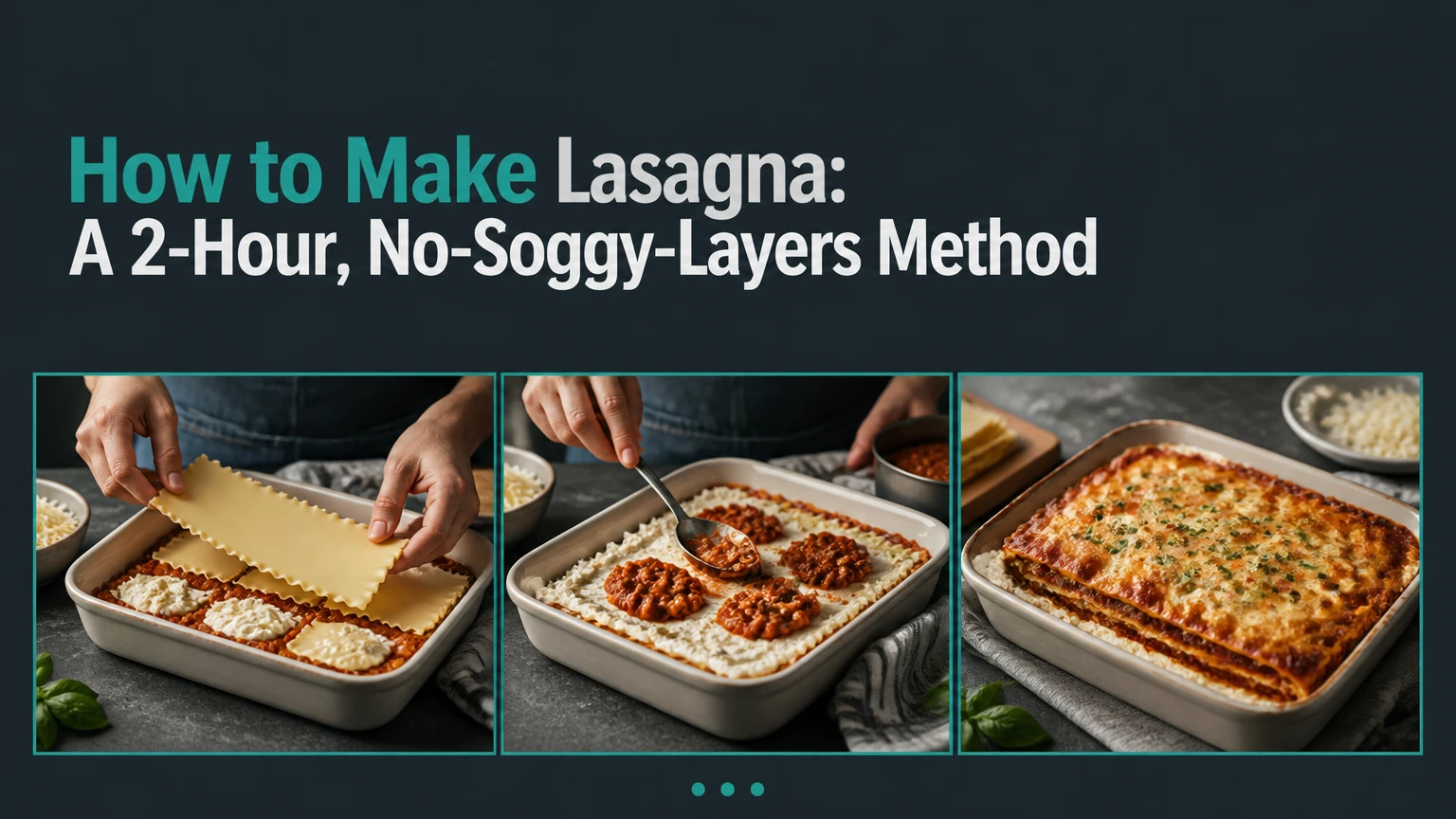
To make lasagna, layer thick meat sauce, pasta sheets, seasoned ricotta or béchamel, mozzarella, and Parmesan in a deep 9-by-13-inch baking dish. Cover and bake at 375°F for 25 minutes, uncover for 15-20 minutes, then rest the lasagna for 20-30 minutes so the starches and cheese set before slicing.
Key Facts at a Glance
- A 9-by-13-inch pan produces 8-10 servings and needs at least 3 inches of depth.
- Lasagna requires four pasta layers for a stable, sliceable structure.
- Covered baking supplies steam; uncovered baking browns the mozzarella and Parmesan.
- The meat sauce should be thick before assembly because watery ragù creates loose layers.
- Typical total time is 2 hours 15 minutes with a quick sauce, or about 3 hours 30 minutes with a traditional simmer.
- Leftover lasagna should reach 165°F when reheated, according to the USDA Food Safety and Inspection Service.
What Makes Lasagna Hold Together?
Lasagna holds together when pasta absorbs controlled moisture while cheese, egg, starch, and reduced sauce form a cohesive filling. The oven softens the sheets, melts the cheese, and concentrates the sauce; the resting period allows the hot liquid to redistribute and the proteins and starches to firm.
Lasagna is an assembled baked pasta dish rather than a single uniform casserole. Each pasta sheet separates the wet fillings, while the sauce provides enough water for dried or oven-ready noodles to hydrate. The balance matters: dry edges become crunchy, but excess liquid makes the cut face collapse.
A thick sauce is therefore more important than an excessive amount of cheese. Ricotta mixed with egg creates a set, spoonable layer, while béchamel contributes smoothness and moisture. Parmesan adds salt and browned flavor, and low-moisture mozzarella supplies stretch without releasing as much water as fresh mozzarella.
Traditional Styles and Their Defining Ingredients
Lasagna alla Bolognese typically uses green spinach pasta, ragù made with beef and pork, béchamel, and Parmigiano-Reggiano. Lasagna Napoletana uses tomato sauce, ricotta, mozzarella, sausage or small meatballs, and sometimes hard-boiled egg.
Vegetarian lasagna replaces meat with roasted mushrooms, zucchini, spinach, peppers, or eggplant. Seafood lasagna usually works better with béchamel or a white wine cream sauce than with a highly acidic tomato sauce. These styles share a layering method, but they do not share identical moisture requirements.
Before You Start
The recipe below makes 8-10 servings and takes about 2 hours 15 minutes with prepared sauce or 3 hours 30 minutes with a two-hour ragù. The difficulty is moderate because the individual techniques are simple, but sauce thickness and assembly control the final texture.
| Item | Typical quantity or specification | Why it matters |
|---|---|---|
| Baking dish | 9 by 13 inches, 3 inches deep | Holds four pasta layers without overflow |
| Ground meat | 1 pound beef plus 1 pound Italian sausage | Provides roughly 2 pounds of cooked filling |
| Crushed tomatoes | 28 ounces | Forms the main ragù liquid |
| Dried lasagna sheets | 12-15 sheets | Usually supplies four layers |
| Ricotta | 15 ounces | Creates the creamy filling |
| Mozzarella | 3 cups, low-moisture shredded | Browns while limiting excess water |
| Parmesan | 1 cup grated | Seasons layers and forms a browned crust |
| Foil and cooking spray | 1 sheet plus light coating | Traps steam and prevents cheese adhesion |
You also need a large skillet or Dutch oven, a 9-by-13-inch dish, a stockpot if boiling pasta, a colander, a mixing bowl, a spatula, a ladle, and a sharp knife. Set the oven rack in the center position and preheat the oven to 375°F before baking.
How to Make Lasagna
Step 1: Choose and Prepare the Pasta
Use 12-15 standard dried lasagna sheets, 12 oven-ready sheets, or enough fresh pasta to cover four layers in the pan. Boil standard dried sheets in salted water until they are about 2 minutes short of the package’s stated time, then drain and separate them on a lightly oiled tray.
Oven-ready sheets can usually go directly into the dish when the sauce is sufficiently loose. For extra insurance, soak them in warm water for 5 minutes, especially when using a thick jarred sauce. Fresh egg pasta needs no boiling and cooks quickly, but delicate sheets should overlap only slightly.
You’ll know it worked when: the sheets bend without cracking but still have a firm center.
Common mistake: treating every pasta type identically. No-boil sheets need more available moisture, while fresh pasta needs less cooking time and fewer heavy layers.
Step 2: Cook a Thick Meat Ragù
Heat 2 tablespoons of olive oil in a large pot over medium-high heat. Brown 1 pound of ground beef and 1 pound of Italian sausage in two batches, if necessary, so the meat sears instead of steaming.
Add 1 diced medium onion, 1 diced carrot, 1 diced celery stalk, and 3 minced garlic cloves. Cook for 6-8 minutes until the vegetables soften. Stir in 2 tablespoons of tomato paste and cook for 1 minute. Add 1 cup of red wine, if desired, and scrape up the browned bits.
Pour in two 28-ounce cans of crushed tomatoes, add 1 teaspoon dried oregano, 1 teaspoon salt, and ½ teaspoon black pepper, then simmer uncovered. A traditional ragù benefits from 2-3 hours of gentle cooking; a practical weeknight sauce needs at least 45 minutes.
The sauce must mound slightly on a spoon rather than run like soup. If the ragù remains thin, simmer it uncovered for another 10-15 minutes before assembly.
You’ll know it worked when: a spatula leaves a visible track across the pot for 1-2 seconds.
Common mistake: assembling with hot, watery sauce straight from a rushed pot. Reduction is the main defense against soupy lasagna.
Step 3: Prepare the Ricotta Filling or Béchamel
For a ricotta filling, stir together 15 ounces ricotta, 1 large egg, ½ cup grated Parmesan, 2 tablespoons chopped parsley, ½ teaspoon salt, and ¼ teaspoon black pepper. If the ricotta looks wet, drain it in a fine sieve for 30 minutes before mixing.
For béchamel, melt 4 tablespoons butter over medium heat, whisk in 4 tablespoons flour, and cook for 1 minute. Gradually whisk in 2 cups warm whole milk, then simmer for 5-7 minutes until the sauce coats a spoon. Season with ½ teaspoon salt, black pepper, and a pinch of nutmeg.
| Filling | Preparation time | Texture | Best pairing | Main limitation |
|---|---|---|---|---|
| Ricotta mixture | 5-10 minutes | Fluffy and grainy-creamy | Tomato ragù and mozzarella | Wet brands can loosen slices |
| Béchamel | 12-15 minutes | Smooth and velvety | Bolognese and spinach pasta | Requires a saucepan and whisk |
| Cottage cheese blend | 5 minutes | Soft and moderately creamy | Budget American-style lasagna | Less dense than drained ricotta |
| Mascarpone béchamel | 15 minutes | Rich and very smooth | Mushroom or vegetable lasagna | Higher cost and heavier flavor |
Béchamel is the better structural choice when the ragù is intensely savory or when using spinach and fresh pasta. Ricotta is faster and more familiar in cheese-forward, Southern Italian-inspired lasagna.
You’ll know it worked when: the ricotta spreads without puddling, or the béchamel falls from the spoon in a thick ribbon.
Common mistake: using fresh mozzarella or undrained ricotta without reducing other liquid.
Step 4: Assemble the Layers in the Correct Order
Spread ½ cup of ragù across the bottom of the baking dish. The thin foundation prevents sticking and protects the first pasta layer from direct heat.
Build four layers using this sequence:
- Place pasta sheets side by side, with about ¼ inch of overlap.
- Spread one-quarter of the ricotta mixture or béchamel.
- Add one-quarter of the remaining ragù.
- Sprinkle about ¾ cup mozzarella and 2 tablespoons Parmesan.
- Repeat until four pasta layers are complete.
Finish with pasta, a thin layer of ragù, the remaining mozzarella, and the remaining Parmesan. Keep every exposed pasta corner under sauce or cheese. An uncovered corner is the most common source of hard, curled edges.
Do not compress the layers aggressively. A gentle press removes large air pockets without forcing all the sauce to the sides. The dish should sit ¼-½ inch below its rim to leave room for bubbling.
You’ll know it worked when: the top is fully covered and the filling reaches nearly the top of the dish without overflowing.
Common mistake: putting cheese directly on the bottom or ending with a dry pasta sheet.
Step 5: Bake Covered, Then Brown the Top
Coat one side of a sheet of foil with cooking spray and cover the dish with the coated side facing the lasagna. Crimp the foil tightly around the rim, leaving a small air space above the cheese.
Bake at 375°F for 25 minutes. Remove the foil and continue baking for 15-20 minutes, until the cheese bubbles across the center and develops golden patches. A refrigerated, assembled lasagna usually needs 35 minutes covered and 15-20 minutes uncovered.
For food safety, the center should reach 165°F when reheating a prepared or leftover lasagna. The USDA Food Safety and Inspection Service states, “Leftovers should be reheated to 165°F,” a useful target for make-ahead dishes as well as leftovers.
You’ll know it worked when: the center bubbles, the edges show active simmering, and a thermometer reads at least 165°F in a reheated dish.
Common mistake: judging doneness only by browned cheese. A dark top can conceal a cool center if the dish began cold.
Step 6: Rest and Slice the Lasagna
Rest the baked lasagna uncovered for 20-30 minutes before cutting. The first 10 minutes reduce surface bubbling, while the remaining time allows the sauce, cheese, egg, and hydrated pasta to settle into distinct layers.
Use a serrated knife or a thin chef’s knife, cutting through the full depth with a gentle sawing motion. Wipe the blade between portions if you want clean edges. A very hot lasagna will always be looser than one rested for 30 minutes.
You’ll know it worked when: a lifted square keeps recognizable pasta layers and does not release a pool of sauce.
Common mistake: serving immediately because the top looks finished. Resting is a structural step, not merely a cooling preference.
Which Pasta and Cheese Combination Works Best?
For the most forgiving result, use standard dried sheets, thick ragù, drained ricotta, and low-moisture mozzarella. Oven-ready sheets are faster, but they depend more heavily on sauce moisture; fresh pasta gives the most tender texture but can become soft when paired with watery vegetables.
| Component | Best texture | Typical cost per pan | Preparation | Use it when |
|---|---|---|---|---|
| Standard dried pasta | Firm, defined chew | $3-$5 | Boil 2 minutes under package time | You want reliable structure |
| Oven-ready pasta | Soft and convenient | $4-$7 | Use directly or soak 5 minutes | You need fewer cooking steps |
| Fresh egg pasta | Tender and delicate | $8-$15 | Roll or purchase sheets | You want a refined Bolognese style |
| Low-moisture mozzarella | Stretchy and browned | $6-$10 | Shred or use pre-shredded | You want controlled moisture |
| Fresh mozzarella | Soft and milky | $8-$14 | Drain and pat dry | You can accept a softer top |
| Parmigiano-Reggiano | Salty, nutty crust | $5-$10 | Grate finely | You need concentrated seasoning |
Fresh mozzarella is not automatically better. Its water content can create wet pockets unless the cheese is drained, patted dry, and used sparingly.
How Can You Adapt the Recipe?
Vegetarian lasagna works when vegetables are roasted or sautéed until their moisture is driven off. Roast 2 pounds of sliced zucchini, mushrooms, peppers, or eggplant at 425°F for 20-30 minutes, then cool and drain before layering.
For a spinach version, wilt 10 ounces of frozen spinach, squeeze it very dry, and mix it into the ricotta. For gluten-free lasagna, use certified gluten-free sheets and check sausage, stock, and spice labels for hidden wheat ingredients.
For a faster version, use 48-64 ounces of prepared marinara, 1 pound of browned beef, oven-ready sheets, and ricotta. This reduces active preparation to about 35 minutes, though the final bake and rest still require roughly 65-75 minutes.
Lasagna is also easy to scale, but pan depth matters. A half recipe fits an 8-by-8-inch dish with three pasta layers; doubling the recipe requires two 9-by-13-inch dishes rather than one overflowing pan.
Can You Make Lasagna Ahead or Freeze It?
Assemble lasagna up to 24 hours ahead, cover it tightly, and refrigerate it before baking. Add 10 minutes to the covered baking stage because the center begins cold. Do not leave an assembled dish at room temperature for several hours.
To freeze lasagna, cool cooked portions completely, wrap them in plastic or freezer paper, and add a foil layer. Freeze for up to 3 months for best texture. Thaw a full dish in the refrigerator for 24 hours, then bake covered at 375°F until the center reaches 165°F.
Individual portions reheat more evenly than a frozen full pan. Microwave a refrigerated square at 70% power for 3-5 minutes, rotating once, or heat it covered in a 350°F oven for 20-30 minutes.
| Situation | Storage limit | Covered cooking time | Best method |
|---|---|---|---|
| Refrigerated unbaked lasagna | 24 hours | 35 minutes | Bake directly from refrigerator |
| Refrigerated leftovers | 3-4 days | 20-30 minutes at 350°F | Cover to retain moisture |
| Frozen cooked portions | 3 months for best quality | 3-5 minutes microwave | Rotate halfway through |
| Frozen full pan, thawed | 3 months for best quality | 35-45 minutes at 375°F | Cover until center reaches 165°F |
| Frozen full pan, unthawed | 3 months for best quality | 75-105 minutes | Use a deep, freezer-safe dish |
Common Mistakes and How to Fix Them
| Problem | Likely cause | Immediate fix next time | Prevention |
|---|---|---|---|
| Soupy slices | Thin ragù or wet ricotta | Chill the pan 30 minutes before serving | Reduce sauce and drain ricotta |
| Crunchy pasta edges | Exposed sheets or loose foil | Add sauce around exposed edges | Cover every noodle surface |
| Cheese stuck to foil | Foil touching melted cheese | Peel foil back slowly after cooling 5 minutes | Spray foil and tent it |
| Dry center | Too little sauce or excessive baking | Add 2 tablespoons hot sauce per portion | Use enough sauce for oven-ready sheets |
| Greasy surface | High-fat sausage or excess mozzarella | Blot gently with paper towel | Drain browned meat and use low-moisture cheese |
| Collapsed layers | Sliced immediately | Rest 20-30 minutes | Cut with a sharp knife after bubbling stops |
A counterintuitive rule is that more sauce does not always improve dry lasagna. If the sauce is thin, adding volume increases free water faster than the pasta can absorb it. Thickening the existing ragù usually produces a better result than adding another ladle.
Another practitioner rule is to season each component lightly rather than salting the assembled dish heavily. Sausage, Parmesan, pasta water, and prepared marinara can each contain substantial sodium, so tasting the ragù and ricotta separately prevents an over-salted final pan.
What Does Homemade Lasagna Cost and How Long Does It Take?
A typical homemade 9-by-13-inch meat lasagna costs $25-$40 and serves 8-10 people, or approximately $3-$5 per serving. The largest cost variables are Parmesan, mozzarella, sausage, fresh pasta, and whether you make the ragù from canned tomatoes or premium meat.
| Version | Active prep | Cooking and resting | Typical pan cost | Servings |
|---|---|---|---|---|
| Shortcut beef lasagna | 35-45 minutes | 65-75 minutes | $25-$32 | 8-10 |
| Traditional ragù lasagna | 45-60 minutes | 2 hours 20 minutes-3 hours 20 minutes | $30-$40 | 8-10 |
| Vegetarian lasagna | 45-55 minutes | 70-85 minutes | $22-$35 | 8-10 |
| Fresh pasta Bolognese | 90-120 minutes | 3-4 hours | $35-$55 | 8-10 |
The traditional Northern Italian version is not the best choice when speed is the priority. Béchamel and a long-cooked ragù reward planning, while ricotta and prepared marinara provide a more practical weeknight route.
Expert Rules for Better Layers
Use less filling per layer than intuition suggests. A layer about ¼ inch thick cooks more evenly and leaves room for four pasta sheets, whereas thick ricotta bands often slide apart when cut.
Keep the top layer simple: pasta, a thin coat of ragù, mozzarella, and Parmesan. A large exposed layer of ricotta or béchamel browns unevenly and can separate from the cheese crust.
Let the ragù cool for 10-15 minutes before assembly when possible. Warm sauce spreads more easily, but boiling-hot sauce melts cheese prematurely and makes it harder to judge how much filling has entered each layer.
Frequently Asked Questions
Do You Have to Boil Lasagna Noodles?
Standard dried lasagna noodles should be boiled unless the package specifically labels them oven-ready. Cook them about 2 minutes under the package time so they finish in the oven. Oven-ready sheets can usually be layered dry when the ragù contains enough moisture, while fresh pasta requires no boiling.
How Many Layers Should Lasagna Have?
Lasagna should have at least four pasta layers for a stable 9-by-13-inch casserole. Three layers can work in a smaller dish, but four layers distribute the filling more evenly and create cleaner portions. Keep each filling layer moderate so the final dish remains below the rim.
Why Is My Lasagna Watery After Baking?
Watery lasagna usually results from reduced moisture control, including thin tomato sauce, undrained ricotta, wet vegetables, fresh mozzarella, or insufficient resting. Simmer ragù until it leaves a track in the pot, drain ricotta for 30 minutes, roast vegetables first, and rest the baked pan for 20-30 minutes.
Can You Use Cottage Cheese Instead of Ricotta?
Cottage cheese can replace ricotta at a one-to-one volume ratio, but blend it briefly for a smoother texture and drain it if watery. Full-fat cottage cheese provides the closest richness. The substitution works best with tomato sauce and mozzarella, although the filling will be softer than drained ricotta.
Should Lasagna Be Covered While Baking?
Lasagna should be covered for the first 25 minutes at 375°F, then uncovered for 15-20 minutes to brown the top. Foil traps steam and hydrates pasta; leaving the dish uncovered from the beginning can dry exposed edges before the center cooks.
How Long Should Lasagna Cool Before Cutting?
Lasagna should cool for 20-30 minutes before cutting. The sauce stops boiling, melted cheese thickens, and hydrated starches firm during that interval. A 10-minute rest is edible but often produces looser portions, while a 30-minute rest gives the cleanest slices without making the dish cold.
The Bottom Line
How to make lasagna successfully comes down to four controls: reduce the ragù, manage moisture in the cheese and vegetables, cover the dish while pasta cooks, and rest the finished pan before slicing. Use four pasta layers in a deep 9-by-13-inch dish, bake at 375°F, and choose ricotta for speed or béchamel for a smoother Northern Italian texture.