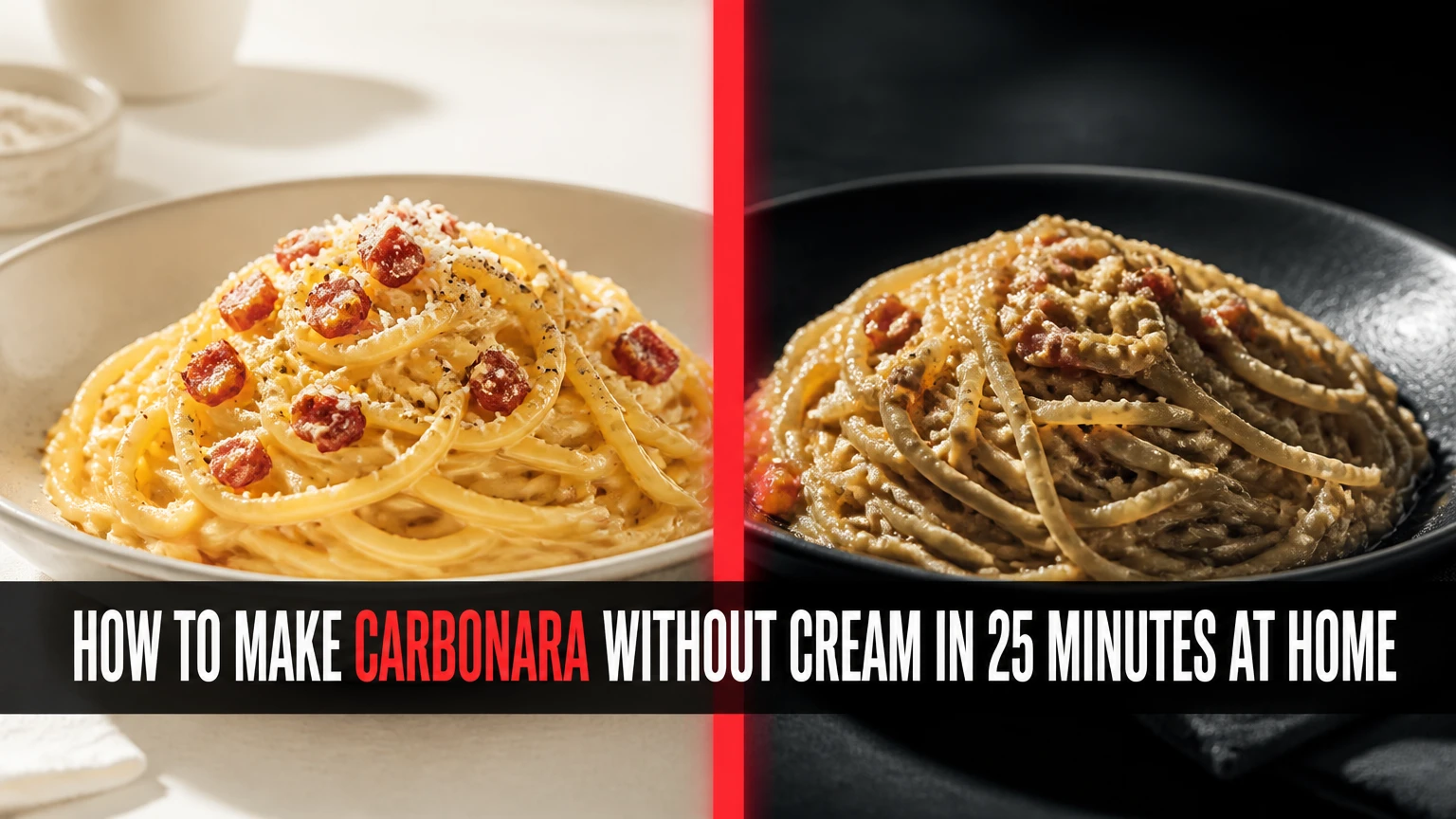
Spaghetti alla carbonara is made by tossing hot al dente pasta with rendered cured pork, finely grated Pecorino Romano, eggs, black pepper, and reserved pasta water. The sauce becomes creamy through emulsification, not dairy cream: residual heat thickens the eggs while pasta starch binds water and pork fat into a glossy coating.
Key Facts at a Glance
- Authentic Roman carbonara contains pasta, guanciale, eggs, Pecorino Romano, black pepper, and pasta water, with no cream.
- A practical two-person ratio is 200 grams pasta, 100 grams guanciale, 1 whole egg, 2 yolks, and 50 grams cheese.
- Carbonara usually takes 20-25 minutes from preparation to plating.
- Egg proteins tighten and scramble when overheated, so remove the pan from direct heat before adding the egg mixture.
- Finely grated cheese and starchy pasta water create a smoother emulsion than coarse cheese and plain water.
- Guanciale gives the deepest traditional flavor, pancetta gives a cleaner substitute, and bacon adds smoke that changes the dish.
What Ingredients Do You Need?
For two generous servings, use 200 grams, or about 7 ounces, of spaghetti, bucatini, or rigatoni; 100 grams of guanciale; 1 large whole egg; 2 large egg yolks; 50 grams of finely grated Pecorino Romano; 1-2 teaspoons freshly cracked black pepper; and lightly salted water.
| Ingredient | Two-serving amount | Functional role | Best practical choice |
|---|---|---|---|
| Pasta | 200 g, 7 oz | Supplies starch and structure | Bronze-die spaghetti or rigatoni |
| Guanciale | 100 g, 3.5 oz | Supplies cured pork flavor and rendered fat | 6-8 mm cubes or strips |
| Eggs | 1 whole egg plus 2 yolks | Thickens and emulsifies sauce | Large eggs at room temperature |
| Pecorino Romano | 50 g, 1.75 oz | Adds salt, body, and sheep’s-milk flavor | Finely grated Pecorino Romano DOP |
| Black pepper | 2-4 g, 1-2 tsp | Adds aroma and bitterness | Freshly cracked or mortar-crushed pepper |
| Pasta water | 120-180 ml, 1/2-3/4 cup | Loosens and stabilizes the emulsion | Water from the cooking pot |
Room-temperature eggs are easier to combine with hot pasta without a severe temperature shock, although temperature control matters more than the starting temperature. Grate the cheese into a powder-like texture with a Microplane or fine box-grater side; thick shreds melt unevenly and can form cheese clumps.
Use half the salt you would normally add to pasta water. Guanciale and Pecorino Romano can contribute substantial sodium, and the finished sauce concentrates both ingredients. The water should taste lightly seasoned rather than aggressively salty.
How Much Carbonara Should You Make?
Use 100 grams of dry pasta and 50 grams of cured pork per person, then adjust the egg mixture by serving count. For one serving, use 100 grams pasta, 50 grams guanciale, 1 yolk, 25 grams cheese, and approximately 60-90 milliliters pasta water.
| Servings | Dry pasta | Guanciale | Egg mixture | Pecorino Romano |
|---|---|---|---|---|
| 1 | 100 g, 3.5 oz | 50 g, 1.75 oz | 1 yolk | 25 g, 0.9 oz |
| 2 | 200 g, 7 oz | 100 g, 3.5 oz | 1 whole egg plus 2 yolks | 50 g, 1.75 oz |
| 4 | 400 g, 14 oz | 200 g, 7 oz | 2 whole eggs plus 4 yolks | 100 g, 3.5 oz |
| 6 | 600 g, 21 oz | 300 g, 10.5 oz | 3 whole eggs plus 6 yolks | 150 g, 5.3 oz |
The two-serving formula is forgiving because the sauce has enough egg yolk to emulsify the rendered fat without becoming heavy. For six or more servings, use a very large bowl and divide the pasta between two skillets or bowls if vigorous tossing becomes difficult.
Before You Start
Carbonara requires approximately 10 minutes of preparation and 10-15 minutes of cooking. The difficulty is moderate, the typical home cost is $3.50-$7 per serving, and the main success factor is keeping the egg mixture below the point where it scrambles.
Tools and prerequisites:
- One large pot holding at least 4 liters, or 4 quarts, of water
- One 25-30 centimeter, or 10-12 inch, skillet
- One large heatproof mixing bowl
- Tongs or a pasta fork
- Fine grater
- Measuring scale or measuring cups
- Serving bowls warmed with hot water
- A mug or ladle for reserving pasta water
Prepare the eggs, cheese, and pepper before boiling the pasta. Carbonara moves quickly once the pasta is ready, and searching for a grater while hot pasta cools makes the sauce less reliable.
Step 1: Render the Guanciale
Place the guanciale in a cold skillet, then set the burner to medium-low. Cook for 5-8 minutes, turning occasionally, until the fat becomes translucent and the meat develops browned edges.
A cold start gives firm cured pork time to release fat gradually. High heat browns the exterior before the interior fat melts, leaving less cooking fat for the emulsion and increasing the chance of burnt pepper later.
You’ll know it worked when: the pan contains a shallow pool of clear rendered fat, while the guanciale has crisp edges and a slightly chewy center.
Transfer the guanciale to a plate with a slotted spoon, leaving the fat in the skillet. Keep 2-3 tablespoons of fat for two servings. If the guanciale releases substantially more, remove the excess, because too much fat can overwhelm the starch and leave an oily sauce.
Common mistake: frying guanciale over high heat. Lower the burner and continue slowly if the pieces darken before they soften.
Step 2: Toast the Black Pepper
Crush 1-2 teaspoons of whole black peppercorns. Add the pepper to the warm guanciale fat after turning off the burner, then stir for 20-30 seconds.
Toasting pepper in pork fat extracts fat-soluble aromatic compounds and produces a rounder flavor than sprinkling raw pepper over the plate. A dry pan can toast the pepper first, but the fat method connects the pepper directly to the sauce.
You’ll know it worked when: the pepper smells floral, woody, and warm without smelling acrid or burnt.
A practical Roman-style adjustment is to use more pepper than a typical cream-based pasta, because pepper cuts through egg yolk and cured pork. Start with 1 teaspoon for a mild dish and use 2 teaspoons for a sharper, traditional profile.
Common mistake: adding pepper while the skillet is still scorching hot. Move the skillet off the burner first.
Step 3: Whisk the Egg and Cheese Paste
Whisk 1 whole egg, 2 yolks, and 50 grams of finely grated Pecorino Romano in a bowl until the mixture forms a thick paste. Add half of the crushed pepper if you prefer the seasoning distributed through the sauce rather than concentrated in the fat.
The yolk supplies emulsifying lecithin and richness, while the whole egg supplies water and proteins that help the sauce coat the pasta. Pecorino Romano adds salt and milk proteins, so the mixture should taste assertive before it meets the bland pasta.
You’ll know it worked when: the cheese disappears into a uniform paste with no dry pockets or visible clumps.
Do not add hot pasta water directly to the egg paste in a large amount. A small, gradual addition can temper the eggs, but the pasta itself provides the heat and starch needed for the final emulsion.
Common mistake: using pre-grated cheese. Anti-caking agents and coarse particles can prevent smooth melting; grate a wedge immediately before mixing.
Step 4: Boil the Pasta
Bring the water to a full boil, salt it lightly, and cook the pasta according to the package timing, stopping approximately 1-2 minutes before the stated al dente point. Reserve at least 180 milliliters, or 3/4 cup, of pasta water before removing the pasta.
Pasta continues softening while it absorbs the sauce, so slightly undercooked pasta finishes at the correct texture during tossing. Bronze-die pasta often releases more surface starch than very smooth pasta, but cooking time and flour composition vary by brand.
You’ll know it worked when: the pasta bends but retains a firm center, and the cooking water feels slightly slippery between your fingers after cooling.
Do not drain the pot before reserving water. Plain tap water cannot provide the same starch concentration, and the final sauce may separate if the liquid lacks enough starch.
Common mistake: salting the water heavily. Taste the finished dish before adding any additional salt, because Pecorino and guanciale can supply nearly all required seasoning.
Step 5: Combine the Pasta and Pork Fat
Lift the pasta directly from the pot into the skillet containing the warm guanciale fat and pepper. Toss for 20-30 seconds, then keep the skillet off the heat for approximately 60 seconds.
The pasta should become lightly coated with fat before the egg paste is added. That coating helps distribute the pork fat while the brief cooling period reduces the risk of direct pan heat scrambling the eggs.
You’ll know it worked when: the noodles look glossy but not oily, and the skillet no longer radiates intense heat from its base.
For beginners, transfer the pasta and fat to a large heatproof bowl instead of finishing in the skillet. A bowl removes the hot metal surface from the equation and gives you more time to toss.
Common mistake: adding the eggs while the burner remains on. Direct burner heat is the most common cause of scrambled carbonara.
Step 6: Emulsify the Carbonara Sauce
Pour the egg-and-cheese paste over the hot pasta and toss continuously with tongs. Add 60 milliliters, or 1/4 cup, of hot pasta water in a thin stream, then continue tossing for 30-60 seconds until the sauce becomes glossy and clings to the noodles.
Carbonara works when hot pasta, starchy water, egg, cheese, and rendered pork fat form a temporary emulsion. Pasta starch helps suspend fat droplets in water, while gentle residual heat thickens the egg proteins without turning them into curds.
You’ll know it worked when: the sauce coats the back of a spoon, gathers in a smooth ribbon between noodles, and leaves no puddle of oil at the bottom of the bowl.
Add more water 1 tablespoon at a time if the sauce looks tight. The final quantity varies because pasta brands, skillet heat, egg size, and evaporation all change the amount of liquid needed.
How Do You Control the Heat?
Control heat by turning off the burner before adding eggs, waiting about one minute after the pasta enters the skillet, and using vigorous tossing rather than prolonged stationary contact. Egg proteins begin thickening across a range of temperatures, while overheating causes them to contract and expel water.
The commonly cited 65-70°C, or 149-158°F, range is a useful warning zone, not a universal switch. Sauce thickness depends on egg concentration, cheese, salt, water, and the speed of mixing. A thermometer can help during practice, but visual texture is more useful during service because the sauce continues changing as it cools.
Food safety requires special attention for pregnant diners, young children, older adults, and immunocompromised people. The FDA advises vulnerable groups to choose pasteurized eggs or fully cooked egg dishes; use pasteurized shell eggs if the sauce will remain below a fully cooked texture.
Step 7: Add the Guanciale and Serve
Fold the crisp guanciale into the emulsified pasta, then plate immediately in warmed bowls. Finish with Pecorino Romano and freshly cracked pepper, but taste before adding salt.
Immediate serving preserves the sauce’s fluid texture. Carbonara thickens rapidly as the pasta absorbs water and the eggs cool, so a sauce that looks slightly loose in the bowl can be correct after 30-60 seconds.
You’ll know it worked when: every strand carries a thin, glossy coating, the guanciale remains distinct, and no cream-colored scrambled egg pieces appear.
Do not garnish with parsley unless you deliberately want a different flavor profile. Traditional carbonara depends on pepper, cheese, cured pork, and egg for its aroma and balance.
Which Cured Pork Should You Use?
Guanciale is the traditional choice because cured pork cheek contains abundant, flavorful fat that renders into a silky sauce. Pancetta is the best widely available substitute, while bacon works in a practical adaptation but adds smoke and often requires less added salt.
| Pork choice | Typical flavor | Fat behavior | Substitute effect | Typical US price |
|---|---|---|---|---|
| Guanciale | Deep, funky, pork-forward | High fat, slow rendering | Most traditional result | $12-$24 per lb |
| Pancetta | Mild, savory, lightly sweet | Moderate-high fat | Clean Roman-style substitute | $10-$20 per lb |
| Thick-cut bacon | Smoky, salty, assertive | Moderate fat, fast browning | American adaptation | $5-$12 per lb |
| Smoked ham | Lean, cured, less fatty | Low rendered fat | Requires added olive oil or butter | $8-$18 per lb |
Pancetta is usually easier for beginners because it has a predictable fat-to-meat ratio and less intense cured flavor. Bacon is useful when availability controls the decision, but rinse-free, heavily smoked bacon can dominate the Pecorino and pepper.
Do not replace the pork with olive oil and call the result traditional carbonara. A meatless version can be delicious, but it is a different preparation and needs another savory source, such as sautéed mushrooms or roasted vegetables.
Which Cheese Works Best?
Pecorino Romano gives carbonara its sharp, salty sheep’s-milk character and is the most traditional cheese. Parmigiano Reggiano melts smoothly and tastes milder, while a 50:50 mixture reduces Pecorino’s salt and intensity for beginners.
| Cheese | Flavor intensity | Salt impression | Melting behavior | Recommended use |
|---|---|---|---|---|
| Pecorino Romano DOP | High, tangy, sheep’s milk | High | Smooth when finely grated | Traditional Roman carbonara |
| Parmigiano Reggiano | Medium, nutty, umami-rich | Medium | Smooth and slightly drier | Milder adaptation |
| 50:50 Pecorino and Parmigiano | Medium-high | Medium-high | Balanced and creamy | Beginner-friendly blend |
| Grana Padano | Medium, buttery, mild | Medium | Smooth, less sharp | Lower-cost substitute |
Grate cheese at room temperature and whisk it into the eggs before combining with pasta. Pre-shredded cheese is less reliable because particle size and anti-caking ingredients interfere with hydration and melting.
What Pasta Shape Should You Choose?
Spaghetti is the classic choice, bucatini holds more sauce inside its hollow center, and rigatoni is easiest to manage in a bowl. Choose a shape that allows vigorous tossing and provides enough surface area for the emulsion to cling.
| Pasta shape | Dry amount per person | Cooking behavior | Best situation |
|---|---|---|---|
| Spaghetti | 100 g, 3.5 oz | Long strands coat evenly | Traditional presentation |
| Bucatini | 100 g, 3.5 oz | Hollow center retains sauce | Rich, substantial texture |
| Rigatoni | 90-100 g, 3.2-3.5 oz | Tubes trap pork and cheese | Beginner technique |
| Tonnarelli | 100 g, 3.5 oz | Thick square strands hold emulsion | Roman-style specialty pasta |
Pasta shape changes the amount of water needed more than the ingredient ratio. Rigatoni’s thicker walls may need an extra 1-2 minutes of cooking, while long pasta cools quickly if lifted from the pot and left untouched.
Common Mistakes and How to Fix Them
| Symptom | Likely cause | Immediate fix | Prevention |
|---|---|---|---|
| Scrambled egg curds | Skillet too hot | Move pasta to a cool bowl and toss with 1 tbsp water | Add eggs off heat |
| Dry, sticky sauce | Insufficient water or weak tossing | Add hot water 1 tbsp at a time | Reserve 180 ml water |
| Watery sauce | Excess water or poor emulsification | Toss longer off heat; add cheese gradually | Add liquid incrementally |
| Oily separation | Too much pork fat | Add starchy water and toss vigorously | Keep 2-3 tbsp fat |
| Gritty cheese | Coarse or pre-grated cheese | Continue tossing with small water additions | Grate finely from a wedge |
| Overly salty dish | Salty water, guanciale, or cheese | Add unsalted pasta or a small amount of plain hot water | Salt cooking water lightly |
If the eggs fully scramble, the original sauce cannot be restored because the proteins have formed curds. The pasta remains edible, but the best recovery is to treat it as a scrambled-egg pasta rather than adding cream and pretending the texture is unchanged.
A watery sauce often needs mixing, not more cheese. Vigorous tossing disperses fat and hydrates cheese; adding dry cheese to a loose sauce can create salty lumps without repairing the emulsion.
Can You Make Carbonara Ahead or Reheat It?
Carbonara is best served immediately and does not reheat as smoothly as tomato or cream sauces. Refrigerate leftovers within two hours in a covered container, then reheat gently in a skillet with 1-2 tablespoons of water over low heat.
Microwaving on high heat usually scrambles the egg and separates the fat. Use 20-30 second microwave intervals at medium power, stirring between intervals, if a skillet is unavailable.
For meal preparation, render the guanciale and grate the cheese several hours ahead, but cook and emulsify the pasta at serving time. Prepared pork fat can be refrigerated for up to several days, provided the cooked pork was chilled promptly and stored at 4°C, or 40°F, or below.
Which Carbonara Variations Are Worth Making?
A 50:50 Pecorino and Parmigiano mixture is the most useful beginner variation because it preserves the egg-and-starch technique while reducing salt and sharpness. Pancetta provides a second practical adjustment when guanciale is unavailable.
Cream is useful when a cook needs a highly stable sauce for buffet service or repeated reheating, but cream-based pasta is not authentic Roman carbonara. Dairy cream replaces part of the water-and-egg emulsion, changes the mouthfeel, and softens the distinctive flavor of Pecorino and cured pork.
For a vegetarian adaptation, omit the pork and build flavor with 150 grams of sautéed mushrooms per two servings, 1 tablespoon olive oil, extra black pepper, and a small amount of miso if desired. The result can retain the egg-and-cheese technique, but it should be labeled vegetarian carbonara rather than traditional carbonara.
How Much Does Homemade Carbonara Cost?
A typical homemade serving costs $3.50-$7, depending on whether imported guanciale and Pecorino Romano DOP are used. A restaurant serving commonly costs $16-$28 in mid-range and higher-end Italian restaurants, with location, labor, and ingredient sourcing driving the difference.
| Cost level | Main ingredients | Typical cost for two | Result |
|---|---|---|---|
| Budget adaptation | Bacon, Parmigiano, supermarket pasta | $7-$12 | Smokier, milder |
| Standard home version | Pancetta, Pecorino, dried pasta | $12-$20 | Balanced and accessible |
| Traditional imported version | Guanciale, Pecorino DOP, bronze-die pasta | $18-$30 | Strongest Roman character |
| Restaurant version | Guanciale, fresh service, labor | $32-$56 | Typically $16-$28 per serving |
The expensive ingredients are used in modest quantities, so buying a wedge of cheese or a larger piece of guanciale can reduce the per-serving cost across multiple meals. Imported ingredients improve flavor, but correct heat control matters more than brand prestige.
Frequently Asked Questions
Can You Make Carbonara With Whole Eggs Only?
Yes, but whole-egg carbonara is thinner and more prone to becoming watery because whole eggs contain more water and less fat than yolks. For two servings, use two whole eggs and 50 grams Pecorino Romano, then add pasta water cautiously. The yolk-heavy formula produces a denser, silkier coating.
Why Is My Carbonara Cheese Clumping?
Carbonara cheese clumps when the cheese is too coarse, the pan is too cool for hydration, or the cheese contacts concentrated heat before it disperses. Finely grate Pecorino Romano, whisk it with eggs, and add hot pasta water gradually while tossing. Pre-grated cheese is less reliable.
Can I Use Parmesan Instead of Pecorino?
Parmigiano Reggiano can replace Pecorino Romano at the same weight, although the sauce will taste milder, nuttier, and slightly less salty. A 50:50 mixture is a practical compromise for diners who find Pecorino too sharp. Avoid using only low-moisture packaged parmesan powder.
Is Carbonara Safe With Runny Eggs?
Carbonara contains lightly cooked eggs, so food-safety risk depends on egg handling and the diner’s health status. Use pasteurized eggs for pregnant people, young children, older adults, and immunocompromised diners, following FDA guidance for higher-risk groups. Fully cooked eggs produce a firmer, less traditional sauce.
Can Carbonara Be Made Without Pork?
Yes, but pork-free carbonara is an adaptation rather than traditional Roman carbonara. Replace the rendered pork fat with olive oil and use sautéed mushrooms, roasted zucchini, or smoked tofu for savory depth. Keep the egg, cheese, pepper, pasta, and starchy-water emulsion technique.
Why Does Carbonara Taste Too Salty?
Carbonara becomes too salty when heavily salted pasta water combines with cured pork and Pecorino Romano. Use lightly salted water, taste before adding finishing salt, and choose Parmigiano or a 50:50 cheese blend if needed. Adding more unsalted pasta is the most effective correction for an already salty batch.
The Bottom Line
To make carbonara, cook 200 grams of pasta, render 100 grams of guanciale, whisk 1 whole egg with 2 yolks and 50 grams Pecorino Romano, then toss everything off heat with reserved starchy pasta water. The key is controlled residual heat: enough to thicken the eggs, never enough to scramble them.