French cuisine uses butter so extensively because butter combines a dairy flavor, controllable browning, pastry-laminating water, and sauce-emulsifying fat in one ingredient. Northern France historically had strong dairy production, while classical chefs turned butter into repeatable techniques such as beurre blanc, monter au beurre, beurre noisette, and laminated pastry.
Key Facts at a Glance
Standard butter contains approximately 80-84% milk fat, with most of the remainder being water.
Butter adds flavor, browning, tenderness, gloss, and body, so French cooks use it as both an ingredient and a finishing technique.
Normandy and Brittany developed strong butter traditions because their cool, wet climates supported pasture and dairy farming.
French haute cuisine formalized butter-rich sauces during the nineteenth and early twentieth centuries, but regional French cooking also uses olive oil, duck fat, lard, and neutral oils.
Brown butter develops toasted milk-solid aromas after its water evaporates; the main browning chemistry is Maillard reaction chemistry, not simply caramelization.
Butter is a poor choice for very high-heat cooking unless clarified, because its water and milk solids can scorch before the fat is hot enough for hard searing.
Why Does French Cuisine Use So Much Butter?
French cuisine uses butter because the ingredient solves several cooking problems simultaneously. Butter carries fat-soluble aromas, softens vegetables and proteins, browns into nutty flavors, coats the palate, and creates glossy emulsions when whisked into reduced stock, wine, or cream.
The phrase “so much butter” also needs qualification. French cuisine is not a single national cooking style. Normandy, Brittany, and much of northern France traditionally favor butter and cream, whereas Provence, Languedoc, Corsica, and other Mediterranean regions rely more heavily on olive oil. A Provençal ratatouille and a Breton kouign-amann are both French, but they express different agricultural systems.
Butter became especially visible because classical restaurant cooking concentrated it in recognizable preparations. A spoonful whisked into a pan sauce can contain more butter per serving than an entire rustic vegetable dish, making butter prominent in haute cuisine without proving that every French meal is exceptionally rich.
What Does Butter Do That Oil Cannot?
Butter provides milk proteins and water in addition to fat. Olive oil can lubricate a pan and carry aromatic compounds, but it cannot produce the same dairy aroma, browned milk-solid flavor, or laminated pastry behavior.
Samin Nosrat summarizes the sensory role in Salt, Fat, Acid, Heat (2017): “Fat carries flavor.” Butter applies that principle while also contributing its own volatile compounds. Its water flashes into steam in pastry, its milk solids brown in a pan, and its fat phase creates a smooth coating on the tongue.
How Did Geography Make Butter a French Staple?
Geography made butter particularly practical in northern and western France, where wetter climates and pasture supported cattle and dairy production. Normandy became associated with cream and butter, while Brittany developed a distinctive salted-butter tradition that appears in caramel, pastries, seafood cookery, and table service.
The contrast with southern France is agricultural rather than merely cultural. Mediterranean farming favors olives, which tolerate hot, dry summers and produce a storable oil. Northern pasture systems produce milk that can be churned into butter, preserved with salt, or cultured for additional flavor.
| French region | Traditional dominant fat | Representative foods | Agricultural reason |
|---|---|---|---|
| Brittany | Salted butter | Kouign-amann, crêpes, seafood | Pasture, dairy, and coastal salt access |
| Normandy | Butter and cream | Butter-basted fish, cream sauces | Cattle pasture and dairy production |
| Provence | Olive oil | Aioli, ratatouille, tapenade | Mediterranean olive cultivation |
| Southwest France | Duck fat and butter | Confit, pommes de terre sarladaises | Waterfowl raising and regional livestock |
| Alsace | Butter, lard, and neutral fats | Tarts, spaetzle, choucroute accompaniments | Mixed farming and Central European influence |
Salt also improved butter’s keeping quality before modern refrigeration. Breton beurre demi-sel was therefore both a flavoring and a preservation strategy, although modern salted butter is usually chosen primarily for taste and culinary identity.
When Did Classical French Cooking Make Butter Central?
Classical French cooking made butter central during the nineteenth century and early twentieth century, when chefs organized regional methods into a professional system of sauces, stocks, garnishes, and service. Marie-Antoine Carême, active in the early 1800s, codified elaborate haute cuisine, while Auguste Escoffier later simplified and systematized professional kitchen practice.
Neither chef invented butter-based cookery. Medieval and early modern European cuisines already used butter, lard, and cream. Carême and Escoffier gave butter a formal place in restaurant sauces, fish cookery, vegetable garnishes, and pastry production.
The classical “mother sauce” framework also made butter seem ubiquitous. Velouté may begin with a roux, béchamel with butter and flour, hollandaise with egg yolks and clarified butter, and many pan sauces finish with cold butter. These techniques made fat part of a sauce’s structure rather than an optional frying medium.
How Does Butter Change Flavor and Texture?
Butter changes food through four distinct mechanisms: it dissolves and carries aroma compounds, contributes dairy flavor, forms a lubricating coating, and enables emulsions. Butter’s water and milk solids also produce effects that pure oils cannot replicate.
The fat phase softens sharp ingredients such as vinegar, wine, mustard, and citrus. A reduced wine sauce can taste aggressively acidic before cold butter is whisked in; the butter does not remove the acid, but distributes it across a richer texture and lowers its perceived harshness.
Butter also changes heat transfer. Butter melts around body temperature, so a butter-rich sauce feels creamy without necessarily containing cream. In pastry, solid butter separates dough layers, while in sautéing it helps transfer heat and flavor to mushrooms, shallots, fish, and poultry.
Why Does Brown Butter Taste Nutty?
Brown butter tastes nutty because its milk solids toast after the butter’s water evaporates, producing roasted, biscuit-like and hazelnut-like aromas. The browning mainly involves Maillard reactions between milk proteins and reducing sugars, while the heated fat develops additional toasted and oxidized flavor compounds.
The process is fast. In a typical 100-gram batch, butter foams as its water boils, then the foam subsides and tan particles collect at the bottom of the pan. Removing the pan when the solids turn amber prevents the bitter, black flavor of beurre noir.
The common claim that brown butter’s flavor comes from “lactones” alone is too narrow. Lactones can contribute buttery and creamy aromas, but browned butter’s flavor is a mixture of Maillard products, lipid-derived compounds, and concentrated milk solids.
How Do French Cooks Mount Butter Into Sauce?
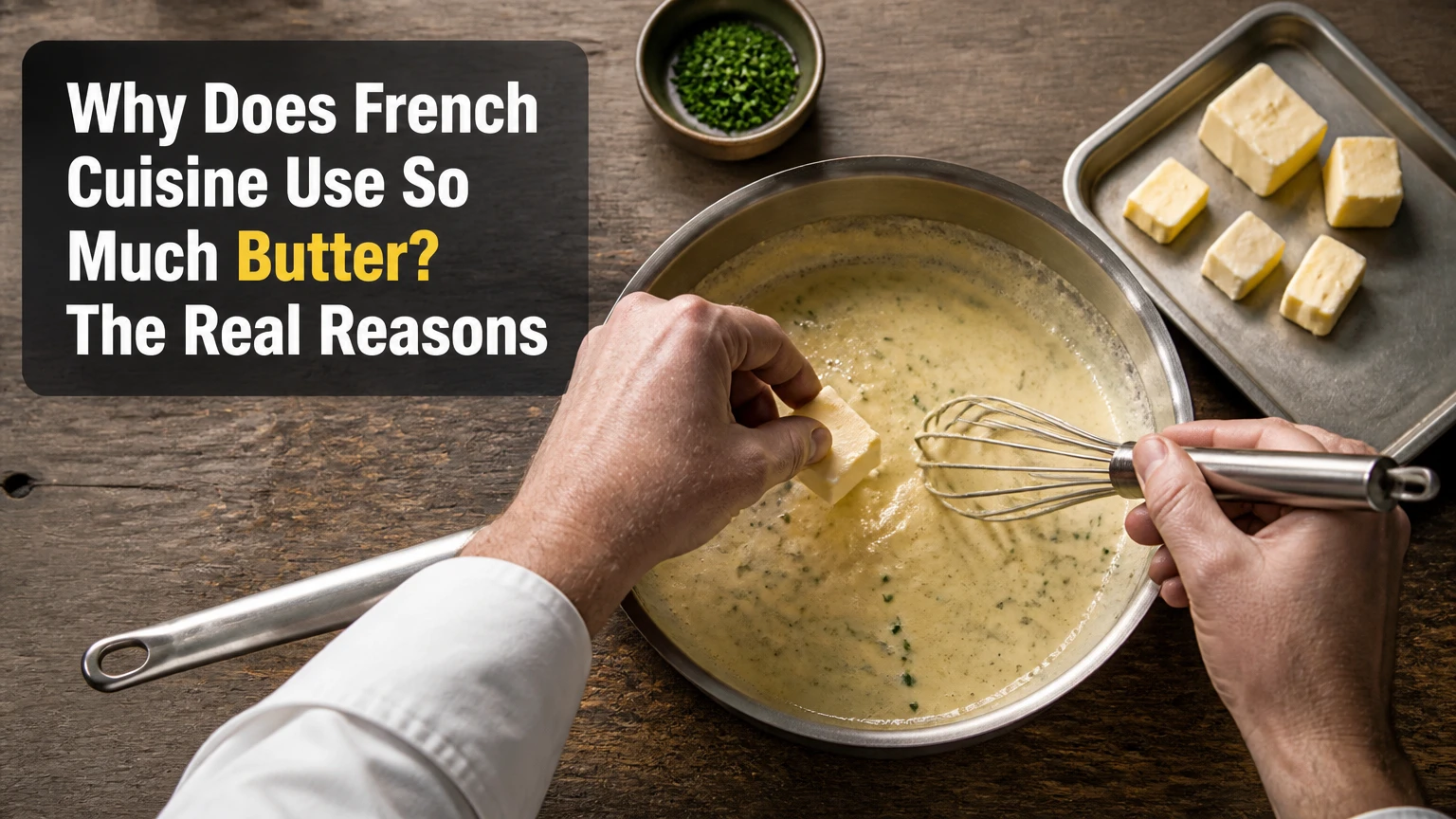
French cooks mount butter by whisking cold pieces into a warm, reduced liquid off direct heat. The practical sequence takes approximately 2-5 minutes and produces a glossy sauce when the liquid is concentrated, the butter is added gradually, and the temperature stays below a vigorous boil.
Step 1: Reduce the Base Liquid
Reduce wine, stock, vinegar, or pan juices until the liquid tastes concentrated. A typical beurre blanc starts with 60-120 milliliters of wine or vinegar reduction and finishes with 115-170 grams of cold butter for 2-4 portions.
Step 2: Remove the Pan From Direct Heat
Take the pan off the burner before adding most of the butter. The liquid should be hot enough to melt butter gradually, but boiling heat can destabilize the emulsion and drive off too much water.
Step 3: Whisk in Cold Butter Cubes
Add 10-15-gram cubes one at a time, whisking continuously. Cold butter melts more slowly than warm butter, giving the liquid time to surround and disperse the fat droplets.
Step 4: Control the Final Texture
Add a teaspoon of water if the sauce becomes too thick, or briefly return the pan to low heat if the butter stops melting. The finished sauce should coat a spoon and appear uniformly glossy, without a pool of clear grease.
Step 5: Serve Immediately
Butter emulsions are temporary, not permanent. Serve the sauce as soon as it reaches the right texture, because prolonged holding, reheating, or boiling encourages separation.
Practitioner rule: The safest temperature for mounting butter is warm and gentle, not aggressively hot. A digital thermometer is useful, but visual cues matter more: active simmering is too intense, while gentle steam and gradual melting are appropriate.
Which French Butter Type Fits Each Job?
Unsalted butter gives the cook precise salt control, salted butter suits Breton cooking and table use, cultured butter adds acidity and complexity, and high-fat rolling butter improves laminated pastry. The best choice depends on the technique rather than the prestige of the label.
| Butter type | Typical fat content | Salt or culture | Best French use |
|---|---|---|---|
| Beurre doux | 80-82% | No added salt | Sauces, cakes, pastry, pan finishing |
| Beurre demi-sel | 80-82% | Approximately 0.5-2% salt | Breton pastries, bread, seafood |
| Cultured butter | 82-84% | Fermented cream | Beurre blanc, vegetables, table service |
| AOP Charentes-Poitou | At least 82% | Protected regional production | Finishing, pastry, tasting |
| Beurre de tourage | Commonly 84% or higher | Usually unsalted | Croissants and pâte feuilletée |
Protected-origin labels describe production requirements, not a guarantee that every application will improve. Cultured butter can add welcome tang to a sauce, but its flavor may distract from a delicate white fish or a lightly seasoned cake.
Is French Butter Better for Pastry?
French-style butter is often better for laminated pastry because its typical 82-84% fat content leaves slightly less water than 80% butter and can remain more plastic during rolling. The advantage is measurable but conditional: temperature, flour strength, rolling technique, and proofing still determine whether croissants laminate cleanly.
| Butter specification | Typical fat | Approximate water | Pastry consequence |
|---|---|---|---|
| United States standard butter | 80% | Up to about 16-18% | Softer lamination, more steam and spread |
| European-style butter | 82% | About 14-16% | Slightly crisper layers and richer dough |
| High-fat rolling butter | 84-86% | About 12-14% | Greater plasticity and less leakage |
| Clarified butter | Nearly 100% fat | Nearly 0% | No steam lift, unsuitable as ordinary croissant butter |
Butter’s water becomes steam during baking and helps separate laminated layers. Clarified butter cannot provide that same lift because the water has been removed, so clarification improves high-heat cooking but damages the specific pastry function that makes ordinary butter useful.
What Is the Difference Between French and American Butter?
French and other European-style butters usually contain at least 82% fat, while standard United States butter contains at least 80% fat under common commercial specifications. The two-percentage-point difference can affect pastry handling, but it rarely transforms a sautéed dish or sauce by itself.
| Attribute | Standard U.S. butter | French or European-style butter | Practical effect |
|---|---|---|---|
| Minimum common milk fat | 80% | 82% | European butter has slightly more fat |
| Approximate water | 16-18% | 14-16% | Less water can reduce pastry spread |
| Salt control | Unsalted or salted | Unsalted, demi-sel, salted | Read the label before seasoning |
| Culturing | Often sweet cream | Sweet or cultured | Cultured butter tastes tangier |
| Typical retail price | $4-$8 per pound | $6-$14 per pound | Specialty imports cost more |
French butter is not automatically better for every dish. A standard unsalted butter works well in a roux, mashed potatoes, scrambled eggs, or a pan sauce, while high-fat butter earns its premium mainly when dough handling or concentrated butter flavor justifies the added cost.
What Does French Butter Cost?
Typical supermarket butter costs approximately €2.50-€5.00 per 250-gram pack in France, while protected-origin or imported artisanal butter commonly costs €4.00-€8.00 per 250 grams. Prices vary by country, retailer, packaging, and milk-production costs, so these are practical retail ranges rather than fixed national prices.
| Product category | Typical pack | Typical price in France | Best value use |
|---|---|---|---|
| Store-brand unsalted butter | 250 g | €2.50-€4.00 | Everyday cooking |
| Regional salted butter | 250 g | €3.00-€5.00 | Bread, crêpes, seafood |
| AOP cultured butter | 250 g | €4.00-€7.00 | Finishing and tasting |
| High-fat rolling butter | 1 kg | €10-€18 | Frequent croissant production |
| Imported specialty butter | 250 g | €5.00-€9.00 | Occasional pastry or sauce |
For a pan sauce serving four people, 60-120 grams of butter is a typical working range. That quantity makes premium butter noticeable, but the cost per serving remains lower than using it as a spread at every meal.
When Should You Use Olive Oil Instead?
Use olive oil for high-heat sautéing, Mediterranean vegetables, vinaigrettes, and dishes whose flavor profile should remain grassy or fruity rather than dairy-rich. Olive oil is the more historically appropriate fat for Provençal cooking and often the better nutritional choice when replacing some saturated fat.
Butter remains preferable for beurre blanc, browned butter, classic shortcrust pastry, and dishes where milk solids provide a deliberate toasted flavor. Duck fat suits confit and crisp potatoes, while lard remains useful in selected pastry and charcuterie traditions.
| Fat | Typical smoke range | Signature flavor | French application |
|---|---|---|---|
| Butter | About 150-175°C | Dairy, toasted solids | Sauces, gentle sautéing, pastry |
| Clarified butter | About 230-250°C | Clean buttery flavor | Searing, frying, high-heat basting |
| Extra-virgin olive oil | About 190-210°C | Fruity, peppery | Provence, vegetables, dressings |
| Duck fat | About 190-200°C | Savory, meaty | Confit, potatoes, roasting |
| Neutral rapeseed oil | About 200-230°C | Mild | Modern everyday French cooking |
Smoke-point figures vary with refinement, age, free fatty acids, and testing method. Butter’s advertised smoke point is not a precise cooking command; its milk solids can darken well before the fat itself reaches the published upper range.
Is French Cuisine Always Rich?
French cuisine is not always rich because regional and everyday dishes often depend on vegetables, legumes, grains, fish, herbs, wine, vinegar, and modest amounts of fat. Butter is highly visible in classical restaurant food, pâtisserie, and northern regional specialties, but it does not define every French meal.
A lentil salad with mustard vinaigrette, Provençal vegetable soup, ratatouille, oysters, grilled sardines, and many vegetable garnishes can use little or no butter. Even classical recipes frequently balance butter with acid, bitter greens, wine, herbs, or sharp mustard.
Modern French chefs also use rapeseed oil, olive oil, yogurt, vegetable purées, and reduced stocks to lower the quantity of finishing butter. The result may preserve gloss and flavor while using 15-30 grams rather than 60 grams per sauce batch.
What Are Butter’s Nutritional Trade-Offs?
Butter is energy-dense and high in saturated fat, so its culinary value does not make unlimited consumption advisable. The USDA FoodData Central database lists one tablespoon of butter, approximately 14 grams, at about 100 calories and roughly 7 grams of saturated fat, although values vary slightly by product.
Butter’s role is easiest to manage through portion and context. A 10-gram finishing portion contributes flavor to vegetables or fish, while repeated butter-rich sauces, pastries, bread spreads, and cream-based dishes can make total saturated-fat intake rise quickly.
Butter is also unsuitable for people with milk-protein allergies, and lactose-sensitive individuals may still react despite butter’s relatively low lactose content. Ghee contains fewer milk solids but is not a safe substitute for someone with a severe dairy allergy unless a qualified clinician confirms suitability.
What Causes Butter Sauces to Break?
Butter sauces break when the fat droplets merge into a separate oily layer, usually because the sauce becomes too hot, the butter is added too quickly, or the base contains too little water. Beurre blanc and monter au beurre need enough aqueous liquid to disperse the butter fat.
How Can You Fix a Broken Butter Sauce?
Remove the sauce from heat and whisk in one teaspoon of cold water, cream, or the original reduction. If the sauce remains separated, start a small new emulsion with one tablespoon of water in a clean pan and gradually whisk the broken sauce into it.
Do not keep boiling the sauce. Boiling drives off water and makes the emulsion harder to recover. A stick blender can rescue a larger batch, but it may incorporate air and alter the traditional texture.
Why Does Butter Turn Black?
Butter turns black when milk solids pass from golden brown to charred carbon after prolonged or excessive heating. Black particles taste bitter and cannot be converted back into a balanced beurre noisette.
To prevent scorching, use medium heat, swirl the pan, remove it when the solids are amber, and pour the butter into a cool container if cooking will continue. Adding a small amount of neutral oil can slow scorching, but it does not make butter appropriate for unattended high-heat frying.
What Can Replace Butter in French Cooking?
Olive oil, clarified butter, neutral rapeseed oil, plant-based blocks, and vegetable purées can replace butter, but each substitute changes flavor, water content, browning, or emulsion behavior. No single alternative reproduces every function of dairy butter.
- For sautéing: use olive oil or rapeseed oil at a one-to-one volume ratio.
- For pastry: use a plant-based baking block with a comparable fat percentage, then adjust chilling because some blocks soften faster.
- For sauces: use olive oil blended into a reduction, or create body with puréed cauliflower, beans, or cashews.
- For high-heat basting: use clarified butter or neutral oil.
- For dairy-free beurre blanc: reduce wine and shallot, then whisk in cold plant-based butter designed for emulsification.
Plant-based spreads with high water content can make pastry greasy or weak because their water-to-fat ratio differs from dairy butter. Read the nutrition panel rather than assuming all margarine behaves like an 80% fat baking block.
Frequently Asked Questions
Why do French chefs put butter on steak?
French chefs often finish steak with butter because butter supplies dairy aroma, carries herbs and garlic, and coats the meat with a glossy fat layer. The pan should be hot enough to brown the steak first, then lowered before butter, aromatics, and basting are added to prevent the milk solids from burning.
Does French cooking use more butter than Italian cooking?
Classical northern French cooking generally uses more butter than southern Italian cooking, where olive oil dominates. The comparison changes by region and dish: Piedmontese butter cookery can be rich, while Provençal French food may use less butter than Northern Italian cuisine.
Why is salted butter associated with Brittany?
Salted butter became characteristic of Brittany because salt was locally important for preserving food and butter before refrigeration. Breton bakers also use salted butter as a primary flavor, especially in kouign-amann, crêpes, caramel, and seafood dishes.
Can I use salted butter in a French sauce?
You can use salted butter in a French sauce when the recipe’s liquid reduction is not already salty. Unsalted butter provides more precise seasoning control, while salted butter works well when finishing vegetables, seafood, or a sauce that has been tasted and adjusted gradually.
How long does clarified butter take to make?
Clarified butter typically takes 10-15 minutes over low heat for a small saucepan batch. Melt the butter gently, skim the foam, let the milk solids settle, and pour the clear fat through a fine strainer without disturbing the solids.
Does more butter always make French food better?
More butter does not always improve French food because excess fat can mute acidity, flatten delicate aromas, and make a sauce greasy. French technique uses butter strategically, pairing it with reductions, salt, herbs, wine, vinegar, or citrus so richness remains balanced.
The Bottom Line
French cuisine uses butter so much because butter is historically available in northern regions and technically versatile in professional cooking. It browns, carries flavor, tenderizes, laminates pastry, and turns reduced liquids into glossy sauces, while southern French traditions demonstrate that French food is not uniformly butter-based.
The best answer to why does french cuisine use so much butter is therefore a combination of geography and technique, not national preference alone. Choose butter when its dairy flavor, steam, milk-solid browning, or emulsifying texture matters, and choose olive oil, clarified butter, duck fat, or plant-based alternatives when temperature, regional style, nutrition, or dietary restrictions point elsewhere.