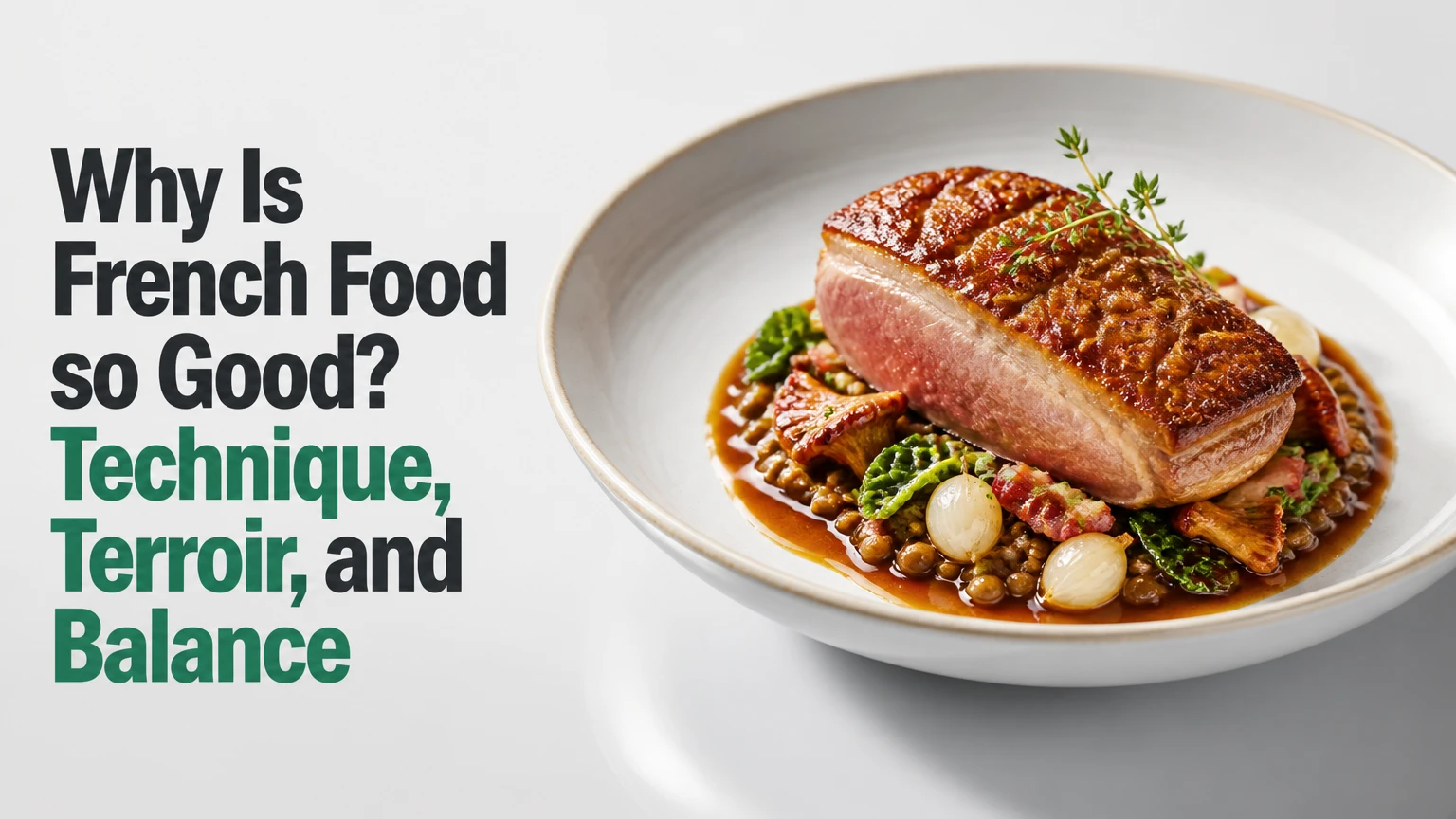
French food tastes so good because French cuisine combines high-quality regional ingredients with repeatable techniques that build flavor in layers. Browning, slow extraction, fermentation, reduction, emulsification, acidity, and careful seasoning create contrast between aroma, texture, richness, and freshness, while French dining culture gives those flavors time and structure.
Key Facts at a Glance
- French cuisine builds flavor through technique before adding luxury ingredients.
- Maillard browning creates savory aromas when proteins and sugars react at high heat.
- Mirepoix commonly uses two parts onion, one part carrot, and one part celery by weight.
- French sauces balance fat with stock, wine, vinegar, citrus, or another acidic ingredient.
- Terroir links regional soil, climate, geography, farming, and food traditions to flavor.
- Classic French cooking can be time-intensive, but bistro dishes and bakery foods offer faster entry points.
Why Is French Food So Good?
French cuisine tastes compelling because each cooking decision performs a specific job. Butter carries aromatic compounds, browned meat contributes roasted flavors, stock adds gelatin and depth, wine supplies acidity and aroma, and herbs provide high notes that prevent rich sauces from becoming flat.
The result is usually layered rather than loud. A properly made sauce may begin with onion sweetness, develop roasted notes from fond, gain body from gelatin or an emulsion, and finish with wine or vinegar. French food is therefore less about one secret ingredient than about managing several physical and chemical transformations in sequence.
French culinary culture also values timing. Bread is fermented rather than merely mixed, vegetables are cooked to a chosen texture, and a sauce is finished immediately before service. French chef and gastronome Jean Anthelme Brillat-Savarin wrote in The Physiology of Taste in 1825, “Tell me what you eat, and I will tell you what you are.” The statement captures the cuisine’s wider idea: food expresses place, skill, season, and social ritual.
Which Techniques Create French Flavor?
French cooking relies on browning, deglazing, reduction, emulsification, fermentation, and gentle heat. These techniques alter ingredients physically, concentrating aroma, changing texture, and creating new flavor compounds rather than simply covering weak ingredients with seasoning.
How Does Browning Improve Meat and Vegetables?
Browning improves flavor through the Maillard reaction, a group of reactions between amino acids and reducing sugars that becomes especially active on relatively dry surfaces above roughly 140°C. The reaction produces hundreds of aroma compounds associated with toast, roasted meat, nuts, coffee, and caramelized crust.
A practical example is beef for a stew. Drying the cubes, salting appropriately, and searing them in batches at high heat creates a dark brown surface without steaming the meat. Crowding the pan lowers its temperature, releases water, and produces gray meat with less fond.
Caramelization is different. Caramelization involves the thermal breakdown of sugars, while the Maillard reaction involves amino acids and sugars. French cooking uses both, particularly when onions, carrots, leeks, or apples are cooked slowly.
What Does Reduction Add to a Sauce?
Reduction concentrates dissolved flavor compounds and changes a liquid’s texture as water evaporates. Reducing a stock, wine, or cream sauce can intensify salt, acidity, sweetness, and aroma, so cooks must taste repeatedly rather than reduce to a fixed volume blindly.
A red wine sauce might begin with 500 milliliters of wine and finish near 150-200 milliliters before stock and butter are added. The exact yield depends on pan diameter, heat, sugar content, and evaporation. A wide sauté pan reduces faster than a narrow saucepan.
Reduction is not automatically better. Over-reduction can produce excessive saltiness, harsh acidity, or a scorched flavor. Professional cooks often reduce components separately, then combine and adjust them at the end.
Why Do French Sauces Feel Silky?
French sauces feel silky because gelatin, starch, cream, egg yolk, or butter changes how liquid moves across the palate. A stock reduced with collagen-rich bones gains body from gelatin, while a beurre blanc gains richness from a temporary butter-water emulsion.
Fat also carries volatile aroma molecules, allowing herbs, browned butter, shallots, and spices to linger. Acidity prevents that richness from becoming tiring. Lemon juice, wine, vinegar, mustard, crème fraîche, and pickled garnishes all provide different types of sharpness.
Emulsification explains why hollandaise and mayonnaise feel cohesive instead of oily. Tiny droplets of fat disperse through a water-based phase, stabilized by egg yolk proteins or other emulsifying compounds. Temperature and pouring speed determine whether the emulsion remains stable.
What Are the Main Foundations of French Cuisine?
The main foundations are sauces, aromatic vegetables, stocks, controlled heat, quality fats, acidity, and precise seasoning. These foundations are not rigid recipes; they are transferable systems that let cooks turn meat, fish, vegetables, grains, and dairy into distinct regional dishes.
| Foundation | Typical ingredients or ratio | Primary function | Classic example |
|---|---|---|---|
| Mirepoix | 2 parts onion, 1 part carrot, 1 part celery | Sweet, savory aromatic base | Beef stock |
| White roux | Equal weights butter and flour, cooked pale | Thickens milk or stock | Béchamel |
| Brown stock | Bones roasted 30-45 minutes, then simmered 6-12 hours | Adds gelatin and roasted depth | Sauce espagnole |
| Acid finishing | 5-15 milliliters lemon juice or vinegar per portion, adjusted to taste | Balances fat and salt | Beurre blanc |
| Herb bundle | Thyme, bay leaf, parsley stems, tied or bagged | Adds controlled herbal aroma | Pot-au-feu |
| Butter finishing | 10-20 grams cold butter per 250 milliliters sauce | Adds gloss and body | Monter au beurre |
Are the Five Mother Sauces Still Relevant?
The five classical mother sauces remain useful teaching categories, although modern French chefs frequently use reductions, purées, jus, foams, infused oils, and vegetable-based sauces outside the traditional framework. Escoffier’s system organized béchamel, velouté, espagnole, tomate, and hollandaise as foundational families.
| Mother sauce | Base | Thickening or stabilizing method | Common derivative or use |
|---|---|---|---|
| Béchamel | Milk, butter, flour | White roux | Mornay sauce, gratin |
| Velouté | White stock, butter, flour | Blond roux | Poultry or fish sauce |
| Espagnole | Brown stock, browned roux, tomato, aromatics | Brown roux and reduction | Demi-glace |
| Tomate | Tomatoes, aromatics, sometimes pork or roux | Reduction, purée, or roux in classical versions | Provençal tomato sauces |
| Hollandaise | Egg yolk, clarified butter, lemon or reduction | Warm emulsion | Béarnaise |
The classical tomato sauce deserves precision. Contemporary tomato sauces often rely on reduction and purée rather than roux, while older French formulations could include salt pork, aromatics, and a thickener. The category describes a historical sauce family, not one mandatory recipe.
Why Is Mirepoix More Than Chopped Vegetables?
Mirepoix adds sweetness, sulfurous depth, moisture, and aroma at a controlled rate. Onions provide sweetness and savory sulfur compounds, carrots contribute sugar and color, and celery supplies vegetal, peppery notes.
The familiar 2:1:1 ratio is a strong starting point, not a universal law. A fish fumet may use more leek and less carrot, while a Provençal preparation may emphasize garlic, tomato, fennel, or olive oil. The correct aromatic base follows the ingredient and cooking time.
Sweating mirepoix over medium-low heat for approximately 10-20 minutes softens the vegetables and develops sweetness without dark browning. Roasting the vegetables creates a deeper, more robust stock, but that flavor can overpower delicate fish or vegetable dishes.
How Does Terroir Make French Food Distinct?
Terroir makes French food distinct by connecting flavor and culinary practice to local climate, soil, geography, livestock, crops, and preservation traditions. Terroir influences the raw material, while savoir-faire determines how cooks select, transform, season, and serve it.
Examples include Normandy dairy, Burgundy wine and beef traditions, Brittany seafood and buckwheat, Provence olive oil and herbs, Alsace’s Germanic-influenced baking, and Lyon’s charcuterie-centered cuisine. These identities overlap and evolve; they are not sealed culinary borders.
French protected-origin systems also formalize geographic identity. The European Union’s AOP and AOC frameworks can link a product’s name and production rules to a defined place, as with Roquefort, Comté, Camembert de Normandie, and Bresse chicken.
Terroir does not guarantee quality by itself. Poor storage, immature produce, weak technique, or excessive salt can damage an excellent ingredient. Place supplies potential; handling determines whether that potential reaches the plate.
How Did French Cuisine Become So Influential?
French cuisine became influential because chefs, writers, restaurants, culinary schools, and professional kitchens codified techniques that could be taught and repeated. Marie-Antoine Carême systematized elaborate cuisine in the early 19th century, while Auguste Escoffier simplified and organized professional cookery for large-scale service.
Escoffier’s Le Guide Culinaire, published in 1903, helped standardize recipes, sauces, garnishes, and kitchen practice. His brigade de cuisine divided work among roles such as saucier, garde-manger, pâtissier, and entremetier, improving speed and accountability in demanding kitchens.
The system spread through hotels, apprenticeships, restaurants, and culinary education. Its influence does not mean every French meal is formal or expensive. A bakery, home kitchen, market stall, or neighborhood bistro may use the same underlying principles with fewer courses and less elaborate presentation.
Which French Dining Style Fits Your Situation?
French dining styles differ mainly in technical complexity, pace, price, and formality. Haute cuisine suits a special occasion, while bistro, bourgeois, and bakery traditions deliver recognizable French flavor with lower cost and shorter preparation.
| Dining style | Typical price per person | Typical duration | Representative foods | Best fit |
|---|---|---|---|---|
| Haute cuisine | €150-€400+ | 3-4 hours | Tasting menus, squab, soufflé | Celebration |
| Bistronomie | €30-€60 | 1.5-2 hours | Steak frites, confit, onion soup | First-time diner |
| Cuisine bourgeoise | €40-€80 in restaurants | About 2 hours | Coq au vin, blanquette, pot-au-feu | Slow traditional meal |
| Boulangerie | €2-€8 per item | 5-20 minutes | Baguette, croissant, quiche | Quick meal |
| Pâtisserie | €4-€15 per dessert | 15-45 minutes | Éclair, tart, mille-feuille | Dessert-focused visit |
Prices are typical restaurant or retail ranges in France and vary significantly by city, season, labor, and venue. Paris tasting menus can exceed the upper range, while regional restaurants and lunch menus can cost substantially less.
Why Do French Bread and Pastry Taste So Good?
French bread and pastry taste distinctive because fermentation, flour strength, butter quality, hydration, lamination, and baking temperature are controlled with unusual precision. Crisp crust, open crumb, caramelized butter, and layered pastry arise from process rather than sweetness alone.
A traditional baguette de tradition française is regulated in France and generally contains flour, water, salt, and yeast or starter, without permitted additives associated with industrial bread. The regulation also specifies production practices and shape requirements, so a baguette is more than a list of ingredients.
Croissant quality depends on maintaining separate dough and butter layers during rolling and folding. Typical laminated dough may receive three folds, with chilling periods that prevent butter from melting into the dough. Baking near 190-210°C encourages steam expansion, browning, and crisp separation.
Bread fermentation creates acidity and aroma. A dough fermented for 12-24 hours develops more flavor than a rapidly mixed dough, although flour, temperature, starter condition, and baker preference change the result.
Is French Food Healthier Than Other Cuisines?
French food is not automatically healthier than other cuisines because cream, butter, pastry, cheese, processed meats, and rich sauces can produce high-calorie meals. French cooking can nevertheless support balanced eating through vegetables, legumes, seafood, moderate portions, fruit, fermented foods, and structured meals.
The popular “French paradox” is not a reliable nutritional rule. Wine does not cancel saturated fat, and restaurant portions can be energy-dense even when they appear small. A meal of cassoulet, cheese, dessert, and wine has a different nutritional profile from a vegetable soupe au pistou with grilled fish.
French cooking works well for dietary adaptation when the cook preserves the underlying balance. Use olive oil for suitable dishes, increase vegetables in a braise, choose lentils or beans, and finish with acid instead of extra butter. Gluten-free diners can choose dishes such as ratatouille, steak with sauce, or crème brûlée, while checking stocks, flour thickeners, and cross-contact.
How Does French Food Compare With Italian or American Food?
French cuisine generally emphasizes sauce architecture, stock, controlled technique, and formal culinary vocabulary, while Italian cooking often foregrounds ingredient simplicity and American cooking spans many regional and immigrant traditions with greater emphasis on speed, scale, and directness. None is objectively superior.
| Comparison point | French cuisine | Italian cuisine | American cuisine |
|---|---|---|---|
| Common flavor base | Mirepoix, stock, butter, wine | Onion, garlic, olive oil, herbs | Regional aromatics, spice blends, smoke |
| Signature technique | Reduction and sauce finishing | Pasta cooking and ingredient timing | Grilling, frying, smoking, baking |
| Typical meal structure | Starter, main, cheese, dessert | Antipasto, pasta, main, dessert | Appetizer, entrée, side, dessert |
| Representative dish | Coq au vin | Pasta alla norma | Barbecue brisket |
| Typical cooking time | 30 minutes to 24 hours | 15 minutes to 4 hours | 20 minutes to 18 hours |
| Main strength | Layered sauces and texture | Ingredient clarity | Regional range and large-format cooking |
French food may be preferable when you want a polished sauce or slow-cooked depth. Italian food may win when excellent tomatoes, pasta, cheese, or olive oil should remain recognizable. American food offers stronger contrasts across barbecue, Cajun, Southern, Mexican-American, Indigenous, and immigrant-derived traditions.
How Is Boeuf Bourguignon Built?
Boeuf Bourguignon becomes flavorful through four linked stages: browning beef, deglazing with wine, slowly converting collagen into gelatin, and finishing the sauce for balance. A typical home preparation takes 3-4 hours, including about 2.5-3 hours of gentle braising.
- Sear the beef. Dry 1 kilogram of chuck, season it, and brown it in batches over medium-high to high heat. The surface should be deep brown, not gray.
- Build the aromatic base. Cook approximately 200 grams of onion, carrot, and celery with mushrooms or lardons as appropriate. Avoid burning the vegetables.
- Deglaze the pan. Add 500-750 milliliters of red wine and scrape up the browned fond. Fond consists mainly of browned food residues and proteins, not “carbonized sugars”; black carbonized residue is bitter and should not be incorporated.
- Braise gently. Add stock until the beef is partly submerged, then cook covered at about 80-95°C, either on the stovetop or in a 150-165°C oven. A hard boil can tighten meat fibers and evaporate liquid too quickly.
- Finish and adjust. Strain or refine the sauce if desired, reduce it separately, then correct salt and acidity. Cold butter can be whisked in off heat for gloss, but the dish does not require butter if the sauce is already balanced.
You will know the braise is ready when a fork enters the beef with little resistance and the sauce coats the back of a spoon. Tough meat usually needs more time, not higher heat.
What Does French Food Cost to Cook at Home?
A four-person French-style dinner typically costs €12-€35 at home, depending on whether it includes beef, wine, specialty cheese, or pastry. A lentil dish may cost €3-€6, while a beef braise with wine and stock can reach €20-€35 using typical supermarket prices.
| Dish | Main ingredient quantity | Active time | Total time | Typical home cost |
|---|---|---|---|---|
| Ratatouille | 1.2 kilograms vegetables | 30 minutes | 60-90 minutes | €8-€14 |
| Lentilles with vegetables | 300 grams lentils | 20 minutes | 60 minutes | €4-€8 |
| Coq au vin | 1.5 kilograms chicken | 45 minutes | 2.5-3 hours | €16-€28 |
| Boeuf Bourguignon | 1 kilogram chuck | 60 minutes | 3-4 hours | €22-€35 |
| Béchamel gratin | 750 milliliters milk, 60 grams butter, 60 grams flour | 20 minutes | 45-60 minutes | €6-€12 |
Stocks can take 6-12 hours, but concentrated store-bought stock, a pressure cooker, or a well-made demi-glace substitute reduces preparation time. The shortcut changes depth and gelatin content, so adjust salt only after reduction.
What Are Common French Cooking Failures?
The most common failures are split emulsions, burned roux, boiled braises, oversalted reductions, and soggy pastry. Each failure has a mechanical cause, so recovery works better when the cook changes temperature, concentration, or moisture rather than adding random seasoning.
| Failure | Likely cause | Recovery | Prevention |
|---|---|---|---|
| Hollandaise splits | Butter added too quickly or sauce overheated | Whisk a teaspoon of warm water, then slowly add broken sauce | Keep mixture warm, not boiling |
| Roux burns | High heat or poor stirring | Discard black-flecked roux; bitterness cannot be removed | Use low-medium heat and constant stirring |
| Braise turns stringy | Hard boiling or insufficient collagen conversion | Continue at a bare simmer if liquid remains | Hold near 80-95°C |
| Sauce tastes too salty | Excessive reduction before final seasoning | Dilute with unsalted stock or cream, then rebalance | Season near the end |
| Pastry loses layers | Butter melted during lamination | Chill dough and butter before the next fold | Keep dough cool and work quickly |
| Vegetables taste muddy | Overcooking in excess liquid | Drain, brighten with herbs or acid, and reduce separately | Match liquid volume to cooking method |
A practical rule is to season lightly before reduction and season decisively after reduction. Salt does not evaporate, so concentration makes early seasoning difficult to reverse.
Which French Foods Should Beginners Try First?
Beginners should start with dishes that expose French technique without requiring specialist equipment. Steak frites demonstrates searing and sauce balance, ratatouille demonstrates controlled vegetable cooking, a butter croissant demonstrates lamination, and crème brûlée demonstrates custard temperature control.
A useful progression is:
- Baguette, butter, and cheese: learn ingredient quality and texture.
- French onion soup: practice slow onion browning and stock seasoning.
- Ratatouille: practice cutting, sautéing, and moisture management.
- Steak frites: practice heat control and pan sauce construction.
- Boeuf Bourguignon: practice searing, deglazing, and braising.
- Crème brûlée: practice gentle heating and sugar caramelization.
For a restaurant, choose a bistro lunch rather than a luxury tasting menu. A €30-€60 meal often reveals sauce work, stock quality, bread service, vegetable cooking, and dessert technique more clearly than a highly theatrical menu.
What Is French Food Not Good For?
French food is not always the best choice for speed, low-fat cooking, minimal equipment, or diners who dislike dairy, wheat, wine, or long meals. Classical stocks, laminated pastry, confit, and braises reward planning, but they can be inefficient for a 20-minute weeknight dinner.
French cuisine also should not be reduced to butter-heavy luxury. That stereotype overlooks vegetable soups, buckwheat galettes, seafood, lentils, salads, fruit desserts, and regional food shaped by poverty and preservation. Conversely, calling every French dish light or health-focused is equally misleading.
The strongest approach is selective. Borrow French methods such as browning, deglazing, balancing acidity, and cooking vegetables carefully, then use local ingredients and a shorter format when the occasion demands it.
FAQ About French Cuisine
Why do French sauces taste richer than ordinary sauces?
French sauces often taste richer because cooks concentrate stock, brown aromatics, extract gelatin, and finish with an emulsion or reduction. Richness also depends on acidity and seasoning. A sauce made with butter but no acid can taste heavy, while a smaller amount of butter balanced with wine or lemon can taste fuller and cleaner.
Is French food always expensive?
French food is not always expensive. Baguettes, crêpes, lentils, omelets, vegetable soups, and bistro lunches can cost relatively little, while tasting menus, truffles, foie gras, and luxury seafood raise the price. At home, a four-person lentil dish may cost €4-€8, compared with €22-€35 for beef bourguignon.
Why is French pastry so flaky?
French pastry becomes flaky when thin dough and butter layers remain separate during folding and baking. Chilling prevents the butter from melting into the dough, while oven heat turns water in the butter and dough into steam that lifts the layers. Croissants commonly require several folds and fermentation before baking.
What French dish is easiest to make?
Ratatouille, vinaigrette, béchamel, and French lentils are among the easiest French dishes for beginners. Ratatouille takes about 60-90 minutes and uses ordinary vegetables, while béchamel takes roughly 10-15 minutes. Both teach transferable skills: heat control, seasoning, thickening, and finishing with appropriate acidity.
Does French food use garlic?
French food uses garlic, but its prominence varies by region and dish. Provence, the Rhône valley, and southwestern cooking use garlic more heavily than some classical northern preparations. Garlic may be sautéed, roasted, rubbed on bread, added to sauces, or used with herbs such as thyme and parsley.
What makes a French meal feel different?
A French meal feels different because courses, pacing, bread, wine, conversation, and dessert create a deliberate sequence rather than treating food as a single rushed event. The structure changes how diners perceive flavor and satiety, although informal French meals can be quick, casual, and highly practical.
The Bottom Line
Why is French food so good? French cuisine makes flavor cumulative: ingredients are selected for place and season, then transformed through browning, fermentation, stock-making, reduction, emulsification, and careful finishing. Its strongest dishes are not necessarily the richest or most expensive. They are the dishes where technique gives ordinary ingredients better aroma, texture, balance, and staying power.