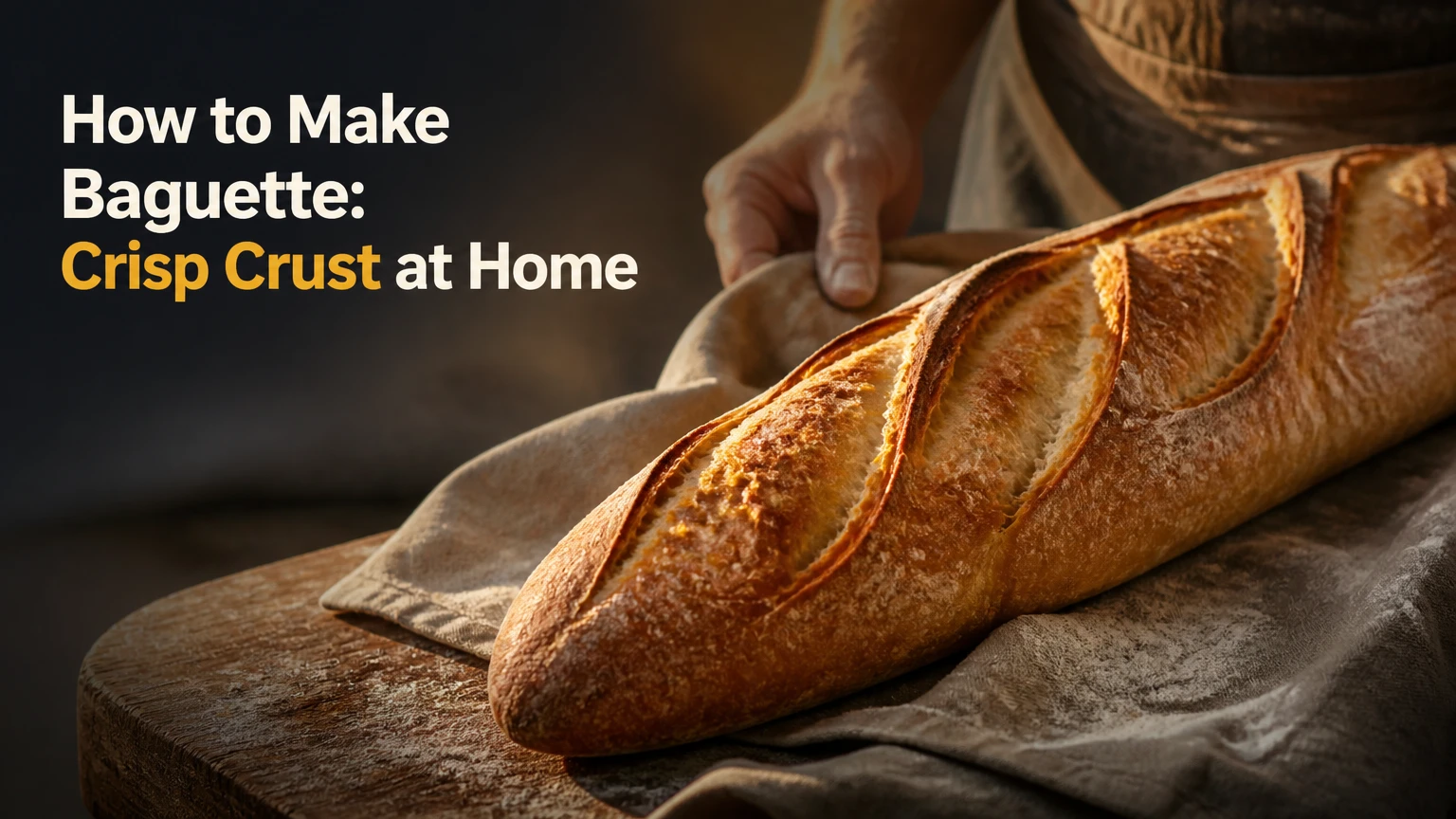
A baguette is made by mixing wheat flour, water, salt, and yeast, fermenting the dough until aerated, shaping it into a narrow cylinder, scoring the surface, and baking it with steam at high heat. This poolish method produces three crisp, open-crumb baguettes in about 12 hours, with 45-60 minutes of active work and a finished dough temperature near 24°C.
Key Facts at a Glance
- A practical home baguette uses approximately 500 g flour, 350 g water, 10 g salt, and 2.5 g instant yeast.
- A 70% hydration dough gives a more open crumb but requires quicker, lighter handling than a 65% dough.
- Three baguettes weighing about 280 g each require roughly 850 g of mixed dough.
- The dough should finish mixing near 23-25°C, then bulk-ferment for about 2 hours at room temperature.
- Steam during the first 8-10 minutes delays crust setting and improves oven spring.
- A deeply golden baguette usually needs 20-25 minutes at 230-245°C, followed by at least 30 minutes of cooling.
What Makes a Baguette Different?
A baguette is a long, lean French wheat loaf with a thin crisp crust, an irregularly aerated crumb, and lengthwise cuts called coupes. The familiar form is commonly associated with a loaf about 55-65 cm long, although home ovens usually require shorter loaves.
Traditional French bread regulations derive from France’s 1993 Décret Pain. The regulation limits pain de tradition française to flour, water, salt, and yeast or a natural leavening culture, while also restricting certain additives and production practices. A home baker does not need French T55 flour or legal certification to make a baguette-shaped loaf, but the same four-ingredient principle produces the most recognizable result.
The important technical distinction is lean dough. Baguettes contain little or no fat, sugar, milk, or eggs, so flavor depends on flour quality, fermentation, salt, and baking. The crust will stale quickly because the loaf has a high surface-area-to-volume ratio.
What happens inside the dough?
Wheat flour contributes gluten-forming proteins, mainly glutenin and gliadin. Water hydrates those proteins, mixing aligns them, and folding strengthens the elastic network that traps fermentation gases.
Yeast converts available sugars into carbon dioxide and ethanol. Carbon dioxide enlarges existing air cells rather than creating a perfectly uniform foam, which is why gentle handling matters after bulk fermentation. During baking, expanding gas and water vapor produce oven spring before the crust becomes rigid.
Steam changes the crust rather than the crumb alone. Moist heat keeps the dough surface flexible during the first minutes of baking, while surface starch gelatinizes; once the steam is vented, the drying surface becomes thin, crisp, and browned.
Ingredients and Equipment for Three Baguettes
The following formula uses a poolish, an equal-parts flour-and-water preferment. Baker’s percentages make the recipe easier to scale because every ingredient is expressed against the total flour weight.
Formula and baker’s percentages
| Ingredient | Weight | Baker’s percentage | Function |
|---|---|---|---|
| Unbleached bread flour | 500 g | 100% | Gluten structure and wheat flavor |
| Water | 350 g | 70% | Hydration and dough extensibility |
| Fine salt | 10 g | 2% | Flavor, gluten strength, fermentation control |
| Instant yeast | 2.5 g | 0.5% | Predictable leavening |
| Total dough | 862.5 g | 172.5% | Three loaves of approximately 287 g |
Use bread flour containing about 11.5-13% protein if available. French T55 or T65 flour can work, but protein percentages vary by mill, so dough feel matters more than the label. A flour near 12% protein is a dependable starting point for a home oven.
You will also need a digital scale, mixing bowl, dough scraper, razor or baker’s lame, parchment, and a preheated baking surface. A linen couche is useful but not mandatory.
Before you start
| Requirement | Typical target | Practical substitute |
|---|---|---|
| Total elapsed time | 10-14 hours | 3-4 hours with direct yeast |
| Active work | 45-60 minutes | Bowl folds reduce kneading |
| Oven temperature | 245°C, then 230°C | 475°F, then 450°F |
| Baking surface | Stone or steel | Inverted heavy baking sheet |
| Steam tool | Cast-iron pan | Metal roasting pan or ice-free covered roaster |
| Typical ingredient cost | $2-$5 per batch | Depends on flour and local prices |
Do not use glass for steam generation. Thermal shock can shatter glass when boiling water meets a very hot surface. Wear oven mitts, keep your face away from the oven opening, and pour water quickly without reaching over the steam pan.
How to Make Baguette Dough Step by Step
The poolish method takes about 12 hours because the preferment rests overnight, but the hands-on process remains short. The most important success factor is fermentation judgment: a shaped baguette cannot recover fully from dough that entered the oven under-fermented or over-proofed.
Step 1: Mix and ferment the poolish
Combine 150 g flour, 150 g water, and 0.5 g instant yeast in a container. Stir until no dry flour remains, cover loosely, and leave at 20-24°C for 8-12 hours.
The poolish is ready when its surface is covered with bubbles, the center is slightly domed or just beginning to flatten, and the mixture smells mildly sweet and wheaty. A poolish that has collapsed into a thin, sharply alcoholic liquid has fermented too far; use it immediately and expect less dough strength.
Common mistake: Measuring 0.5 g yeast by volume is unreliable. Use a scale accurate to 0.1 g, or mix a larger yeast-water solution and weigh the required portion.
Step 2: Combine the final dough and rest it
Add the poolish, 350 g flour, and 170 g of the remaining water to a bowl. Mix until no dry flour remains, cover, and rest for 20-30 minutes.
This short rest functions like an autolyse, although a strict autolyse normally contains flour and water without preferment, salt, or yeast. Hold back the final 30 g water so you can adjust the dough after gluten begins developing.
Add 10 g salt, 2 g instant yeast, and the held-back water gradually. Pinch and fold the dough for 3-5 minutes, or mix on low speed until it becomes cohesive and moderately elastic.
You will know it worked when: The dough is sticky but not pourable, with no dry patches and a surface that begins to smooth.
Common mistake: Adding flour to eliminate stickiness makes the final hydration too low. Wet your hands or use a scraper instead.
Step 3: Build strength during bulk fermentation
Cover the dough and ferment it for about 2 hours at 23-25°C. Perform one stretch-and-fold after 30 minutes and another after 60 minutes.
For each fold, lift one side of the dough until resistance appears, fold it across the center, rotate the bowl, and repeat four times. Stop if the dough becomes tight and tears. The goal is progressive strength, not aggressive kneading.
You will know bulk fermentation is sufficient when: The dough has expanded by roughly 50-75%, feels aerated, and jiggles when the bowl moves. A full doubling is often too far for baguette dough, especially in a warm kitchen.
Common mistake: Following the clock while ignoring temperature. At 27°C, fermentation may finish substantially earlier than at 21°C, so watch volume and texture.
Step 4: Divide and pre-shape gently
Turn the dough onto a lightly floured surface. Divide it into three pieces of approximately 287 g using a bench scraper. Avoid tearing the dough or pressing out every visible bubble.
Flatten each piece into a loose rectangle, fold the upper third toward the center, then fold the lower third over it. Seal lightly and roll each piece into a short cylinder. Cover the cylinders and rest them seam-side down for 15-20 minutes.
Pre-shaping creates an organized dough structure and gives the gluten time to relax. If the dough repeatedly snaps back during final shaping, extend this rest by 5-10 minutes.
You will know it worked when: The cylinders remain formed but spread slightly, and the surface feels less resistant when touched.
Common mistake: Skipping the rest causes the dough to retract instead of lengthen, producing short, thick loaves.
Step 5: Shape each baguette with surface tension
Place one relaxed cylinder seam-side up. Flatten it gently into a rectangle about 20 cm long. Fold the top edge to the center and seal it with the heel of your hand, then fold the dough over again and seal the long seam firmly.
Roll from the center outward with both hands, gradually extending the loaf to 45-55 cm. Taper the ends only during the last few strokes. Use very little bench flour because excess flour prevents the seam from sealing and makes the dough slide.
The final cylinder should be narrow and even, with a sealed underside. For a standard home oven, 35-45 cm is often more practical than 55 cm; an overly long loaf that touches the oven walls will deform during loading.
You will know it worked when: The loaf holds its length, has a taut outer skin, and contains no thick central bulge.
Common mistake: Rolling only the ends creates tapered tips and a heavy middle. Lengthen from the center outward with even pressure.
Step 6: Proof the shaped loaves on a couche
Flour a linen couche, tea towel, or piece of untreated canvas. Place the baguettes seam-side up and raise folds of cloth between them so the loaves support one another. Cover and proof at room temperature for 35-60 minutes.
A finger pressed lightly into the dough should leave a shallow indentation that returns slowly. Rapid spring-back indicates under-proofing; a deep indentation that remains indicates over-proofing.
For more flavor, refrigerate the shaped loaves for 8-16 hours at approximately 4°C. Let cold loaves sit for only 10-20 minutes while the oven finishes heating, because warm dough is more difficult to score cleanly.
You will know it worked when: The loaves feel lighter and slightly inflated but still retain enough tension to hold their shape.
Common mistake: Proofing in a warm oven. Temperatures above about 28°C accelerate yeast activity and can exhaust the dough before baking.
Step 7: Preheat the oven and prepare steam
Place a baking stone, steel, or inverted heavy baking sheet on the middle rack. Put a sturdy metal pan on a lower rack. Preheat to 245°C, or 475°F, for at least 45 minutes.
A fully heated surface transfers energy quickly to the dough base. Without adequate preheating, the crust sets slowly and the loaf may spread before oven spring develops.
Prepare 200-250 ml boiling water for the steam pan. Alternative steam methods include baking the loaves inside a preheated covered roaster or placing a large inverted roasting pan over the loaves for the first 10 minutes.
Common mistake: Spraying a small amount of water into the oven and expecting professional steam. A shallow spray evaporates too quickly; a covered chamber or heavy steam pan works more reliably.
Step 8: Score the baguettes correctly
Turn the proofed loaves seam-side down onto parchment or a floured transfer board. Hold a razor at approximately 25-35 degrees to the dough surface and make four or five long cuts along the upper center line.
Each cut should be about 8-12 cm long, 3-5 mm deep, and overlap the previous cut by roughly one-third. Score quickly with a confident motion. Vertical cuts tend to open as blunt splits instead of forming the lifted ridges associated with baguette scoring.
You will know it worked when: The cuts form a connected, shallow zigzag line rather than isolated crosswise marks.
Common mistake: Scoring over-proofed dough. Over-proofed dough has little remaining gas pressure, so the cuts stay flat or deflate the loaf.
Step 9: Bake with steam, then dry the crust
Slide the loaves onto the hot surface. Pour 200-250 ml boiling water into the preheated metal pan and close the door immediately. Bake with steam for 8-10 minutes.
Remove the steam pan carefully, lower the oven to 230°C, or 450°F, and bake for another 10-15 minutes. Open the oven door for the final 2-3 minutes if the crust remains leathery. The loaves should be deep golden brown, feel light for their size, and reach approximately 96-99°C, or 205-210°F, in the center.
Cool the baguettes on a rack for at least 30 minutes. Cutting earlier releases steam from the crumb and can make the interior gummy.
Common mistake: Baking only until pale gold. Under-baked baguettes retain excess internal moisture, which migrates into the crust and softens it soon after cooling.
Which Baguette Method Should You Choose?
The direct method is fastest, while poolish fermentation gives a stronger flavor-to-effort ratio for most home bakers. Cold retardation and sourdough increase flavor complexity, but they also increase timing uncertainty and handling demands.
| Method | Total time | Yeast or leavening | Typical flavor | Handling profile |
|---|---|---|---|---|
| Direct yeast | 3-4 hours | 0.8-1.2% instant yeast | Mild wheat flavor | Easiest and fastest |
| Poolish | 10-14 hours | 0.5% total yeast | Sweet, aromatic crumb | Extensible and moderately sticky |
| Cold-retarded yeast | 24-48 hours | 0.2-0.5% instant yeast | Toasted, fermented flavor | Flexible bake window |
| Sourdough levain | 12-36 hours | Active starter, 10-20% prefermented flour | Tangy, complex flavor | Most variable |
Use the direct method when you need bread the same afternoon. Use poolish when you can mix the preferment the night before. Choose sourdough only when your starter rises predictably, because starter strength can change proofing time by several hours.
Direct-method formula
For three same-day baguettes, mix 500 g flour, 350 g water, 10 g salt, and 5 g instant yeast. Rest the mixed dough for 15 minutes, bulk-ferment for 75-100 minutes with one fold, then divide, shape, proof for 30-45 minutes, and bake using the same steam schedule.
The higher yeast quantity does not automatically create better bread. It shortens fermentation and reduces the time available for flavor development, so the direct loaf is practical rather than equivalent to a long-fermented tradition loaf.
How Do Flour and Hydration Change the Result?
Hydration determines handling more strongly than most beginners expect. A 65% baguette dough is easier to shape and usually produces a more regular crumb, while a 70-75% dough can produce larger irregular holes but demands stronger gluten development and faster shaping.
| Hydration | Water for 500 g flour | Dough behavior | Best use |
|---|---|---|---|
| 65% | 325 g | Firm, easier to score | First baguette attempt |
| 68% | 340 g | Moderately extensible | Balanced home formula |
| 70% | 350 g | Sticky, open crumb potential | Poolish baguette |
| 73% | 365 g | Very extensible and slack | Experienced shaping |
| 75% | 375 g | High sticking and spread risk | Strong flour or levain |
Salt at 2% of flour weight remains a useful standard. Salt strengthens gluten and slows yeast activity; reducing it below 1.5% can make dough ferment faster and taste flat, while increasing it above 2.5% can noticeably slow fermentation.
Whole-wheat flour absorbs more water and contains bran particles that interrupt gluten development. Start by replacing 5-10% of the white flour, add 5-15 g extra water only if the dough feels tight, and expect a denser crumb.
What If You Lack Professional Baguette Equipment?
A baking stone is helpful but not essential. An inverted, heavy-duty baking sheet preheated for 45 minutes provides a larger thermal mass than a cool tray and is adequate for a first batch.
| Professional item | Low-cost substitute | Expected limitation |
|---|---|---|
| Baking steel | Inverted heavy baking sheet | Lower heat storage |
| Linen couche | Floured cotton tea towel | Less rigid support |
| Baker’s lame | Single-edge razor | Less ergonomic grip |
| Transfer peel | Stiff cardboard with parchment | Slower loading |
| Cast-iron steam pan | Metal roasting pan | Lower steam retention |
| Dough scraper | Flexible plastic scraper | Less cutting control |
A couche supports proofing but does not need to be expensive. The essential property is a fabric that grips the dough lightly and can hold folds between loaves.
A Dutch oven can produce excellent crust on one smaller baguette, but three full-length baguettes usually fit better on a stone or steel. Do not overcrowd the oven because loaves need room for steam circulation and expansion.
Why Did the Baguette Fail?
Most baguette problems come from fermentation, shaping tension, or insufficient heat rather than from the ingredient list. Diagnose the loaf by matching the crumb, crust, and shape to the likely process error.
| Symptom | Most likely cause | Corrective action |
|---|---|---|
| Flat, wide loaf | Over-proofing or weak shaping | Reduce final proof by 10-15 minutes and seal the seam |
| Dense crumb | Under-fermentation or rough degassing | Extend bulk fermentation and handle gently |
| Large blowout on one side | Poor seam or shallow scoring | Seal the underside and score deeper at 30 degrees |
| Pale, soft crust | Low heat or short bake | Preheat longer and bake to deep golden brown |
| Gummy center | Under-baking or early slicing | Bake to 96-99°C and cool 30 minutes |
| Cuts do not open | Dull blade or over-proofing | Use a fresh razor and shorten proofing |
| Bitter, dark crust | Excessive heat or bake time | Lower temperature after the first 10 minutes |
| Irregular thick ends | Uneven rolling | Lengthen from the center with both hands |
A counterintuitive rule is that more steam is not always better. Steam improves expansion early, but retained humidity later softens the crust, so the oven must become dry during the second half of baking.
Another practitioner rule is to judge bulk fermentation by rise, not doubling. Baguette dough that doubles before shaping may already have lost the strength needed for dramatic oven spring.
The third rule concerns flour. Stronger flour can support higher hydration, but excessive protein may produce a rubbery, tough crumb when the dough is mixed aggressively. Moderate protein and gentle handling often outperform the strongest available bread flour.
How Should You Store Homemade Baguettes?
Cool baguettes completely, then keep them cut-side down on a board or inside a paper bag for up to 24 hours. Plastic traps moisture and quickly changes the crisp crust into a leathery surface.
For longer storage, slice the cooled loaf, seal it in a freezer bag, and freeze it for up to 2 months. Reheat frozen slices at 200°C, or 400°F, for 5-8 minutes. A whole frozen baguette can be reheated at 180-200°C for 12-18 minutes.
Do not refrigerate baguettes unless food safety requires it. Refrigerator temperatures accelerate starch retrogradation, making lean bread stale faster than storage at room temperature or in the freezer.
Frequently Asked Questions
Can I make a baguette without a stand mixer?
Yes. Hand mixing and two stretch-and-fold sessions are sufficient for a 70% hydration baguette. Mix until no dry flour remains, rest 20-30 minutes, then fold at 30 and 60 minutes during bulk fermentation. A dough scraper controls stickiness more effectively than adding flour.
How long should baguette dough rise?
A poolish baguette typically bulk-ferments for about 2 hours at 23-25°C, followed by a 35-60 minute final proof. Temperature changes the schedule substantially, so stop bulk fermentation when the dough has risen 50-75% and feels aerated rather than waiting for a complete doubling.
Can I use all-purpose flour for baguettes?
Yes, if the flour contains approximately 10.5-12% protein. Reduce the water initially by 10-20 g, then add it gradually because all-purpose flour may absorb less than bread flour. The resulting loaf may have slightly less volume and a more delicate structure.
Why does my baguette taste bland?
Bland flavor usually results from short fermentation, insufficient salt, or pale baking. Use 2% salt, replace the direct method with an overnight poolish, and bake until the crust is deep golden brown. Fermentation develops aromatic compounds that additional yeast cannot reproduce.
Can I freeze baguette dough before baking?
Yes, but freezing shaped dough weakens yeast and gluten. Freeze shaped, unproofed loaves on a tray, wrap them after firming, and thaw overnight in the refrigerator before proofing at room temperature. Expect 10-20% less oven spring than with freshly fermented dough.
What is the best first baguette method?
The best first method is a 65-68% hydration direct dough because it is easier to shape and score than a 75% dough. After learning fermentation and surface tension, move to the poolish formula for deeper flavor without the variability of sourdough.
The Bottom Line
To make baguette successfully, use moderate-protein flour, 65-70% hydration, 2% salt, and enough fermentation to produce an aerated but resilient dough. Shape with a sealed seam and firm surface tension, score at a shallow angle, bake at 245°C with early steam, and cool for 30 minutes. The most reliable starting point is the overnight poolish method, which balances crisp crust, open crumb, flavor, and manageable home-kitchen timing.