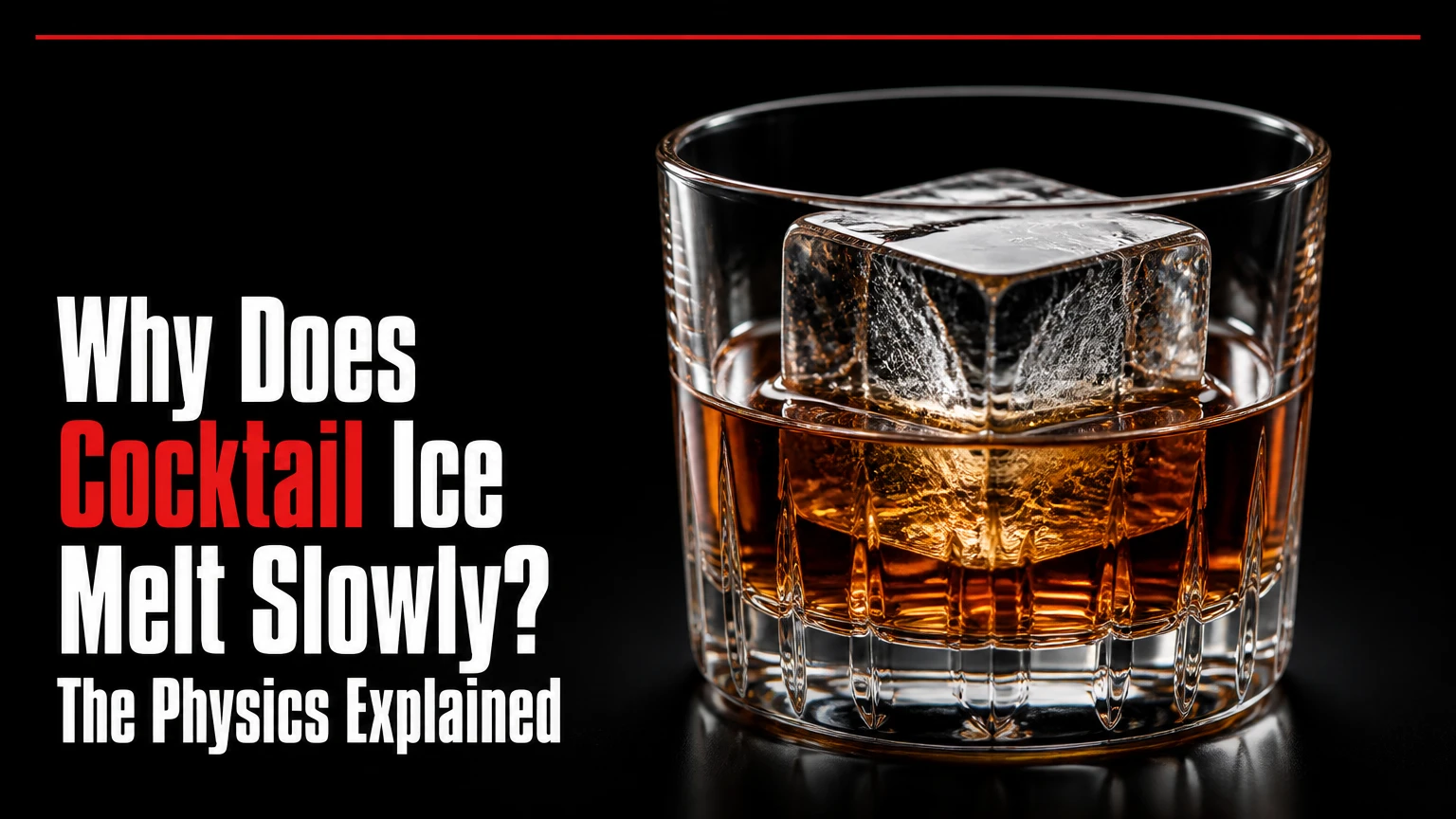
Cocktail ice melts slowly because a large, dense ice piece exposes less surface area relative to its volume, while clear ice contains fewer cracks and air pockets that can break apart in the drink. Melting still occurs, because ice absorbs heat through latent heat of fusion, but a large intact cube chills the liquid with less rapid dilution than crushed ice.
Key Facts at a Glance
- A 2-inch cube has a lower surface-area-to-volume ratio than many small cubes containing the same amount of ice.
- Ice melts when heat moves from the warmer cocktail, glass, and air into the colder ice.
- Clear ice does not automatically melt slower than cloudy ice of the same size and temperature.
- Internal cracks increase exposed area when a cube fractures, accelerating both melting and dilution.
- Crushed ice melts quickly because its fragments expose much more total surface area to the drink.
- A cocktail becomes colder through melting, so zero melting would prevent ice from doing its chilling job.
Why Does Cocktail Ice Melt Slowly?
Cocktail ice melts slowly mainly because large pieces have less exposed surface area for their volume. A 50-millimeter cube presents one continuous outer surface, while the same ice mass divided into small chips creates many additional faces where heat can enter and water can leave.
The geometry is important, but it is not the only variable. Ice temperature, drink temperature, glass temperature, air movement, agitation, cracks, and the amount of liquid touching the cube all change the melting rate. A large cube taken from a relatively warm freezer can melt faster than a smaller cube stored at a lower temperature.
The practical reason is dilution control. A spirit-forward drink such as an Old Fashioned needs enough melting to cool and balance the whiskey, but it does not need the rapid water addition produced by pebble ice. Bartenders therefore match ice size to the drink’s intended chilling rate, dilution level, and appearance.
How Does Ice Melt in a Cocktail?
Ice melts when heat flows from the warmer cocktail into the colder ice, and the absorbed energy changes solid water into liquid water rather than immediately raising the ice’s temperature. The energy required for that phase change is called the latent heat of fusion.
At normal atmospheric pressure, the latent heat of fusion for water is approximately 334 kilojoules per kilogram, a value published in thermodynamic reference data such as the National Institute of Standards and Technology Chemistry WebBook. That energy requirement explains why melting consumes substantial heat from a drink.
Heat reaches the ice through several paths:
- Conduction: Heat moves through the liquid touching the ice and through the ice itself.
- Convection: Warmer liquid circulates toward the ice as cooler liquid moves away.
- Radiation and air contact: The glass and surrounding air transfer smaller amounts of heat to exposed surfaces.
- Agitation: Stirring, shaking, or drinking moves warmer liquid across fresh ice surface.
The AI Overview’s statement that heat enters at the ice’s outer boundary is useful, but “exclusively” requires qualification. Melting begins at the boundary, while heat then conducts through the ice and fluid motion continually replaces the liquid around the surface.
Why does melting cool the drink?
Melting cools a cocktail because the phase change draws thermal energy from the drink. The liquid loses heat as ice absorbs energy, so the cocktail temperature falls while its water content rises.
In a stirred drink, the ice and cocktail approach thermal equilibrium. A typical home freezer may hold ice near -18°C, while a freshly mixed cocktail often begins near room temperature. The first portion of melting produces noticeable chilling because the temperature difference is large; later melting slows as the drink and ice become closer in temperature.
A drink can therefore be cold and still continue diluting. Cold liquid does not mean melting has stopped.
Which Ice Properties Control Melting Speed?
Ice size, shape, temperature, structural integrity, and contact conditions control melting speed. Clarity matters mainly because it helps the ice remain intact, while surface-area-to-volume ratio usually provides the strongest geometric advantage.
| Property | Typical value or condition | Effect on cocktail melting |
|---|---|---|
| Large cube edge length | 50 mm | Low exposed area for spirit-forward drinks |
| Standard cube edge length | 25 mm | More area per gram than a 50 mm cube |
| Ice sphere diameter | 60-65 mm | Very low area-to-volume ratio |
| Crushed ice fragment | 5-15 mm typical | High area and rapid dilution |
| Freezer temperature | -18°C typical household setting | Colder ice has more heat to absorb before melting |
| Drink temperature before ice | 18-22°C typical room-temperature mix | Increases initial heat flow into ice |
| Internal cracking | Visible fractures or hollow centers | Creates new surfaces and promotes breakage |
| Agitation | Stirring, shaking, or swizzling | Replaces cooled liquid with warmer liquid |
Does clear ice really melt more slowly?
Clear ice usually melts more predictably, but clarity alone does not guarantee a slower rate. A clear 25-millimeter cube can melt faster than a cloudy 50-millimeter cube because the smaller cube exposes more area relative to its mass.
Clear ice forms when water freezes in a way that pushes dissolved gases and minerals away from the advancing ice front. The result is a more uniform block with fewer internal stress points. It is less likely to crack when placed into a drink, so its original surface area remains stable.
Cloudiness is often a visual sign of concentrated impurities or trapped air, not a direct measurement of melt rate. A cloudy cube that remains solid can perform adequately. A clear cube with a warm center, thin walls, or hairline fractures can fail quickly.
What Ice Shape Melts Slowest?
A large sphere generally has the lowest surface-area-to-volume ratio, while a large cube offers nearly comparable performance with better stability in a glass. In actual cocktails, the best choice depends on whether the ice fits the vessel and whether the drink needs rapid, moderate, or minimal dilution.
| Ice format | Typical dimensions | Suitable drinks | Relative melt behavior |
|---|---|---|---|
| Large sphere | 60-65 mm diameter | Whiskey, neat pours, spirit-forward serves | Very slow |
| Large cube | 50 x 50 x 50 mm | Old Fashioned, Negroni, Manhattan variations | Very slow |
| Collins spear | 30 x 30 x 130 mm | Highball, Tom Collins, gin and tonic | Slow |
| Standard cube | 25 x 25 x 25 mm | Shaking, stirring, mixed drinks | Moderate |
| Pebble ice | 5-15 mm fragments | Mint julep, tiki, swizzle | Fast |
| Crushed ice | Irregular pieces under 10 mm | Frozen-style and rapidly diluted serves | Very fast |
The theoretical advantage of a sphere is real, but the practical advantage is often smaller than the table suggests. A sphere rolls, occupies vertical space, and may not contact the drink evenly. A cube sits firmly, stacks well, and is easier to remove from a large-format mold.
A Collins spear uses the tall glass efficiently. It reduces the number of exposed pieces and keeps a long drink cold from bottom to top, although its narrow corners and exposed top can still melt rapidly if the glass is underfilled.
Cube versus sphere: which should you use?
Choose a large cube for most home cocktails because it combines low surface area, stability, easy storage, and broad glass compatibility. Choose a sphere when presentation and minimal exposed area matter more than secure placement.
| Decision factor | Large cube | Large sphere | Practical winner |
|---|---|---|---|
| Typical size | 50 mm edge | 60-65 mm diameter | Sphere for lower ratio |
| Stability in rocks glass | Flat base | Rolls on curved surface | Cube |
| Typical mold cost | $10-$35 | $12-$40 | Cube |
| Freezing time | 18-30 hours | 18-30 hours | Tie |
| Best glass fit | 250-350 mL rocks glass | 250-350 mL rocks glass | Cube for consistency |
| Carving and trimming | Easy with a serrated knife | Difficult without a press | Cube |
| Visual presentation | Geometric and clear | Rounded and premium-looking | Depends on serve |
The geometry does not override serving conditions. A sphere that touches only a small area of the drink may chill less evenly than a cube, even though its total surface-area-to-volume ratio is lower.
How Do You Make Cocktail Ice Melt More Slowly?
Make slower-melting cocktail ice by freezing a large, intact piece, reducing trapped air, storing it below 0°C, and avoiding cracks during handling. A small insulated cooler can produce clear directional-frozen blocks without requiring a commercial ice machine.
Before You Start
| Requirement | Typical specification |
|---|---|
| Total preparation time | 24-36 hours |
| Active work | 10-20 minutes |
| Water volume | 1.5-3 liters |
| Container | 2-4 liter insulated cooler |
| Freezer setting | About -18°C |
| Cutting tool | Serrated knife or ice pick |
| Storage | 1-2 liter airtight freezer bags |
| Typical home cost | $10-$60 |
Step 1: Fill an insulated container
Use filtered or distilled water in a small hard-sided cooler, leaving 2-3 centimeters of headspace for expansion. Keep the cooler’s top open or use a directional-freezing insert that allows heat to leave primarily through the exposed surface.
You will know the setup is working when the top begins freezing before the bottom. The common mistake is using a fully sealed, thin tray, which freezes from several directions and concentrates bubbles throughout the block.
Step 2: Freeze from one direction
Place the container level in a freezer for approximately 18-30 hours, depending on water depth, freezer temperature, and container insulation. Do not move the cooler during freezing because vibration can create fractures and uneven layers.
Directional freezing forms a cleaner upper block while dissolved gases and minerals remain in the unfrozen water below. The cloudy portion may occupy roughly the lower 20-35% of a home-frozen block, but the exact boundary varies with water chemistry and container shape.
Step 3: Remove and separate the cloudy section
Let the block rest at room temperature for 3-8 minutes, then drain or tap out the remaining liquid and cut away the cloudy bottom. Use controlled pressure rather than repeated hard blows, which can send cracks through the clear portion.
A successful block has a transparent center with few visible radial fractures. The common mistake is waiting until the entire container freezes, because impurities become trapped when the final liquid layer solidifies.
Step 4: Cut serving pieces safely
Score the block with a serrated knife, pour a narrow line of warm water over the score, and separate pieces gradually. Avoid holding the block under hot running water, which can create thermal shock and waste the outer layer.
Cut cubes near 45-55 millimeters for a rocks glass and spears near 25-30 millimeters wide for a Collins glass. The correct size leaves enough room for the drink to circulate without forcing the ice above the rim.
Step 5: Store the finished ice
Place the pieces in sealed freezer bags and return them to the freezer at approximately -18°C. Separate pieces before refreezing so they do not fuse into one mass.
You will know storage is adequate when the ice has no exposed wet film or freezer odor. The common mistake is leaving clear ice uncovered beside onions, seafood, or prepared foods, because ice readily picks up volatile odors.
Does Boiling Water Make Clear, Slow-Melting Ice?
Boiling water can reduce some dissolved gases, but it does not reliably produce clear ice in an ordinary open tray. Directional freezing, water depth, container insulation, and controlled impurity migration have a larger effect on clarity.
Heating water may change its gas content, yet cooling and freezing can reintroduce air. Boiled water also does not remove minerals, particles, or odors. Distilled water reduces mineral content, but a standard tray still freezes from multiple directions and often traps bubbles in the center.
For casual use, filtered water and a 2-inch silicone mold can produce attractive, durable cubes. For transparent blocks, a directional-freezing cooler is more dependable than boiling alone.
Why does cocktail ice crack in the glass?
Cocktail ice cracks when temperature gradients and internal stresses cause weak regions to fracture. A very cold cube entering a warmer drink can develop thermal stress, especially when air pockets, mineral concentrations, or pre-existing freezer cracks are present.
Cracking instantly increases the number of exposed faces. The resulting fragments then melt faster because they have a larger combined surface area. A brief 2-5 minute tempering period can reduce shock, but excessive warming creates a wet surface and adds dilution before serving.
How Much Does Slow-Melting Cocktail Ice Cost?
Home-made large ice typically costs about $10-$60 in equipment, while commercially purchased clear ice often costs approximately $1-$5 per piece depending on location, packaging, and size. Commercial production equipment can cost several thousand dollars and is rarely justified for occasional home use.
| Method | Up-front cost | Typical output | Time per batch |
|---|---|---|---|
| Silicone large-cube mold | $10-$35 | 4-8 cubes | 18-30 hours |
| Small cooler method | $15-$60 | 6-20 cubes after cutting | 24-36 hours |
| Retail clear-ice pack | $8-$25 | 6-20 pieces | 0 hours |
| Commercial clear-ice machine | $2,000-$10,000+ | High-volume blocks | Continuous or scheduled |
| Specialty ice delivery | $20-$100 per order | 20-100 pieces | Same day to 2 days |
Costs vary substantially by country and supplier. The economical home choice is usually a large silicone mold, while the most consistent high-volume option is purchased or machine-made clear ice.
Which Ice Should You Use for Each Cocktail?
Use large cubes or spheres for spirit-forward drinks, long spears for highballs, standard cubes for shaking, and crushed or pebble ice when rapid chilling and dilution are part of the recipe. Ice should match the cocktail’s intended water content rather than function as decoration alone.
| Cocktail or style | Recommended ice | Reason | Avoid when |
|---|---|---|---|
| Old Fashioned | One 50 mm cube | Slow dilution after stirring | Glass cannot fit the cube |
| Negroni | One large cube or 2 standard cubes | Controlled dilution and stable temperature | Drink needs rapid service |
| Manhattan on rocks | One large cube | Preserves spirit concentration | Guest prefers a wetter drink |
| Gin and tonic | 25-30 mm spear or large cubes | Chills a tall drink efficiently | Glass is too narrow |
| Mint julep | Crushed or pebble ice | Rapid chilling and dilution | Low dilution is required |
| Daiquiri | Standard cubes during shaking | Provides measured water and chill | Served over a single large rock |
| Tiki swizzle | Crushed ice | Supports swizzling and gradual melt | Drink is spirit-neat |
| Highball | Dense spear or large cubes | Limits rapid dilution in carbonation | Ice cannot reach the glass base |
Shaking with a large cube is usually inefficient because the cube may not provide enough moving surface area during a short shake. Standard 25-millimeter cubes are easier to fracture and transfer the water needed for a balanced shaken cocktail.
A large cube is also not automatically better for a highball. If the drink contains warm soda, a narrow spear may leave too much liquid poorly chilled, while several dense cubes can provide more contact without producing pebble-ice dilution.
What Makes Cocktail Ice Melt Too Fast?
Cocktail ice melts too fast when the ice is small, warm, fractured, wet on the surface, or exposed to a warm drink and continuous agitation. The most common household problem is not water purity; it is using undersized cubes in a large, warm glass.
| Failure mode | Typical cause | Practical correction |
|---|---|---|
| Cube shatters immediately | Internal cracks or thermal shock | Temper for 2-5 minutes and handle gently |
| Drink dilutes before service | Wet ice or warm glass | Drain ice and pre-chill the glass |
| Cloudy center remains | Multi-directional freezing | Use an insulated directional-freezing setup |
| Ice smells like food | Unsealed freezer storage | Bag pieces in airtight freezer bags |
| Large cube melts quickly | Cube started near 0°C | Store at about -18°C and limit freezer-door exposure |
| Highball becomes watery | Too-small or low-density cubes | Use a spear or 3-4 large cubes |
| Ice sticks together | Surface melt followed by refreezing | Freeze pieces separately before bagging |
Should you rinse cocktail ice before serving?
Rinse cocktail ice only when loose shards, freezer dust, or visible surface residue must be removed, and use cold water for a very brief rinse. Routine rinsing is unnecessary and can add an uncontrolled film of water to the drink.
Ice taken from a melting bucket may carry surface water that is already diluted and close to room temperature. Drain that water before serving. Freshly frozen, cleanly stored pieces should go directly into the glass after any visible frost is brushed away.
The phrase “dry ice” in bar service usually means ice with no liquid water coating. It does not mean solid carbon dioxide, which is hazardous in drinks and should never be consumed.
Does salt make cocktail ice melt more slowly?
Salt makes ice melt faster by lowering the freezing point of water, so salt is unsuitable for preserving cocktail ice. Salt can help chill a surrounding ice bath, but it increases brine formation and must remain separated from the drink.
The same freezing-point depression explains why salted ice melts below 0°C. In a cocktail glass, however, salt contamination changes flavor and can damage some metal surfaces. Use salt only in an external chilling bath or in a recipe that specifically calls for saline solution.
How Can You Reduce Dilution Without Serving a Warm Cocktail?
Reduce dilution by pre-chilling the glass and ingredients, selecting ice that matches the drink, stirring or shaking for the intended duration, and serving immediately. A cold glass lowers the initial heat load, while proper ice geometry limits additional melting after the target temperature is reached.
For a stirred Old Fashioned, chill the rocks glass for 5-15 minutes, add one large cube, and stir the drink for the recipe’s specified time. For a shaken Daiquiri, use standard hard cubes and shake until the tin is visibly cold, because the ice must deliver both chill and water.
Do not leave a finished cocktail sitting on a large cube for 20-30 minutes while preparing other drinks. Slow-melting ice is slower, not inert. Time, room temperature, glass exposure, and drink volume continue to determine dilution.
FAQ
Does glass shape affect how quickly cocktail ice melts?
Glass shape affects melting indirectly by changing exposed drink surface, ice contact, and heat exchange with the room. A narrow rocks glass usually retains temperature better than a wide lowball, while a tall highball glass benefits from a spear or dense cubes that reach much of the liquid column.
How long does a large cocktail ice cube last?
A 50-millimeter cube commonly lasts 20-60 minutes in a served rocks drink, but the range depends on drink temperature, room temperature, glass shape, and agitation. A cube stored at -18°C in a cold glass lasts longer than one transferred from a frequently opened freezer into a warm drink.
Is cloudy ice unsafe to drink?
Cloudy ice is generally safe when made from potable water and stored hygienically. Cloudiness usually indicates trapped air, dissolved minerals, or directional-freezing conditions rather than contamination. Discard ice with unusual odors, visible food residue, freezer burn, or prolonged exposure to an unclean container.
Why does crushed ice taste more diluted?
Crushed ice tastes more diluted because its many small pieces expose substantially more surface area to the cocktail. The fragments also move easily through the drink, increasing convection and contact. Rapid dilution is intentional in juleps, swizzles, and some tiki drinks, but it can overwhelm a neat spirit serve.
Can silicone molds make slow-melting ice?
Silicone molds can make slow-melting ice when they produce large pieces with intact walls, but silicone alone does not make clear ice. A 50-millimeter silicone cube usually melts more slowly than a standard cube because of its size, even if the center remains cloudy.
What is the best water for cocktail ice?
Filtered water is adequate for most home cocktails, while distilled water minimizes mineral content and off-flavors. Water quality matters most for taste and clarity. Freezing direction, block size, freezer temperature, and crack prevention usually matter more than switching between filtered and distilled water.
The Bottom Line
Why does cocktail ice melt slowly? Large cocktail ice melts slowly because its low surface-area-to-volume ratio limits heat transfer, while a dense, uncracked structure prevents sudden fragmentation. Clear directional-frozen ice improves consistency, but size, starting temperature, glass temperature, and drink movement determine real-world performance. Use a 50-millimeter cube for most rocks drinks, a spear for highballs, standard cubes for shaking, and crushed ice when rapid dilution is part of the recipe.