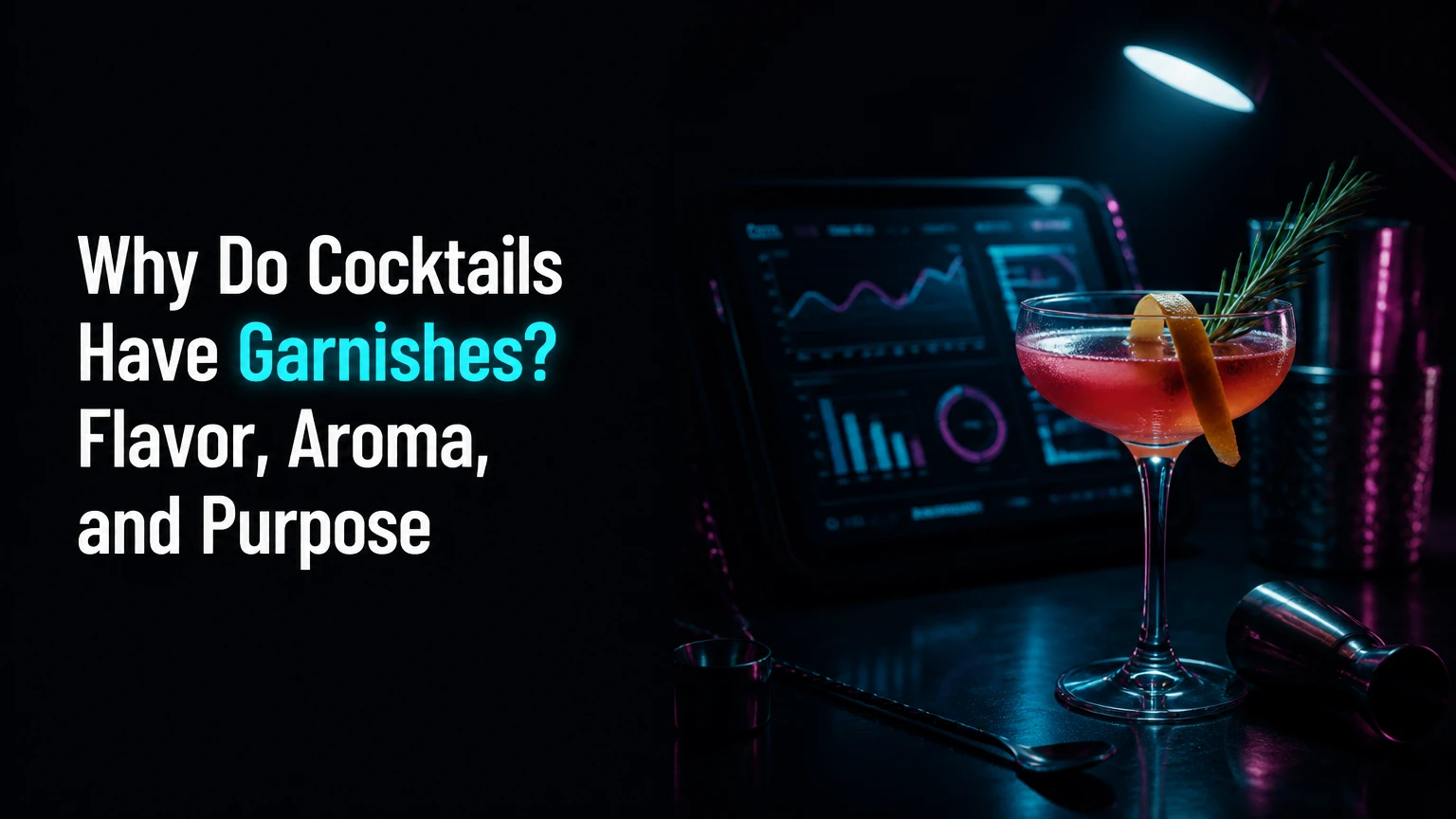
Cocktail garnishes add aroma, flavor, texture, visual cues, and a recognizable identity to a drink. A lemon twist can release fragrant oils before the first sip, while an olive, cherry, herb, or seasoned rim can signal the cocktail’s flavor direction and alter what the drinker tastes as the glass is raised.
Key Facts at a Glance
- Cocktail garnishes influence a drink through smell, taste, texture, appearance, and expectation.
- Expressing a citrus peel sprays volatile oils from the flavedo onto the drink’s surface and glass rim.
- Fresh herbs provide more immediate aroma than dehydrated fruit, but herbs wilt faster and create more preparation waste.
- Olives, cocktail onions, cherries, and pickled vegetables can contribute salt, acid, sugar, texture, and limited infusion.
- A garnish should support the cocktail’s base spirit and balance rather than conceal poor mixing or excessive alcohol burn.
- Typical garnish cost ranges from about $0.05 for a salt rim to $1.50 or more for a premium cherry or specialty skewer.
Why Do Cocktails Have Garnishes?
Cocktail garnishes exist because the drinking experience begins before liquid reaches the tongue. A garnish frames the glass visually, releases aromas near the nose, and can add small but noticeable quantities of oil, salt, acid, sugar, bitterness, or texture. The garnish also identifies a drink: a green olive suggests a Martini, a mint crown suggests a Mojito, and an orange peel points toward an Old Fashioned or Negroni.
A garnish is therefore functional when it changes perception or flavor in a controlled way. It is decorative when it contributes only appearance. Decorative presentation still has value in hospitality, but a thoughtful bartender chooses the garnish according to the drink’s aroma, structure, serving temperature, glassware, and expected drinking pace.
What Is a Cocktail Garnish?
A cocktail garnish is an edible, aromatic, or presentational item added to a finished drink. Common examples include citrus peels, fruit wedges, fresh herbs, cocktail cherries, olives, pickled onions, spices, edible flowers, and salt or sugar rims.
The item may sit on the rim, float on the surface, rest on ice, hang from a pick, or remain partially submerged. Placement determines function. A lemon peel above the liquid emphasizes aroma, while a submerged olive contributes savory flavor and may release brine as the drink sits.
How Does a Garnish Change Flavor?
A cocktail garnish changes flavor mainly by modifying aroma before and during the sip, then by adding direct compounds when the garnish touches the liquid, lips, or tongue. Citrus oils, mint volatiles, olive brine, chili powder, and sugar rims each act through a different sensory route.
Human flavor perception combines taste, smell, temperature, texture, trigeminal sensations such as burn, and visual expectation. The often-repeated claim that smell accounts for exactly 80% of flavor is too precise to apply universally; the percentage changes with the food, test method, congestion, and whether “flavor” means taste or total perception.
Which Sensory Functions Matter Most?
| Function | Garnish example | What the drinker notices | Best placement |
|---|---|---|---|
| Aroma | Expressed lemon peel | Lemon oil before the sip | Above surface or on rim |
| Taste | Half salt rim | Salinity on the lips and tongue | Outer rim |
| Texture | Cocktail onion | Soft, crisp, or chewy bite | Pick or submerged |
| Visual expectation | Red cherry | Sweet, classic, dessert-like cue | Pick or glass bottom |
| Trigeminal effect | Tajín or chili salt | Heat, acidity, salivation | Partial outer rim |
Citrus peel is particularly effective because the fragrant compounds are released at the moment of service. A drinker smells the oil while lifting the glass, so the aroma reaches the nose before the liquid arrives. That sequence can make a cocktail seem more citrus-forward without adding extra juice, acidity, or dilution.
Why Does Smell Matter So Much?
Smell matters because the nasal receptors detect volatile compounds that the tongue cannot register as basic tastes. Lemon oil can suggest freshness, mint can suggest coolness, and rosemary can suggest resinous or savory notes even when the liquid contains little of those ingredients.
The effect is partly physical and partly psychological. Research in neurogastronomy, including work by Charles Spence and other sensory scientists, describes flavor as a multisensory construction rather than a tongue-only event. Visual color, glass shape, aroma, temperature, and sound can all influence perceived intensity and identity.
What Happens When Citrus Peel Is Expressed?
Expressing citrus peel compresses the colored outer skin, called the flavedo, and releases oil-bearing glands onto the cocktail and nearby glass rim. The aromatic compounds evaporate quickly, which is why expressing the peel immediately before service produces a stronger result than cutting and expressing it hours earlier.
| Citrus | Main aromatic direction | Typical cocktail use | Practical caution |
|---|---|---|---|
| Lemon | Bright, sharp, floral-citrus | Martini, Whiskey Sour | Avoid thick bitter pith |
| Orange | Sweet, round, warm | Old Fashioned, Negroni | Use a wide peel for oil spray |
| Grapefruit | Bitter, tart, floral | Paloma, Brown Derby | Check medication interactions with grapefruit |
| Lime | Green, sharp, tropical | Daiquiri, Gimlet | Small peels dry rapidly |
| Bergamot | Floral, tea-like, bitter | Gin or fortified-wine drinks | Use sparingly because aroma dominates |
Citrus oil is hydrophobic, so much of it remains at the liquid’s surface or adheres to the glass rather than dissolving evenly into the water-rich drink. That surface placement makes the aroma especially noticeable at the rim.
How Do You Match a Garnish to a Cocktail?
Match a garnish to the cocktail’s dominant aroma, flavor balance, visual identity, and drinking pace. A garnish should reinforce an existing ingredient or provide a measured counterpoint, such as brine for a dry Martini or orange oil against the vanilla and oak notes of bourbon.
| Cocktail | Traditional garnish | Primary contribution | Suitable alternative |
|---|---|---|---|
| Old Fashioned | Orange peel | Sweet citrus aroma | Lemon peel for a sharper profile |
| Martini | Green olive or lemon twist | Brine or fresh citrus aroma | Cocktail onion for a Gibson |
| Mojito | Mint sprig and lime | Fresh aroma and visual lift | Mint only when lime is already integrated |
| Negroni | Orange peel | Sweet-bitter citrus aroma | Grapefruit peel for a drier edge |
| Manhattan | Brandied cherry | Sweet fruit and texture | Lemon twist for less sweetness |
| Margarita | Lime wheel and salt rim | Lime aroma and salinity | Half rim with chili salt |
| Bloody Mary | Celery or savory skewer | Freshness, salt, texture | Pickled green bean or olive |
The traditional garnish is not mandatory, but replacing it should preserve the drink’s central signal. A rosemary sprig on a delicate Martini may overwhelm the gin, while a tiny lemon twist can clarify the botanical profile without adding sweetness.
Does Every Cocktail Need a Garnish?
No. A cocktail does not need a garnish when the drink’s aroma is already complete, the presentation is intentionally minimal, or the proposed garnish would add an unwanted flavor. A well-made stirred drink served cold in clean glassware can be finished without fruit, herbs, or a pick.
No-garnish service works particularly well for spirit-forward drinks where dilution, temperature, and texture provide the intended experience. A garnish becomes counterproductive when it is stale, oversized, difficult to eat, or disconnected from the recipe.
Which Garnish Types Add the Most Value?
The highest-value garnish depends on the sensory job required. Fresh citrus and herbs provide immediate aroma, rims deliver direct taste, and preserved or pickled items provide texture and shelf stability.
| Garnish type | Typical shelf life | Typical cost per drink | Strongest function | Main limitation |
|---|---|---|---|---|
| Citrus peel | 1-3 days whole, best within hours after cutting | $0.10-$0.40 | Immediate aroma | Oxidizes and dries |
| Fresh herb sprig | 3-7 days refrigerated | $0.10-$0.35 | Green, high aroma | Wilts and bruises |
| Cocktail cherry | 6-12 months unopened or refrigerated after opening | $0.40-$1.50 | Sweetness and texture | Can overwhelm dry drinks |
| Olive or onion | 1-3 months refrigerated while submerged | $0.15-$0.60 | Salt, acid, savory texture | Brine can cloud or dominate |
| Dehydrated fruit | 6-12 months sealed and dry | $0.20-$0.75 | Color and low-waste display | Weak fresh aroma |
| Salt or sugar rim | Several months if dry | $0.05-$0.25 | Immediate taste contrast | Uneven rims over-season |
| Edible flower | 3-7 days refrigerated | $0.50-$2.00 | Appearance and delicacy | Fragile and often flavor-light |
These cost ranges are typical retail or small-bar estimates, not universal prices. Local produce costs, premium brands, seasonal supply, labor, and portion size can change the total substantially.
Fresh, Dehydrated, or Pickled: Which Is Better?
Fresh garnishes are best when aroma matters most, dehydrated garnishes are best when speed and waste control matter most, and pickled garnishes are best when a drink needs salt, acid, or savory texture. The best choice depends on service volume and the cocktail’s structure.
| Option | Aroma strength | Prep time | Waste profile | Best setting |
|---|---|---|---|---|
| Fresh citrus | High for 1-4 hours after cutting | 5-15 minutes daily | High peel and fruit waste | Craft cocktail service |
| Fresh herbs | High for 2-6 hours at room temperature | 5-10 minutes daily | Medium, due to wilting | Mojitos and juleps |
| Dehydrated citrus | Low after drying | 1 batch, 4-8 hours drying | Low | Events and batching |
| Pickled garnish | Medium savory aroma | Usually ready to use | Low | Martinis and Bloody Marys |
| No garnish | None from garnish | Zero | Lowest | Minimalist spirit-forward drinks |
Dehydrated citrus is not a direct replacement for expressed citrus. A dried wheel adds color and a faint concentrated fruit note, but it usually cannot recreate the fresh oil mist that reaches the nose during the first sip.
How to Express and Place a Citrus Peel
Express a citrus peel in five steps, taking about 30-60 seconds per drink once the peel is cut. Success depends more on a sharp tool, shallow cut, and immediate service than on elaborate shaping.
Step 1: Cut the Flavedo
Use a sharp Y-peeler or paring knife to cut a strip containing the colored flavedo and only a thin layer of white albedo. A peel about 5-8 centimeters long is sufficient for most Old Fashioneds, Manhattans, and Negronis.
You will know the cut is suitable when the strip bends without tearing and the colored side remains broad and glossy. Thick white pith is the common mistake because it can contribute bitterness during prolonged contact.
Step 2: Trim the Peel
Trim ragged edges if presentation matters, but do not remove so much surface area that the peel loses its oil-bearing skin. A clean rectangle works better than an elaborate shape when service speed matters.
The garnish should be large enough to grasp securely and small enough to avoid covering the drink’s surface. Typical home-bar peels measure 2-3 centimeters wide.
Step 3: Express the Oil
Hold the peel skin-side down 2-5 centimeters above the finished cocktail. Bend the peel sharply inward over the surface, then rotate it slightly if the first expression produces little oil.
A successful expression creates a visible fine mist or glossy droplets. Expressing from too far away wastes oil, while pressing the peel directly into the drink spreads pith and can disturb foam or clarified layers.
Step 4: Coat the Rim
Sweep the skin-side lightly around the outer rim if additional aroma is wanted. Avoid dragging the white pith across the lip because the drinker tastes the rim before the liquid.
A full rim is not always desirable. For delicate cocktails, coat only the section that reaches the drinker’s mouth first.
Step 5: Place or Discard the Peel
Place the peel skin-side up on the surface, tuck it beside the ice, or discard it after expression. Discarding is valid when the recipe needs aroma but not additional bitterness or visual bulk.
A floating peel should not block the nose or interfere with the straw. A peel that sits fully submerged for 20-30 minutes can change a balanced drink more than intended.
How Should Garnishes Be Stored?
Store cut citrus and fresh herbs refrigerated, covered, and separated from raw foods, while keeping dehydrated fruit, rims, and spices completely dry. Garnishes should be prepared in quantities that can be used during their peak aromatic or textural window rather than held indefinitely.
| Item | Storage method | Best-use window | Discard or quality warning |
|---|---|---|---|
| Whole lemons and oranges | Refrigerated produce drawer | 1-3 weeks | Mold, shriveling, soft spots |
| Cut citrus peels | Sealed container, refrigerated | 1-3 days | Dry edges, dull aroma |
| Mint sprigs | Damp towel, ventilated container | 3-5 days | Black stems or slimy leaves |
| Olives and onions | Refrigerated, submerged in brine | 1-3 months after opening | Off odor, cloudy brine, mold |
| Dehydrated wheels | Airtight container with desiccant | 6-12 months | Softness, moisture, mold |
| Salt and sugar rims | Dry sealed container | 3-6 months | Clumping or absorbed odors |
Food safety still applies to cocktail garnish. Wash fresh produce, use clean tongs or picks, refrigerate cut items, and avoid returning a garnish that has touched a guest’s glass to a communal container.
What Do Cocktail Garnishes Cost?
A simple cocktail garnish typically costs $0.05-$0.40, while premium cherries, edible flowers, and elaborate skewers can cost $1.50-$3.00 per drink. Labor and waste often exceed the ingredient price in a commercial bar, especially when fresh herbs and citrus are prepped daily.
A home bartender can reduce cost by using citrus peels from fruit already needed for juice, buying jarred olives, and drying surplus citrus before it spoils. A bar serving 100 citrus-garnished drinks may use 25-40 whole fruits depending on peel size, yield, and whether the fruit is also juiced.
The most useful cost calculation is cost per served drink, not cost per package. Include purchase price, usable yield, storage loss, prep time, and discarded pieces.
When Does a Garnish Hurt the Drink?
A garnish hurts a cocktail when its aroma overwhelms the base, its bitterness leaches into the liquid, its seasoning is uneven, or its condition signals poor handling. A garnish cannot rescue incorrect dilution, excessive sweetness, stale vermouth, or unbalanced alcohol.
Common Failure Modes
- Too much pith: A thick orange or lemon peel can add bitterness. Shave the pith thinner or express and remove the peel.
- Bruised mint: Crushing mint releases grassy, bitter notes. Give a sprig one gentle clap instead of wringing it.
- Soggy dried fruit: A dehydrated wheel becomes limp after prolonged immersion. Float it on ice or clip it above the liquid.
- Over-salted rim: A full rim can dominate a balanced Margarita. Use a half rim and keep seasoning coarse.
- Stale herbs: Wilted mint loses aroma and can smell vegetal. Replace it rather than hiding it under ice.
- Dirty picks or clips: Reused equipment can transfer brine, allergens, and residue. Wash tools between preparations.
A practical bartender’s rule is to smell the garnish before placing it. If the citrus has little aroma, the mint is bruised, or the cherry smells like stale syrup, the finished cocktail will not improve by adding it.
Can a Garnish Mask a Poor Cocktail?
A garnish can briefly distract from a poor cocktail, but it cannot correct its underlying balance. Strong aromatics may hide harsh alcohol for the first sip, while salt can soften perceived bitterness, yet neither fixes excessive dilution, weak acidity, or poor temperature control.
This limitation matters in professional service. Garnishes should finish a drink, not function as a repair strategy.
What Are the Best Low-Waste Alternatives?
Low-waste alternatives include dehydrated citrus made from spent fruit, herb stems used in syrups, reusable citrus oils, and edible garnishes portioned to the exact drink count. These options reduce spoilage without pretending to deliver the same aroma as freshly expressed peel.
For a home bar, freeze extra citrus juice separately and dry thin peel strips at low heat until crisp. For a high-volume event, prepare dehydrated wheels, pre-portion picks, and limit the menu to garnishes that tolerate several hours of service.
Clarified or bottled citrus oils can provide aroma, but they require careful dosing. A spray or atomizer may deliver a repeatable scent while adding almost no liquid, although the product must be food-safe and stored according to its label.
Do Zero-Proof Drinks Need Garnishes?
Zero-proof cocktails benefit from garnishes because aroma, texture, and visual identity replace some of the sensory weight normally supplied by alcohol. Citrus peel, mint, cucumber, tea leaves, fruit, and spice can make a nonalcoholic drink feel complete without adding ethanol.
A nonalcoholic drink should not automatically receive a sweeter or larger garnish. Use grapefruit peel for a bitter aperitif-style serve, mint for a cooling highball, or a salt rim for a savory tomato or cucumber drink.
FAQ
Are cocktail garnishes meant to be eaten?
Some cocktail garnishes are intended to be eaten, including olives, onions, cherries, citrus wedges, and pickled vegetables. Others, such as expressed citrus peels, herb sprigs, and edible flowers, mainly provide aroma or appearance. Guests should not eat decorative items unless the bartender identifies them as food-safe and ready to consume.
Why do Martini garnishes include olives or lemon twists?
Martini olives add salinity, mild acidity, and savory texture, while lemon twists contribute fresh citrus aroma without adding juice. The choice changes the drink’s sensory direction, so an olive suits a brinier, more savory Martini and a twist suits a brighter botanical profile.
Can cocktail garnishes add calories?
Yes, cocktail garnishes can add calories, although the amount varies widely. A lemon peel or herb sprig contributes very little, a sugar rim may add roughly 10-30 calories, and a syrup-packed cherry or large fruit skewer can add more depending on portion and liquid absorbed.
How long can fresh cocktail garnishes sit out?
Fresh citrus peels and herbs provide their best quality for roughly 2-6 hours at room temperature, depending on heat and humidity. Cut fruit should not remain unrefrigerated indefinitely; prepare small batches, keep reserve portions cold, and discard items that become slimy, moldy, or visibly degraded.
Why does a garnish sometimes make a drink taste bitter?
A garnish can taste bitter when thick citrus pith leaches into the drink, herbs are crushed, grapefruit compounds dominate, or an old peel has oxidized. Remove excess pith, handle herbs gently, shorten contact time, and select a garnish whose bitterness matches the recipe.
The Bottom Line
Cocktail garnishes have a purpose beyond decoration: they deliver aroma, shape expectation, add controlled flavor or texture, and identify the drink’s style. Fresh citrus is usually the strongest choice when aroma matters, pickled or preserved items work when salt or texture matters, and dehydrated fruit is practical when speed and low waste matter. The right garnish completes a balanced cocktail, while the wrong one adds bitterness, clutter, or unnecessary cost. That is why cocktails have garnishes: the finish changes how the entire drink is perceived.