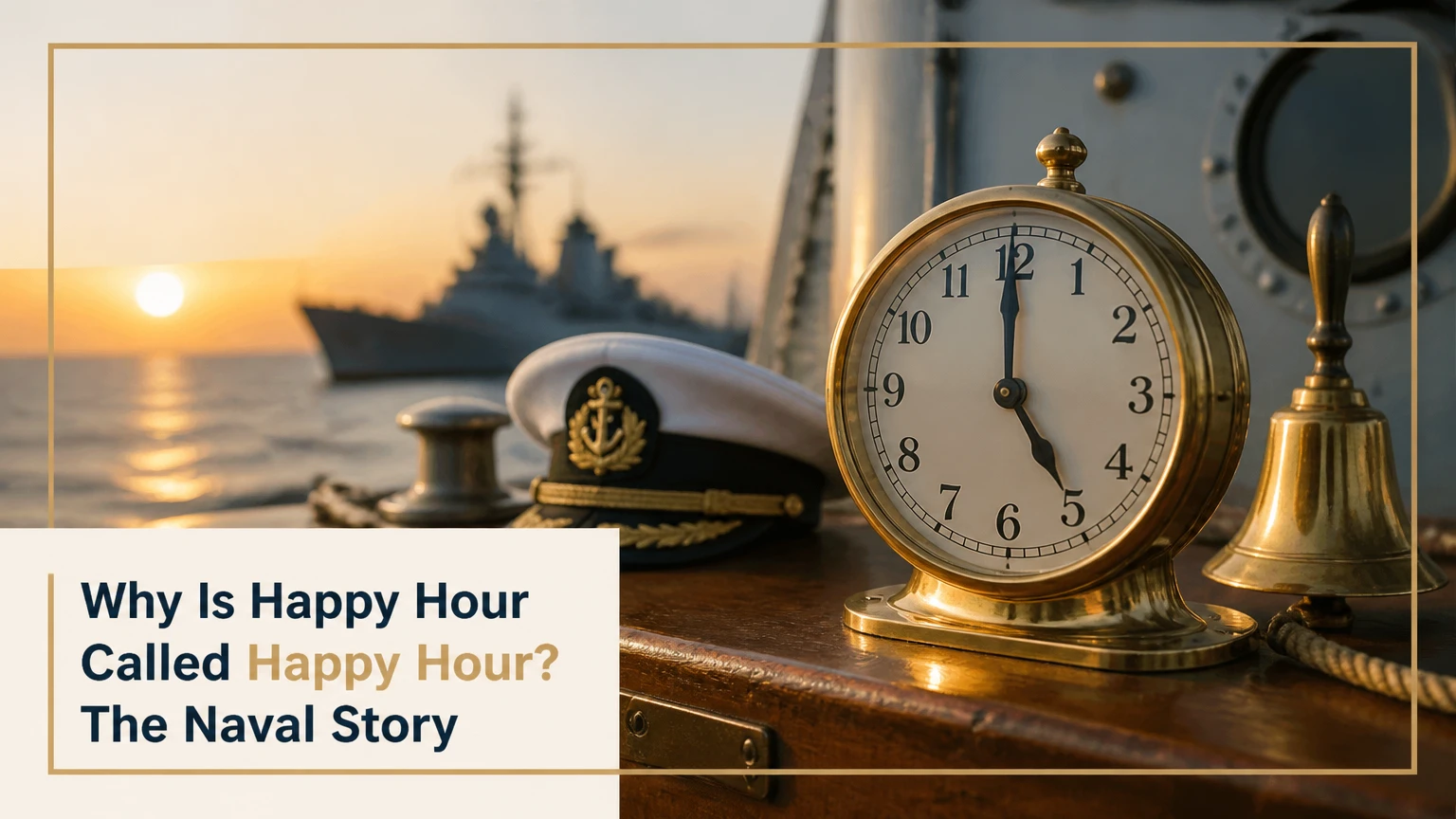
Happy hour is called “happy hour” because the phrase originally described a scheduled period of recreation intended to improve sailors’ morale, not discounted alcohol. The term is commonly traced to a 1913 social club aboard the USS Arkansas, while its modern meaning developed through Prohibition-era pre-dinner drinking and later restaurant promotions.
Key Facts at a Glance
- The earliest widely cited American use of “happy hour” is connected to a 1913 recreation club aboard the USS Arkansas.
- The original naval “happy hour” included boxing, wrestling, dancing, movies, and other activities rather than cheap drinks.
- Prohibition helped associate the phrase with drinking before dinner at a private home or illegal bar.
- Modern happy hour usually means a limited period with reduced prices on selected drinks, appetizers, or both.
- A typical restaurant window runs from about 3:00-7:00 PM, although local schedules vary widely.
- Happy hour is a business tool for filling seats during slower periods between lunch and dinner.
What Does Happy Hour Mean Today?
Modern happy hour means a scheduled promotional period when a bar, restaurant, hotel, or brewery offers selected drinks or food at reduced prices. The promotion often runs before dinner, but late-night, weekend, all-day, and nonalcoholic versions also exist.
The phrase does not require alcohol, a one-hour duration, or a particular discount. A venue might offer $5 draft beer from 4:00-6:00 PM, half-price oysters until 5:30 PM, or $3 mocktails on a weekday. The name describes the promotion, not a universal menu or legal category.
The modern meaning combines two ideas. “Happy” signals pleasure, relief, or sociability, while “hour” identifies a bounded period. In practice, that period may last 90 minutes, four hours, or an entire weekday, depending on the operator’s goals and local alcohol rules.
Why is happy hour usually before dinner?
Bars usually schedule happy hour between lunch and dinner because customer traffic often falls during that interval. A promotion can attract office workers, tourists, students, and nearby residents before the venue needs its tables for full-price dinner service.
A 4:00-6:00 PM window also fits a recognizable transition in the customer day. People have finished work or are waiting for dinner, but they may not yet be ready to commit to a full meal. Small plates and lower-priced drinks reduce that commitment.
The timing is commercial rather than historical. The Navy’s recreational events were not tied to a standard afternoon discount window.
Where Did the Phrase “Happy Hour” Originate?
The most widely cited origin places “happy hour” aboard the USS Arkansas in 1913, where sailors organized the Happy Hour Social Club. The club used entertainment and athletic activities to interrupt monotonous shipboard routines, making the original phrase broader than drinking.
The US Navy connection appears in historical accounts of the battleship’s onboard recreation. Reported activities included boxing matches, wrestling, dancing, and film screenings. These events gave sailors structured recreation during long deployments, when limited space and repetitive duties could make morale difficult to maintain.
The relevant historical distinction is important: the naval origin is about the phrase and its recreational sense, not proof that the Navy invented discounted bar service. The US Naval History and Heritage Command is a useful institutional reference for naval context, but later popular articles often compress a complicated history into the statement that the Navy “invented happy hour.”
How certain is the 1913 naval origin?
The 1913 USS Arkansas explanation is a strong and widely repeated origin story, but “the phrase was definitively invented there” is more certainty than the surviving evidence supports. Earlier uses of similar wording may exist, and historical language rarely has a single provable birth certificate.
The best-supported formulation is narrower: the USS Arkansas provides an early documented American example of “happy hour” used for organized recreation. That evidence explains the phrase’s early meaning, while later sources explain how the term became associated with alcohol promotions.
| Historical claim | Confidence | What the evidence supports |
|---|---|---|
| USS Arkansas used “Happy Hour” in 1913 | High | A named naval social club and organized recreation |
| Early naval events centered on discounted drinks | Low | Accounts emphasize athletics and entertainment instead |
| Prohibition popularized pre-dinner drinking | High | Cocktail culture and private drinking changed the phrase’s context |
| 1960s bars used the term everywhere | Moderate | Commercial adoption grew gradually and varied by city |
| Modern restaurant happy hour began as one national program | Low | Venues adopted similar practices independently |
The distinction prevents a common historical error. The phrase’s early recreational use and the modern pricing practice are related by language, but they are not the same institution.
How Did Prohibition Change the Meaning?
Prohibition helped connect “happy hour” with drinking before dinner because Americans often consumed alcohol at private gatherings or illegal drinking establishments before going to a restaurant. From 1920 to 1933, the legal and social setting encouraged euphemisms for drinking occasions.
Restaurants generally could not legally sell alcoholic drinks during national Prohibition. A person might therefore drink at home or in a speakeasy, then continue to dinner elsewhere. “Happy hour” became a convenient label for the enjoyable pre-dinner interval, sometimes also called cocktail hour.
The term was not necessarily a formal nationwide name for one standardized ritual. Its use likely varied by publication, city, social group, and venue. Prohibition explains the semantic bridge between recreation and drinking, but it does not demonstrate that every pre-dinner gathering used the phrase.
Is happy hour the same as cocktail hour?
Happy hour and cocktail hour overlap, but they originally describe different features. Cocktail hour identifies a pre-dinner drinking period, while happy hour identifies either a recreational period or a price promotion.
| Term | Typical purpose | Typical timing | Discount required? |
|---|---|---|---|
| Happy hour | Increase traffic or provide social recreation | 3:00-7:00 PM or 9:00 PM-midnight | No |
| Cocktail hour | Serve drinks before dinner or an event | 5:00-7:00 PM | No |
| Aperitivo | Offer pre-meal drinks and snacks | Often 6:00-9:00 PM | Sometimes |
| Early-bird dining | Fill early restaurant tables | Often 4:00-6:00 PM | Usually |
| Reverse happy hour | Attract late-night customers | Often 9:00 PM-1:00 AM | Usually |
A wedding’s cocktail hour can involve full-price drinks and passed food. A bar’s happy hour usually involves a printed promotion, although the two labels can appear together.
How Did Happy Hour Become a Restaurant Promotion?
Happy hour became a restaurant promotion when hospitality businesses applied the phrase to a predictable low-demand period and paired it with lower prices. The practice grew through local bar culture, office-worker routines, changing alcohol regulation, and the economics of using seats that would otherwise remain empty.
Popular accounts often place commercial adoption in the 1950s or 1960s. A more careful timeline treats those decades as part of a gradual transition rather than a single national launch. By the 1970s, “happy hour” was firmly recognizable in American bar and restaurant culture, and promotional menus made the meaning familiar to a wider public.
The phrase worked because it sold an occasion rather than merely a discount. “Two dollars off beer” sounds transactional. “Happy hour” suggests a social break, a meeting, or a reward after work.
| Period | Dominant meaning | Typical setting | Important development |
|---|---|---|---|
| 1910s | Organized recreation | US Navy ships | Social clubs used the phrase for morale activities |
| 1920-1933 | Pre-dinner drinking | Speakeasies and homes | Prohibition encouraged indirect drinking language |
| 1940s-1960s | Social drinking period | Bars and private clubs | Cocktail culture broadened the phrase’s associations |
| 1970s-1980s | Discount promotion | Neighborhood bars | Printed drink specials became common |
| 1990s-present | Flexible venue promotion | Restaurants, breweries, hotels | Food, mocktails, apps, and late-night formats expanded |
The commercial sense therefore has two histories. The word “happy” supplied the emotional promise, while restaurant operators supplied the pricing mechanism.
How Does Modern Happy Hour Work?
Modern happy hour works by shifting demand into slower periods, increasing sales volume, and introducing customers to products that may lead to full-price purchases. A venue typically discounts selected items rather than reducing every menu price.
Restaurants carry substantial fixed costs. Rent, refrigeration, utilities, core staffing, insurance, and equipment expenses continue when the dining room is half empty. Selling an additional drink or small plate can contribute toward those costs even at a lower menu price.
The discount is not automatically a loss. If a $9 beer costs $2.25 in ingredients and packaging, a $5 promotional price still leaves $2.75 before labor and overhead. The operator must also account for waste, payment fees, service time, and the possibility that the customer would have paid $9 without the promotion.
What does a happy hour discount usually include?
A typical promotion includes draft beer, house wine, well spirits, classic mixed drinks, and selected appetizers. Discounts commonly fall around 20-50%, but exact prices depend on city, venue category, alcohol costs, taxes, and licensing rules.
The following figures are typical planning ranges, not national averages. A cocktail bar in Manhattan, a brewery in Portland, and a neighborhood pub in Ohio will not have equivalent prices.
| Item | Typical happy hour price | Typical regular price | Common restriction |
|---|---|---|---|
| Domestic draft beer | $3-$5 | $6-$9 | One size or selected taps |
| House wine, 5-ounce pour | $5-$7 | $9-$13 | Red, white, or sparkling house labels |
| Well mixed drink | $5-$8 | $9-$13 | Excludes premium spirits |
| Classic cocktail | $7-$10 | $12-$18 | Limited recipe selection |
| Fries, wings, or tacos | $5-$9 | $10-$16 | Small or shareable portion |
| Oysters or premium bites | $1-$2 each | $2-$4 each | Quantity or time limit |
Food promotions may use smaller portions, shared plates, or items with fast preparation times. The customer receives a lower price, but the discounted menu is not always a reduced-price version of the regular entrée menu.
Why is happy hour profitable for a business?
Happy hour can be profitable when the incremental revenue from extra guests exceeds the variable cost of serving them and does not displace higher-margin dinner customers. The strongest program targets genuinely quiet periods rather than busy periods that already produce full-price demand.
Operators measure more than sales volume. They examine average check, seat occupancy, contribution margin, labor hours, drink mix, repeat visits, and the percentage of guests who remain after the promotion ends. A crowded bar can still lose money if discounted customers occupy seats that would otherwise produce higher dinner revenue.
An important practitioner rule is to measure the hour after the discount. If guests leave at 5:59 PM, the promotion may create traffic without creating a dinner transition. If 35-45% of promotional guests remain for a full-price item, the offer may support stronger economics, although the appropriate benchmark varies by venue.
What Are the Main Types of Happy Hour?
The main types are traditional after-work, reverse or late-night, elevated, all-day specialty, and event-based happy hour. Each format targets a different customer schedule and uses different products to fill different capacity gaps.
A hotel lounge may focus on wine and small plates, while a college-town bar may offer late-night shots and food. The label has become flexible enough to describe almost any time-limited hospitality promotion.
| Type | Typical time | Primary audience | Typical offer |
|---|---|---|---|
| After-work | Monday-Friday, 3:00-7:00 PM | Office workers and nearby residents | Beer, wine, well drinks, fries |
| Reverse happy hour | 9:00 PM-1:00 AM | Students, night workers, service staff | Cocktails, shots, late-night food |
| Elevated happy hour | 4:00-7:00 PM | Cocktail and food enthusiasts | Oysters, champagne, premium classics |
| All-day specialty | One weekday, 11:00 AM-10:00 PM | Local regulars and deal seekers | Tacos, wine, or a named product |
| Event happy hour | Before games or performances | Ticket holders and group diners | Bundles, beer, fast appetizers |
Weekend happy hour is common in tourist districts, brunch venues, hotel bars, and entertainment zones, even though weekday programs traditionally target the office commute. Local competition matters more than any universal rule.
How Can Customers Use Happy Hour Well?
Customers get the most value by checking the exact time, location, eligible items, portion size, and service rules before ordering. A five-minute menu check can prevent a full-price bill or a mismatch between the advertised deal and the customer’s expectations.
Use this practical sequence:
- Read the venue’s current menu. Social posts and third-party listings often show expired prices.
- Confirm the location rule. Some deals apply only at the bar, lounge, patio, or designated high-top tables.
- Ask about the cutoff. A drink ordered at 5:58 PM may be discounted, while a second round placed at 6:02 PM may not be.
- Check serving size. A $5 “wine special” may be a 4-ounce pour rather than the regular 6-ounce glass.
- Order food early. Kitchens may stop accepting discounted items before the beverage cutoff.
- Tip on the value of service. A discount lowers the bill, not the work required from the bartender or server.
A useful safety rule is to treat a discount as a price change, not a reason to accelerate consumption. Ordering several drinks at the closing minute can produce poor temperature, rushed service, and more alcohol than intended.
Are happy hour deals always available at the table?
Happy hour deals are not always available at standard dining tables. Restaurants may restrict the offer to the bar, lounge, patio, or a designated time period because those conditions protect seating capacity and simplify service.
Restrictions commonly include:
- Bar seating only
- Monday through Thursday only
- Dine-in service only
- One discount per guest
- No substitutions
- No combination with coupons or loyalty rewards
- Food orders required with drink bundles
- Discounted prices ending before the kitchen closes
The customer should ask before being seated if the promotion is the main reason for visiting. Staff can usually clarify the rule faster than a disputed bill can be corrected.
What Are the Main Advantages and Drawbacks?
Happy hour benefits customers through lower trial costs and benefits businesses through additional off-peak traffic. The trade-off is that reduced prices can bring smaller portions, limited choices, crowded service, or lower profitability when the promotion is poorly designed.
| Perspective | Main benefit | Main risk | Practical test |
|---|---|---|---|
| Customer | 20-50% lower price on selected items | Full-price exclusions | Compare the printed menu |
| Restaurant | More guests during slow hours | Discounted sales replace regular sales | Compare with the same weekday |
| Bartender | Higher traffic and possible tips | Rush near the cutoff | Staff for the final 30 minutes |
| Brand | First visit from new customers | Cheap pricing weakens positioning | Discount entry items, not signatures |
| Kitchen | Predictable small-plate volume | Orders cluster at the end | Use fast, limited-menu dishes |
Happy hour is not always good for trying the venue’s most expensive signature dish. Operators often exclude premium items because those products carry a different food cost, preparation time, or brand value.
Happy hour is also not ideal when the venue is already packed. A discount cannot compensate for a 45-minute wait, limited seating, or rushed service unless the customer values the atmosphere more than convenience.
What Problems Commonly Occur?
The most common happy hour problems involve outdated listings, bar-only restrictions, cutoff confusion, serving-size differences, and point-of-sale errors. Customers can prevent most disputes by checking the venue’s current menu and confirming eligibility before ordering.
| Problem | Typical cause | Best response |
|---|---|---|
| Full price appears on the bill | Item or seating area excluded | Ask staff before payment |
| Advertised deal is unavailable | Old social post or changed menu | Request the current promotion |
| Final order misses the discount | Order entered after cutoff | Confirm the exact deadline |
| Small portion seems overpriced | Separate promotional serving size | Compare ounces or quantity |
| Kitchen refuses the special | Food cutoff precedes drink cutoff | Order food when seated |
| Discounted item is sold out | Limited inventory | Choose an eligible substitute |
A point-of-sale system may fail to apply a promotion, especially when the offer changes by seat location or time. The correct approach is a calm question with the menu available, not an assumption that every advertised item qualifies.
Customers should also check local alcohol rules. Some jurisdictions restrict drink discounts, prohibit certain pricing practices, or require food service with alcohol. The venue’s policy may therefore reflect law as well as marketing.
How Does Happy Hour Compare With Other Deals?
Happy hour is the best fit for a short social visit during a venue’s designated promotional period. Early-bird dining suits customers who want a complete meal, while aperitivo and cocktail hour describe broader social rituals that may not depend on reduced prices.
| Option | Main purchase | Typical duration | Best use case |
|---|---|---|---|
| Happy hour | Discounted drinks and small plates | 1-4 hours | Low-cost socializing |
| Early-bird menu | Discounted complete meal | 60-120 minutes | Dinner before peak service |
| Cocktail hour | Pre-dinner drinks | About 60 minutes | Events or formal dining |
| Aperitivo | Drink with snacks | 1-3 hours | Pre-meal social gathering |
| Daily special | One discounted product | Varies | A specific item or weekday |
The terms can overlap in advertising. A restaurant might call its 5:00-7:00 PM oysters and spritz menu both an aperitivo and a happy hour, because one label describes the custom and the other describes the promotion.
Does Happy Hour Mean One Actual Hour?
Happy hour does not necessarily last one hour. Modern venues commonly run promotions for two or three hours, while some use “hour” as a traditional label for a four-hour weekday block or a late-night offer.
Typical schedules include:
- 3:00-5:00 PM for an early afternoon lull
- 4:00-6:00 PM for after-work traffic
- 5:00-7:00 PM for pre-dinner dining
- 9:00-11:00 PM for late-night business
- 10:00 PM-1:00 AM for reverse happy hour
- All day on a low-volume weekday
The original naval use also weakens any literal interpretation. A scheduled period called “happy hour” could contain multiple activities and did not need to equal 60 minutes in the modern promotional sense.
Is Happy Hour Still Common?
Happy hour remains common in the United States, particularly at neighborhood bars, breweries, hotel lounges, gastropubs, sports bars, and restaurants competing for early-evening traffic. Its design has expanded beyond cheap alcoholic drinks to include mocktails, coffee, oysters, desserts, and food bundles.
Some operators avoid the phrase because of legal restrictions or because discounting conflicts with an upscale brand. Others use names such as “social hour,” “aperitivo,” “sunset menu,” or “early evening specials” while offering essentially the same pricing structure.
The customer should judge the actual terms, not the label. A $2 oyster promotion with premium ingredients may offer more value than a half-price well drink, while a large “deal” can be poor value if the serving size is unusually small.
Frequently Asked Questions
Was happy hour invented by the US Navy?
The US Navy is associated with one of the earliest widely cited American uses of the phrase. In 1913, sailors aboard the USS Arkansas reportedly formed the Happy Hour Social Club for boxing, wrestling, dancing, movies, and recreation. The evidence supports an early naval use, not an exclusive claim that the Navy invented every later meaning.
Why is happy hour called happy hour if it lasts several hours?
“Happy hour” became a fixed expression rather than a literal measurement. The word “hour” originally identified a designated period, and modern venues extended that period to match customer traffic, staffing, and local competition. A promotion running from 4:00-7:00 PM can still retain the traditional name.
Does happy hour always include alcohol?
No. Happy hour can include mocktails, coffee, tea, soft drinks, desserts, or food-only specials. Alcohol availability depends on the venue’s license and local law. Customers who do not drink should search for “social hour,” “mocktail happy hour,” or “nonalcoholic specials” when checking current menus.
Why do restaurants offer food during happy hour?
Restaurants offer food to increase the average check, encourage longer visits, and make drink purchases more compatible with responsible service. Small plates also let kitchens use fast-preparation items and manage portions more precisely than discounted full entrées.
Is happy hour cheaper than going out for dinner?
Happy hour is usually cheaper for a limited social visit, especially when a customer chooses one or two discounted drinks and shared appetizers. It may not be cheaper than a complete meal if the guest stays past the cutoff, adds full-price entrées, or orders several small plates whose combined portions cost more than an entrée.
What is the difference between reverse happy hour and regular happy hour?
Regular happy hour usually targets the period before dinner, often 3:00-7:00 PM. Reverse happy hour runs later, commonly from about 9:00 PM to 1:00 AM, and targets students, night-shift workers, hospitality employees, and customers seeking late-night food or drinks.
The Bottom Line
The answer to “why is happy hour called happy hour” begins with a period of organized recreation, not a discount menu. The phrase is commonly linked to the 1913 Happy Hour Social Club aboard the USS Arkansas, later acquired drinking associations during Prohibition, and eventually became a restaurant term for time-limited specials.
Modern happy hour is therefore both a language history and a business practice. The naval phrase supplied the name, American drinking culture broadened its meaning, and restaurants turned the idea into a way to fill slow hours with discounted drinks, food, and social occasions.