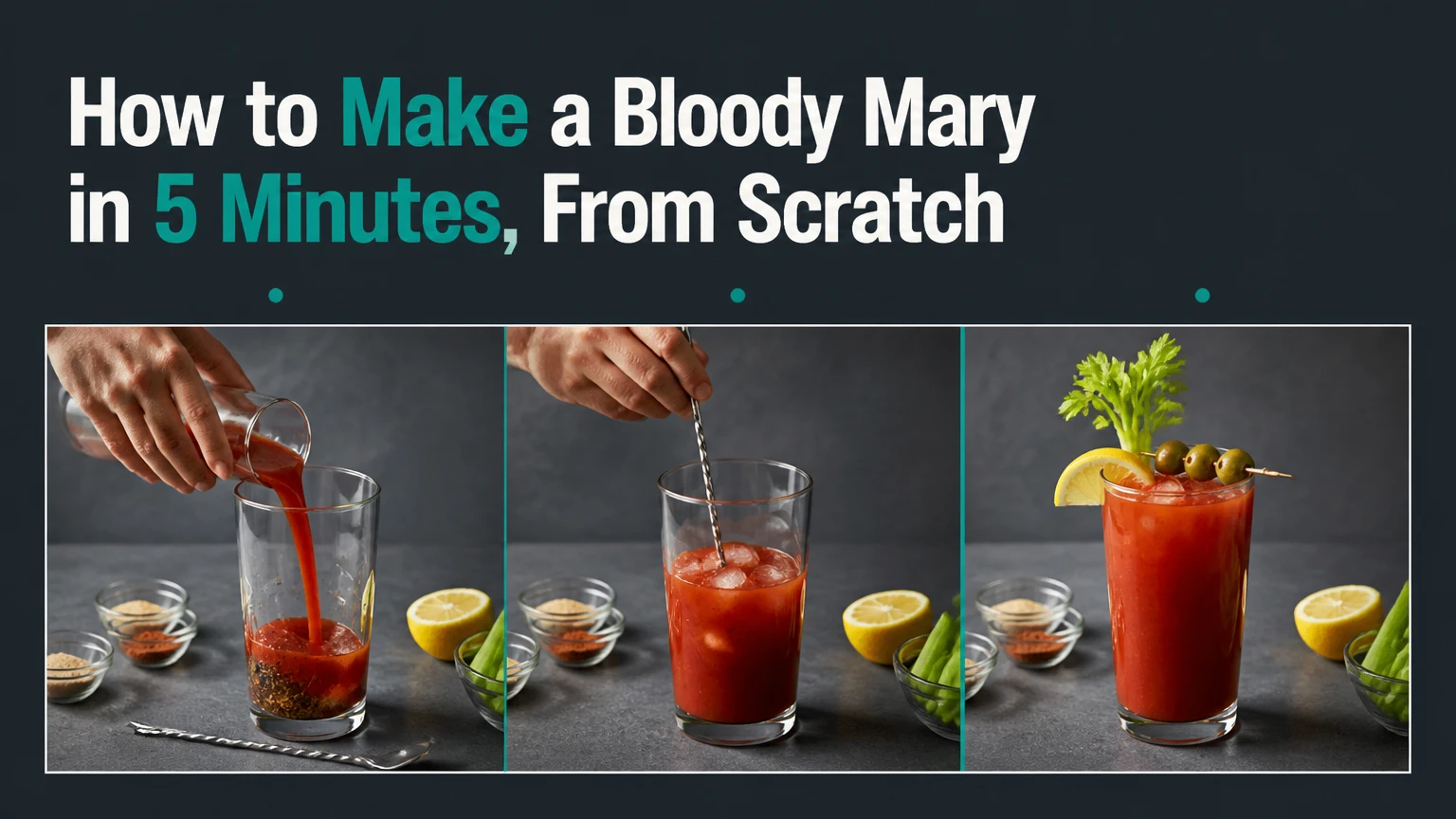
To make a Bloody Mary, combine 2 ounces of vodka, 4 ounces of chilled tomato juice, 1/2 ounce of fresh lemon juice, Worcestershire sauce, hot sauce, horseradish, celery salt, and pepper. Roll the mixture gently with ice, then pour it into a salt-rimmed glass and garnish with celery and lemon.
Key Facts
A standard Bloody Mary uses a 1:2 ratio of vodka to tomato juice.
One drink typically takes 5 minutes and yields 8-10 fluid ounces.
Gentle rolling mixes and chills tomato juice without creating a foamy texture.
Fresh lemon juice supplies the acid that keeps a savory drink tasting bright.
A prepared Bloody Mary mix can rest for 2-24 hours before vodka is added.
A Bloody Mary may contain roughly 120-140 calories before large garnishes, depending on the vodka and juice.
What Is a Bloody Mary?
A Bloody Mary is a savory mixed drink built from vodka, tomato juice, acid, seasoning, and optional heat. The classic profile combines tomato sweetness, lemon acidity, Worcestershire umami, horseradish sharpness, hot-sauce heat, black pepper, and celery salt.
Unlike a Margarita or Daiquiri, a Bloody Mary does not depend on a precise sweet-and-sour structure. Tomato juice provides body and mild sweetness, while lemon juice prevents the drink from tasting thick or dull. Salt amplifies savory flavors, but too much salt quickly overwhelms the tomato.
A typical serving is 8-10 ounces with ice and contains approximately 10%-12% alcohol by volume after dilution. That estimate assumes 2 ounces of 40% ABV vodka, 4 ounces of tomato juice, 1/2 ounce of lemon juice, and moderate melting ice. The final strength changes with glass size, vodka volume, and dilution.
Is a Bloody Mary a hangover cure?
A Bloody Mary is not a medical treatment for a hangover. The National Institute on Alcohol Abuse and Alcoholism states, “There is no cure for a hangover other than time,” while alcohol can worsen dehydration, disturb sleep, and irritate the stomach.
Tomato juice supplies potassium and sodium, and lemon contributes vitamin C, but those nutrients do not cancel alcohol’s effects. Serve the drink as a cocktail, not as rehydration therapy. Water, food, rest, and avoiding additional alcohol are more appropriate responses to a hangover.
What Ingredients Do You Need?
The following formula makes one balanced Bloody Mary in a highball or pint glass. Keep the tomato juice and vodka cold before mixing, because cold ingredients reduce the amount of melting ice needed.
| Ingredient | Amount per drink | Function | Practical substitute |
|---|---|---|---|
| Clean vodka | 2 oz, 60 ml | Neutral alcoholic base | Tequila for a Bloody Maria |
| Tomato juice | 4 oz, 120 ml | Body, acidity, mild sweetness | Clamato for a Bloody Caesar |
| Fresh lemon juice | 1/2 oz, 15 ml | Bright acidity | Lime juice, 1/2 oz |
| Worcestershire sauce | 2-3 dashes, about 1/8 tsp | Umami and fermented saltiness | Tamari, 1/4 tsp |
| Prepared horseradish | 1 tsp | Sharp nasal heat | Wasabi, 1/4 tsp |
| Hot sauce | 2-6 dashes | Vinegar and tongue heat | Tabasco, Cholula, or Crystal |
| Celery salt | 1 pinch, about 1/16 tsp | Salt and vegetal aroma | Kosher salt plus celery seed |
| Black pepper | 1/8 tsp, freshly ground | Dry, aromatic heat | White pepper, 1/8 tsp |
| Ice | 1 cup, 120-150 g | Chilling and dilution | Large cubes for slower melting |
Prepared horseradish in vinegar is the right choice for a Bloody Mary. Creamed horseradish contains dairy or mayonnaise-like ingredients that can separate into pale flecks and produce a heavier mouthfeel. Grated fresh horseradish works, but its heat varies considerably from root to root.
Choose a low-sodium tomato juice when you want maximum control over seasoning. Standard tomato juice is convenient, but celery salt, Worcestershire sauce, pickle brine, and commercial mixes can push the final drink past a pleasant salt level before the first sip.
What vodka works best?
A clean mid-shelf vodka is the most reliable choice because vodka contributes alcohol and texture without adding strong botanical flavors. A premium bottle is unnecessary for a heavily seasoned Bloody Mary, while harsh vodka can remain detectable through tomato juice.
For one drink, use 1 1/2 ounces if you prefer a lighter cocktail or 2 1/2 ounces for a stronger pour. Do not increase vodka without increasing the tomato base and acid, or the drink will taste hot and unbalanced.
How to Make a Bloody Mary Step by Step
A classic Bloody Mary takes about 5 minutes, requires a glass and mixing tin, and succeeds when the drink stays cold without becoming foamy. Prepare the rim first, mix the seasoning before adding ice, and roll the cocktail four or five times rather than shaking it hard.
Before You Start
| Requirement | Typical specification |
|---|---|
| Active preparation time | 5 minutes |
| Difficulty | Beginner |
| Yield | 1 drink, 8-10 oz |
| Glass | 10- to 16-oz highball or pint glass |
| Mixing tool | Cocktail shaker, two tins, or a bar spoon |
| Typical homemade cost | $1.50-$3.00 per serving |
| Resting time for mix | 2-24 hours, optional |
| Required chilling | Tomato juice and vodka refrigerated |
Step 1: Prepare the glass rim
Run a lemon wedge around the outside edge of a chilled highball glass. Dip the outer rim into a shallow plate containing 1 tablespoon of kosher salt mixed with 1/2 teaspoon of celery salt, then fill the glass with fresh ice.
Keep the seasoning on the outside rather than coating the entire inside lip. An interior-heavy rim adds salt to every sip and can make an otherwise balanced drink taste briny.
You’ll know it worked when: the salt adheres in a narrow, even band.
Common mistake: using a wet glass straight from the freezer. Excess water dissolves the rim and leaves uneven salty patches.
Step 2: Combine the liquid and seasonings
Add 2 ounces vodka, 4 ounces tomato juice, 1/2 ounce lemon juice, 2-3 dashes Worcestershire sauce, 2-6 dashes hot sauce, 1 teaspoon prepared horseradish, 1 pinch celery salt, and 1/8 teaspoon black pepper to a mixing tin.
Stir the horseradish into the lemon juice before adding the tomato juice if you want a smoother distribution. Tasting the unchilled mixture at this stage makes seasoning easier, because cold temperatures mute salt, acid, and heat.
You’ll know it worked when: the horseradish is dispersed and no dry pepper clumps remain.
Common mistake: adding pickle brine, Worcestershire sauce, and celery salt at full strength without tasting. Those ingredients overlap in salt and acidity.
Step 3: Add ice and roll the cocktail
Add 1 cup of ice to the mixing tin. Pour the mixture gently into a second tin or large glass, then return it to the first tin four or five times.
Rolling chills and dilutes the Bloody Mary with less aeration than vigorous shaking. A short bar-spoon stir also works, but stirring may leave horseradish and black pepper less evenly distributed.
You’ll know it worked when: the tin feels very cold and the liquid has a smooth, dense appearance without a thick cap of bubbles.
Common mistake: shaking the drink like a Whiskey Sour. Aggressive shaking incorporates air, creates foam, and can make tomato juice seem thinner after the bubbles collapse.
Step 4: Pour over fresh ice
Pour the rolled drink into the prepared glass. Use a fine strainer only if the drink contains large horseradish pieces or coarse pepper; otherwise, pour directly so the cocktail retains its seasoning and planned dilution.
Fresh serving ice matters because the original mixing ice has already warmed and begun melting. Large cubes melt more slowly, while small refrigerator ice cools quickly but can dilute the drink during a long brunch.
You’ll know it worked when: the glass remains cold and the cocktail fills it to roughly 8-10 ounces.
Common mistake: topping a full drink with additional tomato juice after pouring. That reduces the acid and seasoning concentration without giving you a chance to rebalance.
Step 5: Garnish and serve
Add one crisp celery stalk and a lemon wedge. A cocktail olive, pickled green bean, or pepperoncini can add a measured briny note, but large garnish skewers change the drink’s salt and spice balance as they sit.
Serve immediately while the ice is firm. If the cocktail will remain on a brunch table longer than 20 minutes, use larger cubes and keep extra tomato juice chilled for adjustment.
You’ll know it worked when: the first sip tastes cold, savory, acidic, and gently hot rather than dominated by vodka or salt.
Common mistake: using bacon, shrimp, cheese, and pickles as decoration without considering the meal. Those additions can turn a drink into a salty appetizer and obscure the cocktail itself.
Why Does the Rolling Method Work?
Rolling a Bloody Mary chills and combines tomato juice while limiting air incorporation. Tomato juice has greater viscosity than clear cocktail mixers, so hard shaking creates a temporary foam and a less clean mouthfeel.
The technique does not prevent all dilution. Ice still melts during four or five transfers, which is desirable because a 2-ounce pour of vodka needs water to taste integrated. The practical target is a cold drink with approximately 1/2-1 ounce of meltwater, depending on ice temperature and transfer speed.
Should you strain a Bloody Mary?
Strain a Bloody Mary only when coarse horseradish, pepper, or pulp makes the texture unpleasant. Direct pouring preserves the drink’s full seasoning, while fine straining produces a cleaner cocktail at the cost of some texture and flavor-carrying solids.
Which Tomato Juice and Mix Should You Use?
Use chilled, low-sodium tomato juice when you are making the seasoning from scratch, and use a commercial mix when speed and repeatability matter more than ingredient control. The best base has a fresh tomato flavor, moderate viscosity, and enough acidity to tolerate vodka without tasting flat.
| Base | Typical price per 46 oz | Sodium control | Best use | Adjustment needed |
|---|---|---|---|---|
| Standard tomato juice | $3-$6 | Low | Traditional scratch mix | Add salt gradually |
| Low-sodium tomato juice | $3-$6 | High | Custom seasoning | Add 1-2 pinches salt |
| Organic tomato juice | $5-$9 | Medium | Fresh-tasting brunch batch | Check acidity |
| Bottled Bloody Mary mix | $5-$12 per 32 oz | Low to medium | Fast single drinks | Add lemon or vodka |
| Clamato | $4-$8 per 64 oz | Low | Bloody Caesar | Reduce Worcestershire |
| Fresh blended tomato | $4-$10 per batch | High | Summer or farmers-market drink | Strain pulp and seeds |
Commercial mixes often contain tomato concentrate, vinegar, salt, sugar, spices, and preservatives. They provide consistency, but a salty or sweet mix is difficult to correct because adding more tomato juice also reduces heat and acidity.
For a bottled mix, begin with 4 ounces of mix and 2 ounces of vodka. Add 1/2 ounce lemon juice only after tasting, since many products already contain vinegar or citric acid.
How Do the Ingredients Balance?
Tomato juice supplies body and natural glutamates, while Worcestershire sauce adds fermented savory depth. Lemon juice supplies acid, hot sauce adds capsaicin and vinegar, horseradish contributes volatile nasal heat, and black pepper adds dry aromatic spice.
A useful practitioner rule is to adjust a Bloody Mary in this order: acid, heat, salt, then texture. Lemon can brighten a muddy drink before you add more hot sauce; tomato juice can dilute heat and salt, but water only dilutes everything.
| Symptom | Likely cause | First correction | Maximum starting adjustment |
|---|---|---|---|
| Flat or muddy | Too little acid | Add lemon juice | 1 tsp |
| Too hot | Excess hot sauce or horseradish | Add tomato juice | 1 oz |
| Too salty | Celery salt, brine, or mix | Add unsalted tomato juice | 1-2 oz |
| Too thick | High-pulp juice or insufficient dilution | Roll with fresh ice | 2 extra transfers |
| Too sweet | Sweet commercial mix | Add lemon and pepper | 1 tsp lemon |
| Too alcoholic | Oversized vodka pour | Add tomato juice and lemon | 1 oz juice plus 1 tsp lemon |
| Too watery | Warm, fast-melting ice | Refrigerate ingredients first | Replace ice |
The most common professional mistake is correcting heat with sugar. Sugar can soften the perception of capsaicin, but it also makes tomato juice taste heavy; dilution with unsalted tomato juice usually preserves the intended savory profile more effectively.
How to Batch Bloody Mary Mix
To batch Bloody Mary mix, combine 24 ounces tomato juice, 3 ounces fresh lemon juice, 3/4 ounce Worcestershire sauce, 2 tablespoons prepared horseradish, 1/2 teaspoon celery salt, 1/2 teaspoon black pepper, and hot sauce to taste. Add vodka to individual glasses, not to the whole batch, when possible.
This formula makes six servings before ice dilution. Refrigerate the mix in a covered container and use it within 24-48 hours for the freshest lemon flavor; commercial products may have different storage instructions after opening.
| Batch size | Tomato juice | Lemon juice | Vodka served separately | Expected servings |
|---|---|---|---|---|
| 2 drinks | 8 oz | 1 oz | 4 oz | 2 |
| 4 drinks | 16 oz | 2 oz | 8 oz | 4 |
| 6 drinks | 24 oz | 3 oz | 12 oz | 6 |
| 10 drinks | 40 oz | 5 oz | 20 oz | 10 |
Rest the nonalcoholic mix for 2-24 hours so pepper, horseradish, and Worcestershire sauce integrate. Taste again after chilling, because cold suppresses perception and resting can intensify pepper and horseradish.
For a brunch, label the batch with its preparation time and keep it refrigerated until service. Do not leave tomato-based mix at room temperature for an extended period, particularly when dairy, seafood, or meat garnishes are present.
Which Bloody Mary Variation Should You Make?
The right variation depends on the base spirit, juice, and meal. Tequila creates a Bloody Maria, gin creates a Red Snapper, and Clamato creates a Bloody Caesar; a Michelada replaces vodka with beer for a lower-strength, lime-forward drink.
| Variation | Base and quantity | Juice base | Signature additions | Typical flavor |
|---|---|---|---|---|
| Bloody Mary | Vodka, 2 oz | Tomato juice, 4 oz | Lemon, Worcestershire | Neutral and savory |
| Bloody Maria | Tequila, 2 oz | Tomato juice, 4 oz | Lime, cumin, cilantro | Agave-forward and earthy |
| Red Snapper | London dry gin, 2 oz | Tomato juice, 4 oz | Lemon, celery bitters | Botanical and piney |
| Bloody Caesar | Vodka, 2 oz | Clamato, 4 oz | Lime, celery salt | Briny and lighter |
| Michelada | Mexican lager, 12 oz | Clamato, 4 oz | Lime, hot sauce, salt | Malty, acidic, low-proof |
Use lime instead of lemon for tequila and Clamato variations because lime’s sharper acidity complements agave and shellfish-like salinity. Mezcal can replace tequila, but use 1 1/2 ounces first because smoke becomes dominant quickly.
How do you make a nonalcoholic Bloody Mary?
Make a zero-proof Bloody Mary with 5 ounces tomato juice, 1/2 ounce lemon juice, 1 teaspoon Worcestershire sauce, 1 teaspoon horseradish, hot sauce, pepper, and celery salt. Add 1-2 ounces chilled soda water if the texture feels too dense.
For a vegetarian or vegan version, replace Worcestershire sauce with mushroom seasoning, tamari, or a vegan Worcestershire product. Standard Worcestershire sauce commonly contains anchovies, so the label determines whether the drink meets a dietary requirement.
Scratch Mix or Commercial Mix?
Scratch mix is better when you want control over sodium, acidity, and heat; commercial mix is better when you need a consistent drink in under 2 minutes. Neither option is universally superior, because bottled mix reduces preparation while homemade mix gives you more ways to correct the final flavor.
| Decision factor | Scratch mix | Commercial mix | Practical winner |
|---|---|---|---|
| Preparation time | 5-8 minutes | 1-2 minutes | Commercial mix |
| Cost per 8-oz drink | $1.50-$3.00 | $1.25-$3.50 | Depends on bottle |
| Sodium control | High | Low to medium | Scratch mix |
| Batch consistency | Medium | High | Commercial mix |
| Fresh lemon flavor | High | Low to medium | Scratch mix |
| Fridge life after opening | 24-48 hours typical | Label-dependent, often weeks | Commercial mix |
| Adjustment range | Broad | Limited by existing salt and sugar | Scratch mix |
Choose scratch mix for a weekend brunch, dietary restrictions, or guests with different heat preferences. Choose commercial mix for camping, a single morning drink, or a bar setup where speed matters more than customization.
What Should You Serve With a Bloody Mary?
Serve a Bloody Mary with eggs, potatoes, smoked fish, fried chicken, grilled cheese, or salty breakfast meats. The drink’s acidity and pepper can cut through rich foods, but high-sodium pairings require a lighter rim and less Worcestershire sauce.
Use one substantial garnish and one acidic or pickled garnish for balance. A celery stalk with a lemon wedge is stable and traditional; shrimp, bacon, and cheese require separate food-safety handling and should not sit unrefrigerated for an entire brunch.
Common Mistakes and How to Fix Them
- The drink tastes too salty: Add 1-2 ounces unsalted tomato juice, then restore brightness with 1 teaspoon lemon juice if needed.
- The drink is too spicy: Add tomato juice rather than water, because tomato juice preserves body while reducing capsaicin concentration.
- The drink tastes bland: Add acid first, then Worcestershire sauce or pepper; adding hot sauce alone can create heat without depth.
- The drink is foamy: Stop shaking and let it rest for 30-60 seconds, then roll the next drink gently four times.
- The drink separates: Stir before serving and check whether creamed horseradish or another dairy ingredient caused the separation.
- The drink is warm: Chill the juice, vodka, and glass before mixing; replacing melted ice is more effective than adding more seasoning.
- The drink is too thick: Add 1 ounce tomato juice or 1 ounce cold water, then taste before adding more acid or salt.
Frequently Asked Questions
Can you make a Bloody Mary without a shaker?
Yes, a Bloody Mary can be made directly in a glass with a bar spoon. Add the ingredients over ice and stir for 15-20 seconds, or transfer the drink gently between two glasses three or four times. Direct stirring is practical for one serving and creates less foam than shaking.
How much vodka goes in a Bloody Mary?
A standard Bloody Mary contains 2 ounces of vodka for every 4 ounces of tomato juice. Use 1 1/2 ounces for a lighter drink or 2 1/2 ounces for a stronger version, but increase tomato juice and lemon slightly when increasing the vodka.
Can you use lime instead of lemon?
Yes, lime can replace lemon at a 1:1 volume ratio. Lime works especially well in a Bloody Maria, Bloody Caesar, or Michelada, while lemon gives a more traditional Bloody Mary a softer, cleaner acidity.
How long does homemade Bloody Mary mix last?
Homemade Bloody Mary mix keeps for about 24-48 hours in a covered refrigerator container when made with fresh lemon juice. Keep the mixture at 40°F or below, smell and taste it before service, and discard it if its appearance, aroma, or texture changes.
Can you freeze Bloody Mary mix?
You can freeze a Bloody Mary mix, but freezing may dull fresh lemon flavor and slightly change tomato texture. Freeze the tomato-and-seasoning base without vodka in an airtight container for up to one month, thaw it in the refrigerator, then adjust lemon, salt, and heat before serving.
Does a Bloody Mary need celery?
A Bloody Mary does not need celery. Celery is a traditional garnish and contributes aroma, crunch, and a small amount of vegetal flavor, but a lemon wedge, olive, pickled bean, or pepperoncini can replace it without changing the basic recipe.
The Bottom Line
To make a Bloody Mary, use 2 ounces vodka, 4 ounces chilled tomato juice, 1/2 ounce lemon juice, measured savory seasonings, and gentle rolling over ice. Taste before adding more salt or heat, serve immediately, and remember that a Bloody Mary is a cocktail, not a hangover cure.