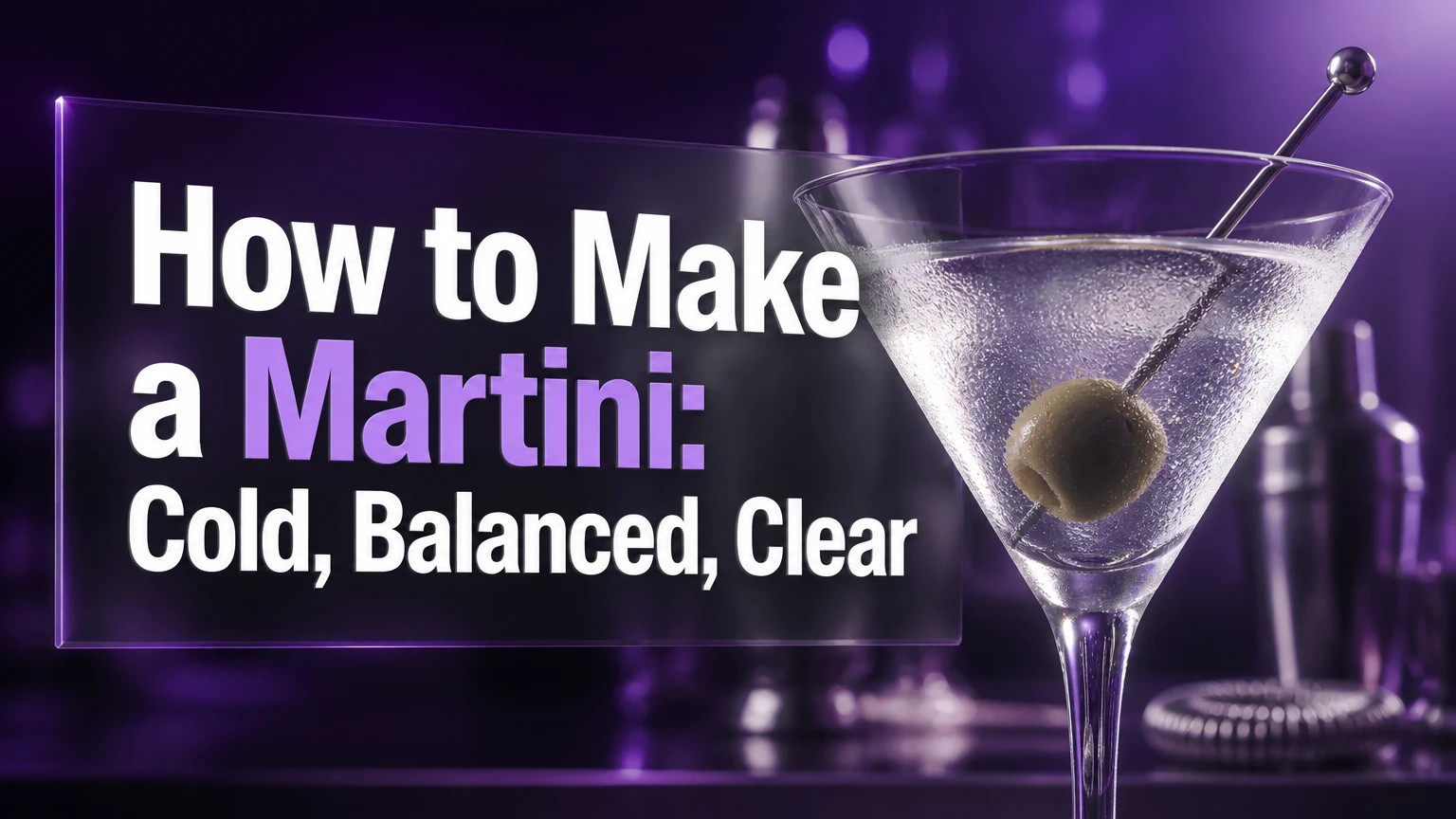
To make a Martini, stir 2 1/2 ounces of gin or vodka with 1/2 ounce of chilled dry vermouth over ice for 30-45 seconds, then strain into a cold cocktail glass. Finish with a lemon twist or olives. The most important variables are vermouth freshness, ice quality, final temperature, and controlled dilution.
Key Facts at a Glance
A standard dry Martini uses 2 1/2 ounces of spirit and 1/2 ounce of dry vermouth.
Stirring for 30-45 seconds with large, cold ice usually produces a clear, silky drink.
Fresh dry vermouth belongs in the refrigerator and typically tastes best within 4-8 weeks after opening.
A Martini commonly contains about 2.5-3 standard drinks of alcohol, depending on its spirit volume and proof.
A lemon twist emphasizes citrus and botanicals; olives add salt, fruitiness, and savory weight.
Total preparation usually takes 3-5 minutes, excluding optional freezer chilling for the glass.
What Is a Martini?
A Martini is a chilled cocktail built from a distilled spirit and dry vermouth, usually garnished with a lemon peel or green olive. Gin creates the traditional juniper-led profile, while vodka produces a cleaner, more neutral drink. The final character depends less on the glass than on the ratio, temperature, dilution, and vermouth condition.
The classic structure is simple, but simple does not mean interchangeable. Dry vermouth is a fortified wine containing botanicals and acidity, so it changes the drink’s aroma, texture, and balance even when used in a small quantity. A bottle that has oxidized can make a Martini taste flat, stale, or faintly sour.
A Martini is also a high-strength cocktail. The National Institute on Alcohol Abuse and Alcoholism defines one United States standard drink as 14 grams of pure alcohol, equivalent to 1.5 fluid ounces of 40% spirits. A Martini containing 2.5 ounces of 40% gin before dilution therefore contains more than one standard drink, and a large bar pour can contain substantially more.
Before You Start
Prepare a chilled glass, fresh vermouth, dense ice, and a way to measure accurately before mixing. A basic dry Martini requires about 3-5 minutes of active work, costs approximately $2.50-$6 at home with mid-range products, and needs no special equipment beyond a spoon, a measuring tool, and a container for stirring.
| Requirement | Typical specification | Practical substitute |
|---|---|---|
| Spirit | 2 1/2 oz, 75 ml, 40-47% ABV | Gin or vodka from a sealed bottle |
| Dry vermouth | 1/2 oz, 15 ml, refrigerated | 1/4 oz for a drier drink |
| Ice | 8-12 large cubes, 300-450 g | The coldest solid cubes available |
| Mixing vessel | 16-20 oz mixing glass | Pint glass or metal shaker tin |
| Serving glass | 5-8 oz coupe or Martini glass | Small wine glass, 6 oz capacity |
| Timing | 30-45 seconds stirring | Taste after 25 seconds if using wet ice |
| Cost | $2.50-$6 per drink | Lower cost with standard spirits |
Chill the serving glass in a freezer for 15-20 minutes, or fill it with ice and cold water while preparing the cocktail. The second method works quickly, but empty the glass completely before straining because residual meltwater changes the ratio.
Use a jigger if possible. A generous free-pour can add 1/4 ounce or more, which changes both alcohol strength and the amount of vermouth needed for balance.
How to Make a Martini, Step by Step
The most reliable dry Martini method uses five actions: chill the glass, measure the ingredients, add dense ice, stir for 30-45 seconds, and strain with the chosen garnish. The recipe below yields one approximately 3-ounce drink before dilution, with a cold temperature, clear appearance, and spirit-forward but aromatic profile.
Step 1: Chill the Serving Glass
Place a coupe or Martini glass in the freezer for 15-20 minutes. If freezer space is unavailable, fill the glass with ice and water before mixing, then leave it for at least 2 minutes.
A cold vessel slows warming after the drink is strained. You will know the glass is ready when its outside feels distinctly colder than room temperature, or when a freezer-chilled bowl has a thin frosty appearance.
The common mistake is chilling only the ingredients while leaving the glass warm. A warm glass can raise the drink’s temperature immediately, especially when the cocktail is served without ice.
Step 2: Measure Gin or Vodka and Vermouth
Pour 2 1/2 ounces, or 75 ml, of gin or vodka and 1/2 ounce, or 15 ml, of dry vermouth into a mixing glass. Add one dash of orange bitters if you want additional citrus and spice.
A 5:1 spirit-to-vermouth ratio gives a recognizable modern dry Martini. Keep the vermouth refrigerated after opening, and smell it before use. Fresh vermouth has wine-like acidity and herbal aroma; stale vermouth often smells dull, sweet, oxidized, or cardboard-like.
The common mistake is treating vermouth like shelf-stable gin. Vermouth is wine-based and deteriorates after repeated exposure to oxygen.
Step 3: Add Large, Cold Ice
Fill the mixing glass about three-quarters full with large, solid cubes. Eight to twelve standard home cubes usually provide enough thermal mass for one drink without filling the vessel with tiny fragments.
Large ice chills more gradually than crushed ice because less surface area contacts the liquid. Extremely wet ice melts faster, so drain water from a container if the cubes have been sitting in a puddle.
You will know the ice is working when the mixing glass becomes very cold and develops condensation. The common mistake is using a small handful of cubes, which warms quickly and produces uneven dilution.
Step 4: Stir Smoothly for 30-45 Seconds
Place the back of a bar spoon against the inside wall and rotate the ice around the liquid without lifting the spoon repeatedly. Stir for 30-45 seconds, or approximately 35-50 smooth revolutions, depending on cube size and temperature.
Stirring performs two jobs: it lowers temperature and adds water. A Martini made with 40% spirit commonly benefits from roughly 15-25% dilution by volume, although wet ice, stirring speed, and ingredient temperature can move that range.
You will know the drink is ready when the vessel feels almost too cold to hold and the ice moves quietly rather than clattering violently. The common mistake is stirring aggressively, which breaks cubes and adds cloudy shards.
Step 5: Strain and Garnish
Discard the ice water from the serving glass, then strain the Martini through a julep or Hawthorne strainer. For a lemon garnish, express the peel over the surface with the yellow side facing down, wipe the rim, and drop or discard the peel.
For an olive garnish, use one or three chilled green olives on a pick. A cocktail onion creates a Gibson, while a small amount of olive brine creates a Dirty Martini.
A Martini is ready when it is clear, cold, aromatic, and free of loose ice. The common mistake is squeezing lemon juice into the drink instead of expressing peel oil, which turns a dry Martini into a sour-leaning cocktail.
Which Martini Ratio Should You Use?
The best starting ratio is 5:1, meaning 2 1/2 ounces of spirit to 1/2 ounce of dry vermouth. Use 6:1 or a vermouth rinse for a more spirit-forward drink, 3:1 for a softer traditional style, and 1:1 when you want vermouth to become an equal aromatic partner.
| Style | Spirit | Dry vermouth | Approximate pre-dilution ABV | Result |
|---|---|---|---|---|
| Bone dry rinse | 2 1/2 oz | 1 tsp, discarded | 36-40% | Very spirit-forward, little wine aroma |
| Dry | 2 1/2 oz | 1/2 oz | 32-36% | Crisp, strong, balanced |
| Medium dry | 2 1/4 oz | 3/4 oz | 29-34% | More herbal, softer finish |
| Wet | 2 oz | 2/3 oz | 27-32% | Wine-like, aromatic, less hot |
| Fifty-fifty | 1 1/2 oz | 1 1/2 oz | 18-25% | Low-proof relative to other Martinis, vermouth-led |
The table’s ABV values are typical estimates after dilution, not laboratory measurements. A 47% London Dry Gin, a 40% vodka, and a heavily diluted drink will not produce identical strength.
“Dry” describes the amount of vermouth, not the sweetness of the vermouth alone. Most dry vermouths are less sweet than sweet vermouth, but individual brands vary in bitterness, acidity, and botanical intensity.
A counterintuitive practitioner rule is to reduce vermouth only after checking its freshness. Many drinkers blame a wet ratio for a flat Martini when the actual problem is oxidized wine.
Should You Use Gin or Vodka?
Choose gin when you want juniper, citrus, spice, and herbal complexity; choose vodka when you want a cleaner spirit profile that places more emphasis on vermouth and garnish. Neither base is automatically more authentic for every drinker, but gin remains the more botanically expressive starting point.
| Base spirit | Typical proof | Dominant flavor | Best garnish | Best use case |
|---|---|---|---|---|
| London Dry Gin | 80-94 proof | Juniper, citrus, spice | Lemon twist | Classic, aromatic Martini |
| New Western Gin | 80-94 proof | Floral, fruit, soft juniper | Lemon twist | Modern botanical profile |
| Standard vodka | 80 proof | Neutral, lightly sweet | Lemon or olive | Clean, restrained drink |
| Wheat or potato vodka | 80 proof | Creamy, soft, neutral | Olive | Rounded texture |
| Navy-strength gin | 114 proof | Intense botanicals, heat | Lemon twist | Small, very spirit-forward pour |
Vodka does not remove alcohol flavor. Neutral vodka removes many botanical flavors, so ethanol heat can become more noticeable when the drink is too cold, too dry, or under-diluted.
For a first gin Martini, a London Dry Gin such as Beefeater, Tanqueray, or Bombay Sapphire gives a clear reference point. For vodka, choose a clean 80-proof bottling and keep enough vermouth in the drink to prevent a one-dimensional result.
Is a Martini Better Stirred or Shaken?
A stirred Martini is the better default because it creates a clear, silky drink with controlled dilution. Shaking chills faster and adds aeration, but it can create temporary cloudiness, small ice fragments, and faster dilution, so use it for a deliberate texture rather than as a universal improvement.
| Feature | Stirred Martini | Shaken Martini |
|---|---|---|
| Typical method time | 30-45 seconds | 10-15 seconds |
| Appearance | Clear, bright | Cloudy at first, often clears |
| Texture | Silky, dense | Aerated, lighter |
| Ice fragments | Few or none | Common with hard shaking |
| Dilution control | More gradual | Faster and less predictable |
| Best application | Gin or classic dry style | Vesper, some vodka styles |
James Bond’s “shaken, not stirred” instruction describes a fictional preference, not a technical rule. Shaking is useful when a drink contains substantial brine, a citrus ingredient, or multiple spirits that benefit from forceful integration.
A useful bar rule is to stir vermouth-forward drinks and shake only when aeration has a purpose. A shaken Martini is not defective; it is simply less clear and less texturally dense.
How Do Martini Garnishes Change the Drink?
A lemon twist adds aromatic citrus oil without adding juice, while an olive contributes salt, fruit, and mild savory notes. Garnish choice changes the first aroma and final flavor, so select it according to the base spirit, vermouth, and desired profile rather than treating it as decoration.
| Garnish | Quantity | Flavor contribution | Pairing |
|---|---|---|---|
| Lemon peel | 1 strip, 2-3 inches | Citrus oil, bitter zest | Gin, orange bitters |
| Green olive | 1 or 3 olives | Salt, brine, vegetal fruit | Vodka, savory gin |
| Stuffed olive | 1 or 3 olives | Pimento, garlic, blue cheese | Dirty Martini |
| Cocktail onion | 1-3 onions | Pickled acidity, umami | Gibson |
| Lemon and olive | 1 peel plus 1 olive | Citrus plus salt | Stronger vermouth ratio |
Express lemon peel over the drink instead of merely dropping it in. The aromatic oil lands on the surface, where it reaches the nose before the liquid reaches the palate.
Use quality olives packed in brine, not oil, and drain excess liquid unless making the drink dirty. A loose olive can shed oil or fragments, while a pick keeps the presentation and texture controlled.
What Are the Main Martini Variations?
The main Martini variations change the base spirit, vermouth ratio, brine, garnish, or secondary fortified wine. A Dirty Martini adds olive brine, a Gibson uses a cocktail onion, and a Vesper combines gin, vodka, and Lillet Blanc or Cocchi Americano.
| Variation | Ingredients | Method | Garnish | Typical profile |
|---|---|---|---|---|
| Dirty Martini | 2 1/2 oz spirit, 1/2 oz vermouth, 1/4-1/2 oz brine | Stir or shake | Olive | Salty, savory, cloudy |
| Gibson | 2 1/2 oz gin, 1/2 oz vermouth | Stir | Cocktail onion | Pickled, sharp, umami |
| Vesper | 3 oz gin, 1 oz vodka, 1/2 oz Lillet Blanc | Shake or stir | Lemon peel | Strong, citrusy, bitter |
| Fifty-fifty | 1 1/2 oz gin, 1 1/2 oz vermouth | Stir | Lemon peel | Aromatic, softer |
| Vodka Martini | 2 1/2 oz vodka, 1/2 oz vermouth | Stir | Olive or lemon | Clean, restrained |
For a Dirty Martini, begin with 1/4 ounce of brine. Increase to 1/2 ounce only if the olives are mild and the drink needs more salt. Brine also adds water, so reduce stirring slightly when using a large quantity.
The Vesper is substantially stronger than the standard recipe because it contains 4 ounces of distilled spirits and uses Lillet Blanc rather than dry vermouth. Cocchi Americano provides more bitterness and quinine-like tension than modern Lillet Blanc.
Why Do Temperature and Dilution Matter?
Temperature suppresses alcohol heat, while dilution lowers ethanol concentration and allows botanical and vermouth aromas to register. A well-made Martini is usually served near the freezing point of water, often around -2°C to 2°C, but the exact temperature depends on alcohol content and dilution.
The frequently cited -2°C to -4°C range is physically plausible for a spirit-heavy cocktail because ethanol lowers the freezing point. It should not be treated as a mandatory home target, since glass temperature, freezer calibration, proof, and vermouth volume produce different results.
Use the sensory checkpoint rather than a thermometer alone. The drink should feel cold and rounded, not numbingly frozen; a nearly frozen surface can mute aroma and make a high-proof Martini seem less balanced.
A practical dilution test is to make two identical drinks, stirring one for 25 seconds and the other for 45 seconds. If the longer version tastes thinner, the ice was wet or the cubes were small. If the shorter version tastes hot and concentrated, continue stirring in 10-second increments.
How Fresh Should Dry Vermouth Be?
Dry vermouth should be refrigerated immediately after opening and generally used within 4-8 weeks for the brightest Martini flavor. The exact window varies with the bottle’s fill level, refrigerator temperature, closure, and producer, so sensory testing matters more than a rigid expiration date.
Store the bottle upright with its cap or cork tightly closed. A half-full bottle has more oxygen in the headspace than a nearly full bottle, so it usually declines faster.
Pour a teaspoon into a clean glass before mixing if the bottle is older than two months. Fresh vermouth smells herbal, wine-like, and lightly acidic. Discard vermouth that smells like bruised apples, vinegar, damp cardboard, or cooked wine.
Refrigeration slows oxidation but does not stop it. The Martini’s small vermouth measure makes stale wine especially obvious because there is no juice, sugar, or liqueur to cover the defect.
What If You Do Not Have Bar Tools?
A pint glass, teaspoon, and fine kitchen strainer can make a respectable Martini when a mixing glass, jigger, or bar spoon is unavailable. Measure 10 teaspoons of spirit and 2 teaspoons of vermouth, add ice, stir with a clean teaspoon for 45 seconds, and strain carefully.
A screw-top jar can replace a shaker, but shaking creates more aeration and ice breakage. Use it for a Vesper or a Dirty Martini, not as the default method for a crystal-clear gin Martini.
If you cannot chill the serving glass, fill it with ice water while preparing the drink. If you lack a strainer, hold back the ice with a fork or the jar lid, leaving a narrow opening for the liquid.
Do not use crushed ice as a substitute for missing tools. Ice geometry affects dilution more than the brand of mixing glass, and crushed ice can turn a balanced drink watery within seconds.
How Strong and How Expensive Is a Martini?
A typical home Martini costs $2.50-$6 and contains roughly 25%-35% alcohol by volume after dilution, depending on proof, ratio, and final volume. A bar Martini often costs $12-$22 or more, while the price reflects venue, spirit tier, vermouth, labor, and garnish.
| Recipe | Spirit volume | Estimated final volume | Typical final ABV | Typical home cost |
|---|---|---|---|---|
| Bone-dry gin | 2 1/2 oz | 2.7-3 oz | 35%-40% | $2.50-$6 |
| 5:1 dry Martini | 2 1/2 oz | 3.3-3.8 oz | 29%-35% | $2.50-$6 |
| 3:1 Martini | 2 1/4 oz | 3.4-3.9 oz | 25%-31% | $2.75-$6.50 |
| Fifty-fifty | 1 1/2 oz | 3.6-4.1 oz | 17%-24% | $2.50-$7 |
| Dirty Martini | 2 1/2 oz | 3.6-4.3 oz | 25%-32% | $2.75-$6.50 |
These are practical estimates, not measured laboratory results. The final volume includes melted ice, and a 47% gin produces a stronger drink than an 80-proof vodka at the same recipe ratio.
A standard 5:1 Martini made with 2.5 ounces of 40% spirit contains about 1 ounce of pure ethanol before accounting for dilution. That is more alcohol than one NIAAA standard drink, so serve it slowly and avoid assuming that its small glass size means low alcohol.
Common Mistakes and How to Fix Them
The Martini Tastes Flat or Sour
Replace the vermouth if it has been warm or open for longer than 4-8 weeks. Oxidized fortified wine cannot be repaired with more gin, bitters, or garnish.
The Drink Tastes Watery
Use larger, drier ice and shorten stirring to 25-30 seconds. If the drink is already mixed, a small amount of fresh chilled spirit can restore intensity, but adding more alcohol changes the intended ratio.
The Drink Tastes Hot
Stir for another 10-15 seconds with solid ice, or add 1/4 ounce more vermouth in the next preparation. A warm, under-diluted Martini often gets mislabeled as “too strong” when it simply needs water and lower temperature.
The Martini Is Cloudy
Cloudiness usually comes from shaking, tiny ice fragments, vermouth sediment, or oils from a stuffed olive. Fine-strain the drink, use a mixing glass, and avoid crushed ice if clarity matters.
The Martini Is Too Salty
Reduce olive brine to 1 tablespoon or less, then use a lemon twist instead of additional olives. Brine varies widely between producers, so measuring by volume is more reliable than counting olives.
The Garnish Dominates
Use one olive rather than three, or express the lemon peel briefly and discard it. Strong garlic, blue cheese, or jalapeño-stuffed olives can overwhelm a delicate vermouth.
How Should You Adapt the Recipe?
Adjust the recipe according to equipment, alcohol preference, and service size, but change one variable at a time. A lower-proof, vermouth-forward Martini is easier to drink; a batch Martini is easier to serve but requires controlled chilling and dilution before guests arrive.
For two drinks, combine 5 ounces of spirit and 1 ounce of vermouth in a chilled container, then stir the full batch with approximately 16-20 large ice cubes for 45-60 seconds. Strain into two chilled glasses and garnish individually.
For a lower-alcohol drink, use 1 1/2 ounces of spirit and 1 1/2 ounces of vermouth, producing a fifty-fifty Martini. This is not a watered-down dry Martini; it is a separate style with more wine aroma and lower spirit intensity.
For a no-freezer situation, fill the glass with ice water first and keep the vermouth refrigerated. For a warm room above 24°C, use extra-cold ice and stir in shorter checks, because the mixing vessel will gain heat more quickly.
An honest limitation matters here: a Martini is not a good choice when you want a long, low-alcohol, highly refreshing drink. The cocktail has little water, sugar, or citrus, so a high-proof pour remains concentrated even after careful dilution.
How Do You Choose the Right Martini?
Choose a 5:1 London Dry Gin Martini with a lemon twist when you want the clearest classic reference point. Choose vodka and an olive for a cleaner, savory drink, a 3:1 ratio for more vermouth character, and a fifty-fifty recipe when lower strength and aromatic complexity matter most.
Use these practical matches:
- New Martini drinker: 2 1/2 ounces of vodka, 1/2 ounce of vermouth, 30 seconds of stirring, lemon twist.
- Gin enthusiast: 2 1/2 ounces of London Dry Gin, 1/2 ounce of vermouth, 40 seconds of stirring, lemon twist.
- Olive lover: 2 1/2 ounces of gin or vodka, 1/2 ounce of vermouth, 1/4 ounce of brine, one olive.
- Vermouth enthusiast: 1 1/2 ounces of gin, 1 1/2 ounces of dry vermouth, 35 seconds of stirring, lemon twist.
- James Bond fan: 3 ounces of gin, 1 ounce of vodka, 1/2 ounce of Lillet Blanc, shaken and finished with lemon.
The best Martini is the one whose ratio matches the drinker’s preferred alcohol intensity. Start with the measured 5:1 recipe, then adjust vermouth by 1/4 ounce rather than making a dramatic change.
Frequently Asked Questions
Can You Make a Martini Without Vermouth?
You can make a vermouth-free drink, but it is essentially chilled, diluted gin or vodka rather than a balanced Martini. A vermouth rinse is a better compromise because it adds wine and botanical aroma while keeping the cocktail spirit-forward.
Should Martini Olives Be Refrigerated?
Refrigerate opened olives after covering them with brine and follow the producer’s label guidance. Use clean utensils, avoid returning used olives to the jar, and discard olives with a sour odor, cloudy brine, mold, or a slimy surface.
How Many Olives Go in a Martini?
Use one or three olives for a conventional garnish. One olive keeps the drink balanced, while three adds more salt and visual weight. The number is less important than the olive’s brine strength and whether the drink already contains added olive juice.
Can You Use Sweet Vermouth in a Martini?
Sweet vermouth creates a different cocktail profile and is not the normal choice for a dry Martini. Use dry vermouth for the crisp, herbal style; sweet vermouth belongs in drinks such as a Manhattan or a sweet Martinez variation.
How Long Can a Mixed Martini Sit?
A strained Martini is best consumed within 5-10 minutes because it warms and its aromas flatten in a room-temperature glass. A drink served over fresh ice can remain colder longer, but additional melting will gradually reduce its strength and change its balance.
The Bottom Line
To make a Martini successfully, measure 2 1/2 ounces of gin or vodka and 1/2 ounce of fresh dry vermouth, stir the mixture with large ice for 30-45 seconds, strain into a chilled glass, and garnish with lemon or olives. Fresh vermouth, dense ice, and controlled dilution matter more than expensive glassware. Start with the 5:1 recipe, then adjust the ratio to make the Martini drier, wetter, dirtier, or more vermouth-forward.