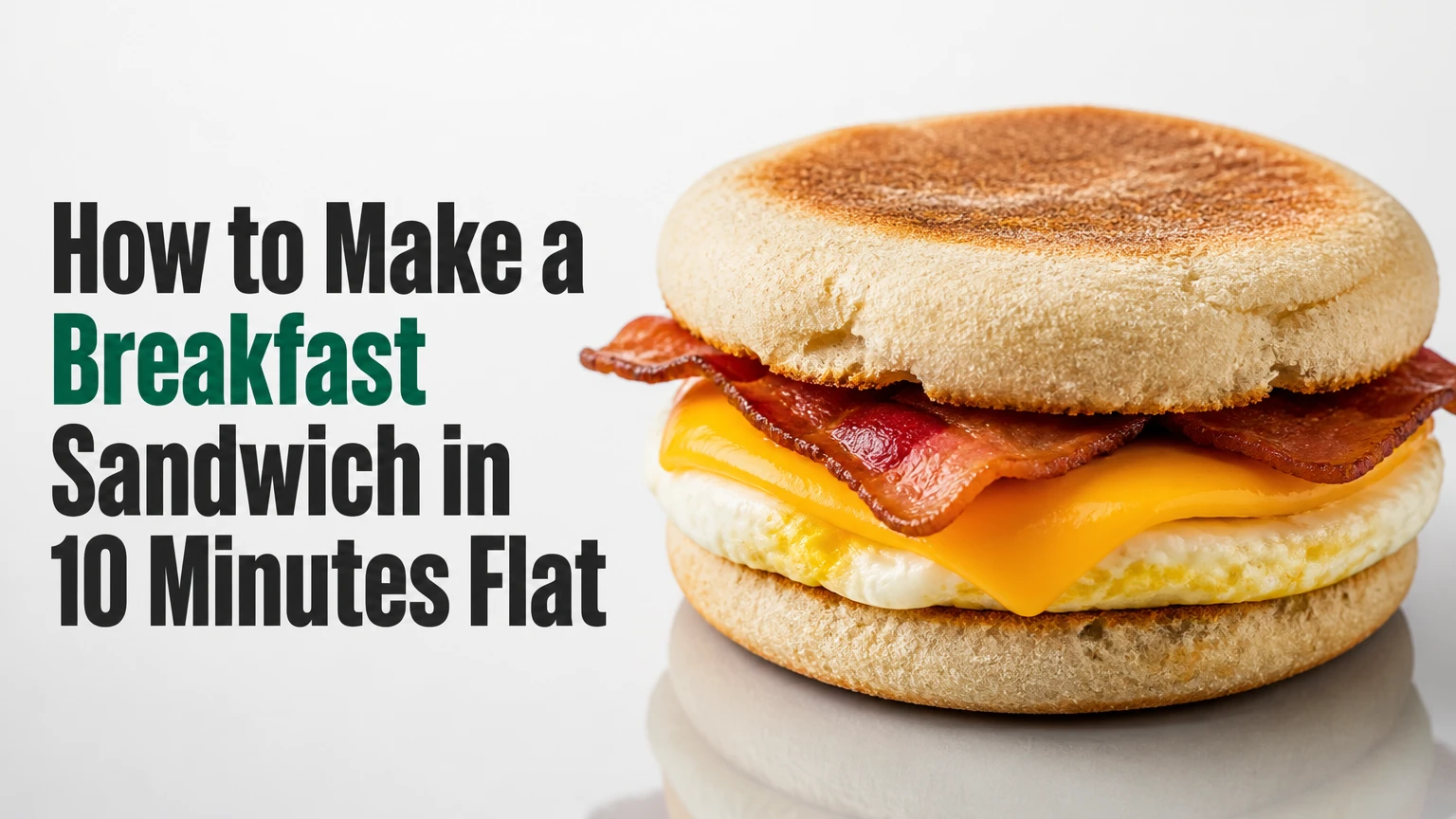
A breakfast sandwich combines toasted bread, a cooked egg, melted cheese, and an optional meat or vegetable filling in one portable meal. Make one in about 8-10 minutes by toasting the bread, cooking the filling, shaping a one- or two-egg portion, melting cheese onto the egg, and assembling with the driest ingredients against the bread.
Key Facts at a Glance
One sandwich uses 1 large egg, 1 slice of cheese, 1 bread vehicle, and 1-2 ounces of filling.
A home-cooked breakfast sandwich typically costs $2-$5 and takes 8-10 minutes.
Medium-low heat produces tender eggs; high heat creates browned edges and a rubbery center.
Toasted bread, melted cheese, and a compact egg shape prevent most sliding and sogginess.
Cook ground sausage to 160°F, and follow FDA guidance to cook eggs until the yolk and white are firm.
A wrapped sandwich keeps refrigerated for up to 3-4 days and reheats best after thawing.
What Makes a Breakfast Sandwich Work?
A breakfast sandwich works when the bread supports the filling, the egg provides a soft protein base, the cheese binds the layers, and a small amount of acid or heat balances richness. The most reliable ratio is one bread vehicle, one egg, one cheese slice, and 1-2 ounces of meat or vegetables.
The bread must be sturdy enough for the filling but not so dense that every bite compresses the center. English muffins and kaiser rolls offer the best everyday balance. Biscuits taste richer but shed crumbs, while bagels carry heavy fillings at the cost of a dense, chewy bite.
Texture matters as much as flavor. Crisp bacon needs a soft egg, melted cheese needs a toasted surface, and ketchup, salsa, or hot sauce should be used sparingly so the bottom bread does not absorb excess liquid.
Before You Start
Prepare the ingredients and equipment before heating the pan. A 10-inch nonstick skillet, spatula, small bowl, fork, toaster, butter knife, and lid are enough for one sandwich.
| Ingredient or tool | One-sandwich quantity | Practical specification |
|---|---|---|
| English muffin, roll, biscuit, or bagel | 1 | 2 halves, about 3-4 inches wide |
| Large egg | 1, or 2 for a taller sandwich | 50-100 grams total |
| Cheese | 1 slice, ¾-1 ounce | American, cheddar, Swiss, or provolone |
| Cooked meat or vegetables | 1-2 ounces | Bacon, sausage, ham, spinach, or mushrooms |
| Butter or oil | 1 teaspoon | Enough to coat the skillet |
| Condiment | 1-2 teaspoons | Ketchup, hot sauce, salsa, or mustard |
| Equipment | 1 skillet and 1 spatula | A lid helps melt cheese evenly |
Use a pre-cooked filling when speed matters. Raw sausage adds flavor but usually takes 6-8 minutes, which makes the full sandwich closer to 12-15 minutes.
How to Make a Breakfast Sandwich in 8 Steps
Follow the sequence below for one sandwich in approximately 8-10 minutes. The factor that most determines success is moisture control: toast the bread, drain fatty fillings, and keep wet condiments away from the bread until the final assembly.
Step 1: Split and Toast the Bread
Split one English muffin, kaiser roll, biscuit, croissant, or bagel evenly. Toast the cut sides until golden and firm, then spread each side with about ½ teaspoon of butter if desired.
Use a toaster for an English muffin or bagel. For a skillet method, place the cut sides face down in the pan for 1-2 minutes after cooking the filling, using the remaining fat for flavor.
You’ll know it worked when: the cut surface feels dry and resists light pressure.
Common mistake: lightly warming the bread instead of toasting it. Warm bread absorbs egg moisture immediately.
Step 2: Cook and Drain the Filling
Cook 2 strips of bacon, one 2-ounce sausage patty, or 1-2 ounces of ham over medium heat. Bacon usually needs 5-7 minutes, sausage patties need 4-6 minutes per side depending on thickness, and sliced ham needs 1-2 minutes.
Transfer the filling to a paper towel. Leave only about 1 teaspoon of fat in the skillet, because excess grease makes the egg slide and softens the bread.
For vegetables, sauté ¼ cup of sliced mushrooms, peppers, or spinach for 2-3 minutes. Remove watery vegetables before adding the egg.
You’ll know it worked when: the meat is hot throughout, the bacon is rendered, and no visible pool of grease remains.
Common mistake: placing wet or steaming vegetables directly on toasted bread. Drain them first.
Step 3: Whisk and Season the Egg
Crack 1 large egg into a bowl and whisk with a fork until the yolk and white are fully blended. Add a pinch of salt and black pepper, or use 1 tablespoon of milk for a softer scramble.
Whisking incorporates a small amount of air, but excessive whisking makes the egg foam and cook unevenly. A single egg makes a thin, compact layer; two eggs make a taller sandwich but require a wider bread vehicle.
You’ll know it worked when: the mixture has one consistent yellow color with no clear streaks.
Common mistake: seasoning only after cooking. Salt distributes more evenly when added before the egg reaches the skillet.
Step 4: Cook the Egg Over Medium-Low Heat
Reduce the skillet to medium-low, add 1 teaspoon of butter or oil if the pan is dry, and pour in the egg. Push the edges inward with a spatula as the liquid center spreads, shaping the egg into a 3-4-inch round.
Cook a folded egg for 60-90 seconds, or cook a flat omelet for about 2 minutes. For a fried egg, crack it into the skillet and cook for 2-3 minutes until the white sets, then cover the pan for 30-60 seconds if the top remains translucent.
The FDA instructs consumers to cook eggs until “the yolk and white are firm.” For dishes that combine egg with other ingredients, the FDA Food Code commonly uses 155°F for 17 seconds, while USDA guidance for many egg dishes uses 160°F. Follow the stricter instruction when serving children, older adults, pregnant people, or immunocompromised diners.
You’ll know it worked when: the egg holds its shape, the center is barely glossy for a tender result, and no liquid white remains.
Common mistake: using high heat to shorten cooking. High heat sets the outside before the center and produces a tough edge.
Step 5: Melt the Cheese Onto the Egg
Place 1 slice of cheese on the egg during the final 20-30 seconds. Fold the egg into a size that matches the bread, then cover the skillet for 15-30 seconds.
American cheese melts fastest because its emulsifying salts keep the fat and moisture combined. Cheddar, Swiss, provolone, and Gruyère provide stronger flavor but may need to be grated or covered longer.
You’ll know it worked when: the cheese is glossy and attached to the egg rather than sliding off as a separate layer.
Common mistake: melting cheese directly on the pan. It burns before it bonds with the egg.
Step 6: Toast or Warm the Bread in the Pan
If the bread is not already toasted, place it cut-side down in the skillet for 60-120 seconds. Keep the heat at medium-low so the surface browns without absorbing a large amount of grease.
A croissant needs only brief warming because its laminated layers become fragile when overheated. A bagel can handle stronger toasting, while a biscuit is best warmed in a 325°F oven for 5-7 minutes if it has become cold.
You’ll know it worked when: the exterior is warm and the cut face is lightly browned, not wet.
Common mistake: leaving bread in the meat fat for too long. The surface becomes greasy rather than crisp.
Step 7: Assemble From Stable to Moist
Build the sandwich in this order: bottom bread, meat or drained vegetables, cheese-covered egg, condiment, and top bread. Put ketchup, salsa, or hot sauce between the egg and top bread instead of directly against the bottom.
The meat creates a flat foundation, and the melted cheese helps connect the egg to that foundation. Fold round ingredients, such as bacon, inward so their edges do not act like rails that push the egg backward.
You’ll know it worked when: the sandwich stays aligned after a gentle squeeze and no filling extends more than ½ inch beyond the bread.
Common mistake: adding tomato slices, avocado, and sauce in one wet layer. Use one moist ingredient, pat it dry, and add it last.
Step 8: Rest, Wrap, and Eat
Let the assembled sandwich rest for 30-60 seconds before eating. For transport, wrap it in parchment or foil after the first minute, leaving enough ventilation that condensation does not collect on the bread.
A short rest allows residual heat to soften the cheese and equalize the temperature. It does not make an undercooked egg safe, so use a thermometer or firm-set standard when food safety requires it.
You’ll know it worked when: the cheese remains melted, the bread is warm but not damp, and the first bite does not force the egg out.
Which Bread Vehicle Should You Choose?
English muffins are the best default for a portable breakfast sandwich because their toasted surface resists moisture and their 2-3 ounce weight does not overpower one egg. Choose a biscuit for richness, a bagel for a heavy meal, a kaiser roll for a soft bodega-style bite, and a croissant for a delicate, high-fat version.
| Bread vehicle | Typical weight | Toasting time | Best filling match | Main limitation |
|---|---|---|---|---|
| English muffin | 2-3 oz | 2-3 minutes | Egg, Canadian bacon, American cheese | Can taste dry without butter |
| Kaiser roll | 3-4 oz | 1-2 minutes | Fried egg, bacon, ketchup | Soft crumb absorbs sauce |
| Buttermilk biscuit | 3-4 oz | 5-7 minutes warm-up | Sausage, folded egg, cheddar | Crumbles during transport |
| Bagel | 4-5 oz | 3-4 minutes | Two eggs, sausage, cream cheese | Dense and calorie-heavy |
| Croissant | 2.5-3.5 oz | 1-2 minutes warm-up | Soft egg, prosciutto, Gruyère | Compresses and tears easily |
Bread choice should follow filling weight. A single fried egg on a bagel feels unbalanced, while two eggs and sausage can overwhelm an English muffin.
What Filling Combinations Work Best?
The classic bacon, egg, and cheese works because crisp bacon supplies salt and texture, the egg softens the bite, and cheese links the layers. Sausage gives a richer, more seasoned center, while ham and Canadian bacon create a leaner sandwich with less grease.
| Style | Bread | Protein | Egg treatment | Cheese or sauce |
|---|---|---|---|---|
| New York bodega | Kaiser roll | 2 bacon strips | Broken-yolk fried egg | American cheese and ketchup |
| Muffin shop | English muffin | 1 oz Canadian bacon | Round fried egg | Processed cheddar |
| Southern biscuit | Buttermilk biscuit | 2 oz sausage patty | Folded egg | Sharp cheddar |
| Bagel deli | Everything bagel | 2 oz sausage or bacon | Scrambled eggs | Cream cheese or provolone |
| Gourmet croissant | Croissant | 1 oz prosciutto | Soft scramble | Gruyère and chives |
| Vegetarian skillet | English muffin | ¼ cup mushrooms and spinach | Fried or folded egg | Cheddar and salsa |
Use a fried egg when a runny yolk is part of the experience, but use scrambled or folded eggs for commuting. A runny yolk increases mess, and the sandwich may not remain at a safe temperature during a long trip.
How Do You Keep Fillings Inside?
Keep fillings inside by matching their size to the bread, draining excess fat and water, and using melted cheese as a binder. Place flat ingredients at the bottom, fold irregular pieces inward, and limit sauce to 1-2 teaspoons.
The common sliding failure is mechanical. A round egg, round tomato slice, and round bread create smooth contact surfaces, while a thick bacon strip can push the egg backward. Break bacon into shorter pieces or arrange it crosswise.
A useful practitioner rule is to keep the filling stack within ½ inch of the bread edge. If the sandwich is taller than about 2 inches, compress it lightly for 5 seconds before wrapping. Do not press hard enough to squeeze out the egg.
What Do Time and Cost Look Like?
A basic home breakfast sandwich takes 8-10 minutes and costs approximately $2-$5 using supermarket ingredients. A pre-cooked filling can reduce active cooking to 5-6 minutes, while raw sausage, a bagel, and premium cheese can push the total cost above $6.
| Build | Typical time | Typical home cost | Estimated calories | Best use |
|---|---|---|---|---|
| Egg, American cheese, English muffin | 6-8 minutes | $1.50-$2.50 | 300-400 | Fast weekday meal |
| Bacon, egg, cheese, English muffin | 8-10 minutes | $2.50-$4.00 | 450-600 | Classic portable breakfast |
| Sausage, egg, cheddar biscuit | 10-15 minutes | $3.00-$5.00 | 550-750 | Larger weekend meal |
| Bagel, two eggs, sausage, cheese | 10-15 minutes | $4.00-$6.50 | 700-950 | High-calorie, high-satiety meal |
| Vegetable egg sandwich | 8-10 minutes | $2.00-$4.00 | 300-500 | Meat-free weekday option |
Calorie estimates are typical ingredient-level calculations, not laboratory measurements. Bread size, cheese weight, cooking fat, and meat brand create the largest differences.
Common Mistakes and How to Fix Them
Why Are the Eggs Rubbery?
Rubbery eggs usually result from high heat or overcooking. Cook over medium-low heat, remove the egg when the center is barely glossy, and allow carryover heat to finish the texture.
If the egg is already dry, add a teaspoon of salsa or yogurt-based sauce and use it in a biscuit or bagel, where a stronger bread can compensate. Do not add extra oil after cooking, because grease will not restore moisture.
Why Does the Bread Get Soggy?
Soggy bread comes from steam, wet vegetables, excess sauce, or an under-toasted cut surface. Toast the bread until firm, drain meat and vegetables, and place wet ingredients between the egg and top bread.
For packed sandwiches, cool the filling for 1-2 minutes before wrapping. Immediate tight wrapping traps steam, which condenses against the bread.
Why Does the Cheese Not Melt?
Cheese fails to melt when it is too cold, too thick, or exposed to dry heat. Put the cheese on the hot egg, cover the skillet for 15-30 seconds, and grate firm cheeses when using more than 1 ounce.
Aged cheddar may soften without becoming fluid because it contains less moisture. American cheese and young provolone produce a smoother bond.
Why Does the Sandwich Taste Greasy?
Greasy flavor usually comes from un-drained bacon or sausage fat combined with buttered bread. Cook the filling fully, blot it, and leave no more than 1 teaspoon of fat in the pan.
Choose Canadian bacon, ham, turkey sausage, or sautéed vegetables when the sandwich already includes butter, cheese, and a rich biscuit.
Why Does the Egg Slide Out?
Eggs slide when the egg is larger than the bread or when smooth ingredients lack a binding layer. Shape the egg to the bread footprint, break bacon into smaller pieces, and melt cheese directly onto the egg.
A folded egg is easier to control than a large omelet. For a 4-inch English muffin, one large egg is usually the most stable portion.
How Can You Adapt the Sandwich?
Adapt the breakfast sandwich by changing one structural component at a time. Keep the same bread and egg while testing a new protein, or keep the filling constant while switching from an English muffin to a biscuit or bagel.
Vegetarian and Dairy-Free Options
For a vegetarian sandwich, replace meat with ¼ cup sautéed mushrooms, spinach, peppers, black beans, or a 1-ounce plant-based sausage patty. Remove excess water from vegetables before assembly.
For a dairy-free version, omit cheese and add avocado, hummus, or a thin layer of bean spread. These ingredients bind less firmly than melted cheese, so use a toasted English muffin and keep the spread to 1 tablespoon.
Higher-Protein Option
Use two eggs, 1 ounce of Canadian bacon, and one slice of reduced-fat cheese on a whole-wheat English muffin. The sandwich usually provides about 25-30 grams of protein, depending on brands and portion sizes.
Egg whites reduce fat but can become dry faster than whole eggs. Add one whole egg to two egg whites for better flavor and moisture.
Gourmet Option
Use a butter-toasted brioche bun, two softly scrambled eggs, 1 ounce of prosciutto, 1 ounce of Gruyère, chives, and 1 teaspoon of hot honey. Keep the bun warm rather than heavily crisped so its delicate crumb does not compete with the filling.
This combination is not ideal for a long commute. Brioche compresses, prosciutto slides, and hot honey becomes sticky as the sandwich cools.
How Can You Meal-Prep Breakfast Sandwiches?
Meal-prep breakfast sandwiches by baking seasoned eggs in a shallow pan, cooling the portions completely, and freezing each assembled sandwich separately. Reheat thawed sandwiches at 350°F for about 10-12 minutes, or microwave them briefly before crisping the bread in a toaster oven.
For six sandwiches, whisk 12 eggs with ½ teaspoon of salt and ¼ teaspoon of pepper, pour into a greased 9-by-13-inch pan, and bake at 350°F until the center is set. Cut six portions, each about 3 inches square.
| Meal-prep stage | Quantity or setting | Time | Safety checkpoint |
|---|---|---|---|
| Bake eggs | 12 eggs in 9-by-13-inch pan | About 15-20 minutes | Center fully set |
| Cool portions | 6 egg squares on rack | 15-20 minutes | No visible steam |
| Refrigerate | Wrapped sandwiches | Up to 3-4 days | Refrigerator at 40°F or below |
| Freeze | Parchment plus foil | Up to 1 month for best texture | Label date and filling |
| Reheat thawed | 350°F oven or air fryer | 10-12 minutes | Center reaches 165°F |
| Reheat frozen | Microwave at reduced power, then oven | About 3-5 minutes plus crisping | Check the center before eating |
Remove fresh tomato, avocado, and watery salsa before freezing. Add those ingredients after reheating because freezing damages their texture and increases moisture.
What Goes With a Breakfast Sandwich?
Fruit, plain yogurt, roasted potatoes, and unsweetened coffee pair well with a breakfast sandwich because they add freshness or volume without another heavy layer of bread and fat. A small orange, apple, or ½ cup of berries adds acidity that balances cheese and sausage.
For a large biscuit or bagel sandwich, choose fruit or black coffee rather than hash browns if the meal already exceeds about 700 calories. For a lighter English muffin sandwich, roasted potatoes or yogurt can provide additional energy.
Frequently Asked Questions
Can I Make a Breakfast Sandwich Without a Skillet?
Yes. Microwave one beaten egg in a greased ramekin for 45 seconds, stir, then microwave in 15-second intervals until set. Toast the bread separately and add pre-cooked meat and cheese. The texture is softer and less browned than a skillet version, but the method takes about 4-6 minutes.
Should I Use One Egg or Two?
Use one large egg for an English muffin or small roll and two eggs for a bagel, large biscuit, or high-protein sandwich. One egg weighs about 50 grams, while two eggs can make the filling too thick for a 3-inch bread vehicle unless folded carefully.
Can I Use a Runny Yolk?
You can use a runny yolk when eating the sandwich immediately, but the result is less portable and requires careful food-safety judgment. The FDA recommends cooking eggs until the yolk and white are firm, especially for vulnerable groups, so use a fully set fried or folded egg for packed meals.
Is an English Muffin Healthier Than a Bagel?
An English muffin is usually lower in calories and carbohydrates than a full bagel because it weighs less, but package sizes vary. A typical English muffin contains about 120-150 calories, while a standard bagel often contains 250-350 calories before fillings. Compare nutrition labels rather than bread names.
How Long Can a Breakfast Sandwich Sit Out?
Perishable egg and meat sandwiches should not remain at room temperature for more than 2 hours, or 1 hour when the surrounding temperature exceeds 90°F. Refrigerate leftovers promptly in shallow wrapping, and reheat them until the center is hot.
What Is the Best Cheese for a Breakfast Sandwich?
American cheese is the most reliable melting cheese, while cheddar offers sharper flavor and provolone melts smoothly with ham or sausage. Use one ¾- to 1-ounce slice for a balanced sandwich; more cheese can overwhelm a single egg and increase leakage.
The Bottom Line
To make a breakfast sandwich successfully, toast one bread vehicle, cook and drain 1-2 ounces of filling, shape one egg over medium-low heat, melt one cheese slice onto it, and assemble from dry ingredients to wet ones. The complete method takes 8-10 minutes and usually costs $2-$5. For the most reliable result, choose an English muffin, keep the egg compact, and use only 1-2 teaspoons of sauce.