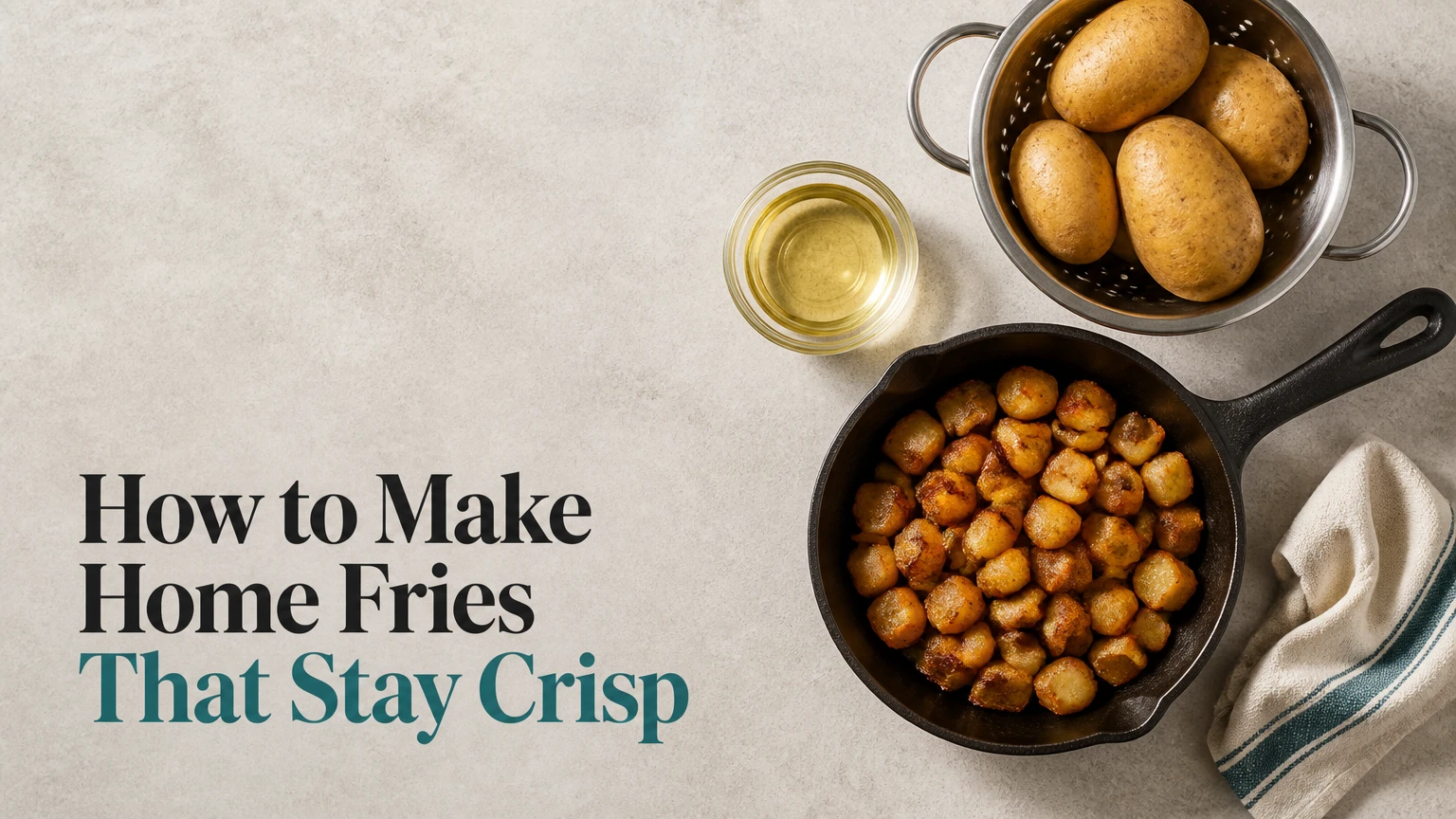
Home fries are diced potatoes cooked in a skillet until browned and crisp outside, while the centers remain tender and fluffy. For reliable results, parboil 2 pounds of evenly cut potatoes for 4-5 minutes, dry them thoroughly, then fry them in a wide skillet without crowding the pan.
Key Facts at a Glance
- Home fries use diced, cubed, or sliced potatoes, while hash browns use shredded potatoes.
- A 1/2-inch to 3/4-inch potato cube gives a practical balance between browning and tenderness.
- Parboiling reduces skillet time and makes tender centers more consistent.
- Yukon Gold potatoes hold their shape and develop a buttery interior; Russets produce a drier, lighter center.
- A single layer of potatoes prevents trapped steam from making the crust soft.
- A family-sized batch costs approximately $2-$4, depending on the fat and vegetables used.
What Are Home Fries?
Home fries are skillet-fried potato pieces, usually served at breakfast or brunch with eggs, sausage, bacon, or toast. Diced potatoes are the most common shape, and onions, bell peppers, paprika, black pepper, and garlic are frequent additions.
Home fries differ from French fries and hash browns by both shape and cooking method. French fries are elongated potato pieces generally deep-fried in oil, while hash browns are shredded, pressed, or loosely scattered before frying. Home fries are typically cooked in a shallow layer of oil or fat in a pan.
The name describes a family of preparations rather than one legally fixed recipe. A diner may use previously boiled potatoes, a home cook may use raw cubes, and a restaurant may roast potatoes before finishing them on a griddle. The defining feature is the browned skillet finish on distinct potato pieces.
Before You Start
The most dependable home fries require about 35 minutes total, including 10 minutes of preparation and 20-25 minutes of cooking. The method is beginner-friendly, but potato dryness and pan crowding determine the final crust more than seasoning does.
Ingredients for Four Servings
- 2 pounds Russet or Yukon Gold potatoes
- 3 tablespoons neutral oil, such as canola or avocado oil
- 1 tablespoon unsalted butter, optional
- 1 medium yellow onion, diced
- 1 bell pepper, diced, optional
- 1 teaspoon kosher salt for the cooking water
- 1 teaspoon kosher salt for final seasoning, adjusted to taste
- 1/2 teaspoon black pepper
- 1/2 teaspoon paprika
- 1/2 teaspoon garlic powder
- 1/2 teaspoon baking soda for the parboiling water, optional
Equipment and Practical Specifications
| Item | Recommended specification | Why it matters |
|---|---|---|
| Skillet | 12-inch cast iron or stainless steel | Holds 2 pounds in a mostly single layer |
| Potato cube | 1/2-3/4 inch | Cooks through before the exterior burns |
| Cooking oil | 2-3 tablespoons | Covers the pan surface without deep-frying |
| Parboiling water | 3-4 quarts | Maintains a boil after potatoes enter |
| Cooking temperature | Medium to medium-high | Browns potatoes without scorching spices |
Use a 14-inch skillet if you want to cook the entire 2-pound batch with substantial spacing. A 10-inch skillet is suitable for approximately 1 pound of potatoes, but forcing 2 pounds into it creates steam and uneven browning.
Which Potatoes and Fat Make the Best Home Fries?
Yukon Gold is the best all-purpose choice for home fries because its medium-starchy flesh stays intact while developing a golden crust. Russets create a lighter, fluffier center and stronger crisping potential, while red potatoes remain firm but usually produce a less rugged crust.
| Potato | Typical starch behavior | Finished texture | Best use |
|---|---|---|---|
| Russet | High starch, low moisture | Fluffy center, crisp edges | Maximum contrast |
| Yukon Gold | Medium starch, naturally creamy | Tender center, golden crust | Best overall balance |
| Red potato | Lower starch, waxy flesh | Firm and moist | Shape retention |
| Fingerling | Waxy, narrow shape | Dense and creamy | Rustic sliced home fries |
Potato age also changes the result. Older potatoes generally contain less water and brown more readily, while very fresh potatoes can release enough moisture to slow crust formation. Avoid green potatoes because green coloring can indicate elevated glycoalkaloids, bitter compounds that are not removed reliably by cooking.
For fat, neutral oil supplies dependable browning, butter adds dairy flavor but can burn at high heat, and bacon grease contributes a savory taste with a lower tolerance for prolonged high heat. A practical combination is 2 tablespoons of canola oil plus 1 tablespoon of butter added after the potatoes have begun browning.
| Fat | Typical smoke point | Flavor | Best timing |
|---|---|---|---|
| Canola oil | About 400°F | Neutral | Start of potato frying |
| Avocado oil | About 500°F | Mild | High-heat searing |
| Unsalted butter | About 300-350°F | Creamy | Final browning stage |
| Bacon grease | About 325-375°F | Smoky, savory | Moderate heat, breakfast batches |
| Duck fat | About 375°F | Rich and meaty | Special-occasion batches |
The USDA FoodData Central database lists a medium raw potato at roughly 150-170 grams, so 2 pounds supplies approximately six medium potatoes. Exact yield varies with peeling, trimming, and cube size.
How Do You Make Home Fries?
The following seven-step method uses parboiled potatoes, aromatic vegetables, and a wide skillet. Total active cooking time is typically 25 minutes, and the strongest determinant of crispness is drying the potatoes before they touch the fat.
Step 1: Cut the Potatoes Evenly
Wash 2 pounds of potatoes, peel Russets if you prefer, and leave Yukon Gold skins attached when they are clean and undamaged. Cut the potatoes into 1/2-inch to 3/4-inch cubes, keeping the pieces as uniform as possible.
Uniform cubes finish at approximately the same time. Very small pieces may burn before larger pieces soften, while 1-inch cubes often require a covered cooking stage and produce less surface crispness.
You will know it worked when: the potato pieces have similar dimensions and no cube is more than twice the size of another.
Common mistake: chopping potatoes irregularly, which creates a mixture of burnt corners and undercooked centers.
Step 2: Parboil the Potato Cubes
Place the potato cubes in a pot and cover them with cold water by approximately 1 inch. Add 1 teaspoon kosher salt and, for a more textured crust, 1/2 teaspoon baking soda per 3 quarts of water.
Bring the water to a boil, then simmer for 4-5 minutes. Drain when the outer edges are tender enough to mark with a fork but the centers still resist pressure. Alkaline water weakens the potato surface and can create more rough starch for browning, but too much baking soda gives the potatoes a soapy flavor and fragile texture.
You will know it worked when: a fork enters the outside edge but does not pass cleanly through the center.
Common mistake: boiling until the cubes are fully tender. Fully cooked pieces break apart during draining and can turn pasty in the skillet.
Step 3: Roughen and Dry the Potatoes
Drain the potatoes in a colander and shake them gently for 10-15 seconds. The goal is to scuff a few edges, not crush the cubes into mash.
Spread the potatoes on a baking sheet or large plate and let surface steam escape for at least 5 minutes. Pat visible moisture away with a clean towel. Surface water must evaporate before frying, because wet potatoes lower the fat temperature and generate steam.
You will know it worked when: the surfaces look matte rather than glossy, and the edges carry small rough patches.
Common mistake: transferring steaming potatoes directly from the colander into the skillet. That move is a frequent cause of pale, soft crusts.
Step 4: Cook the Onion and Pepper Separately
Heat 1 tablespoon of oil in a 12-inch skillet over medium heat. Add the diced onion and bell pepper with a small pinch of salt, then cook for 4-5 minutes until softened and lightly colored.
Transfer the vegetables to a bowl. Removing them prevents their water from steaming the potatoes and keeps the onion sugars from burning during the longer browning stage. If you prefer crisp peppers, cook them for only 2-3 minutes.
You will know it worked when: the onion is translucent at the center and the pepper bends easily without collapsing.
Common mistake: leaving the vegetables in the pan while adding potatoes. The vegetables occupy valuable surface area and release moisture beside the potatoes.
Step 5: Heat the Skillet and Add the Potatoes
Increase the heat to medium-high and add the remaining 2 tablespoons of oil. Add the optional butter only after the oil is hot, then place the dried potatoes in one layer.
A properly heated pan makes the oil shimmer but should not produce sustained smoke. Arrange potatoes with a little visible pan between pieces when possible. If the pan cannot hold a single layer, cook two batches.
You will know it worked when: the first potato pieces sizzle immediately and remain in place rather than floating in liquid.
Common mistake: adding potatoes to lukewarm fat. The cubes absorb oil before a crust forms and are more likely to stick.
Step 6: Brown the Potatoes Without Constant Stirring
Leave the potatoes undisturbed for 4-5 minutes. Turn them with a thin spatula, then brown another side for 3-4 minutes. Continue turning every few minutes until most surfaces are golden, approximately 12-15 minutes total.
Home fries do not need every face to be uniformly brown. Prioritize two or three browned surfaces on each cube, because excessive stirring can scrape away the developing crust and cause breakage.
You will know it worked when: the potatoes release from the skillet with moderate pressure and a cut cube has a tender, steaming center.
Common mistake: stirring continuously. Frequent movement prevents sustained contact with the hot pan and produces uneven color.
Step 7: Add Seasoning and Return the Aromatics
Return the onion and pepper mixture to the skillet. Add 1 teaspoon kosher salt, 1/2 teaspoon black pepper, 1/2 teaspoon paprika, and 1/2 teaspoon garlic powder, then toss for 60-90 seconds over low heat.
Adding powdered spices near the end reduces scorching, especially in cast iron or stainless steel. Turn off the heat and serve immediately, because residual steam softens the crust if the potatoes sit covered.
You will know it worked when: the seasoning adheres to the potato surfaces and the pan contains no wet liquid.
Common mistake: adding paprika and garlic powder at the beginning. Dry spices can darken before the potato centers finish cooking.
Why Does This Method Produce Crisp Potatoes?
Crispy home fries require surface drying, controlled starch exposure, and enough pan space for heat to reach the potato rather than evaporating trapped water. Parboiling softens the centers before frying, while roughening increases the irregular surface area that can brown.
Potato starch gelatinizes in hot water, producing a tender interior. As the drained surface dries in the skillet, water leaves the outer layer and the exposed starches brown through Maillard reactions and caramelization of vegetable sugars. Baking soda can accelerate surface breakdown, but the quantity must remain small.
Oil transfers heat more efficiently than air, yet oil cannot crisp a wet surface until that water has evaporated. That is why a crowded skillet produces soft potatoes even when the oil is hot. The potatoes release moisture faster than the pan can remove it, and the resulting steam keeps the surface near the boiling point of water instead of allowing it to brown.
An experienced kitchen rule is simple: use parboiling to control the center, and use spacing to control the crust. Neither step compensates fully for the other.
Which Cooking Method Should You Choose?
Parboiled potatoes finished in a skillet provide the most reliable diner-style texture. Raw skillet potatoes use one pan but demand more heat management, while oven and air-fryer methods handle larger batches with less active attention.
| Method | Temperature or heat | Typical time | Best result |
|---|---|---|---|
| Parboil then skillet | Medium-high skillet | 25-35 minutes total | Crisp crust, tender center |
| Raw skillet | Medium, then medium-high | 30-40 minutes | One-pan convenience |
| Oven-roasted | 425°F, 218°C | 35-45 minutes | Large batch, moderate crispness |
| Air fryer | 400°F, 204°C | 15-22 minutes | Small batch, low added fat |
Raw Potato Skillet Method
Use 1/2-inch cubes, heat 2 tablespoons of oil, and cook the potatoes over medium heat for 8-10 minutes with a lid. Remove the lid, add another tablespoon of oil if the pan is dry, and cook uncovered for 12-18 minutes, turning periodically.
The lid traps steam to cook the centers, while the uncovered finish removes moisture and develops color. Raw potatoes are less forgiving than parboiled cubes, particularly when cut larger than 3/4 inch.
Oven-Roasted Home Fries
Toss 2 pounds of dried cubes with 2 tablespoons of oil and spread them over a preheated, rimmed baking sheet. Roast at 425°F for 20 minutes, turn the potatoes, and roast for another 15-20 minutes.
The oven is preferable for eight or more servings because a skillet would require several batches. The trade-off is a less distinct seared crust and more reliance on direct contact with the sheet pan.
Air-Fryer Home Fries
Toss 1 pound of parboiled, dried potatoes with 1 tablespoon of oil and air fry at 400°F for 15-20 minutes, shaking after 8 minutes and again near the end. Keep the basket below two-thirds full.
The air fryer works well for one or two servings, but a crowded basket circulates less hot air and extends cooking time. Onions should be added during the final 5-7 minutes or sautéed separately, because small pieces can burn before the potatoes finish.
How Do You Scale Home Fries for Different Groups?
Plan on 6-8 ounces of raw potatoes per person when home fries are a side dish, or 10-12 ounces for a potato-centered breakfast. Scale the skillet size and cooking batches along with the ingredient quantities.
| Servings | Raw potatoes | Oil | Onion | Skillet guidance |
|---|---|---|---|---|
| 2 | 1 pound | 1 1/2 tablespoons | 1/2 medium | 10-inch skillet |
| 4 | 2 pounds | 3 tablespoons | 1 medium | 12-inch skillet |
| 6 | 3 pounds | 4 1/2 tablespoons | 1 1/2 medium | Two batches in 12-inch skillet |
| 8 | 4 pounds | 6 tablespoons | 2 medium | Oven or three skillet batches |
For a large brunch, parboil the potatoes up to 24 hours ahead, drain them, cool them uncovered, and refrigerate them in a shallow container. Fry the cold potatoes directly, allowing about 2-3 extra minutes for the pan to recover its heat.
Why Are Home Fries Soggy, Sticky, or Burned?
Soggy home fries usually result from excess surface water or overcrowding, while sticking usually indicates insufficient preheating, inadequate fat, or premature turning. Burnt exteriors with raw centers usually come from oversized cubes or heat that is too high.
| Problem | Likely cause | Immediate fix | Prevention |
|---|---|---|---|
| Soggy potatoes | Crowded pan or wet cubes | Spread into a wider pan and cook uncovered | Dry for 5 minutes |
| Potatoes stick | Cold pan or early turning | Wait 1-2 minutes, then use a thin spatula | Preheat until oil shimmers |
| Burnt outside, raw center | Cubes over 3/4 inch or high heat | Lower heat and cover for 3-4 minutes | Parboil smaller cubes |
| Broken, mashed pieces | Overboiling or aggressive stirring | Stop turning and finish gently | Drain at fork-resistant stage |
| Burnt spices | Seasoning added too early | Remove dark spices and add fresh seasoning late | Season during final 1-2 minutes |
| Greasy potatoes | Oil temperature fell sharply | Transfer to a rack briefly | Cook smaller batches |
If potatoes stick immediately, do not scrape hard. Give the crust another 60-90 seconds to form; browned starch often releases naturally once the surface has dehydrated. If the pan contains liquid, remove the lid and increase heat only moderately, because aggressive heat can burn the underside before the moisture disappears.
A cast-iron skillet retains heat well but may continue browning after the burner is lowered. Stainless steel releases potatoes more easily after a crust forms, while nonstick cookware reduces sticking but generally produces less aggressive browning. Pan material changes technique, not the underlying need for dry potatoes and adequate space.
How Can You Adapt Home Fries?
Home fries can be made vegan, lower-fat, spicy, or faster without changing the basic sequence: pre-cook the center, dry the surface, brown in a single layer, and season late.
Vegan Home Fries
Use canola or avocado oil instead of butter, and add smoked paprika, chopped scallions, or nutritional yeast after cooking. Avoid replacing the oil with water or broth, because those liquids steam the potatoes rather than creating a frying surface.
Bacon Home Fries
Cook 4-6 ounces of diced bacon first, remove the crisp pieces, and leave approximately 2 tablespoons of rendered fat in the skillet. Fry the potatoes in that fat, then return the bacon with the onion during the final minute.
Bacon fat can burn if the pan becomes too hot, so medium heat is safer than an aggressively heated skillet. The finished potatoes should smell smoky rather than acrid.
Microwave Shortcut
Place 1 pound of diced potatoes in a microwave-safe bowl with 2 tablespoons of water. Cover loosely and microwave on high for 3-4 minutes, drain completely, then spread the potatoes for 3 minutes before frying.
Microwave power varies, so check the cubes after 3 minutes. The pieces should be partly tender, not fully soft. This shortcut reduces total time to approximately 20 minutes but usually creates a less textured exterior than baking-soda parboiling.
Spicy Southwest Variation
Add 1/2 teaspoon ground cumin, 1/2 teaspoon chili powder, and 1 diced jalapeño with the final seasoning. Serve with eggs, black beans, avocado, or salsa.
Add fresh jalapeño with the onion if you want it softened, or during the final minute if you want sharper heat. Acidic salsa belongs on the plate, not in the skillet, because liquid softens the crust.
How Do You Store and Reheat Home Fries?
Refrigerate cooked home fries within 2 hours in a shallow airtight container and use them within 3-4 days. Reheat them uncovered in a lightly oiled skillet over medium heat for 5-8 minutes, or in a 400°F air fryer for 5-8 minutes.
Microwaving is fastest but produces a soft surface because it heats water inside the potatoes. For the best leftover texture, spread the potatoes in a single layer and avoid covering them while reheating.
| Storage method | Maximum typical quality window | Reheating method | Expected texture |
|---|---|---|---|
| Refrigerator | 3-4 days | Skillet, 5-8 minutes | Crispest |
| Freezer | About 1 month | Air fryer, 10-14 minutes | Acceptably crisp |
| Room temperature | 2 hours | Not recommended | Food-safety risk |
| Meal-prep parboiled cubes | 24 hours | Skillet, 15-18 minutes | Near-fresh |
Do not freeze fully cooked home fries if a crisp restaurant-style texture is the priority. Ice crystals damage the potato structure, so thawed pieces tend to be softer and more prone to breaking.
How Much Do Home Fries Cost and How Long Do They Take?
A four-serving batch typically costs $2-$4 at home and takes 25-35 minutes when potatoes are parboiled. Ingredient prices vary by region, but potatoes and cooking fat usually account for most of the cost.
| Batch type | Typical cost | Total time | Active cooking |
|---|---|---|---|
| Two-serving skillet | $1.25-$2.50 | 20-25 minutes | 15-18 minutes |
| Four-serving skillet | $2-$4 | 25-35 minutes | 20-25 minutes |
| Eight-serving oven batch | $4-$8 | 40-50 minutes | 15-20 minutes |
| Restaurant side order | $3.50-$6.50 | 10-20 minutes wait | Staff dependent |
The lowest-cost version uses potatoes, salt, oil, and onion. Butter, bacon, duck fat, bell peppers, and fresh herbs increase the price but change flavor more than basic crispness.
Expert Rules That Improve the Result
First, do not judge doneness by color alone. A dark crust can conceal a firm center, so test one of the largest cubes before removing the batch.
Second, reserve the final tablespoon of fat for the second side if the skillet looks dry. Potatoes absorb fat during the first browning stage, and a completely dry pan can cause patchy scorching rather than a crisp finish.
Third, season in layers. Salt in the cooking water flavors the interior, while final salt seasons the crust; adding all the salt at the end encourages surface over-seasoning before the centers taste properly seasoned.
Home fries are also a poor candidate for constant lid use. Covering the pan helps raw cubes cook through, but prolonged covering traps steam and reverses the crisping process. Use the lid briefly, then remove it.
Frequently Asked Questions
Should You Soak Potatoes Before Making Home Fries?
A brief cold-water rinse can remove loose surface starch, but soaking is not required when potatoes are parboiled. If you soak raw cubes, drain and dry them thoroughly, because residual water creates steam and slows browning. Parboiling offers better control over the tender center.
Can You Make Home Fries Without Onions?
Yes, home fries do not require onions. Omit the onion, increase the potato seasoning slightly, and consider adding scallions, chives, or herbs after cooking. Leaving out onions also reduces moisture in the skillet, which can help a small batch brown faster.
Are Home Fries Gluten-Free?
Plain home fries made from potatoes, oil, salt, vegetables, and spices are naturally gluten-free. Cross-contact can occur on a shared griddle or through seasoning blends containing wheat-based additives, so packaged spices and restaurant preparation areas require checking.
How Many Potatoes Do You Need Per Person?
Use 6-8 ounces of raw potatoes per person for a side dish and 10-12 ounces for a main breakfast component. Two pounds serves approximately four people as a side, assuming the meal includes eggs, meat, fruit, or another substantial dish.
Can You Use Leftover Boiled Potatoes?
Yes, leftover boiled potatoes make excellent home fries because their centers are already tender. Chill them first, cut them into 1/2-inch to 3/4-inch pieces, pat them dry, and fry them with less handling than raw or parboiled cubes.
The Bottom Line
To make home fries with a crisp crust and tender center, cut 2 pounds of potatoes into uniform 1/2-inch to 3/4-inch cubes, parboil them for 4-5 minutes, roughen and dry the surfaces, then brown them in a wide skillet for 12-15 minutes. Add onions, peppers, and dry spices near the end, and serve immediately.