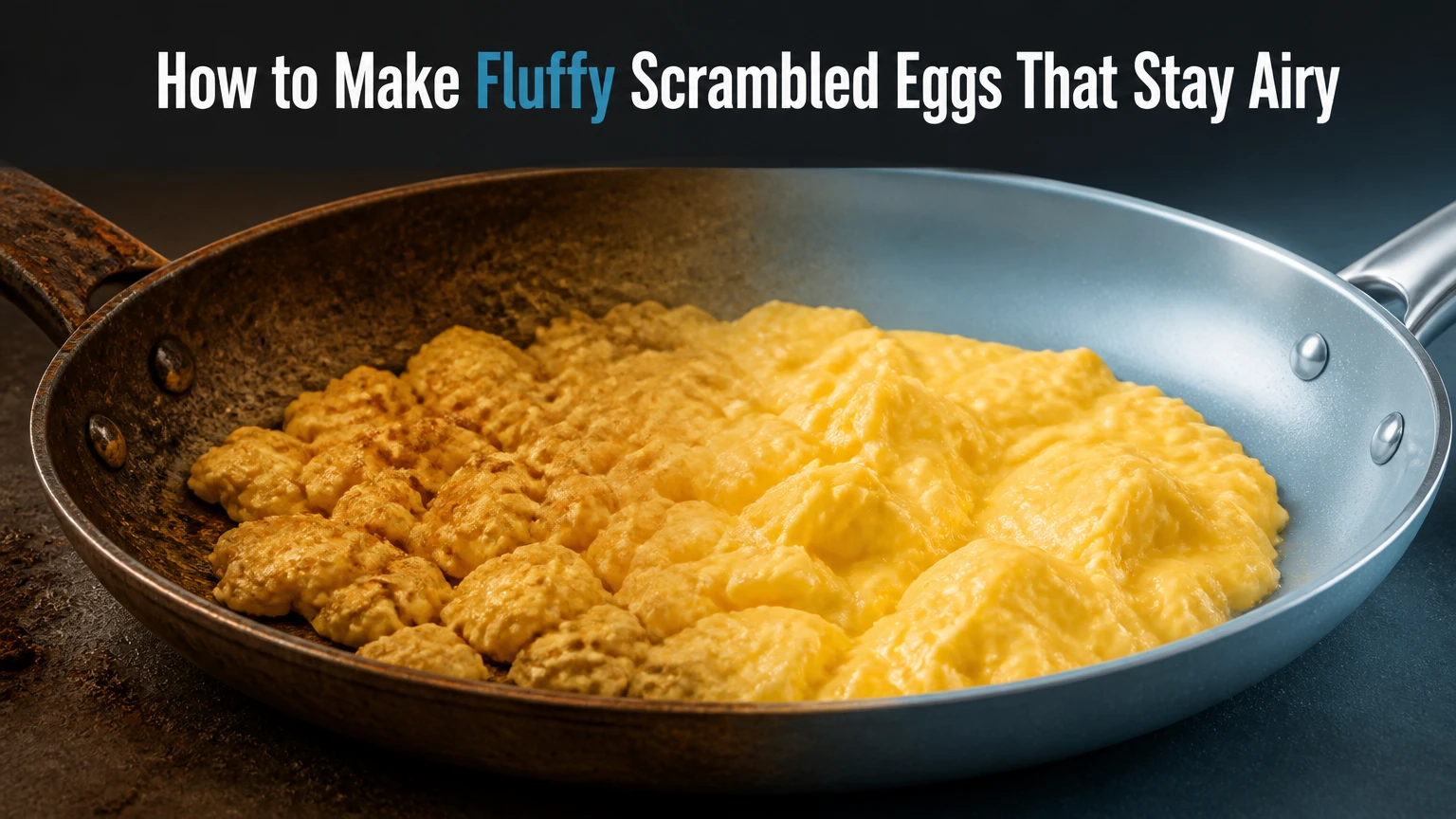
Fluffy scrambled eggs need thoroughly blended eggs, moderate heat, broad spatula strokes, and early removal from the pan. For three large eggs, whisk with a pinch of salt, cook in one tablespoon of butter for about two minutes, fold large curds gently, and plate them while glossy and slightly underdone so carryover heat finishes them.
Key Facts / At a Glance
Use 2-3 large eggs per serving and an 8-10-inch nonstick skillet for even cooking.
Whisk eggs until uniformly yellow, but do not treat a tall foam layer as proof of better eggs.
Cook over medium to medium-low heat for approximately 90 seconds to 3 minutes.
Remove scrambled eggs when they are mostly set, glossy, and still slightly wet.
One teaspoon of water per egg adds tenderness without the richness of dairy.
USDA Food Safety and Inspection Service guidance says to cook eggs until both the yolk and white are firm; people at higher risk should follow stricter food-safety guidance.
What Makes Scrambled Eggs Fluffy?
Fluffy scrambled eggs have large, tender curds with visible height and a moist interior. The texture comes from a loose protein network that retains some water and air, not from a single ingredient or a dramatic “steam explosion.”
Egg proteins unfold when whisked and heated. During cooking, those proteins join into a network that changes liquid egg into soft curds. Vigorous whisking can incorporate air, but much of that air escapes as the eggs warm, so whisking for 60 seconds is not a universal requirement.
Steam contributes moisture and some expansion, especially when water is added. However, water does not meaningfully lower the boiling point in the small quantities used for scrambled eggs. The useful effect is that added water becomes heated moisture within the curd, while the egg proteins set around it.
Why does gentle handling matter?
Gentle handling preserves larger curds after the eggs begin to set. Constant stirring breaks the forming protein network into small fragments, which lose moisture quickly and feel dry even when the cooking time was short.
The best visual target is a pan of broad folds rather than tiny pellets. A silicone spatula should push the cooked edge toward the center, while tilting the skillet allows uncooked egg to run into the exposed pan.
Before You Start
The following quantities make two modest servings or one generous breakfast serving. Use a larger skillet if you double the mixture, because a crowded pan releases water slowly and produces smaller curds.
| Item | Recommended specification | Typical amount or time |
|---|---|---|
| Large eggs | Grade A or standard large eggs | 3 eggs |
| Butter | Unsalted butter | 1 tablespoon, 14 g |
| Optional liquid | Water, whole milk, or half-and-half | 1 teaspoon per egg |
| Skillet | Nonstick, 8-10 inches | 20-25 cm diameter |
| Tool | Flexible silicone spatula | 1 |
| Mixing vessel | Deep bowl or measuring jug | 500 ml capacity |
| Total time | Whisking plus cooking | 4-6 minutes |
| Typical ingredient cost | Standard supermarket eggs and butter | $1-$2 per serving |
A fork works well for three eggs, while a balloon whisk incorporates air faster in a deep bowl. A shallow plate spreads the egg layer thinly and makes aggressive whisking awkward, but it does not make fluffy eggs impossible.
How to Make Fluffy Scrambled Eggs
Step 1: Crack and season the eggs
Crack three large eggs into a deep bowl. Add one small pinch of fine salt, approximately 1/8 teaspoon, and add black pepper either now or after cooking.
Whisk until the yolks and whites are fully combined and no translucent strands remain. Thirty to forty-five seconds is usually enough for three eggs; the mixture should look evenly yellow, slightly thicker, and lightly aerated.
You will know it worked when: no clear white trails remain and the eggs pour as one uniform liquid.
Common mistake: whisking in a flat plate, which leaves unblended whites around the edges. Use a deep bowl and scrape the bottom with the fork or whisk.
Step 2: Choose your liquid, if using one
Add one teaspoon of water, whole milk, or half-and-half per egg if you want softer, more tender curds. For three eggs, that equals one tablespoon of liquid. Skip the liquid when you prefer a more concentrated egg flavor and firmer structure.
Water adds moisture without dairy flavor. Milk contributes lactose and a small amount of fat, while half-and-half adds more richness but can make the mixture feel heavier if overused.
Do not add large amounts of cream. Excess liquid delays setting and can leave watery residue in the pan, especially on low heat.
You will know it worked when: the mixture remains pourable and uniform, without a separate layer of liquid.
Common mistake: adding two or three tablespoons of milk to three eggs. Keep the added liquid near one teaspoon per egg for reliable curd formation.
Step 3: Preheat the skillet with butter
Place an 8-10-inch nonstick skillet over medium heat. Add one tablespoon of butter and wait until it melts and develops a fine foam.
The butter should remain pale. Brown butter adds a nutty flavor but makes the eggs harder to judge visually, and dark milk solids can cling to the curds.
A preheated skillet helps the bottom layer set before the entire mixture spreads thinly. The pan should be hot enough for the butter to foam, but not so hot that the butter browns immediately.
You will know it worked when: the butter is fully melted and gently foaming within roughly 30-60 seconds.
Common mistake: using high heat to shorten the process. High heat creates firm edges before the center sets and increases the chance of rubbery eggs.
Step 4: Pour in the eggs and pause briefly
Pour the beaten eggs into the center of the skillet. Leave them untouched for approximately five seconds, just until a thin layer begins to set on the bottom.
That pause is short by design. Waiting 20-30 seconds creates a thick cooked layer that must be chopped apart, while stirring immediately prevents broad curds from forming.
The exact pause changes with pan material, burner strength, and egg volume. A powerful induction cooktop may need only three seconds; a heavy cast-iron skillet may continue setting after the burner is reduced.
You will know it worked when: the edges look opaque while the center still moves like thick liquid.
Common mistake: waiting until the entire surface looks firm. The eggs will overcook before large folds can form.
Step 5: Push the curds from the edge toward the center
Reduce the heat to medium-low if the eggs are setting quickly. Use a silicone spatula to make slow, broad pushes from the outside edge toward the center, working around the skillet.
After each push, tilt the pan so raw egg flows into the open space. Pause for two or three seconds, then repeat. Fold large sections over themselves instead of stirring in tight circles.
For three eggs in a 9-inch skillet, four to six broad strokes usually produce curds between roughly 2 and 5 centimeters wide. Smaller strokes produce a finer, restaurant-diner style scramble.
You will know it worked when: the pan contains distinct soft folds with a small amount of liquid egg between them.
Common mistake: scraping continuously. Constant motion shatters the curds and encourages moisture loss.
Step 6: Remove the eggs while glossy
Turn off the heat when approximately 90% of the mixture has set. The eggs should hold their shape when pushed but still show a wet sheen in the creases.
Transfer the curds immediately to a warm plate. The skillet and residual internal heat continue cooking the eggs for several seconds, particularly in a heavy pan.
Food safety and texture involve a trade-off. The USDA Food Safety and Inspection Service advises, “Cook eggs until both the yolk and white are firm.” People who are pregnant, immunocompromised, older, or very young should follow current USDA or local public-health guidance rather than prioritizing a soft texture.
You will know it worked when: the eggs are tender and glossy on the plate, not wet with free liquid.
Common mistake: waiting for a dry appearance in the skillet. Dry-looking eggs typically become firm and rubbery by the time they reach the table.
Step 7: Finish and serve immediately
Taste the eggs and add a final pinch of salt if needed. Finish with black pepper, chives, parsley, grated cheese, or a small amount of hot sauce.
Serve scrambled eggs within two minutes of plating. A cold plate accelerates heat loss and can make the curds seem firmer, so warm the plate with hot water and dry it before serving if the room is cold.
Which Ingredients Produce the Best Texture?
The best default is three eggs, one tablespoon of butter, and no more than one tablespoon of added liquid. Water gives the lightest flavor, while half-and-half gives the richest mouthfeel; neither can rescue eggs cooked too long.
| Method | Quantity for 3 eggs | Texture and flavor | Best use |
|---|---|---|---|
| No added liquid | 0 teaspoons | Concentrated flavor, larger but less forgiving curds | Fast weekday breakfast |
| Water | 3 teaspoons, 1 tablespoon | Light, tender, dairy-free curds | Low-dairy cooking |
| Whole milk | 3 teaspoons, 1 tablespoon | Soft curds with mild dairy richness | Family breakfast |
| Half-and-half | 3 teaspoons, 1 tablespoon | Richer, creamy interior | Brunch or plated service |
| Heavy cream | 1-2 teaspoons maximum | Dense richness, slower setting | Small luxury variation |
| Crème fraîche | 1 tablespoon stirred in at finish | Tangy, rich, very soft | French-influenced eggs |
Salt timing has a smaller effect than heat control. Salting immediately is convenient and produces good results; salting 10-15 minutes in advance can season the eggs more evenly and slightly weaken tight protein bonding, but the improvement is subtle rather than dramatic.
Butter is the easiest fat for flavor and release. Neutral oil works for dairy-free cooking, while ghee tolerates more heat and produces a toasted dairy flavor without the water found in butter.
Which Pan and Heat Level Should You Use?
A nonstick skillet over medium to medium-low heat is the most reliable setup for fluffy scrambled eggs. Stainless steel can produce excellent curds when properly preheated and lubricated, but it demands more attention because egg proteins bond readily to bare metal.
| Cookware | Heat behavior | Fat requirement | Technique adjustment | Result for beginners |
|---|---|---|---|---|
| Nonstick, 9-inch | Even and forgiving | 1 tablespoon butter | Broad pushes every 2-3 seconds | Most reliable |
| Stainless steel, 9-inch | Fast surface response | 1 tablespoon butter or oil | Preheat, then reduce heat before eggs | Good with practice |
| Cast iron, 10-inch | Strong heat retention | 1 tablespoon butter plus seasoning | Use lower heat and remove early | Large curds, carryover risk |
| Carbon steel, 10-inch | Responsive after seasoning | 1 tablespoon oil or butter | Keep mixture moving gently | Good for experienced cooks |
| Ceramic nonstick, 9-inch | Moderate, less durable coating | 1 teaspoon to 1 tablespoon fat | Avoid high heat | Convenient, coating-sensitive |
For gas, medium flame usually works. On induction, start around 5 or 6 on a 1-10 scale, then reduce to 3 or 4 once the eggs begin setting. Electric coil burners respond slowly, so remove the pan from the hot coil a little earlier than expected.
What Is the Best Method for Different Goals?
The no-liquid method is best for clean egg flavor and large curds. Water is the practical choice for dairy-free tenderness, while half-and-half suits a richer breakfast when the eggs will be served immediately.
| Goal | Recommended formula | Cooking approach | Trade-off |
|---|---|---|---|
| Largest visible curds | 3 eggs, no liquid | Medium heat, 5-second pause, 4 broad pushes | Cooks quickly and can dry out |
| Softest texture | 3 eggs, 1 tablespoon milk | Medium-low heat, remove at glossy stage | Slightly less concentrated flavor |
| Lightest dairy-free result | 3 eggs, 1 tablespoon water | Medium heat, gentle folding | Less richness |
| Fastest breakfast | 3 eggs, butter, no liquid | Whisk 30 seconds, cook about 2 minutes | Narrow overcooking window |
| Brunch presentation | 3 eggs, half-and-half, chives | Warm plate and careful broad folds | Requires immediate service |
| Cheese scramble | 3 eggs, 20-30 g grated cheese | Add cheese at 80% set | Cheese can release oil or water |
Cheese should enter near the end, not at the beginning. Adding it after the curds have formed prevents the cheese from interfering with coagulation and reduces the time the eggs spend over heat.
Vegetables require separate cooking. Mushrooms, tomatoes, spinach, and zucchini release water, so sauté them first, drain or evaporate excess moisture, and fold them into nearly finished eggs.
How Long Do Fluffy Scrambled Eggs Take?
Three large eggs usually take 4-6 minutes from cracking to plating, including 30-45 seconds of whisking and approximately 90 seconds to 3 minutes in the skillet. A doubled batch generally takes 3-5 minutes to cook in a 10-12-inch pan because the deeper mixture heats more slowly.
| Batch size | Skillet size | Typical cook time | Serving yield |
|---|---|---|---|
| 2 eggs | 8-inch | 60-120 seconds | 1 light serving |
| 3 eggs | 8-10-inch | 90-180 seconds | 1 generous or 2 small |
| 6 eggs | 10-12-inch | 3-5 minutes | 2-3 servings |
| 9 eggs | 12-inch or two pans | 4-7 minutes | 3-4 servings |
| 12 eggs | Two 10-inch skillets | 4-7 minutes | 4-6 servings |
A thermometer can help during practice, but texture is the more useful kitchen signal. The AI Overview’s suggested pull temperature of 68°C, or 155°F, is a practical texture target, not a universal guarantee of food safety, because probe placement, egg size, and carryover cooking vary.
Common Mistakes and How to Fix Them
Why are scrambled eggs flat?
Flat eggs usually result from a cold pan, a wide skillet, or excessive liquid. A 9-inch pan gives three eggs enough depth for curds, while a 12-inch pan spreads the same mixture into a thin layer that sets before it can fold.
Fix: use a smaller skillet, limit liquid to one teaspoon per egg, and preheat the butter until it foams.
Why are scrambled eggs dry and rubbery?
Dry, rubbery eggs were usually cooked past the glossy stage or held in a hot skillet after the burner was turned off. Eggs lose moisture rapidly as the protein network tightens.
Fix: remove the pan when the eggs are 90% set. If the eggs are already firm, fold in one teaspoon of butter or sour cream off heat, although the original tenderness cannot be fully restored.
Why do scrambled eggs release water?
Watery eggs can come from too much milk, frozen vegetables, tomatoes, or prolonged holding. Salt is sometimes blamed, but the more common cause is a weak protein structure created by excess moisture and overcooking.
Fix: cook wet mix-ins separately, reduce added liquid, and serve immediately. Do not cover hot eggs tightly, because trapped condensation falls back onto the curds.
Why do eggs stick to stainless steel?
Egg proteins stick when stainless steel is underheated, inadequately lubricated, or disturbed before the bottom releases. Excessively high heat also causes rapid bonding and browned residue.
Fix: preheat the pan, add butter, reduce to medium-low, and wait five seconds before the first push. A nonstick skillet is the simpler choice for routine breakfasts.
Can you whisk scrambled eggs too much?
You can whisk long enough to create large surface bubbles, but moderate over-whisking is less damaging than overcooking. Air incorporated during whisking escapes as the mixture heats, so foam alone does not create permanently tall curds.
Fix: whisk until uniform and lightly aerated, usually 30-45 seconds for three eggs. Focus more attention on heat and removal timing.
Variations for Specific Situations
How do you make fluffy scrambled eggs without milk?
Use one teaspoon of cold water per egg, or omit liquid entirely. Water keeps the recipe dairy-free and adds moisture, while butter can be replaced with one teaspoon of avocado, canola, or olive oil for a dairy-free pan.
The eggs may taste less rich than a milk-based version. Add herbs, nutritional yeast, or a dairy-free cheese substitute after the curds have formed rather than diluting the mixture heavily.
How do you make eggs for a crowd?
Cook six eggs in a 10-12-inch skillet or use two pans for nine or more eggs. Whisk each batch thoroughly, avoid stacking cold eggs in a small pan, and transfer finished portions to a shallow warm serving dish.
Large holding times reduce quality. If eggs must wait, remove them slightly earlier, keep them above 140°F under applicable food-service rules, and expect smaller, firmer curds.
Can you add cheese and vegetables?
Yes, but cook moisture-heavy ingredients before adding the eggs. Add 20-30 grams of grated cheddar, Gruyère, or Monterey Jack for three eggs during the final 20-30 seconds, when the curds are mostly formed.
Soft herbs can be folded in at the end. Bacon, sausage, and potatoes should be fully cooked separately, because raw mix-ins change the required cooking time and can compromise safety.
How can you reduce calories?
Use a well-maintained nonstick skillet with one teaspoon of oil or a light coating of spray instead of one tablespoon of butter. Three large eggs contain roughly 210 calories before added fat, but the exact value varies by egg size and brand.
Removing yolks changes both flavor and structure. Egg whites set more firmly and contain less fat, so a fluffy whole-egg and white blend needs lower heat and earlier removal.
Frequently Asked Questions
Does adding water really make scrambled eggs fluffier?
Water can produce softer, lighter-feeling curds because it adds moisture that heats within the egg mixture. It does not work by substantially lowering the boiling point, and it cannot compensate for high heat or overcooking. Use approximately one teaspoon per egg for a reliable result.
Should you salt eggs before or after cooking?
Salt can be added before cooking for even seasoning, or after cooking for direct control at the plate. A 10-15 minute pre-salt may produce slightly more tender curds by altering protein interactions, but immediate salting remains practical and effective for everyday scrambled eggs.
Can cold eggs make scrambled eggs less fluffy?
Cold eggs are not a major barrier to fluffiness, but room-temperature eggs cook more predictably because the pan temperature drops less after they are added. Set refrigerated eggs out for 10-15 minutes when convenient, but do not leave them at room temperature for extended periods.
What whisk is best for scrambled eggs?
A fork is sufficient for two or three eggs. A balloon whisk blends faster and incorporates more air, while a flat whisk reaches the corners of a shallow bowl. The utensil matters less than eliminating clear white streaks before the eggs enter the skillet.
Can scrambled eggs be reheated?
Scrambled eggs can be reheated, but they will be firmer and less fluffy than freshly cooked eggs. Refrigerate leftovers within two hours, store them in a sealed container, and reheat gently in short intervals until hot. Add a teaspoon of water before reheating to limit drying.
What temperature should scrambled eggs reach?
Texture-focused cooks often remove eggs near 155°F, or 68°C, because carryover heat continues setting them. Food safety guidance is separate: USDA FSIS recommends firm yolks and whites, and higher-risk diners should prioritize that guidance over a soft, glossy finish.
The Bottom Line
To make fluffy scrambled eggs, whisk three large eggs until uniform, add no more than one teaspoon of liquid per egg, and cook them in one tablespoon of butter over medium to medium-low heat. Pause five seconds, push broad curds toward the center, and remove the eggs while glossy. The exact keyword is how to make fluffy scrambled eggs, but the decisive skill is stopping before the pan makes them dry.