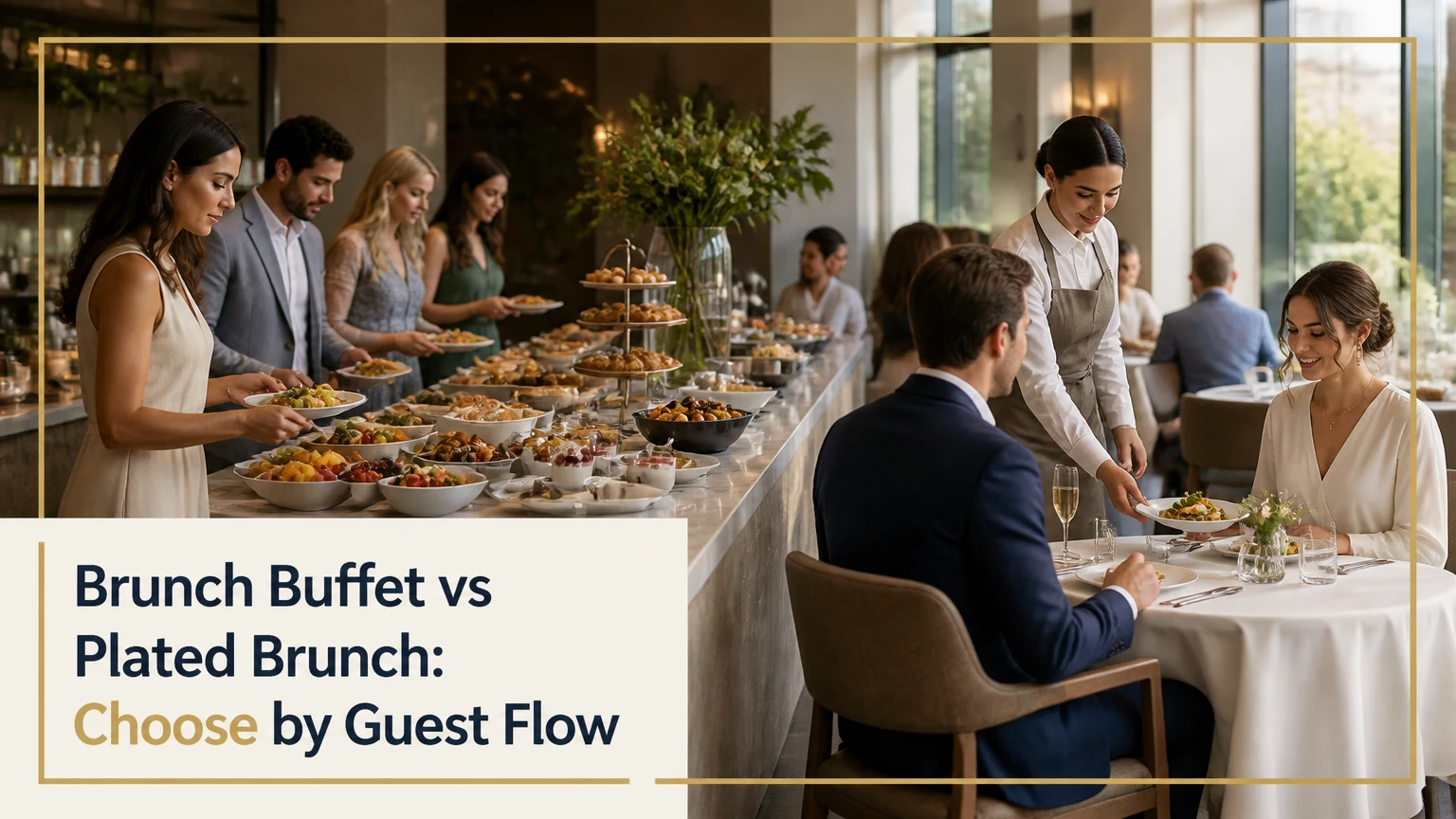
A brunch buffet is usually best for large, flexible groups that value variety, repeat servings, and informal movement. Plated brunch is usually better for smaller or schedule-driven events that prioritize cooked-to-order quality, accessibility, and synchronized service. The deciding factors are guest count, kitchen capacity, venue layout, budget, and the required level of formality.
Key Facts at a Glance
A buffet gives guests immediate access to multiple dishes, while plated brunch delivers predetermined portions to seated guests.
Buffet brunch generally requires more floor space, holding equipment, and food overproduction.
Plated brunch generally requires more servers, stronger kitchen coordination, and accurate entrée counts.
Typical event-planning costs range from $35-$85 or more per person for a buffet and $25-$75 for plated service, depending on menu and labor.
The FDA Food Code sets 135°F as the hot-holding minimum for many time-temperature controlled foods; buffet menus must be designed around safe holding.
A hybrid format, such as plated entrées with self-service pastries and fruit, can reduce queues without sacrificing every advantage of table service.
What Is the Difference Between a Buffet and Plated Brunch?
A brunch buffet is a self-service meal in which guests select food from shared stations, whereas plated brunch is a table-service meal in which kitchen staff portion individual dishes and servers deliver them to seated guests. The distinction affects guest movement, portion control, food holding, labor, menu flexibility, and event timing.
In buffet service, guests typically receive a plate, visit one or more stations, return to the table, and repeat the process as desired. Staff replenish pans, clear used dishes, pour beverages, and monitor presentation. A flat per-person price is common, although premium drinks may cost extra.
In plated service, guests remain seated while servers provide menus, record orders, deliver courses, clear plates, and present the check. The format may be à la carte, prix fixe, or a preselected banquet menu. Individual preparation improves control over doneness and presentation, but the kitchen must coordinate many orders at once.
The distinction is not simply casual versus formal. A well-designed station brunch can feel polished, while a poorly staffed plated meal can feel slow and disorganized.
How Does Each Format Work?
Buffet brunch moves guests through food access points, while plated brunch moves food through the dining room. A buffet depends on station design and replenishment; plated service depends on order accuracy, ticket timing, and synchronized delivery.
Typical buffet sequence
- Guests are seated or directed toward a station.
- Servers offer coffee, juice, cocktails, or water.
- Guests take clean plates and select food.
- Guests return for additional portions or another course.
- Staff clear dishes and replenish food.
- The host or restaurant settles payment using a fixed or package price.
A single linear buffet works for a narrow menu and modest attendance. Multiple stations work better when the menu includes separate hot, cold, bakery, beverage, or carving areas. The scatter approach reduces congestion because guests do not need to follow one path.
Typical plated sequence
- Guests sit and receive menus or a preselected entrée indicator.
- Servers deliver beverages and any opening course.
- Guests order from an à la carte or prix fixe menu.
- The kitchen prepares and plates each selection.
- Servers deliver courses, ideally to the full table within a short window.
- Staff clear plates, serve dessert or coffee, and present the bill.
Plated banquet service can use a restricted menu to simplify production. For example, a host might offer chicken and waffles, vegetable frittata, or brioche French toast, with entrée choices collected during RSVP.
Which Format Usually Costs Less?
Plated brunch can have the lower food-waste rate, but buffet brunch can have the lower labor cost per guest when attendance is high and the menu is standardized. The cheaper format depends on food prices, service charges, beverage orders, staffing wages, rental equipment, guest count, and whether the venue charges a minimum spend.
| Cost component | Buffet brunch, typical planning range | Plated brunch, typical planning range | Main cost driver |
|---|---|---|---|
| Food package | $25-$65 per guest | $22-$60 per guest | Seafood, steak, and specialty pastries |
| Service labor | 1 server per 20-30 guests | 1 server per 10-15 guests | Clearing, ordering, and course delivery |
| Equipment | $5-$18 per guest | $2-$8 per guest | Chafers, induction units, carts, and linens |
| Food waste allowance | 15%-25% of prepared volume | 5%-10% of prepared volume | Attendance uncertainty and menu breadth |
| Typical total package | $35-$85+ per guest | $25-$75 per guest | Venue package and staffing model |
| Payment model | $35-$85 fixed package | $25-$55 à la carte or $40-$75 prix fixe | Menu structure and beverage inclusion |
These are typical planning ranges, not universal market prices. A restaurant may offer a $32 buffet, while a luxury hotel can exceed $100 per person for seafood, champagne, carving stations, and premium labor.
The important comparison is total event cost, not the advertised meal price. A buffet may need 200 square feet of station space, chafing fuel, chef-attended stations, extra linens, and larger purchasing buffers. A plated meal may need fewer rentals but more servers and longer kitchen prep.
How Does Each Format Control Time?
Buffet brunch gives guests flexible arrival and eating times, while plated brunch gives the host more control over when the meal begins and ends. Buffet service suits rolling attendance; plated service suits a defined schedule with a known seating time.
| Event condition | Buffet brunch | Plated brunch | Better operational choice |
|---|---|---|---|
| 40 guests arriving within 15 minutes | 10-20 minutes for first service | 20-35 minutes for seating and orders | Plated if the kitchen is ready |
| 100 guests arriving across 90 minutes | Rolling access throughout the window | Multiple delayed orders and late tables | Buffet |
| Two-hour program with speeches | Guests can eat during transitions | Courses can be paused or synchronized | Plated |
| 90-minute event before another booking | Flexible but less predictable table use | 75-105-minute planned meal window | Plated |
| Late arrivals after the main meal | Food remains available if replenished safely | Entrée may require a new ticket | Buffet |
| Large group with no assigned seating | Easy access by station | Difficult order and delivery control | Buffet |
A buffet is not automatically faster. One 30-foot line can create a 20-minute queue, particularly when guests stop to customize omelets or waffles. Two or three shorter stations often outperform a single large display.
Plated service can also stall. If the kitchen receives 80 entrée tickets simultaneously but has one six-burner range and limited oven space, a nominal 90-minute event may become a two-hour meal.
Which Format Produces Better Food Quality?
Plated brunch generally produces better texture, temperature, and visual consistency for delicate foods, while buffet brunch performs better with sturdy dishes that tolerate holding and replenishment. Eggs Benedict, soufflé pancakes, fried foods, and rare steak lose quality faster on a buffet than potatoes, braised meats, fruit, and baked casseroles.
| Menu item | Buffet performance | Plated performance | Recommended control |
|---|---|---|---|
| Scrambled eggs | Acceptable for 15-30 minutes in small batches | Better moisture and seasoning control | Replenish shallow pans |
| Eggs Benedict | Poor after prolonged holding | Strong when plated immediately | Plate to order |
| Bacon and sausage | Good with frequent replenishment | Consistent portion size | Use small batches |
| Waffles and pancakes | Good at a live station | Strong for premium presentation | Cook in waves |
| Smoked salmon and fruit | Very good when chilled correctly | Good but slower to portion | Buffet display |
| Steak and eggs | Uneven doneness in bulk | Better individual cooking | Plated |
| Pastries | Good for 60-90 minutes if protected | Good as a starter or side | Covered display |
| Fried chicken | Quality declines under heat | Better when timed to service | Short holding window |
The USDA Food Safety and Inspection Service gives the practical instruction, “Keep hot food hot and cold food cold.” The FDA Food Code uses 135°F as the minimum hot-holding temperature for many potentially hazardous foods, while cold foods commonly require 41°F or below. Local health departments may impose additional rules.
Food quality and food safety overlap but are not identical. A tray can remain legally hot while becoming dry and unattractive. That is why experienced caterers use shallow pans, smaller replenishment batches, induction heat, and live cooking stations rather than placing an entire morning’s production on one table.
How Much Staff and Space Do You Need?
A buffet usually needs more guest circulation space and fewer servers per guest, while plated brunch needs less service footprint and more front-of-house labor. Planning should include kitchen staff, beverage staff, bussers, station attendants, and a manager, not only the person carrying plates.
| Guest count | Buffet staffing pattern | Plated staffing pattern | Recommended floor plan |
|---|---|---|---|
| 30 guests | 1 chef, 2 servers, 1 busser | 1 chef, 3 servers, 1 busser | One 8-foot station or table service |
| 60 guests | 1-2 chefs, 3 servers, 1-2 bussers | 2 chefs, 5-6 servers, 2 bussers | Two stations or compact seated room |
| 120 guests | 2-3 chefs, 5-6 servers, 2-3 bussers | 3-4 chefs, 9-12 servers, 3 bussers | Three stations or banquet seating |
| 200 guests | 4-5 chefs, 8-10 servers, 4 bussers | 5-6 chefs, 15-20 servers, 5 bussers | Distributed stations or phased seating |
These figures are typical banquet-planning assumptions. A complex cocktail program, large venue, elevated service standard, or made-to-order stations can increase staffing.
Allow approximately 30-36 inches of clear guest passage around dining tables and at least 42-48 inches where guests queue or serve themselves. A buffet also needs space behind the display for replenishment, waste containers, utensils, and staff movement.
A common planning mistake is measuring only the table length. A 12-foot buffet may occupy 12 feet of wall space but require another 8-12 feet of queue depth and circulation area during peak service.
How Do Guest Experience and Accessibility Differ?
Plated brunch is usually more accessible because guests do not need to carry plates, navigate queues, or reach across shared displays. Buffet brunch provides more autonomy and variety, but the venue must supply clear paths, reachable utensils, assistance, and seating for guests who cannot comfortably stand.
Buffets work well for families with different appetites because a child can take fruit, a large eater can return for potatoes, and a vegetarian guest can avoid meat without requesting a custom entrée. Buffets also encourage movement, which can help networking events where guests should interact beyond their assigned tables.
Plated brunch creates a calmer experience for older adults, wheelchair users, guests using mobility aids, parents holding infants, and attendees wearing formal clothing. Servers can identify dietary meals and place them directly at the correct seat.
Neither format automatically solves inclusion. A buffet with a narrow aisle, high chafing dishes, poor labels, or inaccessible beverage dispensers can exclude guests. A plated meal with only one entrée and no advance dietary process can exclude guests through the menu instead.
How Do You Handle Dietary Restrictions and Allergens?
Plated brunch provides stronger individual control when dietary requirements are collected in advance, while a buffet provides broader visible choice but carries more risk of utensil mistakes and shared-surface contamination. Neither format should rely on guests to infer whether a dish is safe.
Use a written guest list that identifies vegan, vegetarian, gluten-free, halal, kosher, dairy-free, nut-free, and medically diagnosed allergy requirements. The kitchen should confirm ingredients, preparation surfaces, sauces, garnishes, and cross-contact controls.
For a buffet:
- Place allergen-sensitive dishes at a separate, clearly labeled station.
- Use dedicated, color-coded serving utensils.
- Put ingredient cards beside every dish.
- Keep gluten-free bread and pastries covered.
- Assign a staff member to answer ingredient questions.
- Replace contaminated utensils immediately rather than wiping them.
For plated service:
- Mark dietary meals on the seating chart and kitchen tickets.
- Use a separate prep area when the allergen requires it.
- Deliver the special meal directly to the named guest.
- Avoid announcing the guest’s medical condition at the table.
- Verify substitutions before service begins.
A buffet often offers more nominal choice, but plated service can offer better verified choice. That distinction matters for severe allergies.
Which Buffet Format Fits the Event?
A standard linear buffet fits a compact menu and low-to-moderate attendance, while action stations or scattered stations fit larger events with varied preferences. The correct buffet design depends on peak arrival volume, menu complexity, and available cooking equipment.
| Buffet format | Best guest count | Typical menu | Main advantage | Main limitation |
|---|---|---|---|---|
| Linear buffet | 20-80 | Eggs, bacon, potatoes, pastries | Simple setup and low equipment cost | Queue bottleneck |
| Double-sided buffet | 80-180 | Full hot and cold spread | Doubles serving positions | Requires wide room layout |
| Scattered stations | 100-300 | Bakery, fruit, seafood, hot entrées | Separates traffic by food type | More labels and attendants |
| Chef-attended stations | 50-250 | Omelets, waffles, carving, crepes | Fresh customization | Slower peak service |
| Cocktail-style mini buffet | 30-120 | Small plates, pastries, fruit, sandwiches | Supports mingling | Less filling for large appetites |
Action stations improve freshness but introduce queue risk. A chef can cook omelets to order, yet one station producing six omelets every ten minutes cannot satisfy 100 guests quickly without a second cook or pre-cooked components.
For a wedding brunch, a pastry and fruit station can open immediately while hot dishes begin in waves. That staggered release reduces the first rush and protects food temperature.
What Counts as Plated Brunch?
Plated brunch includes any service in which the kitchen portions the main food and staff deliver it to seated guests, including à la carte, prix fixe, preselected banquet menus, and some family-style variations. Family-style service differs from true individual plating because shared platters remain on the table.
| Plated model | Guest choice | Typical meal length | Best use |
|---|---|---|---|
| À la carte | Each guest selects items and price | 60-100 minutes | Restaurant brunch |
| Prix fixe | One choice per course | 75-120 minutes | Showers and formal events |
| Preselected banquet | Choice collected at RSVP | 60-90 minutes | Weddings and conferences |
| Limited-choice menu | Two or three entrées at service | 75-105 minutes | Medium-size private events |
| Family-style | Shared platters at each table | 60-100 minutes | Social gatherings |
A prix fixe menu may include a pastry or fruit course, one entrée, and dessert or specialty coffee. A preselected menu is more predictable because the kitchen can order ingredients and stage production before guests sit.
Plated service is not synonymous with fine dining. A breakfast sandwich delivered to each guest is plated service, even if the room is informal.
How Should You Budget Food and Waste?
Buffet purchasing should be based on expected consumption by category, while plated purchasing should be based on confirmed covers plus a controlled contingency. Buffet managers often overproduce because empty pans look inadequate, whereas plated kitchens can limit excess through preorders.
For a buffet, estimate total portions by separating high-demand items from low-demand items. A typical planning model might allocate 1.5-2 entrée portions per guest across the full menu, 3-5 ounces of protein, 4-6 ounces of starch, 4-6 ounces of fruit, and 2-3 bakery items per person, then adjust for children, event duration, and beverage service.
For plated brunch, order confirmed entrée counts plus approximately 3%-8% contingency, depending on cancellation terms and menu cost. A steak entrée may justify a lower buffer than pancakes because the ingredient cost and preparation requirements differ.
The counterintuitive point is that buffet guests do not necessarily eat more total food. Buffet waste includes unserved food discarded after the service window, while plated waste often includes untouched food returned on plates. Track both categories separately before judging efficiency.
When Is a Hybrid Format Better?
A hybrid brunch combines self-service components with plated items, making it useful when guests need variety but the host wants reliable entrée quality and a controlled schedule. A common design is a self-service pastry, fruit, and coffee station followed by plated eggs, chicken, or vegetarian entrées.
Hybrid formats solve several operational conflicts:
- Guests can eat immediately while the kitchen prepares hot courses.
- Delicate entrées avoid prolonged buffet holding.
- Pastries and fruit require fewer servers than individual starters.
- Dietary meals can be plated and identified privately.
- A host can keep speeches or presentations on schedule.
A hybrid meal usually costs more than a simple buffet because it combines equipment and service labor. It can still reduce waste and complaints when the menu includes fragile foods or the event has a fixed end time.
Use stations plus plated entrées for bridal showers, conference breakfasts, milestone birthdays, and weddings with 60-180 guests. Avoid hybrid service when the venue lacks a staging area or when guests will arrive continuously over several hours.
What Problems Should You Prevent?
The most common buffet failures are queue congestion, unsafe holding, poor labels, and depleted presentation; the most common plated failures are cold delivery, wrong entrée placement, kitchen delays, and inaccurate counts. Each failure has a predictable prevention measure.
Buffet failure modes
Large pans of scrambled eggs become watery and rubbery. Use shallow pans, smaller batches, and replenishment intervals of about 15-30 minutes. Live omelet service is better for premium egg quality.
One line blocks the room. Separate hot food, bakery, fruit, and beverages. Beverage stations should not sit at the end of the main food queue.
Guests contaminate special-diet dishes. Isolate allergen-sensitive food, label it, and provide dedicated utensils. Staff should replace utensils after a spill or suspected contact.
The buffet looks empty near the end. Use smaller presentation vessels and replenish more often instead of displaying the entire inventory at once.
Food remains on display too long. Follow the caterer’s approved time-control plan and local health rules. The FDA Food Code permits specific time-based procedures only when documented controls are followed.
Plated failure modes
The first plates arrive cold. Stage tables in small waves, use heated holding equipment where permitted, and avoid sending all plates from the kitchen at once.
Guests forget their selected entrée. Print entrée symbols on place cards or seating charts, then verify the symbol discreetly during service.
The kitchen falls behind. Limit choices, pre-sort tickets, cook shared components in batches, and perform a timed rehearsal before the event.
A special meal goes to the wrong guest. Use seat numbers, discreet symbols, and a server-side dietary list rather than relying on memory.
Late arrivals disrupt the table. Hold a small number of components safely, offer a simplified late plate, or define a final seating time in the invitation.
How Do You Choose by Guest Situation?
The best format changes by guest behavior, event schedule, and venue constraints. Buffet brunch wins for mobility between tables and uncertain arrival times, while plated brunch wins for controlled ceremonies, accessible service, and food that must reach guests immediately after cooking.
Choose a buffet for large, flexible groups
A buffet fits corporate networking events, family reunions, open-house celebrations, and post-wedding gatherings where arrivals span 60-180 minutes. The format also works when guests have sharply different appetites or the host wants a broad menu without collecting entrée choices.
Do not choose a buffet solely because the guest count is high. A 150-person event with a 45-minute meal window may need plated or phased service because one crowded buffet cannot feed everyone promptly.
Choose plated service for formal and schedule-driven events
Plated brunch fits bridal showers, baby showers, award ceremonies, intimate weddings, and events that transition into speeches or presentations. Guests remain seated, the room looks orderly, and the host can coordinate food with the program.
Plated service is a poor choice when attendance is uncertain or the kitchen cannot produce the selected menu within the required window. A restricted menu with advance entrée counts is safer than a large à la carte offering.
Choose a hybrid for quality plus flexibility
Hybrid service fits hosts who want a polished main course but do not want guests waiting hungry. It is particularly effective when the first 20 minutes include arrivals, photographs, registration, or networking.
The hybrid format requires a staging plan. Without separate beverage and food traffic, it can inherit the buffet’s queue problems while retaining plated service costs.
What Should You Ask the Venue or Caterer?
Ask for operational details rather than only menu descriptions. The answers reveal whether the quoted format can handle your guest count, menu, and schedule.
- What is the maximum guest count for this service style?
- How many servers, cooks, and bussers are included?
- What is the planned service window?
- How many buffet stations or serving positions will operate?
- Which foods are cooked to order?
- What hot-holding and cold-holding equipment is used?
- How are vegan, gluten-free, halal, kosher, and allergy meals identified?
- What happens when guests arrive late?
- Are coffee, juice, cocktails, rentals, tax, and gratuity included?
- What is the cancellation and final guest-count deadline?
- Does the venue charge a room minimum or service minimum?
- Can the kitchen perform a timed service for the full guest count?
Request a written staffing plan for events above 75 guests. Request a floor plan when a buffet, bar, registration table, dance floor, or presentation area shares the room.
Which Should You Choose?
Choose a brunch buffet when variety, flexible arrival, repeated servings, and guest interaction matter more than synchronized presentation. Choose plated brunch when the event needs predictable pacing, individual food quality, easier seated access, or a formal atmosphere.
| Priority | Recommended format | Practical threshold or condition | Reason |
|---|---|---|---|
| Flexible arrivals | Buffet | Arrival window exceeds 45 minutes | Food remains available by waves |
| Formal presentation | Plated | Assigned seating and defined start time | Courses reinforce the schedule |
| Broad dietary variety | Buffet or hybrid | Four or more dietary patterns | Guests can select visible options |
| Delicate food quality | Plated | Eggs Benedict, steak, soufflé pancakes | Individual timing protects texture |
| Limited floor area | Plated | Less than 42 inches for queue circulation | Tables require less service footprint |
| Elderly or mobility-limited guests | Plated | More than 10% need seated assistance | Servers carry food |
| Large uncertain attendance | Buffet | More than 100 guests or open arrival | Avoids individual order bottlenecks |
| Fixed program under 90 minutes | Plated | Presentation follows the meal | Host controls course timing |
For the corporate event planner
Choose a buffet for networking and rolling attendance, or use a hybrid when presentations begin at a fixed time. Put coffee and juice away from the hot-food queue, and open a pastry station 10-15 minutes before the main food.
For the wedding or shower host
Choose plated service for an intimate, photograph-focused event with assigned seating. Choose a hybrid when guests need time to mingle but the entrée should arrive at a coordinated moment.
For the restaurant operator
Choose a buffet when purchasing power, station throughput, and high-volume demand support batch production. Choose plated service when the concept depends on technique, customization, and higher perceived control over portions.
For the accessibility-focused host
Choose plated service unless the buffet has wide paths, reachable serving heights, trained assistance, and accessible beverage placement. A buffet can be inclusive, but accessibility must be designed rather than assumed.
FAQ
Is a brunch buffet better for children?
A brunch buffet is often better for children because adults can select small portions, repeat popular foods, and avoid committing to one entrée. Place child-friendly items such as fruit, pancakes, potatoes, and yogurt at reachable but supervised stations. Plated service may be calmer for younger children who struggle with queues.
Does plated brunch always mean higher quality?
Plated brunch does not always mean higher quality. Individual service improves timing for delicate foods, but a weak kitchen, long ticket queue, or poorly planned delivery can produce cold plates. A well-managed buffet with small batches and live stations can outperform plated service for waffles, eggs, and pastries.
How far in advance should guests choose plated entrées?
Collect plated entrée choices 10-21 days before a private event when the menu includes expensive proteins, allergy substitutions, or multiple preparation methods. Confirm the final count 3-7 days before service, then print seat-level indicators so servers do not depend on guest memory.
Can a buffet be formal enough for a wedding?
A buffet can suit a formal wedding when the display uses attended stations, coordinated serving pieces, clear labels, controlled replenishment, and adequate circulation space. Premium presentation does not remove the need for queue management. A plated or hybrid format remains better when the reception schedule is tightly choreographed.
Which format creates less food waste?
Plated brunch usually creates less unserved food waste because production follows confirmed entrée counts, with typical preparation buffers of 3%-8%. Buffet brunch can create more waste because operators must maintain full displays and accommodate uncertain demand. Measuring discarded kitchen food separately from guest plate waste gives the fairest comparison.
The Bottom Line
Brunch buffet vs plated brunch is a decision about flow, not prestige. Select a buffet for varied appetites, flexible arrivals, and social movement; select plated service for accessibility, delicate food, and a controlled schedule; select a hybrid when the event needs both immediate choice and hot individual entrées. Confirm guest count, staffing, floor space, dietary controls, holding procedures, and the meal’s exact time window before signing the catering contract.